Key takeaways
- Compare ownership and leasing across the full period of use, including maintenance responsibilities and any residual value, rather than judging by payments alone.
- Match the funding choice to cash-flow needs and how long the exoskeleton is expected to support the operation.
- Consider how each arrangement affects balance-sheet reporting and tax treatment, which depend on the applicable accounting and tax rules.
- A hybrid approach can align established needs with buying and uncertain or changing needs with a trial or lease.
- Use vendor-neutral device comparisons, ROI calculations and Deploy & Decide trials to assess fit for the actual workplace before committing to a purchase.
Table of contents
- Maintenance and residual value in asset ownership
- Lease or buy: the cash-flow effects
- Balance-sheet and covenant effects
- Tax effects of interest and depreciation
- Hybrid leasing and buying strategies
- Ryggo
Maintenance and residual value in asset ownership
Buying means the business takes responsibility for upkeep and the device’s eventual value. Compare those obligations with the terms of any alternative before deciding which option costs less.
Maintenance and repair responsibilities
With ownership, the business arranges and pays for maintenance and repairs unless a separate agreement covers them. Service responsibilities under a lease depend on the contract. Compare options for the same task, use pattern, service scope and term. List training, fitting, maintenance and insurance separately, rather than assuming they are included in the purchase price or lease payment.
For each task, record who reports faults, arranges repairs and decides when a device can return to use. These responsibilities affect operations as well as cost.
Resale value and ownership equity
An owned device may retain resale value, giving the business an asset to sell or reuse. But future value is uncertain: condition, demand, suitability and product changes can all affect what a buyer might pay. Treat resale proceeds as a possible offset, not guaranteed equity.
A lease removes reliance on resale, but the return conditions matter. Check who is responsible for wear, damage and collection. Compare the ownership cost after any resale proceeds with the full lease cost and return obligations.
Technology obsolescence in ownership
Ownership gives the business control over how long it keeps a device, but also leaves it holding equipment if the task, workforce or available designs change. Before buying, assess whether the exoskeleton fits the movement, posture and duration of the task, and whether employees can use it comfortably.
Base selection on the safety requirements that apply at your site and a documented task risk assessment; avoid treating a device as suitable solely because it meets a vendor specification.
Cost per hour and maintenance history
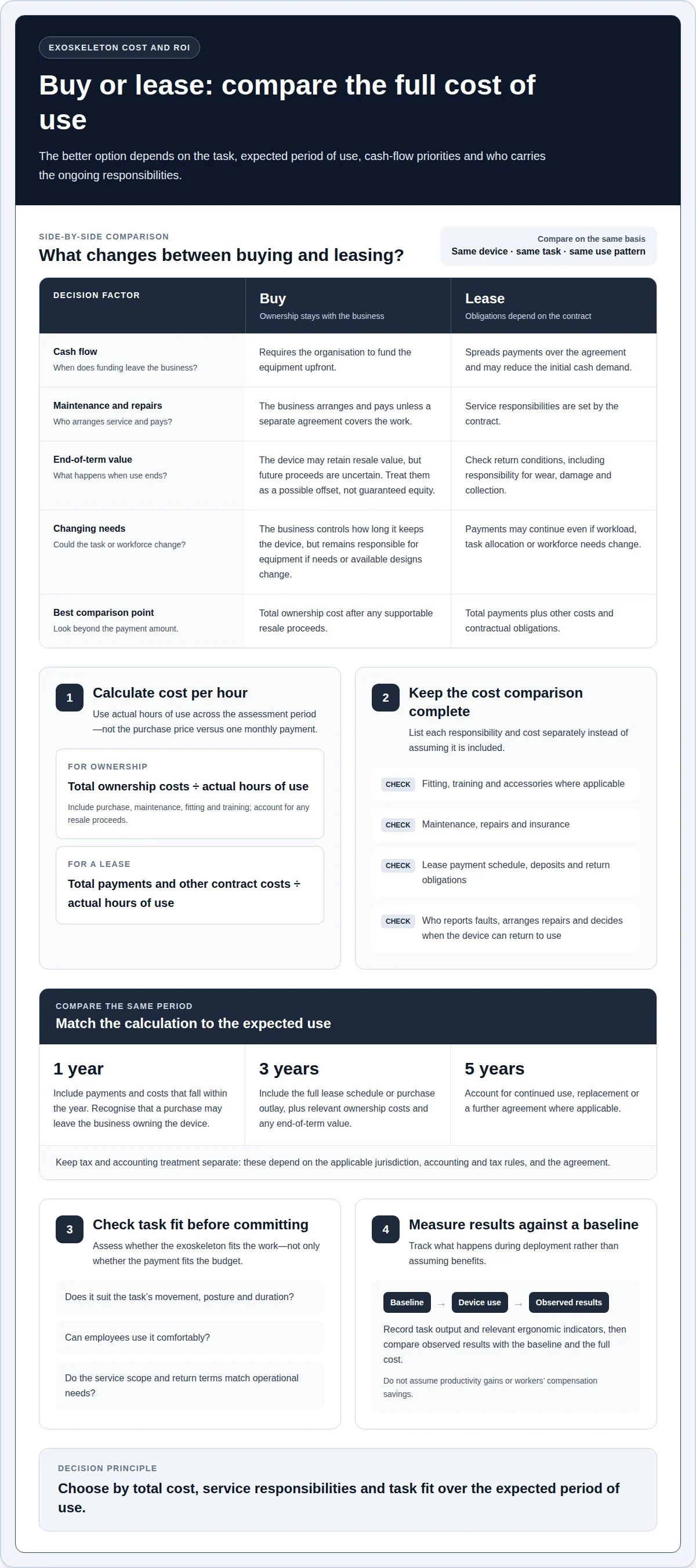
To calculate cost per hour, divide total ownership costs over the assessment period by the hours of actual use. Include purchase, maintenance and fitting, as well as training and any resale proceeds. For a lease, compare total payments and other contract costs with the device’s actual hours of use. This is more useful than comparing the purchase price with one monthly payment.
Estimate ROI by recording a baseline for the task, then tracking device use, task output and relevant ergonomic indicators during deployment. Don’t assume productivity gains or workers’ compensation savings. Compare observed results with the baseline and the full cost.
| Option | Maintenance | Residual value | Best comparison point |
|---|---|---|---|
| Buy | Buyer arranges it | Potential resale value | Cost after resale |
| Lease | Set by contract | Return terms apply | Total payments and obligations |
Choose by comparing total cost, service responsibilities and task fit over the expected period of use.
Lease or buy: the cash-flow effects
For a European buyer, the cash-flow question is whether to pay upfront or spread payments across an agreement. Compare both options over the period the exoskeleton is expected to serve the operation, using the same assumptions for use, deployment and end-of-term treatment.
Upfront purchase costs
An outright purchase requires the organisation to fund the equipment upfront, so the full outlay must fit the investment budget. This may suit a well-understood task with a clear operational need, but can limit funds available for other planned work. Build the purchase case around the deployment plan, not just the device invoice.
Separate the equipment purchase from other costs of introducing it into the workplace, such as fitting, training or accessories where applicable. Map when each cost is due against the deployment schedule. This gives finance and operations a clearer picture of the initial cash requirement before approving a purchase.
Monthly lease payments
A lease spreads payments over the agreement and may reduce the initial cash demand compared with buying outright. In return, the business takes on an ongoing commitment that may continue even if workload, task allocation or workforce needs change. Review the payment schedule alongside expected use, and include any deposit, return conditions or other obligations specified in the contract.
Assess affordability separately from total cost. A manageable monthly payment does not prove that leasing costs less over the full term. For a European operation, account for the currency and payment timing stated in the agreement, then compare these with the organisation’s budgeting and reporting periods.
Total lease and purchase costs
For a one-year comparison, include payments and costs that fall within that year, while recognising that a purchase may leave the business owning the device. Over three years, include the full lease schedule or purchase outlay, along with relevant ownership costs and any end-of-term value. At five years, account for continued use, replacement or a further agreement where applicable.
Use the same device, task and expected-use assumptions for each option. For a lease, total the payments and contractual obligations across the period being assessed. For a purchase, include acquisition and ownership costs, and count resale value only when it is supportable. Keep tax and accounting treatment separate because they depend on the jurisdiction and agreement.
This method avoids comparing one monthly payment with the full purchase price. Choose the option that fits the operation’s expected use and cash-flow priorities over the period being assessed.
Balance-sheet and covenant effects
The lease-or-buy decision affects more than cash flow: accounting treatment can change reported assets and liabilities. For European businesses reporting under IFRS, the agreement and its term matter to the balance sheet.
How leases appear on the balance sheet
Under IFRS 16, lessees generally recognise a right-of-use asset and a corresponding lease payment obligation on the balance sheet. Limited exemptions apply to short-term and low-value leases. A lease therefore shouldn’t be assumed to keep an exoskeleton off the balance sheet. Compare the agreement’s accounting treatment with the purchase treatment using the reporting framework your business applies.
For a practical comparison, model the lease liability and right-of-use asset alongside cash flows, then show how each changes over the expected use period. A lease may spread payments, but its reported liability can still affect how finance teams assess the organisation’s position.
What to check in covenant definitions
Loan covenants depend on the wording of the finance agreement. A leverage test may use reported liabilities, while another covenant may define its own adjustments. If the relevant calculation includes lease liabilities, a new agreement could change the measured position even when its payments fit the operating budget.
Before deciding, compare each proposed payment and liability with the exact covenant definitions. Record the expected reporting effect in the investment case alongside the operational reason for selecting an exoskeleton. This lets procurement and finance assess the same decision using consistent assumptions.
Compare like with like
Set out the purchase and lease options on one schedule, using the same device, deployment period and assumptions about use. Include purchase funding, scheduled lease payments, any lease obligation recognised under IFRS 16, and the treatment of the owned asset. Separate cash-flow effects from balance-sheet effects; they answer different questions.
- Cash flow: show when purchase funding or lease payments leave the business.
- Reported position: identify the assets and obligations recorded under the applicable accounting framework.
- Covenants: apply the agreement’s definitions to each option, rather than assuming every lease affects every test in the same way.
This comparison matters when a business has limited covenant headroom or plans other capital investments. A lease can preserve cash upfront yet add a reported obligation. An outright purchase can require more cash initially, with different accounting effects. Present both views before approval, then choose the option that fits operational needs and financial constraints.
Ready to find the right device for your operation?
Tax effects of interest and depreciation
For European buyers, the tax effect of leasing or purchasing an exoskeleton depends on the country and the organisation’s tax position. Interest on purchase financing, depreciation and lease payments may receive different treatment. Build the comparison using the tax rules for the purchasing entity, and keep tax assumptions separate from operational benefits such as task suitability or employee acceptance.
There is no single European tax treatment for every operation. A group buying for several countries may need separate calculations for each purchasing entity and agreement. Ask the finance team to model payment timing, interest and depreciation under the relevant national rules. This provides a comparable after-tax view without applying assumptions from another jurisdiction.
For a practical comparison, prepare a separate schedule for each funding option. Include expected payment dates, interest on any finance, depreciation assumptions for a purchase and the tax treatment of lease payments. Ask finance to state which jurisdiction and entity each calculation covers. This prevents an international group from applying one country’s tax assumptions across all sites.
Finally, compare the after-tax cash flows over the same operational period used for the lease-or-buy decision. Show tax effects as a separate line rather than blending them with expected ergonomic or productivity value. This creates a clearer investment case, reflecting the buyer’s tax position while keeping the operational rationale visible to procurement, finance and site management.
Hybrid leasing and buying strategies
A hybrid approach separates proven operational needs from uncertain ones. For example, a warehouse could buy an exoskeleton for a recurring, well-defined task while testing another type for work with different postures or workforce requirements. This avoids treating every device as the same investment and helps operations build evidence before committing more widely.
Match the funding route to task certainty
Start by grouping tasks according to how consistently they occur and how clearly the device’s role is understood. A stable task with demonstrated user acceptance may support outright purchase. A changing task, new site or untested workforce may favour a trial or lease, since committing capital before assessing fit can create avoidable expense.
For example, a factory might buy a device for a repeated overhead task, then test another option for lifting across varied workstations. Base the decision on observed task fit and worker feedback, not simply a preference for ownership or monthly payments.
Use a staged decision
Set a defined assessment period, task measures and a decision point before choosing whether to buy, lease or stop. Track use, comfort, task compatibility and practical barriers during deployment. Keep the investment case separate from expected tax deductions; the applicable accounting and tax treatment depends on the country and agreement.
A trial can reduce uncertainty before purchase. Deploy & Decide offers trial periods of 2, 4 or 8 weeks. If you keep the devices, the trial fee counts towards their purchase price; if you return them, the fee is not refunded.
Keep the contract and credit clear
For each device being trialled or leased, record the payment schedule, servicing responsibilities, return conditions and any purchase route in the contract. For a purchased device, document who owns it, how maintenance is handled and how long the business expects to use it. These details keep comparisons consistent across funding structures.
Then set a practical credit or approval limit for expansion. A team could proceed from one task group to another only after the first deployment meets its agreed operational criteria. This staged approach limits exposure while preserving a route to broader adoption when results support it.
The decision guide is straightforward: buy for established tasks with sustained use; trial or lease where suitability, demand or workforce acceptance remains uncertain. For a workplace-specific comparison, explore exoskeleton options and trial planning.
Not sure which exoskeleton fits your task? Let the Ryggo advisor match it independently.
Ryggo
Ryggo helps organisations match exoskeletons to workplace needs and compare options through a real-world trial. Its free, unlimited matching process and vendor-independent recommendations are based solely on fit across vendors, helping procurement and operations teams assess task suitability before making a purchasing decision.
When task fit or workforce acceptance is uncertain, Ryggo’s Deploy & Decide programme lets companies trial exoskeletons in their own operations before buying. Ryggo also matches exoskeletons for healthcare settings, including hospitals and care homes. Teams can assess options against task requirements and workplace needs, rather than choosing on payment structure alone.
If you’re assessing exoskeleton options for your workplace, contact Ryggo to discuss your requirements.
Turn the comparison into a workplace decision
A practical exoskeleton leasing vs buying analysis should lead to a clear next step, not an open-ended procurement debate. Choose a workplace task to assess, identify who will use the device and agree what evidence would justify wider adoption. This could include task suitability, worker feedback, use in normal operations and the financial case.
Keep the decision grounded in the workplace. An exoskeleton suited to warehouse picking may not fit factory assembly or a healthcare task. Set clear criteria before committing capital, and involve operations, procurement and HSE so the decision reflects practical use and financial requirements.
Where the right device or buying route is still unclear, Ryggo can support the next step with free, unlimited matching and vendor-independent comparisons based solely on fit. Contact Ryggo to discuss your options and move towards a decision based on your workplace needs.
Start with the task. Build the evidence. Then choose the route that works for your operation.
Frequently Asked Questions
What does it mean to lease capital assets?
Leasing a capital asset means paying to use equipment under an agreement rather than buying it outright. The contract sets the payment schedule, term, conditions of use and options at the end of the agreement. Depending on its terms, the business may return the equipment, continue using it or pursue a purchase option. Distinguish a lease from a workplace trial: they have different payment and return conditions.
What do industrial exoskeletons cost to buy?
There is no single purchase price for an industrial exoskeleton. The amount depends on the device’s design, supported body area, technology and the quantity required. A business should compare like-for-like quotes and separate the equipment price from any transport, onboarding, training or accessories. Build your budget from quotes for the chosen devices and the intended deployment.
What are typical exoskeleton leasing or rental rates and contract terms?
Rates and terms vary by device, agreement and what the contract covers, so a general rate may not be useful. Review payment timing, agreement length, servicing responsibilities, return conditions and any purchase or upgrade option. Distinguish a lease from a trial programme: a trial evaluates a device in workplace conditions, while a lease is an arrangement for using equipment under contract.
What are the benefits and drawbacks of leasing an exoskeleton versus buying one?
Leasing can spread payments and may suit a changing operational need, but it creates an ongoing contractual commitment and may not build ownership equity. Buying gives the business control over continued use and any resale, but also responsibility for upkeep and the risk of holding a device that no longer fits the task. Compare both options against expected use, employee acceptance and full costs, not payment timing alone.
What lease options are available for industrial exoskeletons, including trial periods, service, and upgrade terms?
Lease terms depend on the agreement. Separately, Ryggo’s Deploy & Decide trials run for 2, 4 or 8 weeks, and require at least 2 devices. If devices are kept, the trial fee counts fully towards their purchase price; if returned, the fee is not refunded. Devices must be returned in good condition within 5 days after the trial ends. Vendors provide device service and onboarding.
What are the risks of exoskeleton ownership, including obsolescence, downtime, and employee adoption?
With ownership, the organisation decides how long a device remains suitable and manages how maintenance-related downtime affects operations. A device may see limited use if it doesn’t fit the task or workers don’t adopt it. Before buying more, test the equipment in the actual work process, gather user feedback and record barriers to routine use. Vendors provide device service.
How do the total costs of leasing versus buying an exoskeleton compare over 1, 3, and 5 years?
For one year, compare costs falling within that year and account for the device still being owned after a purchase. Over three years, include the full lease schedule or purchase and ownership costs, plus any supportable resale value. Over five years, account for continued use, replacement or a further agreement. Which option costs less depends on these factors and expected use.
Find the right device before you trial anything
The Ryggo advisor maps your task, environment, and requirements to compatible devices — independently, across the full European market.