Key Takeaways
- Define the care tasks and movements the device is intended to support before selecting an exoskeleton.
- Use staff concerns about comfort, movement and practicality to shape the trial criteria, not as objections to dismiss.
- Ask staff to record what feels supportive, restrictive or unsuitable during normal work.
- Compare task fit, staff feedback and day-to-day usability in a simple scorecard to guide the purchase decision.
- Use vendor-neutral matching and DGUV 208-062 selection guidance to inform the choice before a trial begins.
Table of Contents
- Why a care home exoskeleton trial can meet staff concerns better than a sales pitch
- Matching care home exoskeletons to tasks for staff trials
- How to involve care staff in an exoskeleton trial without pressuring them
- How to judge whether a care home exoskeleton trial is useful
- How Ryggo Deploy & Decide supports a care home exoskeleton trial
Why a care home exoskeleton trial can meet staff concerns better than a sales pitch
A care home considering an exoskeleton needs to answer a practical question: does a particular device support a specific task without making other parts of care harder? Not every worker, movement or shift calls for one. A care home exoskeleton trial lets staff and decision-makers assess fit in the actual working environment, rather than relying on a demonstration or general claims.
Resident care involves more than lifting. Staff may bend to assist someone, reach across a bed, change posture repeatedly or move between tasks. A device that feels suitable for one movement may restrict another. Exoskeletons come in different forms and have different applications, as outlined in Exoskeleton (human), but a general description cannot establish whether a particular device suits a care task.
A workplace trial evaluates fit in real tasks; it does not guarantee safety or injury prevention. Treat an exoskeleton as a possible source of ergonomic support, not a replacement for existing care procedures, handling equipment or professional advice. Assess any potential reduction in strain in context, alongside the organisation’s established approach to care.
Which care tasks might warrant closer evaluation?
Start with the movement, not the job title. Record the task, the posture involved and when it occurs. For example, note whether assisting a resident involves bending, reaching, repeated physical movements or holding a position. Then consider whether the same movements recur during the shift and whether wearing a device could interfere with other tasks.
This helps define what the trial needs to establish. The question is whether the device supports the target movement while allowing staff to complete the wider task as required, not whether a whole role or worker is “suitable” for an exoskeleton.
What staff may be concerned about
Ask staff what they want to find out before trying a device. Invite specific concerns about comfort, mobility, ease of use, workload and interaction with residents. For instance, could the device feel restrictive when changing position or moving between a resident and nearby equipment? Could wearing it affect communication or the way staff provide support?
Record concerns as questions to investigate, not objections to overcome. During the trial, staff should be able to describe which movements feel comfortable, restricted or impractical, and when. Feedback may vary between people and tasks. That variation helps the team judge fit honestly, without assuming one device will work for everyone or that staff acceptance is assured.
Matching care home exoskeletons to tasks for staff trials
Choose a device only after defining what the trial needs to assess. Describe the task, observe the movements, record workplace constraints and set clear trial questions. This keeps selection focused on the work rather than assumptions about a job title or a device’s general capabilities.
For example, if staff repeatedly bend while supporting a resident, record when the bending occurs, how the task is carried out and what else the worker needs to do at the same time. A device may support one posture but interfere with another movement or part of the task. The trial should assess both the intended support and fit across the wider workflow.
Describe the work before considering devices
Use a short task survey guided by DGUV 208-062 to capture the work, movements and environment. Describe the sequence of actions, when staff change posture and any practical constraints that could affect wearing or using a device. This gives the matching process relevant context rather than relying on a task label alone.
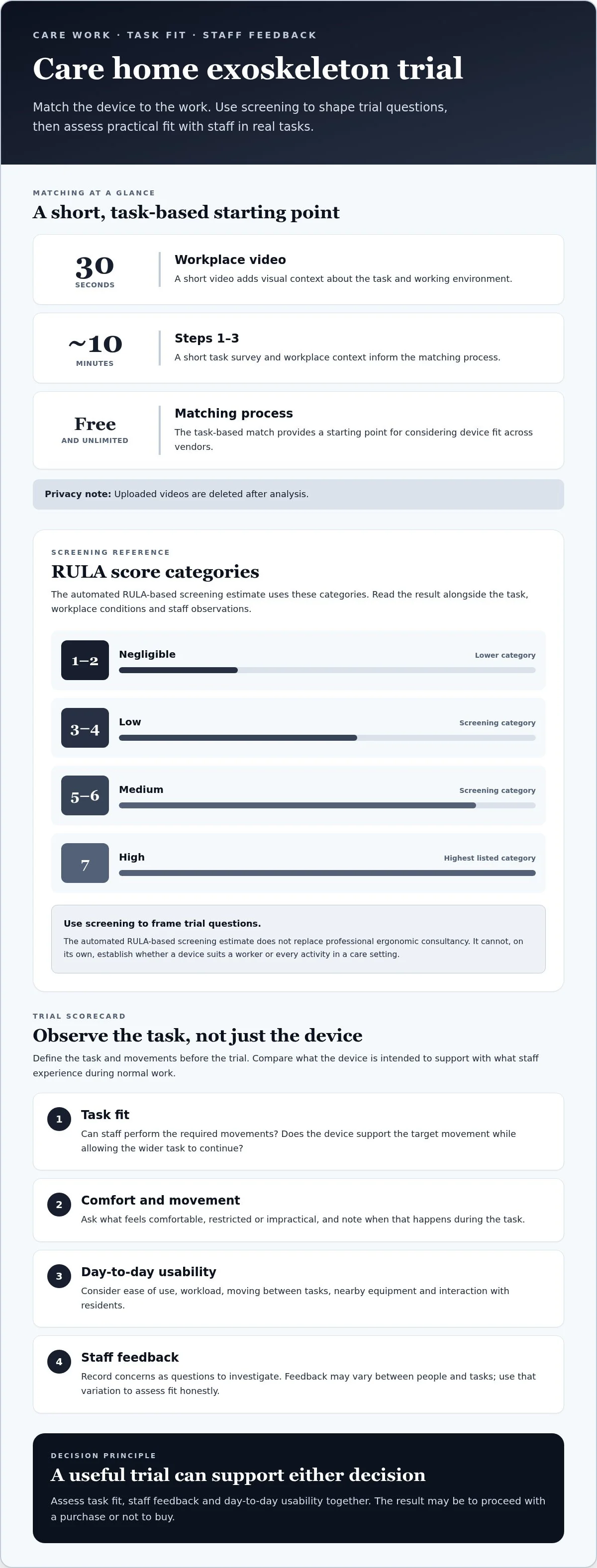
A 30-second workplace video can add visual context. Ryggo uses the video and survey to inform an automated RULA-based screening estimate and a device recommendation. Uploaded videos are deleted after analysis. Steps 1-3 take about 10 minutes, and the matching process is free and unlimited.
Interpret screening and selection information responsibly
The RULA score categories are 1-2 negligible, 3-4 low, 5-6 medium and 7 high. Treat these as screening categories, not a verdict on a worker or a standalone reason to choose a device. Read the result alongside the task description, workplace conditions and staff observations.
An automated RULA-based screening estimate is not a certified assessment and does not replace professional ergonomic consultancy. Use it to frame trial questions, then assess the device in the actual task. The estimate alone cannot establish that an exoskeleton suits an individual worker or every activity in a care setting.
Ryggo provides one neutral recommendation based solely on fit across vendors. This gives decision-makers a starting point for comparing task requirements with device suitability, rather than treating a screening result as a purchase decision. A task-based exoskeleton match can help focus the selection before staff trials begin.
Turn the task description into observable criteria before confirming a trial. Can staff perform the required movements? Does the device remain practical through the task sequence? What do users report? These questions connect the initial screening to staff evaluation during normal work.
Ready to find the right device for your operation?
Find my exoskeleton →How to involve care staff in an exoskeleton trial without pressuring them
Involve staff before anyone puts on a device. Explain why the care home is considering a trial, which tasks it will focus on and how the team will make its decision. Be clear that the purpose is to assess task fit and possible ergonomic support, not to prove that an exoskeleton works or promise a particular outcome.
Tell staff that their feedback can support either a decision to proceed or a decision not to buy. A trial is not a compliance exercise, and taking part should not be treated as endorsement. Practical concerns are part of the evidence decision-makers need.
Set expectations with the care team
Before introducing the device, explain which work situations are being evaluated, how feedback will be gathered and who will review it. Existing care procedures remain in place. Staff should continue to follow the organisation’s processes and use relevant handling equipment; the exoskeleton is being assessed as possible additional support.
Invite questions about fit, use and the tasks included in the evaluation. Make clear that staff can raise concerns at any point and that their comments do not commit them to using or purchasing the device. Explain how the team will weigh observations and feedback, including what would prompt the trial to stop.
Collect useful feedback during real work
Ask for feedback about a specific task and moment, rather than relying on one overall rating. A worker might report that a movement feels comfortable at one stage but restricted when changing position, reaching for equipment or moving to the next part of the task. These details give the team something concrete to review.
- Task: What work was being done, and which movement was involved?
- Experience: Did the device feel comfortable, restrictive or impractical during that movement?
- Context: Did it affect mobility, interaction with the resident or the flow of work?
- Follow-up: What would the worker want to try or clarify next time?
Supervisors can note whether the task was completed as usual and record practical interruptions. Keep these observations distinct from the worker’s own account. This avoids turning interpretation into fact and can help show whether different experiences relate to the task, the individual or the device.
Some staff may choose not to take part or may find the device unsuitable for their work. Record that accurately and without pressure. A useful care home exoskeleton trial makes room for mixed feedback; it does not assume universal acceptance or infer clinical outcomes from short-term impressions. Planning an open evaluation alongside vendor-neutral exoskeleton advice helps decision-makers set fair criteria before the trial begins.
How to judge whether a care home exoskeleton trial is useful
A useful trial gives the care home relevant evidence for a decision, not proof of a guaranteed benefit. Before it begins, agree what would count as a suitable fit for the intended work. Keep the assessment practical: can staff complete the task as required, does the device feel workable during the relevant movements, and are there concerns that outweigh its potential ergonomic support?
Use a short scorecard to bring the evidence together. Record the task, the worker’s feedback and observations about day-to-day usability. Separate what someone directly experienced from what the team assumes might happen over time. “The device felt restrictive during this movement” is an observation; a prediction that it will improve health or productivity is not evidence from the trial.
Agree decision criteria before the trial begins
Choose a small set of task-specific questions in advance. Keep them connected to the intended work, and record both staff feedback and operational observations, including whether the device interferes with movement or the sequence of work.
- Task fit: Can the worker perform the intended movements while wearing the device?
- Worker experience: What do participating staff report about comfort, mobility and practical use?
- Usability: Does the device fit into the task without creating a practical obstacle?
These prompts are not a clinical outcome measure. They keep the team focused on what it can observe and discuss, rather than inferring changes in injury risk, health or productivity from a trial.
Turn mixed feedback into a clear decision
Mixed feedback is not a failed evaluation. Compare positive, neutral and negative observations, and look for context. If one worker finds a movement restrictive while another reports no issue, check whether they performed the same task in similar conditions. One response need not settle the decision, but a recurring concern tied to the target task deserves attention.
Consider whether a concern points to device fit, the task chosen for evaluation or the way the trial was organised. If the team cannot distinguish between these, the evidence may not support a confident purchase decision. Document the reason for keeping or returning the device, including unresolved limitations.
Keep the device only if the trial evidence supports fit for the intended work and the agreed criteria are met. If it does not, returning it is a clear outcome, not a failure. To plan the evaluation stages and decision points, explore the industrial exoskeleton trial programme guide.
How Ryggo Deploy & Decide supports a care home exoskeleton trial
Ryggo is Europe’s first independent exoskeleton exchange. Its Deploy & Decide programme helps care homes evaluate a device in their own working environment before deciding whether to buy. The process starts with the task, not a preferred brand: Ryggo uses workplace information to provide one neutral recommendation based solely on fit across vendors.
Ryggo accepts no paid listings or vendor sponsorship. Vendors submit device specifications through a standard form, and Ryggo reviews the data before a device is listed. This creates a consistent basis for matching and comparison, while the care home’s trial is where staff assess fit in practice.
From workplace information to a Deploy & Decide trial
The matching process combines a 30-second workplace video with a short task survey guided by DGUV 208-062. The video produces an automated RULA-based screening estimate, alongside information used to identify a suitable match. Uploaded videos are deleted after analysis. The screening estimate can inform selection, but it does not replace professional ergonomic consultancy.
Deploy & Decide offers trials of 2, 4 or 8 weeks. During the trial, the care team can evaluate the recommended device against its task criteria and staff feedback. Devices ship directly from manufacturers, who provide onboarding, training and service. Ryggo supports the matching and trial pathway, not device training or service.
Use the trial to gather evidence against the questions agreed in advance. Does the device feel workable during the intended task? Can staff move as needed? Do practical concerns remain unresolved? A structured trial helps the care home assess potential ergonomic support without treating a recommendation or screening output as proof of benefit.
Understand the trial fee and next step
If a trial is unsuccessful, the refund is up to 75% for a 2-week trial, 70% for a 4-week trial or 60% for an 8-week trial. If the care home proceeds to purchase, 100% of the trial fee is credited towards the purchase, so there is no double payment.
Ryggo operates in 23 European countries under one set of commercial terms. The next step is to match a device to a defined task, then let staff and decision-makers assess its fit in practice. Explore Ryggo Deploy & Decide to start planning a trial before making a purchase decision.
Not sure which exoskeleton fits your task? Let the Ryggo advisor match it independently.
Find my exoskeleton →Make the next step a practical one
A care home exoskeleton trial is most useful when it leads to a clear operational decision, not an expectation that every task or staff member needs the same support. Turn the care team’s priorities into a focused brief: which work should be assessed, what staff need to experience for themselves and what evidence will be enough to proceed or stop.
If the device is not a fit, the team has learned something specific about the task and its requirements. If it appears suitable, decision-makers can move forward with a clearer understanding of what staff found workable and what still needs attention. Either outcome supports a more considered ergonomics decision.
Ready to explore a structured trial pathway for your care setting? Explore Ryggo Deploy & Decide and take the next step towards evaluating task fit with your team. A clear brief and an open decision process give staff a meaningful role from the outset.
Frequently Asked Questions
Is an exoskeleton suitable for every care-home task?
No. Suitability depends on the device, movement and task being assessed. A device that feels helpful during repeated bending may be awkward during reaching, walking or changing position. In a care home exoskeleton trial, assess each intended activity separately and record where the device fits or gets in the way. Do not assume that a result for one task applies to an entire role.
Can a care worker use an exoskeleton while supporting a resident?
That depends on the device and the task, so do not assume it is suitable for resident support. Evaluate it only for activities included in the trial, and keep existing care procedures and handling equipment in place. Before using it during resident support, consider whether it fits the task, whether staff have received the manufacturer-provided training and whether its use is consistent with professional guidance.
Does an exoskeleton replace professional ergonomic consultancy?
No. An exoskeleton is a potential source of ergonomic support, not a substitute for professional advice or established care procedures. Use a trial to examine device fit alongside the care home’s wider ergonomic approach. A screening result or positive user comment is not a full ergonomic evaluation and does not mean other controls or equipment are no longer needed.
Are RULA screening estimates from a workplace video certified assessments?
No. The video output is an automated RULA-based screening estimate, not a certified assessment. It can inform initial matching, but cannot establish by itself that a device is appropriate for a particular worker or care task. Interpret it alongside workplace observations and staff feedback, and remember that it does not replace professional ergonomic consultancy.
What happens to a care-home video uploaded for Ryggo matching?
The uploaded workplace video is deleted after analysis. It informs the matching process, so keep the clip focused on relevant work rather than including unnecessary footage. Care homes should consider privacy and their own procedures for recording work, particularly where residents could appear in the video. The video is an input for matching, not a substitute for observing device fit during the trial.
Who provides training and service during a Deploy & Decide trial?
The device manufacturer provides onboarding, training and service during the trial. Ryggo supports matching and the trial pathway, but does not deliver device training or service. Before staff begin, use the manufacturer’s onboarding to understand how the device is fitted and used, and give workers an opportunity to raise practical questions about setup and the tasks being evaluated.
Find the right device before you trial anything
The Ryggo advisor maps your task, environment, and requirements to compatible devices — independently, across the full European market.
Find my exoskeleton →