Key Takeaways
- Transition from open-ended vendor showcases to a structured exoskeleton trial program designed around empirical posture and fatigue data.
- Eliminate procurement bias by screening specific manual handling tasks against guidelines like DGUV 208-062 before selecting back or shoulder support systems.
- Drive frontline worker adoption through disciplined baseline tracking, precise mechanical fitting, and structured on-shift acclimatisation protocols.
- Justify deployment costs to executive stakeholders by calculating measurable reductions in lost working days and musculoskeletal strain.
- Protect capital expenditure using structured trial frameworks offering 2-, 4-, or 8-week testing terms with creditable fees and up to 75% refund guarantees.
Table of Contents
- What Is an Industrial Exoskeleton Trial Program?
- Selecting Hardware: The Vendor-Neutral Matching Process
- How to Run an Exoskeleton Pilot: A Step-by-Step Framework
- Evaluating Pilot Financials and Ergonomic Return on Investment
- Deploy & Decide: Mitigating Risk with Structured Trial Programmes
What Is an Industrial Exoskeleton Trial Program?
An industrial exoskeleton trial program is a time-bound, operational testing framework designed to evaluate wearable mechanical devices under real production conditions. Unlike a showroom demonstration, a structured pilot places hardware directly onto shop-floor workers across standard shifts to validate mechanical fit, biomechanical strain reduction, and workflow integration. It shifts wearable robotics from an abstract technology interest to an empirical safety intervention.
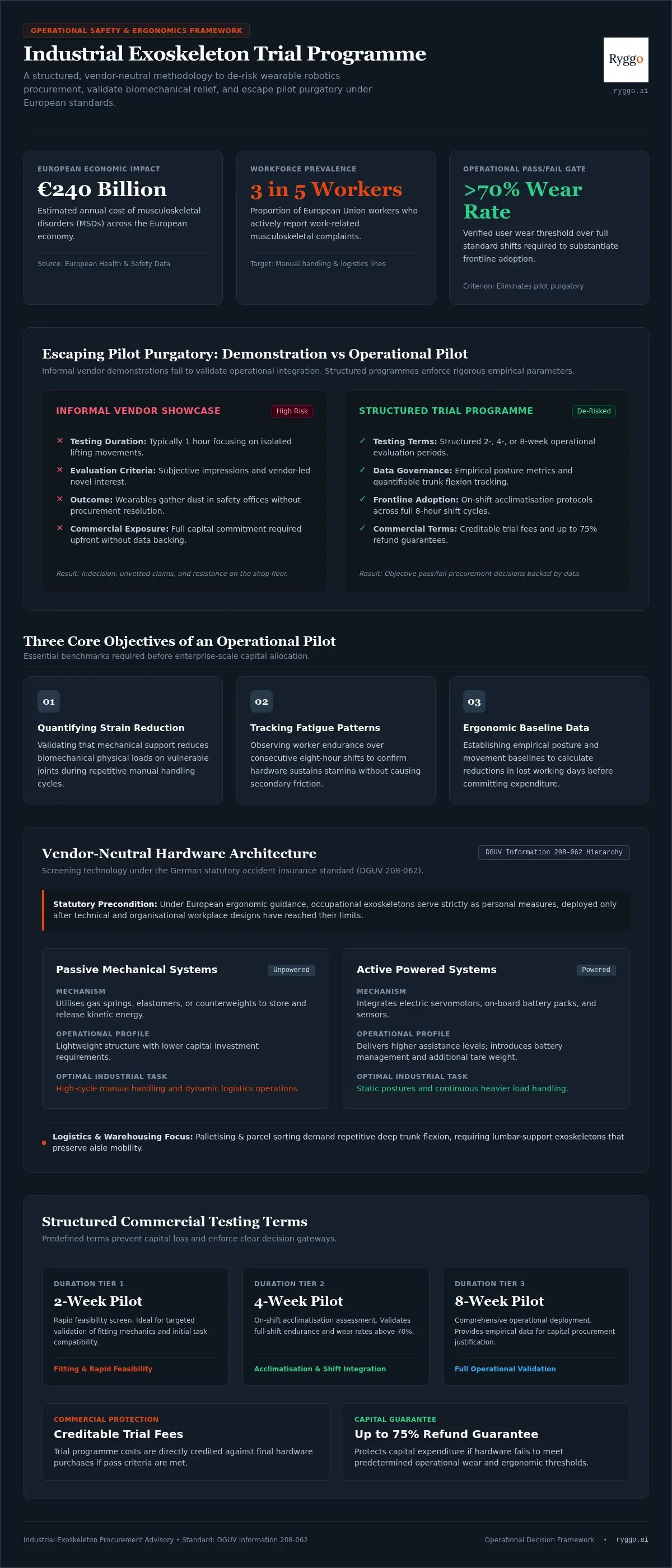
Musculoskeletal disorders (MSDs) cost the European economy an estimated €240 billion annually. Overcoming this burden requires structured deployment rather than superficial trials. While vendor demonstrations usually last an hour and highlight isolated lifting movements, an authentic occupational exoskeletons evaluation spans set periods, typically structured over 2-, 4-, or 8-week testing durations. This timeframe allows frontline teams to move past initial mechanical novelty, adjust straps and support settings, and demonstrate whether a suit genuinely supports full-shift physical demands.
Core Objectives of an Operational Pilot
Deploying wearable robotics into active production environments demands clear operational benchmarks. A successful trial focuses on three primary objectives:
- Quantifying strain reduction: Validating that mechanical assistance reduces physical loads on vulnerable joints during repetitive manual handling cycles.
- Tracking fatigue patterns: Observing worker endurance over consecutive eight-hour shifts to confirm the hardware sustains energy levels without creating secondary friction points.
- Establishing ergonomic baselines: Collecting objective posture and movement data before committing substantial capital expenditure across entire facilities.
Escaping the Trap of Pilot Purgatory
Pilot purgatory occurs when an enterprise cycles through endless, unstructured evaluations without reaching an actionable procurement decision. Wearable devices gather dust in safety offices because trials lack predefined success criteria. The underlying cause is almost always unvetted vendor bias coupled with informal testing environments.
When manufacturers run internal tests without rigid boundaries, subjective opinions replace operational evidence. A structured exoskeleton trial program eliminates this friction by instituting strict pass-fail parameters. Establishing operational criteria, such as verified user wear rates above 70% of shift time and quantifiable reductions in trunk flexion, ensures that procurement leads can justify investments or discontinue unsuitable equipment without operational delay.
Selecting Hardware: The Vendor-Neutral Matching Process
Procuring wearable robotics without independent evaluation leads directly to discarded equipment. Every manufacturer claims their specific architecture solves frontline fatigue, yet hardware optimised for static assembly will actively hinder dynamic logistics picking. Initiating an exoskeleton trial program requires an unbiased assessment that pairs concrete biomechanical stresses with appropriate mechanical structures.
European health and safety frameworks provide the blueprint for this selection. The German statutory accident insurance framework, DGUV Information 208-062, outlines a clear hierarchy: exoskeletons serve as personal measures to be deployed only after technical and organisational workplace designs reach their limit. Within this framework, safety leads must weigh passive mechanical systems against active powered units:
- Passive systems: Utilise gas springs, elastomers, or counterweights to store and release kinetic energy. They offer lightweight profiles and lower capital investment, making them ideal for high-cycle manual handling.
- Active systems: Integrate electric servomotors, battery packs, and sensors. They deliver higher assistance levels for heavier, static loads, though they introduce battery management and additional weight.
Task-Specific Device Categorisation
Matching equipment to physical movement profiles prevents costly deployment missteps across distinct industrial sectors:
- Logistics and warehousing: Palletising and parcel sorting demand repetitive deep trunk flexion. These roles require lumbar-support exoskeletons that preserve mobility in narrow aisles.
- Automotive and manufacturing: Prolonged overhead assembly induces severe deltoid and trapezius strain. Workers benefit from upper-limb devices that elevate and support the arms above shoulder level.
- Healthcare environments: Patient transfer involves erratic, multi-planar movements. Frontline care teams need flexible trunk stabilisation systems that assist lifting without restricting sudden corrective motions.
Screening Workflows via Video Assessment
Modern ergonomic assessments no longer require weeks of manual paperwork or invasive on-site tracking. Operations teams can now record standard 30-second smartphone videos of high-risk tasks to generate automated posture metrics. These video-based tools map joint angles and trunk inclinations directly to standard ergonomic scales like RULA.
These automated RULA estimates function as rapid screening tools to highlight excessive biomechanical load; they do not replace certified occupational safety assessments. Operational data security remains vital, which is why compliant workflows ensure uploaded footage is permanently deleted immediately following digital processing. For facilities ready to identify task-appropriate systems across multiple manufacturers, screening your workstation through the /exo-advisor/ tool provides an objective, ten-minute device matching baseline before any physical units arrive on site.
How to Run an Exoskeleton Pilot: A Step-by-Step Framework
Executing an effective exoskeleton trial program requires disciplined operational management rather than casual testing. Rolling out wearable robotics into live logistics or manufacturing environments demands a structured four-stage deployment model:
- Baseline data capture: Document unassisted cycle times, posture profiles, and reported worker discomfort levels across standard shifts before introducing any equipment.
- Professional fitting and onboarding: Adjust frame sizing, harness straps, and mechanical support settings to individual body dimensions. Dedicated onboarding ensures operators avoid pressure hotspots during routine movement.
- Active shift deployment: Embed the systems into standard workflows across structured 2-, 4-, or 8-week evaluation windows. This timeframe allows operators to move past initial biomechanical adaptation and build natural movement habits.
- Objective KPI evaluation: Compare post-trial physical strain data and operator surveys directly against pre-trial baselines to establish a definitive business case.
Securing Frontline Worker Adoption
Frontline buy-in determines whether an exoskeleton trial program succeeds or fails. Position each device strictly as an ergonomic safety aid, never as a monitoring tool to police shift pacing or artificially inflate picking quotas. The initial 48 hours present the highest operational hurdle as wearers adapt to unfamiliar mechanical resistance.
Run initial trials exclusively with voluntary cohorts rather than mandating participation. Giving operators ownership over the process builds peer advocacy across shifts. Back this up by collecting short, structured feedback forms at the end of each shift to identify pressure points and recalibrate hardware settings immediately.
Operational Metrics That Matter
Evaluate trial performance using sustainable operational indicators rather than forced output spikes:
- Fatigue and exertion scoring: Track reductions in shift micro-breaks and log changes in perceived physical exertion using standardised Borg scales.
- Task completion stability: Monitor consistency across shift cycles. A successful deployment maintains steady output into the seventh and eighth hours of physical shifts without worker exhaustion.
- Hardware durability: Inspect structural textile straps, locking buckles, and mechanical joints under real shop-floor conditions to assess resistance against dust, friction, and daily operational wear.
Ready to find the right device for your operation?
Find my exoskeleton →Evaluating Pilot Financials and Ergonomic Return on Investment
Procurement conversations frequently stall when wearable robotics are treated as experimental expenses rather than capital protective assets. A well-orchestrated exoskeleton trial program delivers the empirical evidence needed to bridge the gap between occupational safety and financial balance sheets. By converting mechanical support into measurable operational stability, safety leads can present an undeniable investment case to finance directors.
Direct Versus Indirect Cost Reductions
Direct costs present the most straightforward calculations for operational leadership. In Great Britain alone, Health and Safety Executive (HSE) data for 2024/25 shows that work-related musculoskeletal disorders caused 7.1 million lost working days, with back injuries accounting for 43% of all cases. Reducing days lost to lumbar strain yields immediate payroll protection and sharply decreases reliance on premium agency cover.
Indirect financial dividends often exceed direct medical avoidance. High-strain logistics and manufacturing roles experience severe staff turnover driven by physical exhaustion. Cushioning workers against repetitive strain protects institutional skill, stabilises late-shift output, and eliminates the continuous cycle of recruiting and retraining replacement staff.
The Measurable Cost of Operational Inaction
Accepting the status quo carries a compounding financial penalty. Chronic absenteeism, micro-stoppages caused by muscle fatigue, and elevated injury liability drain operating margins month after month. The minor cost of testing wearable hardware is negligible when weighed against the financial fallout of preventable spinal injuries or production bottlenecks.
Defensible procurement decisions rely on concrete operational numbers rather than manufacturer projections. To model your facility's projected payback period and benchmark multi-vendor performance across active manual workflows, visit ryggo.ai to calculate ergonomic ROI before committing capital to permanent deployments.
Deploy & Decide: Mitigating Risk with Structured Trial Programmes
Speculative procurement is the fastest route to capital waste. Purchasing unverified wearable hardware without empirical shift testing forces industrial facilities into unnecessary commercial exposure. A structured try-before-you-buy exoskeleton trial program removes this risk by aligning commercial terms with operational validation.
Under Ryggo's Deploy & Decide programme, organisations can trial hardware over defined 2-, 4-, or 8-week testing windows. Financial risk is mitigated directly through contractual refund provisions: unsuccessful tests return 75% of the fee for a 2-week trial, 70% for a 4-week trial, and 60% for an 8-week trial. When a trial meets its operational success criteria, 100% of the trial fee is credited directly against the final device purchase, eliminating duplicate expenditure. A unified commercial framework governs these terms across 23 European countries, standardising cross-border procurement for multi-site operations.
The Neutral Exchange Advantage
Vendor bias frequently distorts hardware selection. Equipment manufacturers inevitably pitch their proprietary models regardless of whether your facility requires shoulder support or lumbar assistance. Ryggo operates as an independent exchange listing 13 verified devices from 6 leading manufacturers, completely free from paid listings or vendor sponsorship.
This neutral standing enables operations teams to compare competing architectures side-by-side within identical workflows. Warehouse teams can benchmark contrasting passive mechanical suits against active systems under real operating conditions, ensuring the ultimate purchase decision rests purely on operator performance and biomechanical suitability.
Initiating Your Facility Pilot
Launching an on-site pilot no longer requires protracted procurement cycles. Facilities begin with a 10-minute digital matching survey and task video upload, where footage is automatically analysed and permanently deleted immediately after processing. This initial screening generates automated RULA estimates mapped directly to the DGUV 208-062 selection guidance, identifying the most effective mechanical categories for your task profile.
Once suitable hardware is identified, devices arrive on shift backed by structured vendor onboarding and technical support. Safety and operations managers can explore suitable multi-vendor options and initiate an evaluation through Ryggo Deploy & Decide to validate ergonomics before deploying capital across European facilities.
Take the Next Step Toward Structured Ergonomic Validation
Operational safety requires empirical validation, not speculative guesswork. Moving from informal demonstrations to a disciplined exoskeleton trial program ensures your capital investment directly protects frontline physical health. Grounding device selection in task-specific motion analysis and European safety standards builds workforce trust while establishing verifiable data on strain reduction.
Procuring wearable robotics no longer demands unchecked financial exposure. Ryggo provides independent access to 13 devices from 6 leading European manufacturers under unified commercial terms across 23 countries. With up to 75% trial fee refund protection and 100% of pilot fees credited directly toward final equipment acquisition, operations teams can validate mechanical fit and shift endurance with complete commercial certainty.
Equipping your teams with ergonomic support is a practical operational decision that safeguards long-term productivity. Find your ideal device and start a Deploy & Decide trial to establish an objective, risk-protected safety baseline across your facilities today.
Frequently Asked Questions
How long should an industrial exoskeleton trial program last?
An industrial exoskeleton trial program should run for 2, 4, or 8 weeks. Single-day demonstrations fail to capture shift fatigue or biomechanical adaptation. A two-week evaluation suits straightforward picking workflows, while four- or eight-week pilots allow operators across rotating shifts to adjust hardware, test varied payload cycles, and establish reliable long-term ergonomic data. These structured windows give teams enough operational time to build genuine movement habits without dragging tests into endless pilot purgatory.
What is the Deploy & Decide trial fee refund policy?
If an equipment trial fails to meet agreed operational or ergonomic criteria, the Deploy & Decide framework provides clear refund tiers based on testing duration. Participating companies receive a 75% refund for a 2-week trial, 70% for a 4-week trial, and 60% for an 8-week trial. This transparent structure limits financial downside, ensuring your procurement team only commits capital if frontline teams fully accept the hardware on shift.
Are video-based RULA ergonomics assessments legally certified?
No, video-based RULA scores are automated screening estimates, not certified occupational health assessments. They analyse short 30-second task recordings to map joint angles and identify posture risks rapidly, categorising strain from negligible to high. These estimates align with the DGUV 208-062 framework to guide initial equipment selection. However, formal workplace compliance still requires validation by certified internal safety leads or occupational ergonomists in line with national labour regulations.
Can our facility test multiple exoskeleton brands simultaneously?
Yes, facilities can deploy and compare multiple devices in parallel under a single commercial agreement across 23 European countries. Rather than negotiating separate contracts with different manufacturers, Ryggo lets you benchmark systems side-by-side on identical workstations. Comparing passive mechanical units against powered active suits during the same operational shift provides clear, comparative data on worker preference, fit flexibility, and physical strain reduction across your manual handling teams.
How many frontline workers should participate in an initial pilot?
An initial cohort of four to eight voluntary operators per target workstation provides sufficient demographic diversity while keeping feedback cycles manageable. Selecting participants with varying heights, body builds, and shift patterns helps identify hardware adjustment limits early. Voluntary involvement is vital. Forcing operators to wear mechanical equipment breeds resistance, whereas willing participants provide candid daily feedback, test fit ergonomics accurately, and naturally become internal advocates across the wider workforce.
What happens if workers find the exoskeleton uncomfortable during trials?
Discomfort during early shifts usually stems from improper strap tensioning or misaligned joint pivots. Dedicated vendor onboarding sessions address these friction points by recalibrating mechanical settings and swapping harness sizes. If persistent physical discomfort remains after the initial 48-hour acclimatisation window, the trial framework allows you to return the hardware under contractual refund terms or pivot to an alternative device architecture better suited to that specific movement profile.
Are exoskeleton trial programs suitable for airport baggage handling?
Yes, airport ramp operations and baggage make-up areas represent prime use cases for an exoskeleton trial program. Baggage handlers repeatedly lift luggage weighing up to 32 kg in confined aircraft holds and sorting carousels, generating high lumbar strain. Deploying compact passive back-support suits during live turnaround shifts validates whether mechanical assistance reduces lower-back loading without restricting rapid torso twisting, vehicle boarding, or movement around apron ground support equipment.
Can our business credit trial program fees toward a purchase?
Yes, 100% of your Deploy & Decide trial fee counts directly toward the outright purchase of the hardware once testing proves successful. There are no penalty charges, double payments, or hidden platform commissions. If the pilot demonstrates measurable strain reduction and frontline acceptance, your business simply pays the remaining balance on the equipment, turning your operational evaluation into a zero-loss procurement step across all supported European operations.
Find the right device before you trial anything
The Ryggo advisor maps your task, environment, and requirements to compatible devices — independently, across the full European market.
Find my exoskeleton →