What runtime figures really mean
Published runtimes vary widely between models, and a single product can have two honest figures: one under heavy strain and a longer one under a lighter workload. The gap between them is the duty cycle.
Research offers a useful way to think about it. A lab study of a walking exoskeleton derived runtime directly from energy: using the full 432 kJ of the battery would give 2.7 hours of operation (Autonomous exoskeleton reduces metabolic cost of human walking). That is a walking device, not an industrial benchmark, but the logic carries over. Runtime is stored energy divided by average power draw, and average power draw depends on what the wearer is doing. A simulation-based comparison of exoskeletons also notes that the maximum battery life of portable exoskeletons is limited to around 5 hours, which implies several charging breaks within a day.
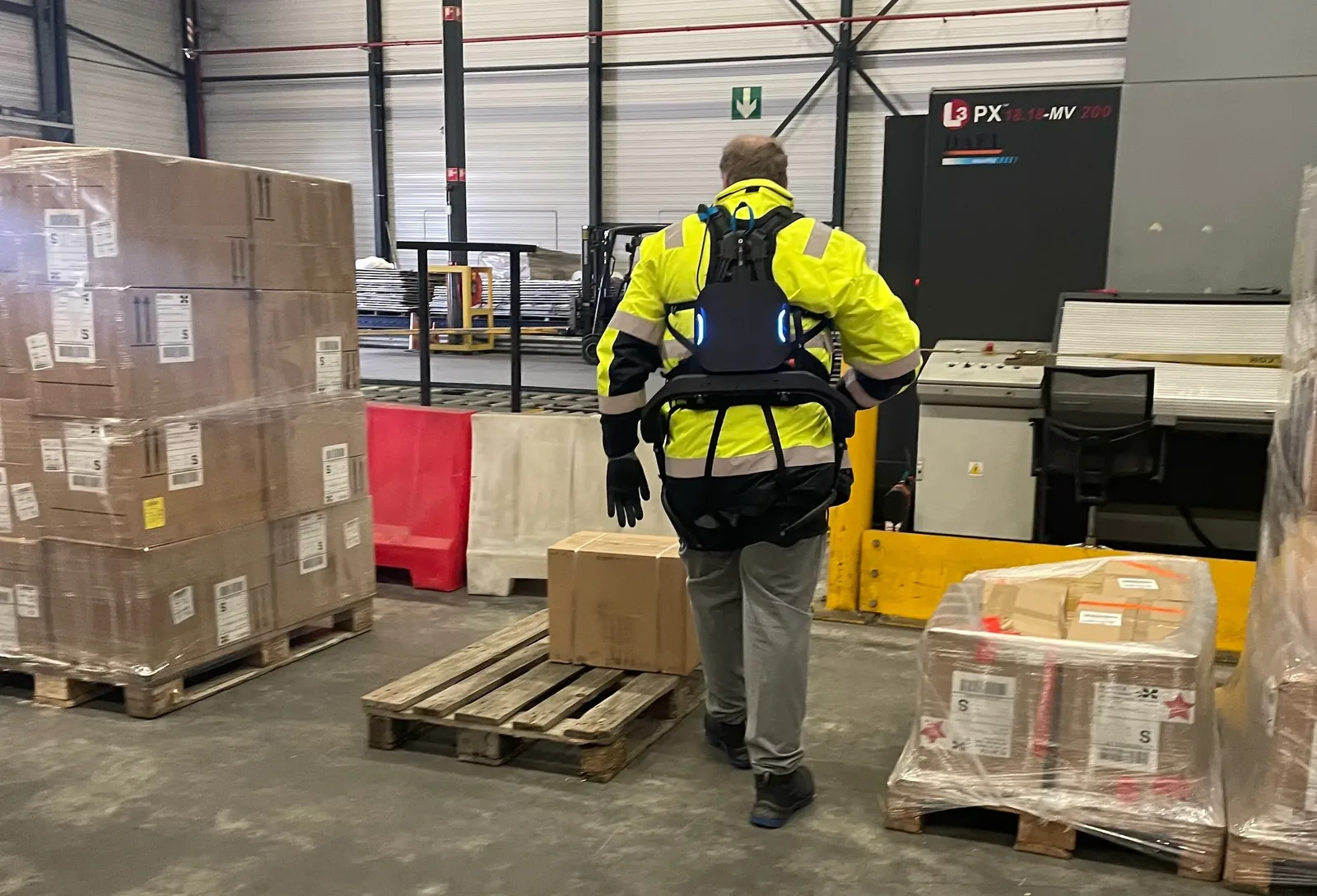
Treat published figures as indicative, and expect them to conflict between sources. When you compare options, use the manufacturer's current datasheet and ask what workload sits behind the number.
Passive versus active: when battery life matters
Exoskeleton battery life hours only matter for powered devices. Passive exoskeletons use springs or elastic elements to store and return energy, so they give consistent support throughout the shift with no charging and no risk of a power failure. For many back-support and shoulder-support tasks, that simplicity is the main argument for passive designs.
Active devices earn their place where a passive design cannot deliver enough assistance, or where support has to adapt to varying loads and movements. The trade-off is operational: batteries need managing, and active units are typically restricted from certain hazardous areas unless they carry the right certification. If your site has explosive atmospheres, check certification before battery hours even enter the discussion.
A practical way to decide is to start from the task, not the power source. If a passive device genuinely covers the strain pattern of the job, the battery question disappears. If it does not, you accept a charging routine as the price of the extra assistance. The Exoskeleton Advisor can help narrow down which back or shoulder device suits an operation, and the exoskeleton catalogue lets you compare passive and powered options side by side.
Whichever route you take, fit and comfort still decide whether people wear the device for a full shift. A unit with excellent runtime that workers take off after two hours delivers nothing.
Ready to find the right device for your operation?
Mapping runtime to a multi-shift day
A quoted runtime can sound comfortable against an 8-hour shift until you look at how a real day is structured. Start by writing it out: start-up, productive work, breaks, handovers and any idle periods. Powered devices often draw less when the wearer is not actively handling loads, so a shift with long stretches of standing or walking can run beyond the heavy-duty figure. A continuous lifting shift will do the opposite.
Then compare three numbers: the runtime you can realistically expect, the length of the working period, and the charging window available. If runtime falls short of the shift, you have a few options:
- Charge during scheduled breaks, if the charge time fits inside them.
- Keep spare packs and swap them between users.
- Choose a design built for hot-swapping, where an empty battery can be replaced while the unit stays operational.
In a multi-shift operation, hot-swap capability often matters more than the headline hour count, because it removes downtime rather than merely postponing it.
On a two-shift line, add handover to the picture. If the same unit passes from one worker to the next, the battery needs topping up in the gap, and the fit has to be adjusted for the new wearer. Decide in advance where batteries charge, who is responsible for swapping them, and what happens when a pack goes missing. Charging infrastructure is part of the cost of ownership, so include it in your business case alongside the payback period.
Not sure which exoskeleton fits your task? Let the Ryggo advisor match it independently.
Battery health, cycle life and charging rules
A battery that delivers six exoskeleton battery life hours when new will not necessarily deliver the same in a year, because lithium-ion packs lose capacity with each charge-discharge cycle. Treat any cycle-life or degradation figure you are quoted as a question for the vendor, not a planning number.
What you can do is ask the vendor for specifics in writing:
- the rated cycle life, and how much capacity remains at that point;
- the warranty terms on the battery pack, which are often shorter than the warranty on the frame;
- the replacement cost and lead time for a pack;
- the charge time from empty, and whether partial charges are acceptable;
- the weight of the pack, since it adds to what the wearer carries.
Charging rules matter as much as cell chemistry. Charge in a dry, ventilated, temperature-controlled space, follow the manufacturer's instructions, and never leave a damaged pack in service. Cold environments such as chilled warehouses can reduce usable capacity, so a figure measured at room temperature may not hold there. Build a simple routine: label packs, log cycles where the vendor supports it, and retire any pack that swells or loses capacity suddenly.
Measuring battery performance in your own trial
The spec sheet is a starting point. What decides fit is exoskeleton battery life hours in your own workplace, under your loads, with your workers. A trial is the most reliable way to find out, and the Deploy & Decide programme is built for exactly this: you try a device in your own operation for 2, 4 or 8 weeks before committing. For background on the commercial terms, see our guide to the cost of exoskeleton trials and the broader try-before-you-buy buyer's guide.
To make battery data useful, decide what to record before the trial begins:
- Charge level at the start and end of each shift, per unit.
- The number of swaps or mid-shift charges needed, and when they happened.
- Any unplanned stoppages caused by a flat battery.
- The task mix that day, so you can link heavier workloads to faster drain.
- Charge time actually achieved, and whether it fitted the break schedule.
- Worker feedback on pack weight and handling.
Compare the results against the vendor's stated exoskeleton battery life hours. If the device comfortably covers your longest shift with margin, battery life is a non-issue. If it only just manages, you know to budget for spare packs or a different design. Either answer is useful, and it is far cheaper to learn it during a trial than after a fleet purchase.
Finally, keep the battery result in proportion. Runtime is one criterion alongside task fit, comfort and adoption. A device that meets your hours but fails on comfort is still the wrong device.
Find the right device before you trial anything
The Ryggo advisor maps your task, environment, and requirements to compatible devices — independently, across the full European market.