Key Takeaways
- Use exoskeleton try-before-you-buy programs to assess performance in real work, not just during a product demonstration.
- Check whether device selection considers the task, posture, loads and work environment, and references DGUV 208-062 for selection guidance.
- Agree on trial tasks, worker feedback methods, operational observations and decision criteria before the devices arrive.
- Compare trial duration, unsuccessful-trial refund terms and purchase credit before committing.
- Check whether a recommendation is vendor-neutral and based on fit, so the trial tests a device suited to your operation.
Table of Contents
- Why consider an exoskeleton try-before-you-buy programme for workplace use?
- What should buyers evaluate before choosing an exoskeleton trial programme?
- How do trial duration, refund terms and purchase credit compare?
- How can a workplace run a decision-ready exoskeleton trial?
- How does Ryggo Deploy & Decide support exoskeleton trial decisions?
Why consider an exoskeleton try-before-you-buy programme for workplace use?
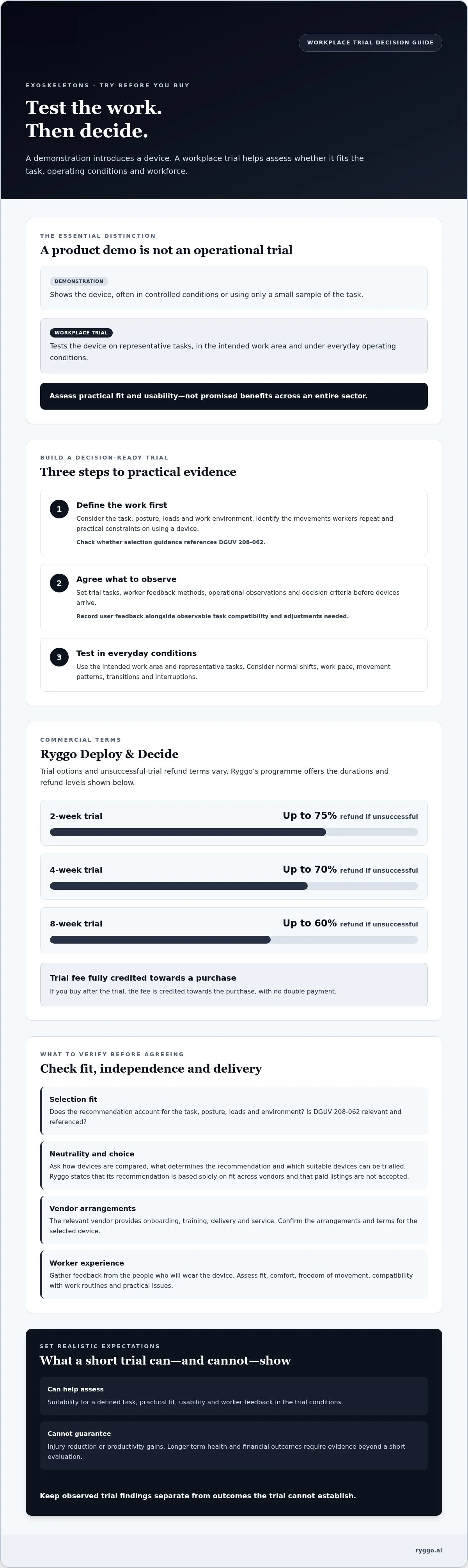
An exoskeleton try-before-you-buy programme is a workplace trial that lets an organisation assess a device against real tasks and operating conditions before deciding whether to purchase it. Unlike a short product demonstration or showroom visit, a workplace trial gathers practical evidence about fit and usability, while giving the organisation a chance to assess the commercial terms.
A human exoskeleton can be powered or passive, but neither category alone tells you whether a device suits a particular job. Start by looking at the movements workers perform, the loads they handle, the time spent in relevant postures and the conditions around them. Trial terms matter too, because fees, refunds and purchase credits affect the commercial decision.
Which workplace decisions can an exoskeleton trial support?
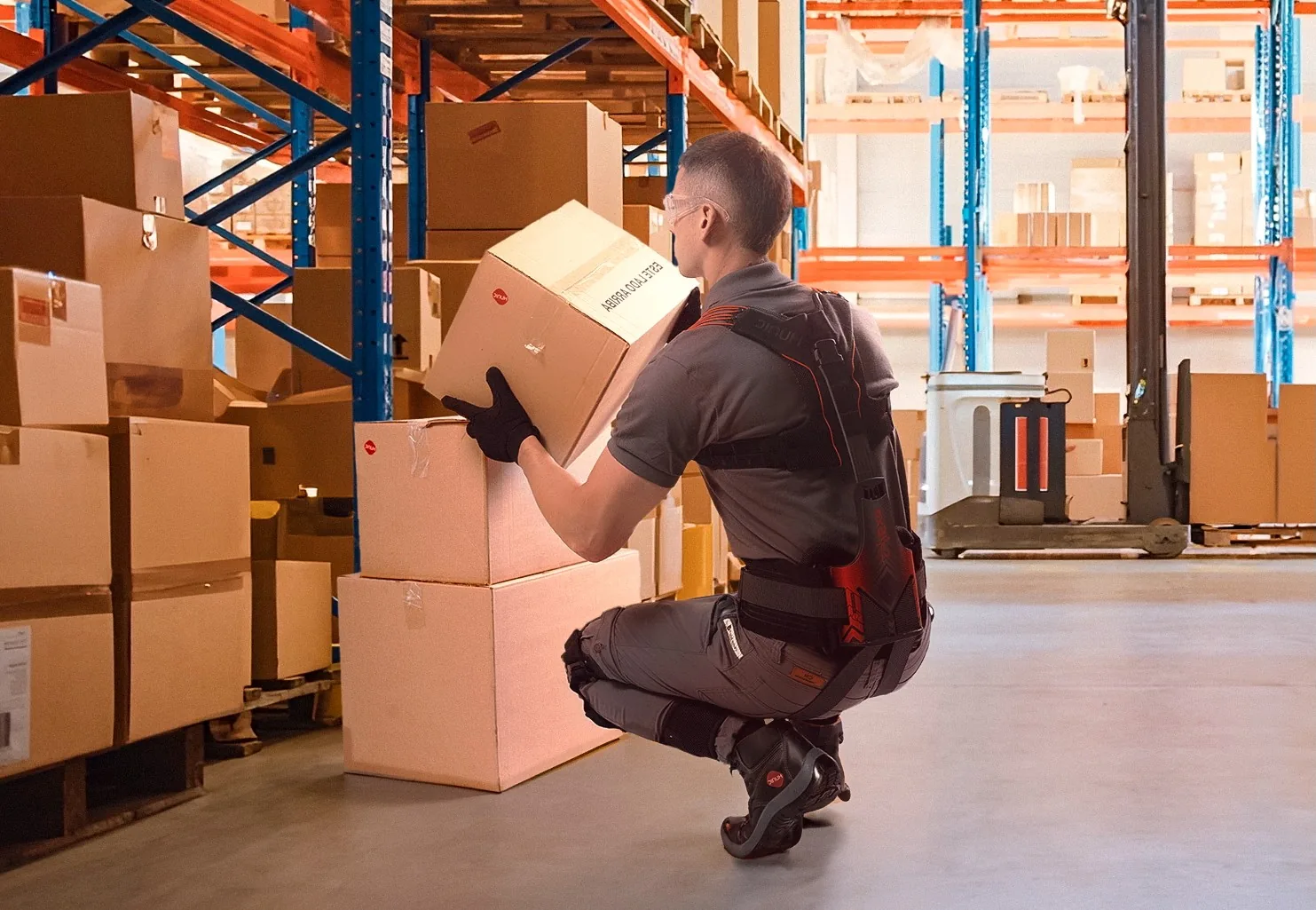
A trial can help buyers assess whether a device is suitable for a defined task. For example, observe how it fits during repeated order picking, whether it interferes with movements while unloading, or how comfortable it feels during overhead assembly. For baggage handling, check whether the device works with the lifting and carrying movements involved. These are task-specific questions, not promises of benefit across an entire sector.
Worker feedback is essential. A device may appear suitable to an observer but feel restrictive, uncomfortable or impractical to the people expected to use it. Record what users report alongside observable details, such as task compatibility and adjustments needed. A trial assesses suitability, but it can’t guarantee injury reduction or productivity gains. Longer-term health and financial outcomes require evidence beyond a short evaluation.
Why can a demonstration alone be insufficient?
A controlled demonstration is a useful introduction, but it may not reproduce normal shifts, work pace, movement patterns or environmental constraints. The wearer may perform only a small sample of the task, without the transitions or interruptions that affect day-to-day use.
Test the device in the intended work area and on representative tasks. Agree in advance what users and supervisors will observe: comfort during the task, freedom of movement, compatibility with work routines and practical issues that arise. Keep these findings separate from outcomes that can’t be established during the trial, such as long-term health effects or return on investment.
For buyers comparing exoskeleton try-before-you-buy programs, the distinction is straightforward: a demonstration shows the device, while an operational trial helps determine whether it fits the work and workforce. Clear commercial terms support a sound keep-or-return decision.
What should buyers evaluate in exoskeleton try-before-you-buy programs?
Start with the work, not a product shortlist. A relevant recommendation should account for the task, posture, loads and operating environment, including the movements workers repeat and any practical constraints on using a device. Check whether the programme’s selection guidance references DGUV 208-062, and ask how that guidance informs the recommendation for your work.
Independence matters. Ask how candidate devices are compared against the task and user needs, and whether commercial relationships can influence which device is recommended. Ryggo provides one recommendation based solely on fit across vendors. Paid listings aren’t accepted, so vendors don’t buy placement.
What should buyers confirm before agreeing?
Separate confirmed programme terms from details you still need to establish. Ryggo offers trials of 2, 4 or 8 weeks, and the trial fee is fully credited towards an eventual purchase, with no double payment. The relevant vendor provides onboarding, training, delivery and service. Confirm the arrangements and terms for your selected device before proceeding.
- Selection: Does the recommendation account for the task, posture, loads and environment? Is DGUV 208-062 relevant and referenced?
- Neutrality and choice: How are devices compared, and what determines the recommendation? Which suitable devices can you trial?
- Trial terms: What is the duration, what happens if the trial is unsuccessful, and how is the fee treated if you buy?
- Vendor arrangements: Who provides onboarding, training, delivery and service, and what should users expect during the trial?
What should an exoskeleton pilot measure?
Agree on measures before the trial starts. Record user feedback on fit, comfort and usability, alongside observations of task compatibility and practical use in the work area. Choose operational measures that reflect your objective, then compare them under consistent conditions. These findings can inform a decision, but they don’t establish that the device will reduce injuries or improve productivity.
Keep screening tools in perspective. Ryggo’s RULA results are automated screening estimates, not certified assessments. They can help indicate which type of exoskeleton may merit consideration, but they don’t replace professional ergonomic consultancy. These boundaries make the evidence easier to interpret and help prevent a screening score from being treated as a complete evaluation.
Use this checklist to compare exoskeleton try-before-you-buy programs on fit, independence, support arrangements and transparent terms. Learn more about Ryggo’s approach to exoskeleton matching and trials.
Ready to find the right device for your operation?
Find my exoskeleton →How do trial duration, refund terms and purchase credit compare?
Compare the trial period and the outcome if the device doesn’t meet your requirements as separate points. A longer evaluation window gives a workplace more time to observe the device in its operation, but the refund rate for an unsuccessful trial also varies by duration. Check the programme terms before agreeing, and set clear decision criteria from the outset.
| Trial duration | Refund for an unsuccessful trial |
|---|---|
| 2 weeks | Up to 75% |
| 4 weeks | 70% |
| 8 weeks | 60% |
These are the refund rates for Ryggo’s Deploy & Decide programme. The refund for an unsuccessful 2-week trial is up to 75%; the 4-week option has a 70% refund, and the 8-week option has a 60% refund. “Up to” matters: it isn’t a promise of a full refund. Confirm the terms that apply to your selected trial before it begins.
What happens if the exoskeleton does not meet expectations?
If the trial is unsuccessful, the applicable refund depends on the chosen duration and the programme’s terms. Don’t treat the listed rate as a guaranteed full reimbursement. Before the device arrives, clarify how the programme defines an unsuccessful trial and what steps you need to follow to reach a keep-or-return decision. This gives procurement and operations a shared basis for assessing the outcome.
Does the trial fee count towards the purchase?
Yes. If you decide to buy, the trial fee is fully credited towards the eventual purchase. You don’t pay the trial fee twice, so it isn’t an additional amount on top of the purchase price. Keep this purchase credit distinct from a refund: the credit applies if you proceed with a purchase, while the refund rates above apply to an unsuccessful trial.
When comparing exoskeleton try-before-you-buy programs, put duration, unsuccessful-trial refund and purchase credit side by side. Confirm the applicable terms before committing. This makes the commercial comparison clearer without confusing a purchase credit with a refund or assuming a full refund is guaranteed.
How can a workplace run a decision-ready exoskeleton trial?
A useful trial starts before the device arrives. Set the task, observation method and decision criteria in advance so the team can assess practical fit rather than rely on memory or a general impression. Keep the process focused: prepare the work information, agree how the trial will be observed, then document the decision.
What information should a buyer prepare?
Describe the task and the conditions in which it takes place. Include the movements involved, postures, loads and work environment, along with routine transitions that could affect device use. Ryggo’s short survey uses workplace information to support selection guidance referencing DGUV 208-062. A short workplace video can also inform matching, and uploaded videos are deleted after analysis.
RULA results from video are automated screening estimates, not certified assessments. Treat them as an input to selection, not a substitute for professional ergonomic consultancy.
How should the team decide whether to keep or return a device?
Before the trial, agree on what acceptable fit and usability mean for the task. Then gather feedback from the workers using the device and operational observations from the people overseeing the work. Consider responses in context rather than treating one person’s experience as representative of the whole workforce.
- Prepare: Document the task, movements, loads and working environment.
- Agree: Set user feedback prompts, operational observations and decision criteria before the trial starts.
- Check arrangements: Confirm who provides onboarding, training, delivery and service. These are provided by the vendor, so establish arrangements for the selected device.
- Decide: Compare findings with the agreed criteria, record the reason to keep or return the device, and note any unresolved questions.
This approach keeps the decision tied to observed fit and usability. A trial can inform whether the device appears suitable for the task, but it can’t establish longer-term health or productivity outcomes. Documenting evidence and open questions also gives procurement, operations and HSE teams a clearer basis for the next step.
Preparation makes exoskeleton try-before-you-buy programs more useful without making the process unnecessarily complex. Ryggo’s exoskeleton advisor can help you begin the matching process by sharing information about the workplace task.
How does Ryggo Deploy & Decide support exoskeleton trial decisions?
Once you’ve defined the task, trial measures and commercial criteria, a programme can connect workplace needs to a device recommendation and an operational test. Ryggo’s Deploy & Decide combines workplace information, a vendor-neutral recommendation and a trial of selected devices. The recommendation is based solely on fit across vendors. Paid listings aren’t accepted.
What are the steps in Ryggo’s matching and trial process?
Buyers upload a free, unlimited 30-second workplace video and complete a short survey about the work, including loads, movements and environment. Ryggo uses this information to provide one recommendation, with its rationale and ROI. Steps 1-3 of the matching process take about 10 minutes. Uploaded videos are deleted after analysis.
Buyers can trial the selected device for 2, 4 or 8 weeks, then decide whether to keep or return it. Use the trial to test task and workforce fit against criteria agreed in advance. The recommendation informs selection; it doesn’t replace workplace evaluation or guarantee a particular result.
What should buyers know about Ryggo’s European coverage and support?
The platform covers exactly 23 European countries under one set of commercial terms. The relevant vendor provides onboarding, training, delivery and service, not Ryggo. Confirm the arrangements for the selected device before the trial begins, including what vendor support is available during the evaluation.
For buyers comparing exoskeleton try-before-you-buy programs, Deploy & Decide offers a defined route from task information to a fit-based recommendation and workplace trial. The value still depends on the quality of your evaluation: observe the real task, gather worker feedback and make the purchase decision against agreed criteria.
To start assessing a workplace task, use Ryggo’s exoskeleton advisor to provide information for device matching.
Not sure which exoskeleton fits your task? Let the Ryggo advisor match it independently.
Find my exoskeleton →Make the next step a task-fit assessment
A workplace trial is most useful when it tests a defined task under real operating conditions and gives workers a clear way to report fit and usability. Agree on evaluation criteria before the device arrives, then use the findings to make a keep-or-return decision, not to assume long-term health or productivity outcomes.
Ryggo’s recommendation is vendor-neutral and based solely on fit, with no paid listings. If you proceed to purchase after a trial, the trial fee is fully credited, so there’s no double payment. The platform covers 23 European countries under one set of commercial terms.
Ready to assess whether an exoskeleton may suit your operation? Explore exoskeleton try-before-you-buy programs with Ryggo by sharing information about the workplace task.
Frequently Asked Questions
What is an exoskeleton try-before-you-buy programme?
An exoskeleton try-before-you-buy programme is a structured workplace trial to assess whether a device suits a real task before purchase. Set out the task, users, evaluation criteria and commercial terms before the trial starts. This is more informative than a brief demonstration, which may not reflect normal work. Treat trial observations as evidence about short-term fit and usability, not proof of long-term health or productivity outcomes.
Can a company try more than one exoskeleton before buying?
Yes. Ryggo allows customers to trial multiple devices side by side in their own operation. Its matching process provides one neutral recommendation based solely on fit across vendors; that recommendation does not mean buyers can only trial one device. For a useful comparison, test devices against the same tasks and agreed criteria. This helps teams assess operational suitability consistently rather than drawing conclusions from different test conditions.
How long are Ryggo Deploy & Decide trials?
Ryggo Deploy & Decide trials are available for 2, 4 or 8 weeks. Choose a period that allows the team to assess the device in the relevant work setting, and confirm the applicable programme terms before starting. The matching process across steps 1-3 takes about 10 minutes, separate from the time spent evaluating a device during the trial.
What refund is available if an exoskeleton trial is unsuccessful?
For an unsuccessful trial, the stated refund is up to 75% for a 2-week trial, 70% for a 4-week trial and 60% for an 8-week trial. These rates don’t promise a 100% refund. Confirm the terms that apply to the selected programme before deployment. A refund for an unsuccessful trial is separate from the purchase credit available if you decide to buy the device.
Can the exoskeleton trial fee be applied to a purchase?
Yes. Ryggo states that the trial fee counts fully towards the eventual purchase, so no double payment is required. The credit means the fee isn’t an additional charge on top of the purchase. It’s distinct from an unsuccessful-trial refund: the credit applies if you proceed with a purchase, while the refund terms apply if the trial doesn’t meet expectations. Check the terms for your chosen trial before committing.
Are Ryggo’s RULA scores certified ergonomic assessments?
No. Ryggo’s video-based RULA scores are automated screening estimates, not a certified assessment, and they don’t replace professional ergonomic consultancy. The score categories are 1-2 negligible, 3-4 low, 5-6 medium and 7 high. Use the screening as an initial indication alongside task information and appropriate professional judgement. Don’t treat a score as certification or as a complete assessment of the workplace.
What happens to workplace videos uploaded for Ryggo screening?
Ryggo states that uploaded videos are deleted after analysis. The screening process uses a 30-second workplace video alongside a short survey about the work, including loads, movements and environment. Explain the video process to relevant workers and follow your organisation’s applicable data-handling practices. The stated process is deletion after analysis.
Does Ryggo provide exoskeleton trials across Europe?
Ryggo’s platform covers exactly 23 European countries under one set of commercial terms. Customers sign up once and can order across borders within that coverage. Vendors provide onboarding, training, delivery and service for trial devices; Ryggo doesn’t provide these directly. Before arranging a trial, confirm that your country and selected device are covered and clarify the vendor’s arrangements for the evaluation.
Find the right device before you trial anything
The Ryggo advisor maps your task, environment, and requirements to compatible devices — independently, across the full European market.
Find my exoskeleton →