Key Takeaways
- Build an exoskeleton pilot program for logistics around a specific task and the conditions workers encounter during a normal shift.
- Use task demands and posture to guide device matching, with DGUV 208-062 as the selection guide.
- Agree in advance how you’ll assess task fit, worker experience and operational practicality.
- Deploy & Decide follows a clear sequence: upload a workplace video, complete a task survey, receive a recommendation and trial a suitable device. Matching steps one to three take about 15 minutes.
- Compare trial evidence with your agreed criteria before deciding whether to purchase or return the device.
Table of Contents
- Why run an exoskeleton pilot programme for logistics?
- Matching exoskeletons to warehouse tasks and conditions
- How to set practical success criteria for a logistics exoskeleton trial
- How to run an exoskeleton pilot programme for logistics
- What to do after the logistics exoskeleton pilot
Why run an exoskeleton pilot programme for logistics?
Deploy & Decide gives logistics teams a structured way to match an exoskeleton to a work task, trial a suitable device in their operation and decide whether it fits. A focused exoskeleton pilot program for logistics tests a practical question: does the device support the intended work without creating new difficulties for the worker or operation?
A demonstration can show how a device is put on and how it is intended to move. It cannot establish how well it fits a full shift, a changing work pace or the demands of a specific warehouse task. In live work, teams can observe whether the device allows the required movements, fits the work area and is comfortable for users. Any potential strain reduction or ergonomic benefit must be assessed during the trial, not assumed.

An overview of exoskeletons as wearable devices can help explain the range of designs and applications. For a buying decision, the key question is more specific: what type of support, if any, fits the task being assessed?
Which logistics tasks could justify a pilot?
Assess tasks separately. Similar job titles can involve different postures, handling demands and working conditions. Describe what workers actually do instead of choosing a device based on a broad role label.
- Order picking: Note how often workers reach, bend or handle items, whether picking involves different shelf heights, and how repetitive the movements are.
- Unloading: Record the handling demands, working postures and frequency of lifts, as well as the space available around the unloading area.
- Replenishment: Consider whether the task combines lifting and carrying with repeated reaching, bending or movement between locations.
- Repetitive handling: Identify which movements are repeated, how often they occur and whether workers change position or pace as work progresses.
Include relevant work-area conditions, such as clearance and movement between locations. These details help the team assess whether a device fits the task in practice. Don’t assume a device suitable for one activity will suit another, or that the same option will work for every worker or warehouse.
What should a pilot help the buyer decide?
Set the decision criteria before the trial begins. Compare what happens during use with the task description and working conditions you established in advance. Keep the assessment grounded in three areas:
- Task fit: Can the worker complete the intended movements and handle the task while wearing the device?
- Worker experience: How do users describe comfort, ease of movement and willingness to use the device for the task?
- Operational practicality: Does the device fit the work area and normal workflow without disrupting task completion?
A pilot should not be an open-ended equipment trial without a decision framework. If the evidence does not support the intended use, the team can decide not to proceed. If it does, the findings provide a clearer basis for the next step. In either case, any ergonomic benefit is something to assess through the trial, not a promise to assume.
Matching exoskeletons to warehouse tasks and conditions
Task matching connects the physical demands and postures of a specific job with a suitable type of support. Don’t select a device simply because it is described as suitable for logistics. Base the decision on what workers do, how they move and the conditions in which they work.
DGUV 208-062 provides guidance for selecting and using exoskeletons. Apply it to the task under consideration, then use a live trial to assess whether the recommendation fits the work in practice. In an exoskeleton pilot program for logistics, matching is a starting point for a decision, not proof that a device will reduce strain or make work safer.
Describe the work before choosing a device
Write a separate description for each task. Workload, movement patterns and the environment together help determine which type of support may fit. A task survey should capture the details that distinguish one activity from another, rather than blending several roles into a general description of “warehouse handling”.
- Loads: Describe what workers handle and how the load is moved during the task.
- Movements: Record actions such as lifting, carrying, reaching or bending, and how often they occur.
- Posture: Note whether workers repeat a posture, change position or work at different heights.
- Operating conditions: Include relevant space constraints and the need to move around the work area.
For example, replenishment may combine lifting with travel between locations, while repetitive handling may involve similar movements in one area. Assess these as distinct tasks. Averaging their demands can hide differences that affect device fit.
A 30-second workplace video can provide input for screening alongside the short task survey. It is a brief view of the work, not a complete ergonomic audit. Choose footage that represents the task being assessed, and remember that a short clip cannot show every variation across normal operations.
Interpret screening and recommendation appropriately
The video produces an automated RULA-based screening estimate. It can inform the matching process, but it is not a certified assessment and does not replace professional ergonomic consultancy. Treat it as one input to selection, not as a score that certifies risk, proves a device is suitable or guarantees safer work.
Ryggo provides one vendor-neutral recommendation based solely on fit across vendors. Paid listings and vendor sponsorship do not influence it. Ryggo earns from orders placed through the exchange, at rates that do not depend on a device’s ranking. Uploaded videos are deleted after analysis.
Use the recommendation to define what to assess during the trial: whether the device supports the relevant movements, suits the working conditions and is practical for users. Explore task-based exoskeleton matching to move from workplace information towards a trial decision.
Ready to find the right device for your operation?
Find your exoskeleton →How to set practical success criteria for a logistics exoskeleton trial
Decide what evidence will matter before the trial starts. This keeps the assessment tied to the selected task and its normal working conditions, rather than letting a first impression or one positive comment determine the outcome. For a useful exoskeleton pilot program for logistics, assess task fit, worker experience and operational practicality separately.
Use the task description established before the trial as your reference. Compare what workers do while wearing the device with the intended movements, work pace and site conditions. Record observations consistently, including when the device seems suitable and when it restricts or complicates the task.
Assess fit during real warehouse work
Observe whether the device supports the intended body area during the selected task. Note whether workers can make the required movements, maintain their usual pace and move through the work area as expected. Include conditions relevant to the task, such as available space or transitions between work locations.
Ask users for feedback consistently. For example, record comfort, ease of movement and practical difficulties after a work period. Positive feedback is useful evidence of user experience, but it does not prove that strain has reduced or risk has changed. Keep those conclusions separate.
Turn observations into a clear decision
Assign an owner to each evidence area, such as the warehouse lead for workflow observations and the HSE lead for ergonomic considerations. The trial team can then review a shared record rather than relying on informal impressions.
| Criterion | Evidence to record | Owner | Decision question |
|---|---|---|---|
| Task fit | Whether the device supports the intended body area and allows the task’s movements | Task supervisor | Does observed use match the task requirements? |
| Worker experience | Consistent user feedback on comfort, movement and ease of use | Trial lead | Can users work with the device as intended? |
| Operational practicality | Fit with work pace, workflow and site conditions | Warehouse manager | Can the device be used in the planned operation? |
Agree in advance what would support proceeding, what would call for an adjustment and what would lead to returning the device. A device may appear to fit the task but prove impractical in the work area. Treat that as a reason to review the scope or stop, not as a result to explain away.
Keep task observations separate from an ROI calculation or financial forecast. They may inform a later business case, but do not establish productivity gains, injury reductions or financial outcomes by themselves. If you track quantitative measures, define them before the trial and interpret them alongside worker feedback and task-fit observations.
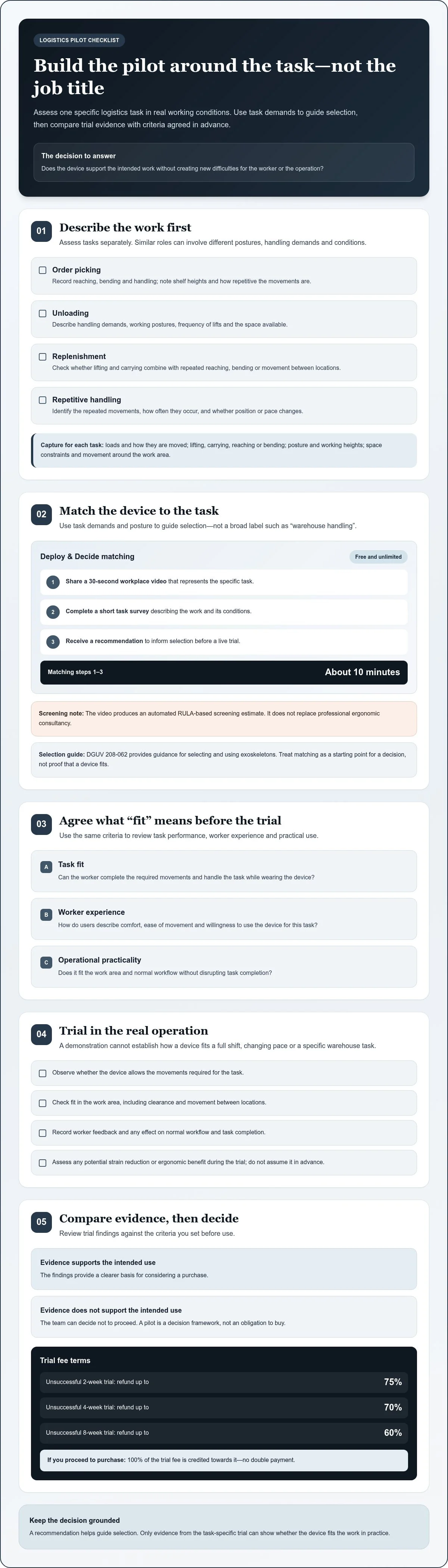
How to run an exoskeleton pilot programme for logistics
A clear sequence keeps a trial connected to the task and the decision you need to make. Deploy & Decide moves from workplace information to a vendor-neutral recommendation, then to a trial of a selected device in your operation. The matching process is free and unlimited, so you can assess task fit before committing to a purchase.
Move from task information to a neutral recommendation
Start with a 30-second video showing the work under consideration, then complete a short task survey. Describe the loads handled, movements performed and relevant features of the work environment. Keep the information specific to the task. A video of one activity should not stand in for several jobs with different physical demands.
The survey follows the DGUV 208-062 selection framework. Together, the video and survey inform an automated RULA-based screening estimate and the matching process. The estimate is not a certified assessment and does not replace professional ergonomic consultancy. Uploaded videos are deleted after analysis.
Ryggo’s recommendation is based solely on fit across vendors, with no paid listings or vendor sponsorship. Steps one to three, from submitting workplace information to receiving a recommendation, take about 15 minutes. Use the result to identify a suitable device to trial, then compare its use with the task and conditions you described.
For a broader view of the process, the industrial exoskeleton trial programme guide explains how a structured trial supports a purchase decision.
Choose a trial period and understand the terms
Once a device has been selected, choose a trial length that gives your team time to assess it during the intended work. Trials are available for 2, 4 or 8 weeks. Use the period to gather evidence against criteria agreed in advance, including task fit, worker experience and operational practicality. A trial lets you test before purchasing, but it does not guarantee that a device will suit the operation.
If a trial is unsuccessful, the refund is up to 75% for a 2-week trial, 70% for a 4-week trial and 60% for an 8-week trial. If you proceed to purchase, 100% of the trial fee is credited towards it, so there is no double payment.
Before starting, make sure everyone involved understands the task being assessed, what evidence they will record and how the team will reach its final decision. A shared plan keeps observations useful throughout the trial and gives procurement, operations and HSE teams a common basis for deciding what to do next.
Explore Deploy & Decide to move from task information to a vendor-neutral recommendation and practical trial decision.
What to do after the logistics exoskeleton pilot
Close the pilot by comparing the evidence with the task description and success criteria agreed before deployment. Don’t let a strong first impression outweigh difficulties observed during normal work, or treat one concern as decisive without reviewing the wider findings. Document the decision: proceed with the device for the defined task, adjust the scope or return it.
Proceed only when the evidence supports the decision
Review task fit, worker experience and operating conditions separately. Did the device support the intended movements? Could workers use it comfortably and practically at the normal work pace? Did the actual environment match the conditions considered when selecting the device? Record differences between expected and observed use, and note whether they affect the original purpose of the trial.
If the evidence supports proceeding, describe the device as a potential aid to ergonomics and strain reduction for that specific task. Keep the conclusion proportionate: trial observations inform the decision, but do not prove the device will have the same effect for every worker or role. If evidence is mixed, consider whether a narrower task or a different match is appropriate rather than extending use by default.
A buyer’s guide to exoskeleton try-before-you-buy programmes can help procurement teams understand how trial findings fit into a purchase decision.
Make the next step straightforward
For a suitable match, proceed to purchase with the trial findings and intended use clearly documented. If you buy the device, 100% of the trial fee is credited towards the purchase, so there is no double payment. Devices are shipped directly by their manufacturers, who provide onboarding, training and service.
If the trial does not support proceeding, return the device. The refund is up to 75% for a 2-week trial, 70% for a 4-week trial or 60% for an 8-week trial. Base the decision on the evidence and agreed terms, not on an assumption that a trial guarantees a successful outcome.
Before closing the pilot, retain a concise record of the task assessed, the criteria used, key worker and operational observations, and the reason for the final decision. This gives HSE, operations and procurement teams a shared account of what the trial established and what remains uncertain. Keep any future use within the scope supported by the evidence.
To begin a task-led assessment for your warehouse, Start a logistics exoskeleton match.
Not sure which exoskeleton fits your task? Let the Ryggo advisor match it independently.
Find your exoskeleton →Make the next decision evidence-led
A logistics pilot can inform more than one purchase. It can help your team identify other tasks where ergonomic support may be worth assessing, and where changes to the task or work area deserve attention first. Tie any future decision to the conditions actually evaluated. If the task, workflow or operating environment changes, reassess the fit rather than assuming the original result still applies.
The value of an exoskeleton pilot program for logistics is a clearer basis for action, including the confidence to decide that a device is not suitable. Use the findings to guide a focused next step, not as a reason to extend use beyond the evidence.
Ryggo’s matching process provides a free and unlimited route to a vendor-neutral recommendation based solely on fit across vendors. If you proceed to purchase after a trial, the trial fee is fully credited towards it.
Start a logistics exoskeleton match and take the next step towards an informed decision for your operation.
Frequently Asked Questions
How long should a logistics exoskeleton pilot last?
Ryggo offers trials of 2, 4 or 8 weeks. Choose among these options based on how your team can observe the device during the selected logistics task and compare its use with the criteria set in advance. A short or variable task may need careful observation planning, but the trial period must be one of the available durations. A longer trial does not automatically produce stronger evidence.
What should a warehouse exoskeleton pilot measure?
Assess whether the exoskeleton fits the task, how workers experience using it and whether it works in the operation. For example, record whether users can perform the intended movements, how they describe comfort and ease of movement, and whether the device fits the workflow and work area. A well-defined exoskeleton pilot program for logistics compares these observations with the task conditions agreed beforehand, without treating feedback as proof of reduced strain.
Can we trial more than one exoskeleton in our logistics operation?
Yes. Your company can trial more than one device side by side in its own operation. Keep the comparison focused on the same defined task and working conditions so that observations are useful. Ryggo provides one neutral recommendation for that task, based solely on fit across vendors. The trial lets your team assess how the selected device or devices work in practice, without assuming that every option will suit every user.
How much of the trial fee is refunded if an exoskeleton is not suitable?
If a trial is unsuccessful, the refund is up to 75% for a 2-week trial, 70% for a 4-week trial and 60% for an 8-week trial. The rate depends on the selected duration. These are the applicable refund rates, not a promise of a full refund. Review the trial terms alongside your decision criteria before starting, so the team understands the keep-or-return options.
Is the trial fee credited towards buying the exoskeleton?
Yes. If you proceed to purchase the exoskeleton, 100% of the trial fee is credited towards the purchase. The trial fee is not charged again as an additional payment, so there is no double payment. This lets procurement assess a device in the intended operation before making a purchase decision. Base that decision on the evidence collected, not on the fee credit alone.
Is the RULA score from a workplace video a certified ergonomic assessment?
No. The video produces an automated RULA-based screening estimate, not a certified assessment. It can provide an initial input to matching, but it does not replace professional ergonomic consultancy. Treat it as screening information rather than a definitive judgement about risk or device suitability. Consider the estimate alongside the task description and observations made during a trial in actual working conditions.
What happens to workplace videos uploaded for exoskeleton matching?
Uploaded workplace videos are deleted after analysis. The video is used as an input to the matching process alongside the task survey, helping relate the work shown to a suitable type of support. Keep the clip focused on the task you want to assess rather than using it to represent unrelated warehouse activities. This helps keep the screening estimate and recommendation relevant to the work under consideration.
Find the right device before you trial anything
The Ryggo advisor maps your task, environment, and requirements to compatible devices — independently, across the full European market.
Find your exoskeleton →