Key Takeaways
- Match an exoskeleton to specific patient-handling tasks and clinical movement patterns, rather than assuming one device suits every care setting.
- Assess caregiver strain alongside comfort, movement, hygiene and workflow fit during a real-world trial.
- Plan for staff training and include instruction and maintenance when considering the full cost of adoption.
- Compare trial performance with work performed without an exoskeleton, including staff feedback as well as physical responses.
- Use vendor-independent comparison and a trial programme to inform whether a device fits your hospital’s patient-handling needs.
Table of Contents
- Patient lifting, transfers, repositioning, and mobility support
- Occupational health and musculoskeletal strain prevention
- Exoskeleton purchase, training, and maintenance costs
- Caregiver experiences using exoskeletons
- Patient lifting, repositioning, and transfers
- Ryggo: Trial programmes for exoskeletons (called Deploy & Decide)
Patient lifting, transfers, repositioning, and mobility support
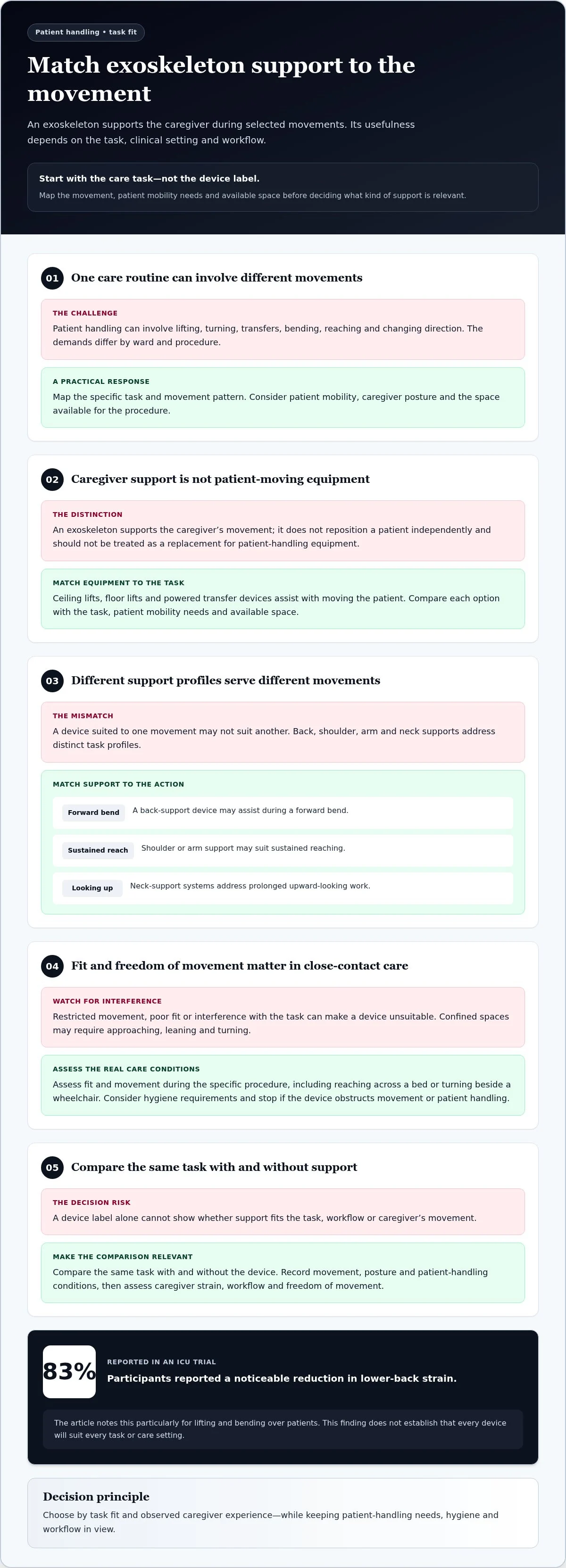
Passive and powered exoskeletons are available for different patient-handling movements, including lifting, repositioning and transfers. An exoskeleton for patient repositioning in hospitals supports the caregiver’s movement; it does not move the patient independently.
For example, a back-support device may assist during a forward bend, while shoulder or arm support may suit sustained reaching. The task and clinical setting determine which type of support is relevant.

Robotic Supports and Movement Controls
Joint supports, sensors and movement controls affect how an exoskeleton responds to a caregiver’s movements. Fit matters because repositioning can involve bending, reaching and changing direction in a confined space.
Passive systems provide mechanical support without powered assistance, while active systems use powered components. For a bed-to-wheelchair transfer, assess whether the device allows the caregiver to approach, lean and turn as needed. Neck-support systems address prolonged upward-looking work; shoulder and arm supports target overhead tasks. These are distinct task profiles, not interchangeable solutions.
Movement tests can help assess how a device behaves during relevant actions. ASTM International identifies ASTM F3517-21 as a standard practice for movement tests when using an exoskeleton. Use movement examples from the ward, such as turning a patient in bed, to make evaluation relevant.
Exoskeletons and Patient-Handling Devices
Exoskeletons support the wearer, while ceiling lifts, floor lifts and powered transfer devices assist with moving the patient. Hospitals use them for different purposes, so an exoskeleton shouldn’t be treated as a replacement for patient-handling equipment.
A ceiling lift may assist with a bed-to-chair transfer; a floor lift can serve a similar purpose where a ceiling system is unavailable. A powered transfer device can help move a patient between surfaces. An exoskeleton, by contrast, supports the caregiver during movement. Compare equipment with the actual task, the patient’s mobility needs and the space available.
At m&i-Fachklinik Enzensberg, staff use exoskeletons to assist with transfers between beds and wheelchairs. This illustrates one application, not a universal solution. For each ward, map tasks such as bed repositioning and transfers, then assess which equipment best supports the patient and caregiver.
Safety Risks and Contraindications
Risks during patient repositioning include restricted movement, poor device fit and interference with the task. Patient safety is essential, particularly with active exoskeletons, because powered assistance must respond predictably during close-contact care.
There is no single contraindication that applies to every device and task. Suitability depends on the device’s intended use, the caregiver’s movements and the patient-handling procedure. Before use, assess fit and movement during the specific task, such as reaching across a bed or turning beside a wheelchair. Stop if the device obstructs movement or patient handling.
Movement patterns and hygiene requirements matter, especially when considering a system designed for industrial settings. A device suitable for one ward may not suit another. Evaluate the relevant movements and care conditions together rather than relying on the device label alone.
Occupational health and musculoskeletal strain prevention
Patient handling can place repeated physical demands on healthcare workers, particularly during bending, lifting and repositioning. Evaluate exoskeletons as one part of a broader approach to ergonomic work design.
Musculoskeletal Injury Risks
Repeated patient-handling movements can contribute to musculoskeletal strain for nurses and care assistants. In Germany, back pain ranked among the top three causes of sickness incidents and total sickness days in 2023. That makes it useful to assess the movements behind an absence pattern, rather than treating equipment choice as a stand-alone response.
Map demanding tasks by ward and movement. Repositioning a patient in bed, for example, differs from assisting someone after a stroke. Both patient mobility and caregiver posture shape the physical demands.
Reducing Physical Strain
An exoskeleton can support a caregiver’s physical effort during selected movements, but it doesn’t replace safe handling procedures or other ergonomic controls. Studies have found that powered or passive systems can significantly reduce lower-back muscle activity during dynamic lifting or material handling. In an ICU trial, 83% of participants reported a noticeable reduction in lower-back strain, particularly when lifting and bending over patients.
To assess a device, compare the same task with and without it. Record the movement, posture and patient-handling conditions in both observations. A device that supports bending may not suit a task focused on reaching or transferring. Assess caregiver strain alongside workflow and freedom of movement.
Worker and Patient Perspectives
Technology acceptance depends on whether a device fits daily work and existing healthcare workflows. At University Hospital Magdeburg, participants’ mean Affinity for Technology Interaction score was 4.6±0.9 on a six-point Likert scale. That finding describes participants’ technology affinity; it doesn’t establish that every staff member will accept a wearable exoskeleton.
Gather feedback from the staff who perform the task, including their concerns about movement, comfort and practical use. Explain the purpose before a trial and give workers a way to share feedback and reservations during the evaluation. Consider the patient’s mobility and comfort too. For example, observe whether the device complicates communication or positioning during a bed repositioning task.
Regulations and Guidelines
For US hospitals, Safe Patient Handling and Mobility programmes are required by law in 11 of the 50 states; no federal legislation mandates these programmes. Apply relevant workplace requirements alongside any applicable state rules when planning exoskeleton-assisted handling.
Safe Patient Handling and Mobility programmes combine engineering, administrative and personnel controls. Treat an exoskeleton as one possible ergonomic measure within that broader approach, not as a substitute for the programme. Document the task, staff feedback and physical response, then compare the results with the same work performed without the device.
Exoskeleton purchase, training, and maintenance costs
Evaluate an exoskeleton against defined repositioning tasks, compare its fit with other approaches, and trial it with staff before purchasing. Budget for the device, staff instruction, cleaning and maintenance, not just the purchase.
Start with a task profile. Record whether nurses need support while turning a patient in bed, assisting with a transfer or working in another posture. Identify who will use the device, where it will be worn, and how its fit and movement affect care. Compare those needs with the device’s intended use: a system suited to one movement may not support another.
Assess the full ownership cycle, including purchase, onboarding and training, routine cleaning, and maintenance arrangements. These costs depend on the device and its care requirements, so consider them alongside staff time and expected use. A device reserved for selected tasks has a different role from one used across routine care.
Training should cover fit, adjustment, controls and the movements staff will perform. Use a representative task, such as repositioning a patient in bed, to practise putting on the device and moving through the work sequence. Include the nurses and other professionals who will use it, and capture their feedback on comfort, movement and task fit. Training is part of implementation, not a one-off introduction.
Maintenance planning should account for cleaning between users and the device’s care instructions. Define who handles checks and storage, and who arranges service; include these activities in the department’s workflow. A shared device, for example, needs a clear handover process between shifts. Manufacturers provide device service and training, so distinguish those responsibilities from the hospital’s cleaning and use procedures.
Gait training has a different purpose from patient repositioning. Exoskeletons for people with lower-extremity impairments can support standing or walking after a neurological event, but gait assistance does not establish suitability for caregiver handling tasks. After a person with spinal cord injury is medically stabilised, a physical therapist typically assesses candidacy for exoskeleton therapy, considering weight, therapy goals and other health concerns.
For home use, the user and support person receive training on wearing and controlling the device, navigating terrain and using it in daily activities. Hospitals evaluating gait training should distinguish rehabilitation objectives from staff ergonomics and assess adjustable assistance against the intended mobility task. A system designed to support walking may not address the postures involved in repositioning a patient.
Record decision criteria before purchase: task fit, staff comfort, training needs, cleaning, maintenance and patient-care workflow. Compare trial observations with the same work performed without the device. This gives procurement and clinical teams a practical basis for deciding whether the exoskeleton supports the intended task and fits ongoing care.
Ready to find the right device for your operation?
Find your exoskeleton →Caregiver experiences using exoskeletons
Caregiver feedback shows why hospitals should assess comfort and task fit alongside physical support. In a two-month trial at University Hospital Magdeburg, 17 healthcare professionals from several departments accumulated 312 hours of exoskeleton use.
Use was selective, not continuous. Participants wore the device for an average of approximately 20 hours each, or about three shifts. Most participants, 76%, did not wear it for an entire shift. Instead, they used it for specific tasks. That pattern helps hospitals consider whether a wearable device suits demanding moments in nursing work, rather than expecting all-shift use.
Task preference was clear in the trial: 82% preferred wearing an exoskeleton for specific activities, including lifting or patient repositioning, rather than throughout a full shift. For an implementation team, that points to a practical evaluation question: which care tasks feel demanding enough to justify putting on and adjusting the device? Repositioning, standing work and transfers can each create different experiences for a caregiver.
Reported benefits also varied. Among intensive care unit participants, 83% noticed reduced lower-back strain, particularly while lifting and bending over patients. In the wider group, 65% said the exoskeleton promoted a more upright posture and encouraged conscious movement. These responses describe staff perceptions, not a guarantee of improved function or reduced fatigue for every wearer.
Comfort deserves equal attention. Forty-one percent of participants reported increased sweating, and 41% reported pressure points, especially around shoulder and leg straps. A device may support a movement yet feel uncomfortable during prolonged wear. During evaluation, ask staff to describe where pressure occurs, whether straps restrict movement, and how the device feels after repeated use.
The trial’s overall rating was 2.7±0.99 on the German school grading scale, where 1 means very good and 6 means very bad. This group average sits alongside both reported benefits and practical drawbacks. It should not replace individual feedback: a nursing assistant repositioning a patient may assess the same device differently from a professional completing another task.
Recruitment reached approximately 300 staff members across participating hospital units, while 12 of the 17 participants worked in intensive care. Those figures show the difference between staff awareness and direct use. Hospitals can gather feedback from both groups, then compare the views of users with those of colleagues who observed the device in their work setting.
For a useful assessment, record the task, wear duration, comfort issues and staff comments. Compare caregiver responses during device-assisted work with the same task performed without the exoskeleton. Include feedback on posture, ease of movement, sweating and pressure points. This makes the decision more relevant to daily nursing than a demonstration focused only on standing or rehabilitation.
Patient lifting, repositioning, and transfers
Patient handling involves different movements. Repositioning someone in bed, transferring them to a wheelchair and helping them stand place different demands on caregivers. Exoskeletons support the wearer during selected movements; they do not move the patient independently. The practical question is which task, posture and care setting the device is intended to support.
Break each task into its working movements before assessing a device. For repositioning, observe how the caregiver bends, reaches and changes position beside the bed. For a transfer, note the approach to the patient, movement between surfaces and any turning required. This task map helps distinguish support for repeated lifting from support for sustained leaning or reaching.
Patient mobility affects the handling demands. Someone who can assist with a transfer requires a different movement sequence from someone who cannot contribute to repositioning. A person recovering after a stroke may also have specific mobility needs during care. Include the patient’s ability to participate, the caregiver’s posture and the care task in the assessment, rather than focusing on load handling alone.
Use an observed task to judge whether an exoskeleton fits the care sequence. During a bed reposition, for example, check whether the caregiver can reach the patient, maintain the required contact and move freely through the task. During a wheelchair transfer, assess whether the device allows the caregiver to approach and turn beside the chair. These observations show whether it supports the caregiver or complicates movement.
Keep patient safety central, especially when evaluating powered systems. Before starting, confirm that the device is fitted and controlled as intended. During the movement, observe whether it changes the caregiver’s posture or timing in a way that affects patient handling. If it interferes with the care sequence, pause and reassess its fit for that task. An ergonomic benefit for the wearer cannot be separated from safe patient handling.
Exoskeleton support also differs from medical mobility or therapy equipment. A wearable device intended to support a caregiver’s movement should not be treated as a mobility aid for the patient. For a patient with lower-extremity impairment, standing or walking support belongs in a rehabilitation context, with different objectives from caregiver assistance during lifting or repositioning.
Hospitals can make the decision more practical by documenting a focused set of task-specific observations:
- Record the patient-handling task and the movements it requires.
- Observe caregiver posture, reach and ability to move through the sequence.
- Capture any effect on patient contact, positioning or transfer flow.
- Compare the task with and without the exoskeleton.
These observations help teams decide where a device may support ergonomic handling and where other patient-handling methods remain more suitable. To structure a task-based review, use the exoskeleton assessment advisor.
Not sure which exoskeleton fits your task? Let the Ryggo advisor match it independently.
Find your exoskeleton →Ryggo: Trial programmes for exoskeletons (called Deploy & Decide)
Ryggo helps hospitals compare healthcare exoskeletons and assess their fit for patient-handling tasks. Its AI-powered recommendations, vendor-neutral device comparisons and ROI calculations help hospitals weigh care needs against operational priorities.
Through Deploy & Decide, hospitals can trial a suitable exoskeleton before purchasing. Trials run for 2, 4 or 8 weeks. If a trial is unsuccessful, the refund is up to 75% for a 2-week trial, 70% for a 4-week trial or 60% for an 8-week trial. If the hospital proceeds to purchase, 100% of the trial fee is credited towards it.
For a hospital weighing options after reviewing caregiver feedback and task requirements, Ryggo’s healthcare exoskeleton matching can help narrow the choice. Explore the exoskeleton assessment advisor to consider the next step.
Turn the decision into a focused evaluation
Start by choosing a patient-handling task that matters to your care team and defining what a useful outcome looks like. For an exoskeleton for patient repositioning in hospitals, this could mean assessing whether staff can complete a specific movement comfortably while maintaining the patient-care workflow. Ground the evaluation in observed work, not assumptions about device performance.
Bring clinical, ergonomic and procurement perspectives together before deciding. Their shared view can clarify which tasks merit closer assessment, what staff feedback to record and how a potential device fits the hospital’s wider approach to patient handling. This provides a practical basis for a decision that serves caregivers and patients.
If you’re ready to explore the options for your hospital, contact Ryggo about patient handling. A considered next step can help your team move from interest to a clear, task-focused evaluation.
Frequently Asked Questions
What is an exoskeleton?
An exoskeleton is a wearable structure that supports a person’s body during selected movements. It may be passive, using mechanical elements, or powered. In healthcare, distinguish devices worn by staff from mobility equipment used by patients. A caregiver device is intended to assist the wearer during work; it is not a patient transfer system or a treatment for the person receiving care.
Why should I try one?
A trial lets the hospital assess practical fit before committing to a purchase. Choose a real care task and involve the staff who perform it, rather than relying on a demonstration alone. Record whether putting on the device fits the routine, whether staff can communicate comfortably with patients, and whether the device is ready when needed. These observations can reveal workflow barriers that specifications cannot.
How do wearable exoskeletons assist nurses with patient repositioning and transfers?
Exoskeletons provide targeted physical support to the wearer during movements such as bending or reaching. The relevant support depends on the device’s design and the caregiver’s posture. For instance, a system designed to support the back may not address sustained arm work. Nurses should assess whether the device suits the movement sequence and allows them to maintain the contact and coordination required for the care task.
What is the clinical evidence that exoskeletons reduce caregiver injuries during patient handling?
Research findings on reduced muscle activity or reported strain do not prove that a device reduces injuries. These outcomes measure different things. To assess evidence for a hospital decision, consider which task and device were studied, how long staff wore it, and whether researchers measured injuries or only short-term responses. This distinction matters when setting expectations for a workplace evaluation.
How much do hospital patient-handling exoskeletons cost, including maintenance and training?
Budget planning should account for more than the device itself. Consider staff instruction, cleaning between users, storage, maintenance arrangements and any effects on work routines. Compare these costs with the intended frequency and type of use, rather than assuming the device will be worn throughout a shift. Procurement and clinical teams can make a stronger decision when they assess the same use case and ownership assumptions.
What training and staffing procedures are needed to use exoskeletons safely in hospitals?
Set clear procedures before introducing a device: identify intended users, define the tasks in scope, and arrange instruction on fitting and operation. Establish a process for reporting discomfort or interference with care, and decide how staff will hand over shared equipment between shifts. Training should reflect the actual work environment and relevant patient-handling routines, with responsibilities aligned to the hospital’s existing procedures.
What exoskeletons are available for patient repositioning in hospitals?
Passive and powered exoskeletons can support selected patient-handling movements. Back-support devices may assist with bending, while shoulder or arm supports may suit sustained reaching. The appropriate system depends on the task and clinical setting.
Find the right device before you trial anything
The Ryggo advisor maps your task, environment, and requirements to compatible devices — independently, across the full European market.
Find your exoskeleton →