Key Takeaways
- Build the industrial exoskeleton onboarding process around the task, movements and work environment, rather than choosing a device first.
- Use a clear sequence to move from task information to a device recommendation and a workplace trial before purchase.
- Separate manufacturer-provided device instruction from workplace onboarding, and check applicable training or credential requirements for your location.
- Set task-specific indicators and gather employee feedback on fit, comfort, movement and compatibility during the trial.
- Use vendor-neutral matching to identify a suitable option, then let employees evaluate the recommended device in real work conditions.
Table of Contents
- Why industrial exoskeleton onboarding needs a task-first plan
- How to prepare an industrial exoskeleton onboarding process
- Employee training and exoskeleton certification: what to clarify
- How to evaluate employee onboarding during an exoskeleton trial
- How Ryggo supports a vendor-neutral industrial exoskeleton onboarding process
Why industrial exoskeleton onboarding needs a task-first plan
An industrial exoskeleton onboarding process involves more than showing an employee how to put on a device. It starts with selecting the task, preparing the employee, arranging manufacturer instruction and evaluating the device in the workplace. This sequence matters because an exoskeleton should be considered as support for defined work, not as a shortcut around understanding the job’s physical demands.
Fit depends on what employees do, how they move, the conditions around them and the body region the device is intended to support. A device that looks suitable in a demonstration may feel restrictive or interfere with normal movements during the actual task. For a general introduction to powered devices and terminology, see Powered exoskeleton. Selection still needs to start with the work being done.

Start with the work, not the device
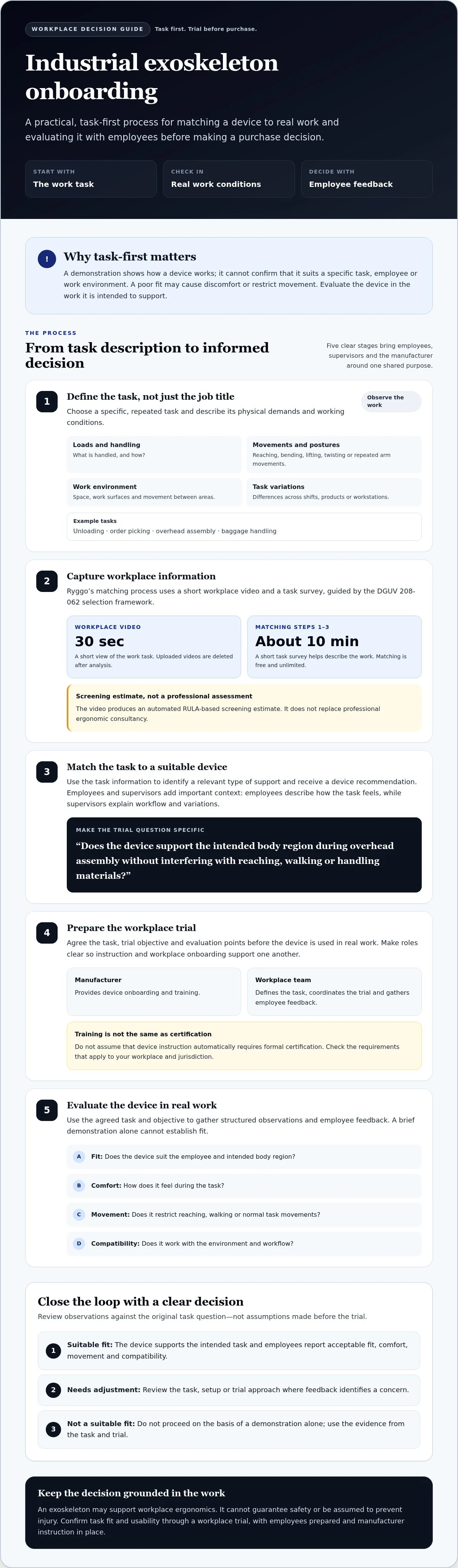
Choose a specific, repeated task, such as unloading, order picking, overhead assembly or baggage handling. Describe its demands: the loads handled, working postures, movement patterns, work pace and environmental conditions. Note whether employees move between stations, bend or reach frequently, or work in restricted spaces. The same job title can involve different physical demands in different workplaces, so observing the task is more useful than relying on the title alone.
This description helps the team identify what kind of support may be relevant and which movements need to remain comfortable and practical. It also gives the manufacturer a clear context for device instruction and gives employees a specific basis for feedback during the trial.
Set a realistic onboarding objective
Before a trial, agree on the question it should answer. For example: does the device support the intended body region during overhead assembly without interfering with reaching, walking or handling materials? Keep the objective specific to the task. Decide what the team will observe and ask employees about, including fit, comfort, movement and compatibility with the work environment.
Musculoskeletal disorders cost approximately €240 billion per year across the EU, according to EU-OSHA (2020). That figure does not show whether a particular exoskeleton suits a particular workplace. Fit and usability need to be assessed in the real task, with employees prepared to use the device and manufacturer instruction in place.
An exoskeleton can support workplace ergonomics, but it cannot guarantee safety or be assumed to prevent injury. Treat the trial as a way to assess whether the device suits the defined task. A task-first plan gives the workplace a practical basis to proceed, adjust the approach or decide that the device is not a suitable fit.
How to prepare an industrial exoskeleton onboarding process
A practical industrial exoskeleton onboarding process turns the task description into a focused trial plan. Keep the sequence simple: define the task, gather workplace information, receive one device recommendation, then agree how to evaluate it before the trial begins. This gives employees, supervisors and the manufacturer a shared purpose instead of leaving the device to speak for itself.
Capture task and workplace information
Ryggo’s matching process uses a 30-second workplace video and a short task survey guided by the DGUV 208-062 selection framework. The video-based RULA score is free, and video uploads are unlimited. Matching steps 1-3 take about 10 minutes, and uploaded videos are deleted after analysis. Give the survey practical detail so the recommendation can reflect the work:
- Loads: describe the materials or items handled and how they are handled.
- Movements: note reaching, bending, lifting, twisting or repeated arm movements involved in the task.
- Environment: record relevant constraints, such as available space, work surfaces and movement between work areas.
- Task variations: explain how the work changes across shifts, products or workstations.
Ask employees and supervisors to contribute. Employees can explain how the task feels and where movement is restricted; supervisors can describe the workflow and its variations. Use these accounts as input to check against the task itself, not as proof that a device will fit.
The video produces an automated RULA-based screening estimate. It is not a certified assessment and does not replace professional ergonomic consultancy. Use it as screening information to support selection, not as a conclusion about the task or the device.
Turn the recommendation into a trial plan
Ryggo provides one vendor-neutral recommendation based solely on fit across vendors. Before the trial begins, turn that recommendation into a clear question, such as whether the selected device supports the intended movement without disrupting the task. Agree on what employees and supervisors will observe and how they will record feedback. That way, the trial can provide evidence relevant to the purchase decision.
For help structuring the evaluation itself, consult Industrial Exoskeleton Trial Program: The Operational Guide to Pilot Success. You can also explore vendor-neutral exoskeleton matching when identifying a suitable option for your workplace.
Ready to find the right device for your operation?
Find my exoskeleton →Employee training and exoskeleton certification: what to clarify
Training, workplace onboarding and formal credentials are different things. A clear industrial exoskeleton onboarding process assigns each one to the right party, so employees know how to use the device and managers know what local requirements to check.
| Area | What it covers | Who to involve |
|---|---|---|
| Device-specific instruction | Fitting, adjustment, use, care and device limitations for the task. | The manufacturer and the employee. |
| Workplace onboarding | How the device fits the selected task, workplace procedures and the trial evaluation. | Workplace leads, supervisors and employees. |
| Formal credentials | Any credential or training requirement that applies to the workplace or jurisdiction. | The employer or relevant local authority, as appropriate. |
What device-specific training should cover
Manufacturers provide device onboarding and training, by video or on-site. Before employees use the exoskeleton during normal work, ask the manufacturer to explain how to fit and adjust it, how to use and care for it, and what limitations apply to the intended task. Employees should practise following the manufacturer’s instructions and raise discomfort or uncertainty before the workplace evaluates the device in routine conditions.
Clarify the service route as well. Manufacturers provide device service; Ryggo does not. Employees and supervisors should know whom to contact if the device needs attention during the trial.
Is a formal exoskeleton certificate required?
Do not assume there is one universal employee certificate or that a certificate is always required. Requirements may depend on the workplace and applicable local rules. Check with the relevant employer contacts and confirm the position for the jurisdiction before the trial. Keep a record of what was checked and any applicable instruction employees need to complete.
Manufacturer instruction covers how to use a particular device. It does not replace workplace procedures or professional ergonomic consultancy. Likewise, an automated RULA-based screening estimate from a workplace video is not a certification or a complete ergonomic assessment, and it does not replace professional ergonomic consultancy.
DGUV 208-062 provides guidance for exoskeleton selection. Use it to inform device selection while checking any separate workplace or jurisdiction-specific requirements. A guide titled DGUV 208-062 Framework: Standards-Based Exoskeleton Match may offer further context if available, but do not treat guidance as proof of a credential requirement.
How to evaluate employee onboarding during an exoskeleton trial
A trial should answer a workplace question, not validate a sales claim. Before employees begin, record a baseline for the selected task and decide what the team will observe. Choose practical indicators, such as whether employees can complete the required movements, whether the device interferes with other work equipment and whether the task can be performed as usual. Do not set an expected improvement without evidence to support it.
Collect useful feedback without overclaiming
Use a consistent feedback record throughout the trial. Ask employees to note fit, comfort, ease of movement and compatibility with the task. Record the task conditions and relevant manufacturer-provided instruction alongside their comments, so the feedback can be understood in context. Invite employees to report discomfort or restrictions promptly.
Keep participant feedback separate from operational data, such as task completion records. If both appear to change together, that alone does not show the exoskeleton caused the change. Consider whether the task, staffing or work conditions also differed. The evaluation should establish whether the device offers practical support in the actual work context, without claiming results beyond the evidence collected.
A workplace trial tests task fit and usability, not guaranteed outcomes.
Decide whether to keep or return the device
Deploy & Decide trials last 2, 4 or 8 weeks. At the end, review the original task question alongside employee feedback and relevant operational observations. If the evidence does not support the intended use, do not treat the trial as a failure of the onboarding process. It has identified a mismatch before purchase.
If the buyer proceeds to purchase, the full trial fee is credited toward it, so there is no double payment. If the trial is unsuccessful, the refund is up to 75% for a 2-week trial, 70% for a 4-week trial or 60% for an 8-week trial.
For further guidance on evaluating try-before-you-buy options, see Exoskeleton Try-Before-You-Buy Programs: A Buyer’s Guide. To assess suitable options for your workplace, compare exoskeletons and plan a trial.
How Ryggo supports a vendor-neutral industrial exoskeleton onboarding process
Vendor neutrality matters because a recommendation should follow the workplace task, not a commercial relationship. Ryggo is Europe’s first independent exoskeleton exchange, operating in 23 European countries under one set of commercial terms. It supports device matching, automated screening estimates and Deploy & Decide trial arrangements, helping buyers move from task information to a device they can evaluate before purchase.
Paid listings are not accepted. Recommendations are based solely on fit across vendors. This gives HSE, operations and procurement teams a clear basis for considering a suitable option, while the workplace remains responsible for assessing how the selected device performs in its own conditions.
What Ryggo does, and what manufacturers provide
Ryggo matches workplaces with suitable exoskeleton devices and provides one neutral recommendation based on fit. Its video output is an automated screening estimate, and its Deploy & Decide programme lets companies trial selected devices in their own operations. Matching supports selection, but it does not establish that a device is suitable for every task or employee. Workplace evaluation remains an important part of onboarding.
Manufacturers provide device delivery, onboarding, training and service. Ryggo does not physically distribute devices or provide their training or service. Keep those responsibilities clear in the trial plan so employees know where to get device-specific instruction and whom to contact about service.
Ryggo’s video output is an automated RULA-based screening estimate. It is not a certified assessment and does not replace professional ergonomic consultancy. Use it as screening information alongside workplace expertise and trial evidence, not as a stand-alone decision.
Move from task information to a fit-based trial
Start by describing the task you want to evaluate. Whether the work takes place in a warehouse, factory, retail store, construction site or healthcare institution, include the movements and practical constraints that matter. A specific task description helps connect a neutral recommendation to a focused trial question, such as whether the device supports the intended work without restricting necessary movement.
Use the recommendation to plan a trial with employees and the manufacturer, then review the evidence before deciding whether to purchase. Explore Ryggo’s independent exoskeleton exchange to submit workplace task information and identify a suitable option to evaluate.
Not sure which exoskeleton fits your task? Let the Ryggo advisor match it independently.
Find my exoskeleton →Make your next decision evidence-led
A practical industrial exoskeleton onboarding process starts with the task, prepares employees through manufacturer instruction and checks fit in real working conditions. Keep training distinct from formal credentials, and verify any requirements that apply to your workplace. Then assess employee feedback and task observations against a clear trial question, without assuming the device will deliver a particular result.
Ryggo’s matching steps 1-3 take about 10 minutes. The platform provides a vendor-neutral recommendation based solely on fit across vendors, helping your team identify an option to evaluate rather than relying on a product claim. If you proceed to purchase after a trial, the full trial fee is credited toward it.
Ready to assess an exoskeleton for your workplace task? Explore Ryggo’s independent exoskeleton exchange and take the next step toward a decision grounded in employee experience and workplace evidence. A focused trial can help your team move forward with greater clarity.
Frequently Asked Questions
How do you onboard employees to an industrial exoskeleton?
Start by identifying the task and the ergonomic question the trial should answer. Gather details about loads, movements and the work environment, then select a suitable device and arrange manufacturer-provided instruction. Prepare employees to use the device according to that instruction, and evaluate fit, movement and feedback during a workplace trial. Keep the process task-specific: a device or training approach that suits one role may not suit another.
Do employees need certification to use an industrial exoskeleton?
Do not assume there is a universal certification requirement for industrial exoskeleton use. Requirements may depend on the workplace and applicable local rules, so confirm them with the relevant employer contact or authority before implementation. Manufacturers provide device onboarding and training. Ryggo’s automated RULA-based screening estimate is not a certified assessment and does not replace professional ergonomic consultancy or any workplace procedures that apply.
Who provides industrial exoskeleton training?
The device manufacturer provides onboarding and training, which may be delivered by video or on-site. Employers should clarify how this instruction fits their workplace onboarding and task procedures. Ask the manufacturer to explain device-specific fit, adjustment and use, and make sure employees know where to direct service queries. Ryggo supports device matching and trial arrangements; manufacturers provide device delivery, training and service.
How long does exoskeleton matching take with Ryggo?
Ryggo’s matching steps 1-3 take about 10 minutes. The process uses a 30-second workplace video and a short task survey covering work demands such as movements, loads and the environment. Ryggo provides one neutral recommendation based solely on fit across vendors. The video produces an automated RULA-based screening estimate, and uploaded videos are deleted after analysis.
Are RULA scores from an exoskeleton onboarding video certified assessments?
No. Ryggo’s video output is an automated RULA-based screening estimate, not a certified assessment. The RULA categories are 1-2 negligible, 3-4 low, 5-6 medium, and 7 high. The estimate can support initial screening and help inform device selection, but it does not replace professional ergonomic consultancy or a task-specific assessment by an appropriate professional. Treat it as one input, not a final determination.
How long can an industrial exoskeleton trial last?
Deploy & Decide trials last 2, 4 or 8 weeks. If a trial is unsuccessful, the refund is up to 75% for a 2-week trial, 70% for a 4-week trial or 60% for an 8-week trial. If you proceed to purchase, the full trial fee is credited toward it, so there is no double payment.
Does an exoskeleton trial prove that a device will prevent injuries?
No. A trial helps your workplace assess task fit, employee experience and whether the device supports ergonomics in that specific operation. It cannot guarantee injury prevention or establish that risk has been removed. Set a clear evaluation question, record relevant observations and consider the results in the context of the task and working conditions. Do not treat one trial’s findings as universal claims about other workplaces.
Find the right device before you trial anything
The Ryggo advisor maps your task, environment, and requirements to compatible devices — independently, across the full European market.
Find my exoskeleton →