Key Takeaways
- Assess how an exoskeleton fits the task, worker, clothing and protective equipment, not just how much assistance it appears to provide.
- Use a workplace trial to observe comfort, movement and task compatibility under real operating conditions.
- Define success measures before testing, including worker feedback, task performance, ergonomics and operational impact.
- Evaluate potential strain reduction alongside any effects on productivity, workflow and return on investment.
- Use vendor-neutral recommendations and device comparisons to narrow options before deciding whether to adopt.
Table of Contents
- Definition and purpose of occupational exoskeletons
- Ergonomics, comfort, and range of motion
- Injury reduction, productivity, and return on investment
- What is an exoskeleton proof of concept (POC)?
- What goals and success metrics should an exoskeleton POC define?
- Ryggo: Healthcare exoskeleton matching
Definition and purpose of occupational exoskeletons
In a shipyard, an occupational exoskeleton is a wearable support designed to assist workers during specific physical tasks. It may transfer or redistribute some loads through a frame, joints, straps or mechanical elements. The purpose is to support ergonomics during movements such as sustained overhead work, rather than replace safe work design or remove risk. A proof of concept asks whether that support fits the job in practice.
Wearable exoskeletons are worn on the body and move with the user. Their design can support the back, shoulders, arms or legs, depending on the task. For example, a shoulder-support device may suit repeated overhead fastening, while a back-support design may be considered for frequent bending. The task, movement and worker all matter: a device that assists one posture can restrict another.

Occupational exoskeleton design ranges from passive mechanical systems to powered technologies. Passive models use elements such as springs to store and return energy during movement. Powered models use actuators, including electric, hydraulic or pneumatic systems, to provide assistance. In a POC, compare these types against the actual shipyard task, including the movements workers need to perform and the work conditions they encounter.
Passive systems provide mechanical assistance without powered actuators, while powered systems use actuators to deliver support. Neither type is automatically better. Test whether the assistance helps the target movement without impeding other required actions, such as reaching, turning or handling tools.
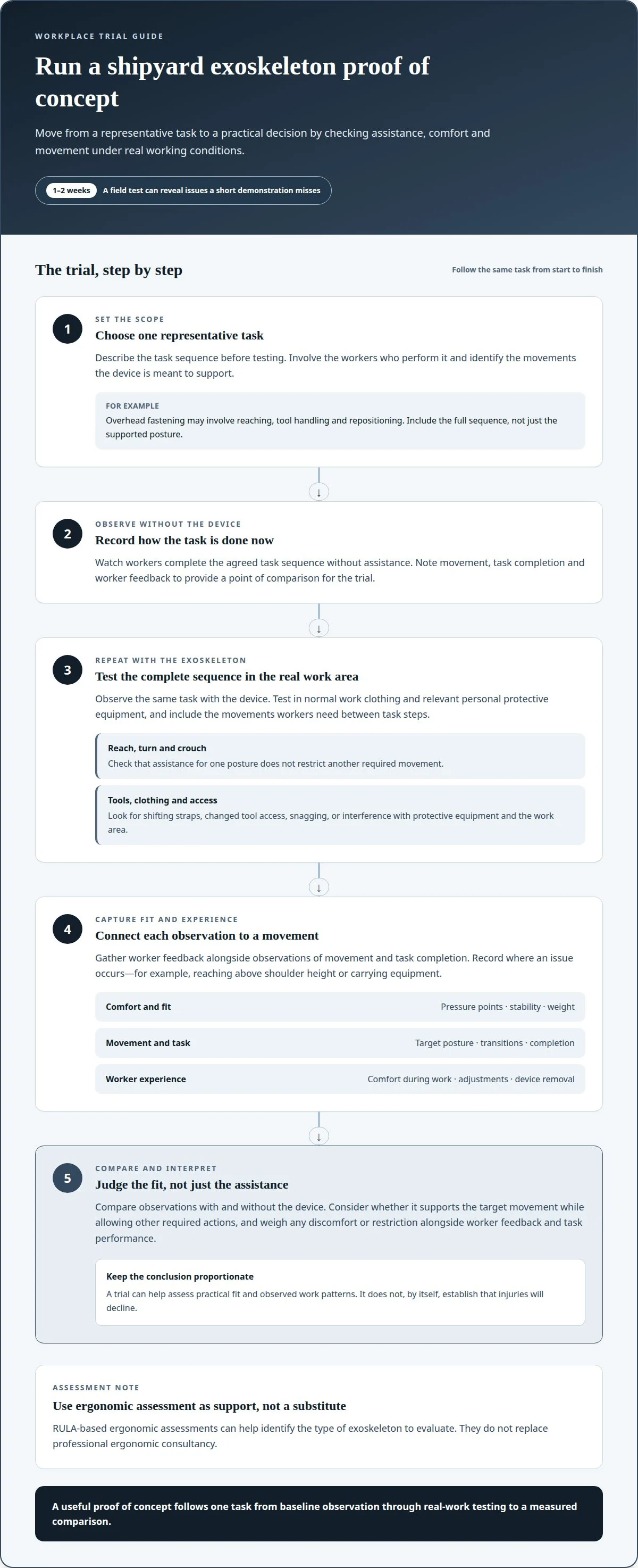
Shipyard work makes task-specific assessment essential. A worker moving beneath a hull may need to crouch, turn and stand; a worker fitting equipment overhead needs shoulder movement and tool control. The exoskeleton should allow these actions without interfering with protective clothing, personal protective equipment or access to the work area. Record the task sequence before testing, then observe each movement with and without the device.
POCs commonly fail when teams choose a device before defining the task, test only a brief demonstration, or overlook worker comfort and movement. Avoid those errors by selecting a representative shipyard task, involving the workers who perform it, and recording agreed measures before the trial begins. Judge the device by fit, assistance and task compatibility, not by appearance or novelty.
Ergonomics, comfort, and range of motion
Scope the trial around one representative shipyard task, then assess fit, assistance and movement during that work. Agree the task, participants and observations before field testing begins.
Ergonomic assessment and field testing
An ergonomic assessment examines how a device interacts with the worker, task and working environment. Field testing then shows whether that fit holds during real operations. In a shipyard, observe a complete task sequence, such as overhead fastening followed by tool handling and repositioning. A field test lasting 1 to 2 weeks can reveal issues that a short demonstration misses.
Comfort and range of motion
Comfort and range of motion describe whether workers can wear the device and complete required movements without avoidable interference. Check pressure points, stability and device weight during repeated work, not only during fitting. A shipyard worker may need to reach overhead, turn around a structure, crouch and step across uneven surfaces. The device should support the target movement while allowing these transitions.
Ergonomics and injury reduction
Ergonomics considers how work demands affect the body; an exoskeleton may support a posture or movement linked to physical strain. That support does not establish that injuries will decline. Compare observed work patterns and worker feedback before and during the trial. For example, note whether shoulder support changes overhead posture, while also recording discomfort or restricted motion.
Clothing and protective equipment are part of the fit assessment. Test the exoskeleton with the coveralls, gloves, harnesses and other equipment workers use for the task. Check whether straps shift, access to tools changes, or the device catches on nearby structures. Repeat the assessment in the actual work area, where confined access and changing positions can affect fit.
Assess weight and mechanical assistance together. A device may support a posture but feel burdensome during walking, bending or moving between workstations. Ask workers about comfort during task transitions, then observe whether they adjust or remove the device. Record each issue against a specific movement, such as reaching above shoulder height or carrying equipment.
For a practical trial, define the target task and observe workers completing it without assistance, then repeat it with the device. Include normal work clothing and relevant site conditions, such as wet or dusty areas. Collect worker feedback alongside observations of movement and task completion. RULA-based ergonomic assessments can help identify the type of exoskeleton to evaluate; they do not replace professional ergonomic consultancy.
Continue by asking workers whether the fit remains comfortable for an entire workday in their expected conditions; proper fit is important for both comfort and effectiveness. Ask vendors for case studies or specific data on whether their exoskeletons reduce workplace injuries, and treat those claims separately from observations made during the trial.
Injury reduction, productivity, and return on investment
A shipyard proof of concept should test whether an exoskeleton supports ergonomics without disrupting work. It cannot establish that a device prevents injury. Treat reduced strain as a question to evaluate, then compare worker feedback and task observations before deciding whether adoption makes operational sense.
To make a decision about one task, examine its physical demands, how often workers perform it, and whether the device supports the relevant posture or movement.
Measure injury-related indicators carefully. During the trial, record task-specific discomfort, reported strain and any difficulties using the device. Compare these observations with the same work performed without it, accounting for differences in task conditions. Changes in worker feedback can inform an ergonomics decision, but they do not prove that injury rates will fall.
Productivity needs its own measures. For example, observe whether a worker can perform overhead fastening at the usual pace while maintaining tool access and work quality. Note delays caused by adjusting the device, changing posture or moving between work areas. A device that supports one activity but slows the next may not improve overall workflow.
Use a consistent comparison. Record the same task sequence, work conditions and output measures with and without the exoskeleton. Include worker feedback alongside task completion, movement restrictions, pauses and any changes in quality. This gives HSE and operations teams evidence about practical effects, rather than relying on a demonstration or a single productivity measure.
ROI depends on how the device fits the operation, not on a general productivity claim. The assessment can consider purchase cost, training, onboarding, device use, task frequency and measured operational effects. Do not count hypothetical injury savings as realised returns. Separate observed outcomes from assumptions, then show decision-makers how each assumption affects the business case.
For example, a shipyard could assess a device for repeated overhead assembly. The team can compare comfort, task completion and workflow disruption, then decide whether the observed support justifies further evaluation. If the device changes how workers perform other tasks, include those effects rather than viewing the target activity in isolation.
A sound adoption decision balances ergonomics, operational performance and cost. Increased output alone is not enough if workers report discomfort or movement becomes restricted. Likewise, perceived support alone does not establish a return on investment. Use the findings to decide whether to proceed, adjust the task or reject that device for the application.
Ready to find the right device for your operation?
What is an exoskeleton proof of concept (POC)?
An exoskeleton proof of concept (POC) is a time-bounded evaluation designed to support a specific adoption decision. It differs from a demonstration because the outcome is not simply whether a device can be worn or switched on. The team defines what evidence would justify further investment, then records whether the trial produced it. An exoskeleton proof of concept guide should make this decision purpose clear from the outset.
A POC is narrower than a full deployment. It tests an operational proposition, such as whether a support device can fit into an existing work process without unacceptable disruption. The result applies to the tested use case, not automatically to every role, site or device. Defining that boundary prevents a positive result in one application from becoming a blanket adoption claim.
The value of a POC comes from a traceable decision process. Before reviewing outcomes, clarify which observations count as evidence, who evaluates them and how conflicting findings will be handled. For instance, positive feedback from some users should not obscure a recurring issue that materially affects work. An exoskeleton proof of concept guide can help keep those decision rules explicit.
- Frame the decision. State what the organisation needs to decide, such as whether to continue evaluation or stop consideration of the device.
- Set evidence boundaries. Distinguish direct observations and participant feedback from assumptions about future benefits.
- Review findings. Bring operational, HSE and procurement perspectives together, and note where their interpretations differ.
- Record the outcome. Document the decision, its supporting evidence, unresolved questions and any conditions for a next phase.
A POC outcome can be positive, negative or inconclusive. A positive result supports a decision to advance, but does not prove every future deployment will perform identically. A negative result can prevent commitment to an unsuitable option. An inconclusive result means the available evidence does not yet support either decision.
Make the final record useful beyond the trial team. Include the decision rationale, evidence reviewed and limitations that shaped the conclusion. For example, if the evaluation covered one operation only, state that the finding applies to that application. This makes later procurement discussions more transparent and reduces the risk of treating a local result as universal.
The POC is complete when decision-makers can explain what they learned and what follows. That may mean moving forward, ending consideration or commissioning a different evaluation. A clear record turns the trial from a temporary experience into an accountable step in the organisation’s adoption process.
What goals and success metrics should an exoskeleton POC define?
Set success criteria before the shipyard trial starts. Otherwise, teams may judge the device by impressions rather than evidence. Choose measures that connect the intended ergonomic support with task performance, worker experience and operational fit. Each measure should help answer a decision question: proceed, refine the use case or stop.
Start with the physical demand the POC targets. For overhead installation, the goal might be to support workers during sustained arm elevation. Record whether the device supports that posture, whether workers can complete required movements, and whether its weight creates additional effort. Assistance has value only when it fits the work.
Set measures across four areas:
- Task compatibility: Can workers perform required actions without device interference, including reaching, turning and handling tools?
- Worker experience: What do users report about comfort, pressure, fatigue and confidence during the task?
- Operational performance: Does task completion, work quality or workflow change while the device is worn?
- Practical deployment: Can the device fit the intended work clothing, task sequence and operating conditions?
For each measure, define how the team will collect evidence. A supervisor might record task completion and workflow interruptions, while workers report discomfort or restricted movement after using the device. Keep the task and observation method consistent between work without assistance and the trial. This makes the comparison more useful than relying on memory or a single demonstration.
Separate outcomes from assumptions. If the team hopes to reduce strain, record relevant observations and worker feedback; do not present them as proof of injury prevention. If the business case depends on increased productivity, specify which output or workflow measure matters. Then capture training, onboarding and operational requirements that could affect wider use.
Define thresholds before reviewing results. For example, the team may decide that repeated interference with tool access means the tested configuration fails, even if workers report support in one posture. A clear threshold keeps favourable impressions from outweighing a material limitation. It also gives procurement and HSE a shared basis for a decision.
Include deployment capacity in the decision if wider adoption is under consideration. Assess whether the solution can support a larger deployment, while retaining the same task fit and evaluation criteria. A successful trial with one worker does not automatically establish suitability for a larger group.
Use the agreed measures to compare options and quantify operational impact. A vendor-neutral exoskeleton comparison can help connect task fit with ROI calculations before a purchase decision.
Not sure which exoskeleton fits your task? Let the Ryggo advisor match it independently.
Ryggo: Healthcare exoskeleton matching
Ryggo helps organisations turn POC findings into more informed device decisions through AI-powered recommendations, vendor-neutral comparisons and ROI calculations. For hospitals and clinics, healthcare exoskeleton matching can help identify options suited to specific work demands. The same principle applies to shipyard teams: match the device to the task, then evaluate fit before adoption.
Ryggo’s Deploy & Decide trial programme lets companies try exoskeletons before purchasing. It gives teams a practical way to assess whether a recommended device supports the intended work and meets the success measures defined for the POC. Vendor-neutral comparison and ROI calculations can then help structure the next procurement decision.
If you’re assessing exoskeletons for a shipyard, hospital or clinic, contact Ryggo to discuss your requirements.
Turn the trial findings into a clear decision
An exoskeleton proof of concept guide is most useful when it leads to a decision, not simply a completed trial. Use the findings to identify which tasks suit the tested device, where adjustments are needed and what should happen next. If the evidence is mixed, narrow the use case or compare another device before committing to wider adoption.
Ryggo can support the next step with AI-powered device recommendations, vendor-neutral comparisons and ROI calculations. Its Deploy & Decide trial programme lets organisations try exoskeletons before purchase, while comparison helps connect workplace fit with procurement priorities. The goal is a decision grounded in task requirements and trial evidence, not assumptions about what a device should achieve.
Discuss your requirements and possible next steps with Ryggo’s exoskeleton team. A focused evaluation can help you move forward with greater clarity and confidence.
Frequently Asked Questions
Is there anything I should be aware of when using an exoskeleton?
Yes. Check that the device suits the task and works with required protective equipment. In a shipyard, a harness, gloves or tool belt may affect fit or movement. Workers should know how to put on, adjust and remove the device, and when to stop using it if it restricts a task. Treat the exoskeleton as ergonomic support, not a substitute for established risk controls.
What safety risks and human-factors issues should an exoskeleton POC assess?
Assess whether the device catches on structures, restricts access, shifts during movement or creates pressure points. Consider fatigue, heat, comfort, task transitions and whether workers can reach controls or tools. For example, observe a worker moving between overhead work and a low access point. Record discomfort and near-interference as well as task completion, then use the findings to decide whether the tested use is suitable.
How should an exoskeleton POC recruit participants and collect performance data?
Include workers who regularly perform the target task, reflecting relevant experience and working methods. Explain the trial’s purpose and collect feedback directly from participants, not only supervisors. Record a baseline without the device, then use the same task conditions to note completion, interruptions, movement restrictions and comfort during use. Keep observations anonymous where practical so workers can report problems candidly.
How long should an exoskeleton POC run, and how do you evaluate its results?
Choose a trial period of 2, 4 or 8 weeks according to the task and the evidence needed. A longer period can capture varied work cycles and changing conditions. Evaluate results against criteria agreed beforehand, such as comfort, task compatibility and workflow effects. Separate worker-reported experience from observed performance, and document whether the evidence supports adoption, a narrower use case or stopping the evaluation.
What vendors offer exoskeletons for pilot programmes, and how can they be compared?
Suitable exoskeletons depend on the support type and task, such as back assistance for repeated bending or shoulder support for overhead work. Compare devices using consistent criteria: task fit, movement, comfort, compatibility with protective equipment and operational impact. Ryggo provides vendor-neutral device comparisons and Deploy & Decide trials, helping organisations evaluate options in their own work before purchase.
Find the right device before you trial anything
The Ryggo advisor maps your task, environment, and requirements to compatible devices — independently, across the full European market.