What assembly line exoskeletons do and where strain starts
These are the tasks that feed musculoskeletal disorders (MSDs). For an operations director, MSDs show up as sick leave, turnover and difficulty keeping experienced operators. They are more than an ergonomics statistic.
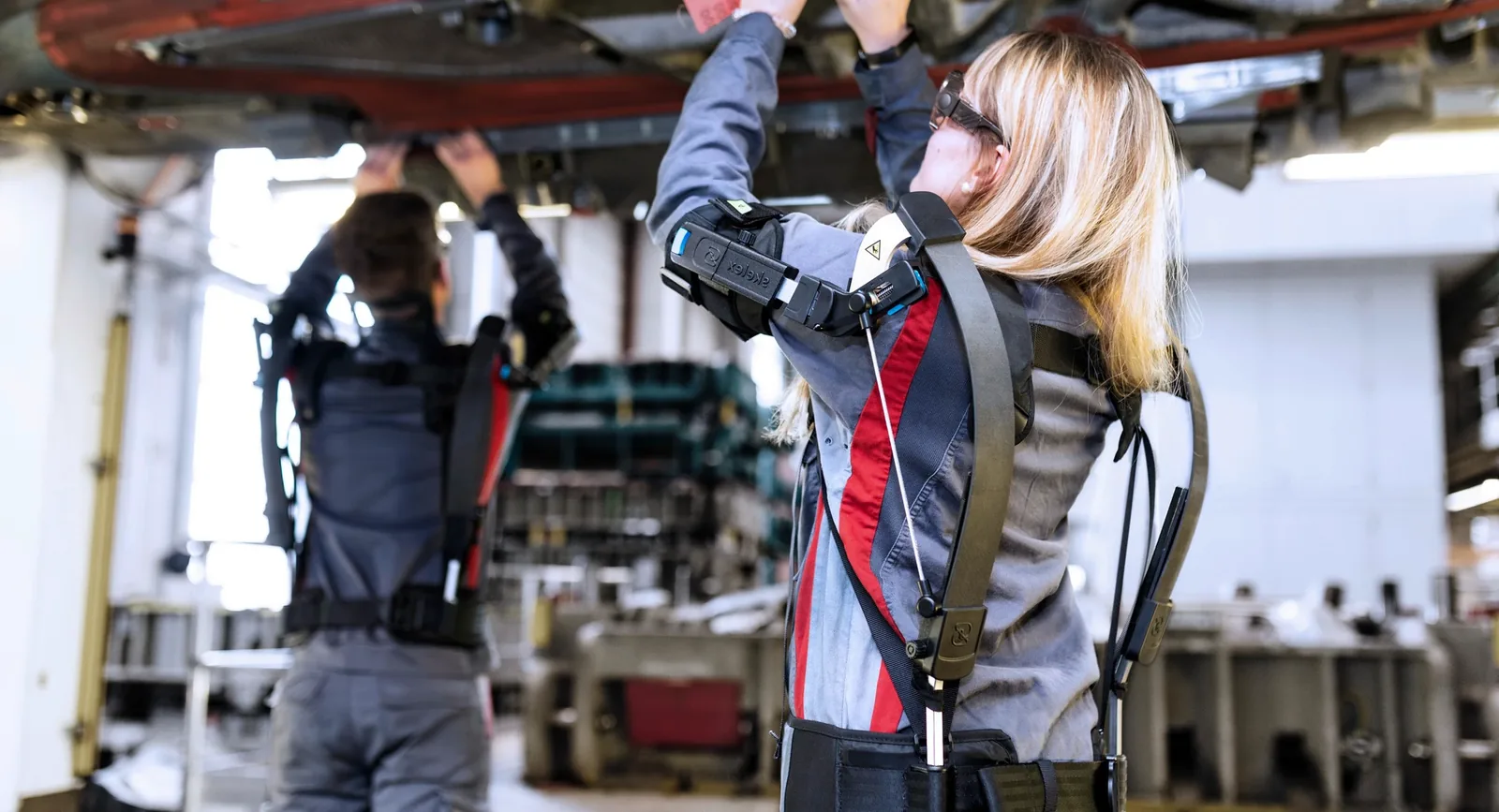
Devices fall broadly into two groups, defined by the body region they support. Shoulder and arm exoskeletons help with work at or above shoulder height, typical of body-in-white, door fitting or underbody work. Back-support devices help with lifting and trunk flexion, which is more common in material handling around the line, kitting and end-of-line loading. Knowing which region your operators actually overload is the first step, because a device that supports the wrong region won't help.
The simplest way to find out is to look at the work itself. Ryggo offers a free ergonomic analysis from a 30-second video that scores a task using RULA. You get a task-level picture of where the load sits before you shortlist anything.
Passive vs active devices: matching the tool to the task
The choice between passive and active devices is the most consequential specification decision. Passive exoskeletons have no motors. According to IAexplore's overview of industrial exoskeletons, they rely on springs, coils and dampers to redistribute weight, while active devices use electric or hydraulic actuators and sensors.
For most exoskeletons for assembly line workers, passive devices are the practical default. They're lighter, need no charging, and go on and off quickly, which matters when operators rotate between stations or share equipment across shifts. Their support is mechanical and predictable, which suits repetitive, well-defined postures such as holding the arms overhead for a fixed cycle. Active devices can offer adjustable or sensor-driven assistance, which may suit variable loads or tasks where the support needs to change. They also bring extra weight, batteries and maintenance.
Task fit matters more than the technology label. Before choosing, ask:
- Is the main strain overhead work, forward bending, or repeated lifting?
- How long is each work cycle, and how often does the operator move between stations?
- Does the worker need unrestricted walking, crouching or reaching into confined spaces?
- Will several people share each device, and do they differ widely in body size?
You can browse the full range of listed exoskeletons by body region and type, and the Exo Advisor recommends a back or shoulder device based on the operation you describe. Because Ryggo is vendor-independent, the comparison isn't weighted toward one manufacturer's range.
Ready to find the right device for your operation?
What the evidence shows on strain, productivity and comfort
The research on exoskeletons for assembly line workers is encouraging on strain reduction, but it is specific and, in places, mixed. Read it carefully rather than assuming a device will help every body region or every task.
On strain, a field study of a passive shoulder exoskeleton in automotive assembly with 16 workers found that the device may reduce shoulder muscle and joint loading during overhead work. The authors also noted that shoulder flexion and abduction angles increased, which is why fit and task-specific setup matter. A separate ergonomics assessment of passive upper-limb exoskeletons in an automotive assembly plant, covering 12 workers, found reduced deltoid and trapezius muscle activity but no effect on the erector spinae and latissimus dorsi. The lesson: a shoulder device helps the shoulder, and you shouldn't expect it to relieve the back.
On productivity, the picture is murkier. A systematic review of quality, productivity and economic implications of occupational exoskeletons concluded that the evidence is mixed. In manual assembly it found no significant change in completion time for some tasks, and a slower time for a screwing task at shoulder height. The sound expectation, then, is that exoskeletons are primarily a strain-reduction tool. Measure any productivity benefit on your own line rather than assuming it.
Comfort and acceptance sit alongside the biomechanics. A poorly fitting device will stay in the locker whatever the research says. A device that reduces load in the lab but is rejected on the floor delivers no benefit, which is why the trial stage matters so much.
EU regulation and compliance checks before you buy
Regulation is where buyers most often hit uncertainty, because the legal category of industrial exoskeletons hasn't been settled in a single, uniform way.
The product-side question is which rules a device falls under, and sources disagree. The Federation of the European Ergonomics Societies notes that exoskeletons used at work are often certified with a CE mark under the Medical Devices Regulation, although by definition they arguably belong under the PPE regulation.
Given that ambiguity, a sensible procurement approach is to ask for documents rather than rely on assumptions:
- The declaration of conformity and the CE marking, and the regulation it was issued under.
- The intended use stated by the manufacturer, and whether it covers your task and posture.
- User instructions covering fitting, adjustment, cleaning and maintenance.
- Any risk assessment or test data the vendor can share for comparable tasks.
Your own health and safety function should also fold the device into the workplace risk assessment, since introducing a wearable changes how the task is performed. Confirm the classification with the vendor and, where needed, your notified body or legal adviser before you commit to a purchase.
Not sure which exoskeleton fits your task? Let the Ryggo advisor match it independently.
Running a workplace trial and measuring success
A trial in your own plant is the most reliable way to learn whether an exoskeleton for assembly line workers suits your people and your tasks. Lab results and other companies' pilots show what's possible; only your line shows what happens with your operators, your cycle times and your layout. The try-before-you-buy approach exists to make that step low-risk.
Ryggo's Deploy & Decide programme lets you test any listed device for 2, 4 or 8 weeks. You pay a test fee when you order, and the balance is invoiced only if you keep the devices. How a Ryggo order works sets out the steps, and the article on the cost of exoskeleton trials explains what a trial costs.
To make a trial conclusive, define success before it starts. A workable set of measures includes:
- Baseline and follow-up RULA scores for the target tasks, using the free video analysis.
- Perceived exertion and discomfort, collected from operators through short, consistent questionnaires.
- Task time and quality, so you can see whether the device helps or hinders output.
- Wear time and willingness to keep using it, which is the clearest signal of real acceptance.
- Operator feedback on fit, heat, mobility and ease of putting on.
Choose a representative group, including different body sizes, and run the trial long enough for the novelty to wear off. A two-week pilot may capture little more than the adjustment period; longer trials show whether comfort and benefit hold across full shifts.
Building the business case and moving beyond pilot purgatory
A strong business case links the device to costs you already track. For an exoskeleton for assembly line workers, that typically means sickness absence linked to MSDs, turnover and retraining costs, and the cost of ergonomic problems on particular stations. Keep the claims modest. The evidence supports reduced muscle and joint loading for specific body regions, while productivity gains are mixed. Build the case on strain reduction and retention, and treat any output gain as a bonus to be confirmed by your own data. The payback period guide walks through how to calculate ROI on ergonomic improvements, and Ryggo's pricing page outlines the options.
Pilot purgatory, where a promising trial never turns into a decision, usually comes from unclear criteria and no owner. To avoid it:
- Agree the success thresholds with operations, HSE and finance before the trial begins.
- Name one owner responsible for the go or no-go decision and its date.
- Involve operators early, so the rollout is something they've helped shape rather than something imposed.
- Plan the scale-up, including how many devices, which stations, and how sizing and hygiene will be handled, before the pilot ends.
Ford's experience shows what scale is possible: after testing in two Michigan vehicle assembly plants, it extended exoskeleton vests to employees in 15 factories across seven countries. Your rollout will be smaller, but the principle holds. Test, measure against agreed criteria, decide, and then scale the version that worked.
Find the right device before you trial anything
The Ryggo advisor maps your task, environment, and requirements to compatible devices — independently, across the full European market.