Key Takeaways
- Build your exoskeleton deployment strategy around the task’s physical demands and operating context, not a device shortlist.
- Use DGUV 208-062 to guide a structured path from task definition and fit assessment to trial and decision.
- Evaluate options in real working conditions, paying attention to movement, setup, worker feedback and workflow fit.
- Keep the initial evaluation separate from any later decision to expand to other tasks or teams, with clear ownership across stakeholders.
- Set decision criteria before a workplace trial, then use the findings to decide whether to proceed, adapt the use case or stop.
Table of Contents
- Why an exoskeleton deployment strategy must start with the task
- Build an exoskeleton selection pathway around DGUV 208-062
- Compare deployment approaches by fit, usability and decision value
- Plan a controlled rollout without confusing a pilot with scale
- Use Deploy & Decide for exoskeleton decisions
Why an exoskeleton deployment strategy must start with the task
An exoskeleton deployment strategy is a staged decision process, not a device rollout. First identify a task where additional ergonomic support may be relevant. Then define what needs to be assessed, compare suitable options and validate fit in the workplace before deciding whether to proceed. Starting with a preferred device reverses that logic and risks trying to make the task fit the equipment.
Describe the work as it happens, not just by job title. Record the postures, reaches, loads, repetitions and time spent on the task. Note the pace, available space, movement between task stages and any interaction with tools or equipment. An exoskeleton may support ergonomics and reduce strain, but suitability depends on the task and wearer. A workplace trial is needed to evaluate that fit in practice.
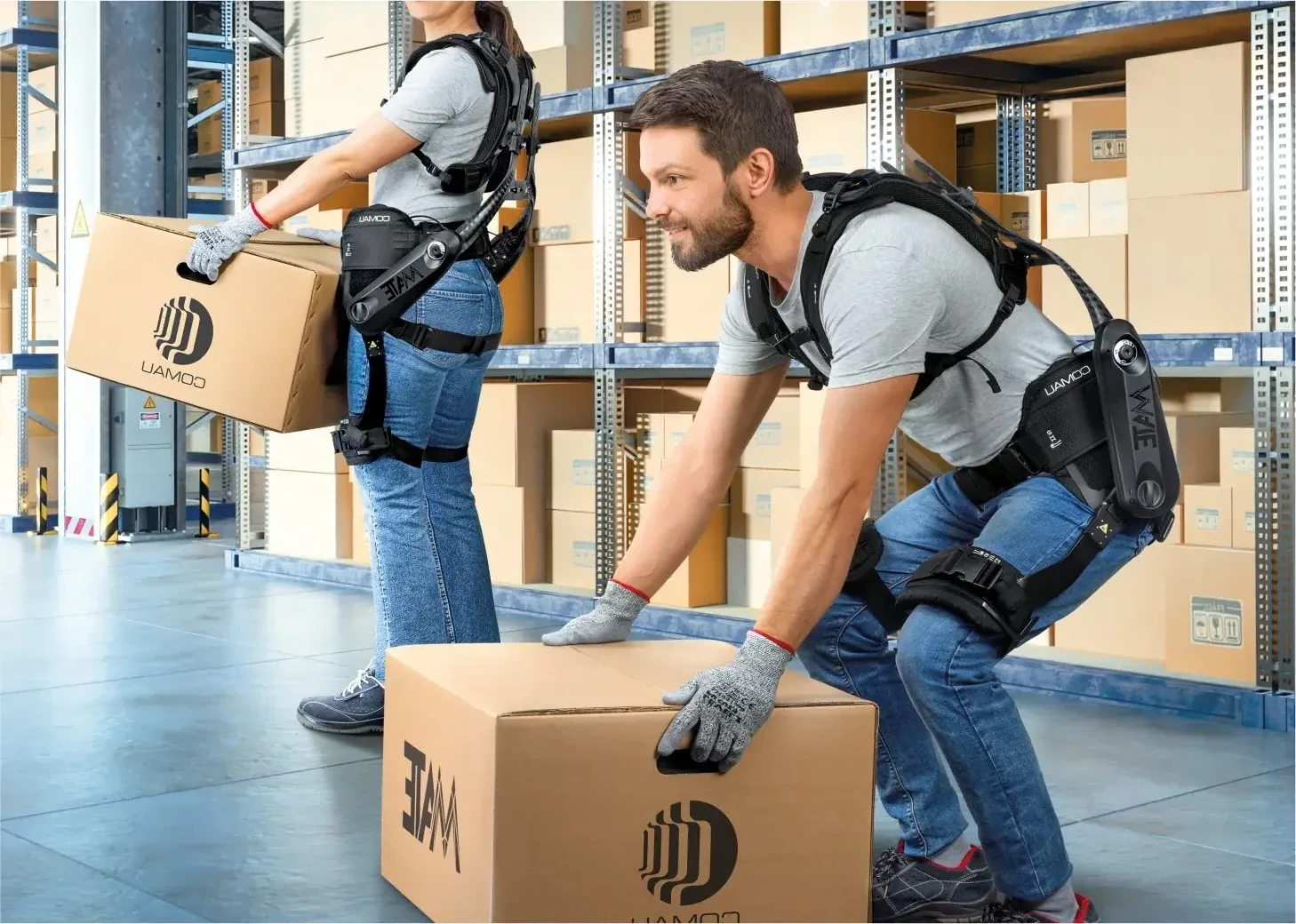
Start with the physical work, not a preferred device
Order picking, overhead assembly, baggage handling and patient handling can all involve physical demands, but the tasks are not interchangeable. Order picking may involve reaching at different heights while moving between locations. Overhead assembly can require sustained arm elevation, while patient handling involves a changing environment and coordinated movement. These examples help define what to observe; they do not, on their own, determine which body region needs support.
Separate observed demands from assumptions. Note when a posture occurs, how often it is repeated, whether the task involves carrying or lifting, and which movements must remain unrestricted. Include variations across shifts: product mix, staffing, work pace and task rotation can all change the movement pattern and how practical a device feels. A device that suits one task segment may be cumbersome during another.
Set a realistic deployment objective
Set an objective that can be assessed. For example, determine whether an exoskeleton supports the target posture, remains usable through the relevant task cycle and fits the workflow without unacceptable disruption. Do not define success as guaranteed injury prevention. Musculoskeletal disorders cost the EU €240 billion annually (EU-OSHA). This figure illustrates the scale of the ergonomics challenge, not the results a particular device will deliver.
Task-led deployment means matching an exoskeleton to a defined job demand, then checking its fit in real work before deciding whether to buy or expand its use. Before an evaluation begins, agree on the decision it must inform: proceed, adapt the task or stop. A general overview of exoskeletons and their applications can provide background, but operational suitability must be judged against the work itself.
Make the evaluation useful by recording the task and conditions before the trial. Include worker feedback alongside observations of movement and workflow. This gives HSE, operations and procurement a shared reference for discussing fit, rather than relying on first impressions or device specifications alone.
Build an exoskeleton selection pathway around DGUV 208-062
A repeatable selection pathway keeps the decision tied to the work. Use DGUV 208-062 as guidance for evaluating whether an exoskeleton is appropriate, then move through a clear sequence: define the task, capture its requirements, assess device fit, trial a suitable option and decide whether to proceed. Each step should answer a specific question, so the organisation can see what the evidence supports and where further evaluation is needed.
This structure also keeps screening and selection in perspective. A screening result can help indicate which type of support may be relevant, but it is not a substitute for professional ergonomic judgement or workplace validation. The exoskeleton deployment strategy should give HSE, operations and workers a shared basis for moving from an initial indication to a practical decision.
Capture task and workplace requirements
Start with information that describes the task, rather than asking workers to select a device. Ryggo Advisor uses a short workplace video and task survey to capture work context, including movements, loads and the environment. The video produces an automated RULA-based screening estimate. It is not a certified assessment and does not replace professional ergonomic consultancy. Uploaded videos are deleted after analysis.
Steps 1-3 of the matching process take about 15 minutes, and video uploads are free and unlimited. Use the survey to add context the video may not show, such as how the task changes during a shift or what movements workers must perform between task cycles. The result is a starting point for selection, not a final verdict on suitability.
Move from requirements to one recommendation
Once the work requirements are captured, compare them with device characteristics and the demands of the task. Ryggo’s recommendation is based solely on fit across vendors. Paid listings and vendor sponsorship are not accepted. This gives procurement and operations a consistent starting point for comparing options, while leaving the final decision dependent on workplace evaluation.
Use the recommendation to identify what to examine during a trial: whether the device supports the target movements, feels usable through the task cycle and fits the workflow. A vendor-neutral exoskeleton evaluation can keep those criteria connected to operational requirements rather than brand preference. The next step is a workplace trial, where workers and managers can assess fit under the conditions the device is intended to support.
For organisations ready to move from task information to a fit-based recommendation, Ryggo Advisor provides a route into the selection process. The recommendation narrows the decision; the trial helps determine whether the device suits the work, and the organisation decides whether to scale its use.
Ready to find the right device for your operation?
Find your exoskeleton →Compare deployment approaches by fit, usability and decision value
Each route to an exoskeleton decision provides a different level of evidence. Desk research can narrow options, and a demonstration can show how a device is worn. Neither necessarily shows how it fits the target task over a working shift. A structured workplace trial lets workers and decision-makers evaluate practical use under the conditions that matter.
Compare the approaches against the same questions. The table shows what each can help you learn and where evidence may remain limited.
| Approach | What it can show | Evidence to consider |
|---|---|---|
| Buy after desk research | How stated specifications appear to match the task requirements. | Limited evidence of movement compatibility, setup burden, worker acceptance or workflow disruption during actual work. |
| Single-device demonstration | How the device is fitted and used in a short, guided example. | A promising demonstration may not reflect task variation, shift patterns or sustained use in the workplace. |
| Structured workplace trial | How the selected device interacts with the target task and operating conditions. | Worker feedback and operational observations can inform a decision to proceed, adapt the use case or stop. |
This is not a ranking of routes. The right level of evaluation depends on the decision you need to make. A specification comparison can screen options, but it cannot establish how a device feels during repeated movements or whether wearing and removing it fits the job’s rhythm. A demonstration is useful for initial familiarisation, but it should not be mistaken for evidence of sustained operational fit.
Compare options against the real operating context
Evaluate the operating conditions that could affect usability: shift patterns, task rotation, available space and interaction with existing equipment. Observe whether workers can put on and take off the device without interrupting the job or changing the workflow. A device that appears suitable in an isolated demonstration may be less practical when workers move between tasks or work areas.
Use a consistent record for each observation. Note the task being performed, the movement involved, any setup difficulty and what workers report. This makes it easier to distinguish a device-specific issue from a mismatch between the device and task conditions.
Make the decision criteria visible before testing
Agree in advance what evidence would support proceeding, adapting the use case or stopping. Include worker feedback alongside observations of task completion and workflow, without treating positive feedback as a guarantee of ergonomic benefit. A try-before-you-buy exoskeleton evaluation can help gather evidence before purchase and assess the result against criteria set for the target work.
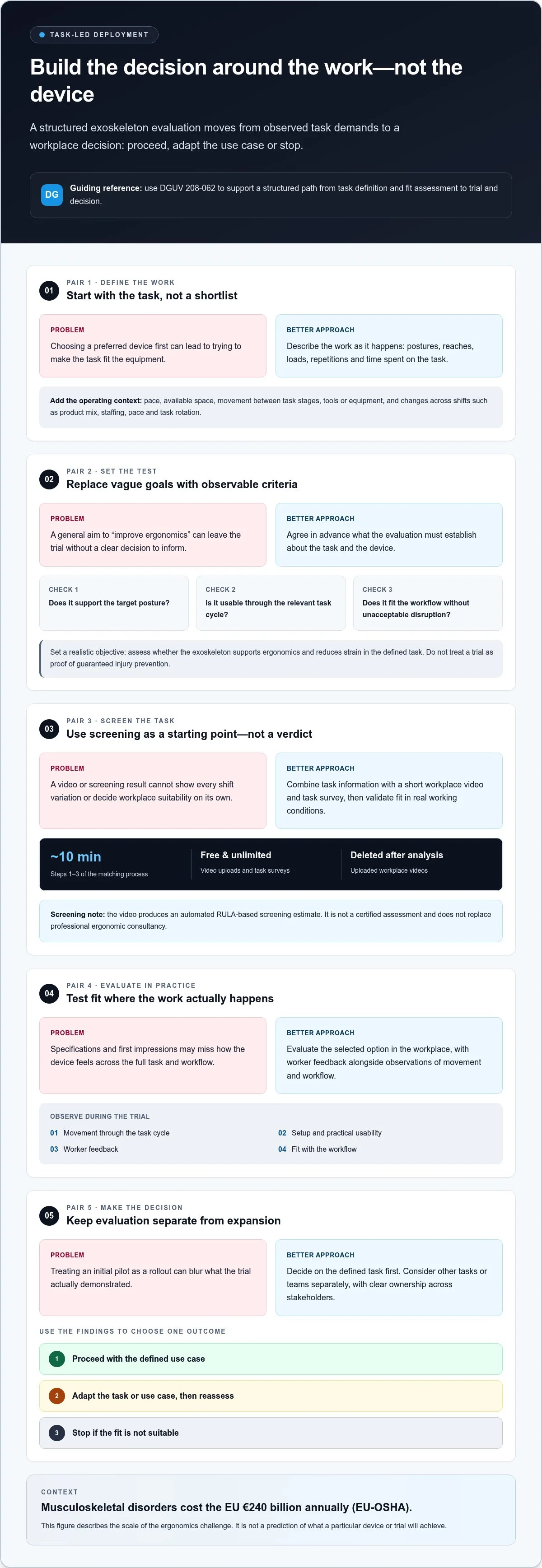
Plan a controlled rollout without confusing a pilot with scale
A trial answers a bounded question about a defined task. It does not establish that the same exoskeleton will suit every worker, shift or job in the organisation. Treat the initial evaluation as its own decision point, then consider wider use separately. This keeps findings tied to the conditions in which they were collected and avoids assuming that a promising result on one task applies to others.
Give the evaluation clear ownership. HSE can coordinate ergonomic considerations and help define how observations will be recorded. Operations can confirm the target task and assess workflow fit. Supervisors can organise participation around normal work routines, while procurement tracks the purchase decision and its rationale. Participating workers should be able to report practical issues and describe how the device feels during the work. One named lead can bring these perspectives together for the review.
Prepare teams and operating routines
Before the trial, tell workers what is being evaluated, which task it relates to and how their feedback will inform the decision. Be clear that the aim is to assess practical and ergonomic fit, not to prove a predetermined benefit. Invite specific observations on comfort, movement, setup and whether the device interferes with normal work. Make it easy to raise concerns during the evaluation, not only at the final review.
Build manufacturer-provided onboarding and training into the plan, and account for how service will be provided. Devices ship directly from manufacturers, who provide onboarding, training and service. Planning these arrangements alongside task coverage helps the trial reflect how the device will be introduced and used.
Define a scale-up gate
Before starting, agree what would lead to one of three outcomes: proceed with the evaluated use case, adapt it and gather further evidence, or stop. Use the organisation’s stated criteria, including task fit, usability and workflow compatibility. Record worker feedback alongside operational observations, and note conditions that influenced what was observed, such as task rotation or differences between shifts.
Keep conclusions specific. If the trial assessed one task in one operating context, its findings support a decision about that use case, not automatic adoption across other teams or sites. Any expansion needs its own rationale and evaluation. A controlled decision gate gives decision-makers a practical basis for acting without presenting a pilot as proof of injury prevention, guaranteed safety or universal suitability.
Use a structured Deploy & Decide trial to evaluate a selected exoskeleton in real working conditions before making a purchase or scale-up decision.
Use Deploy & Decide for exoskeleton decisions
Ryggo is Europe’s first independent exoskeleton exchange, helping organisations move from a work requirement to a device recommendation and a workplace trial. Ryggo is not an exoskeleton manufacturer. Its role is to support a more informed selection decision, while the chosen device is evaluated in the workplace before the organisation decides whether to buy.
The process starts with a defined task. Upload a 30-second workplace video, complete a short task survey and receive one fit-based recommendation across vendors. Then decide whether to trial the selected device. The recommendation helps narrow the options; it does not establish that a device is right for every task or worker. The trial lets the organisation assess fit against its own work and decision criteria.
This makes Deploy & Decide a practical part of an exoskeleton deployment strategy: it connects task information to a recommendation, then gives the organisation a chance to evaluate the device before committing to purchase. Recommendations are based solely on fit across vendors.
Understand the trial terms before deciding
Deploy & Decide trials are available for 2, 4 or 8 weeks. If a trial is unsuccessful, the applicable refund is up to 75% for a 2-week trial, 70% for a 4-week trial or 60% for an 8-week trial. These are maximum refunds for unsuccessful trials, not a guarantee of a full refund.
If the organisation proceeds to purchase, 100% of the trial fee is credited toward the purchase, so the buyer does not pay twice for the trial amount. This keeps the trial decision distinct from the purchasing decision: organisations can evaluate operational fit first, then decide whether to proceed with the selected device.
Ryggo operates in 28 European countries under one set of commercial terms. For organisations working across locations, this provides a consistent commercial basis for considering trials across European operations.
Take the next step with a defined use case
Before selecting a device, be specific about the task and workplace requirements. Identify the movements involved, the conditions in which the task takes place and what the organisation needs to learn from a trial. Clear requirements help make the recommendation relevant and give workers and managers a practical basis for evaluating the result.
Use the recommendation as a starting point, not a substitute for workplace judgement. A trial can help assess whether the selected exoskeleton supports the intended task and fits the workflow, while the final decision remains with the organisation. If the evidence points to a poor fit, adapt the use case or stop rather than scaling on assumption.
To move from a defined task to a fit-based recommendation, Explore Ryggo Advisor.
Not sure which exoskeleton fits your task? Let the Ryggo advisor match it independently.
Find your exoskeleton →Turn your next task into a clear decision
Choose one defined task where physical demands warrant closer ergonomic evaluation. Set out what your organisation needs to learn, who will assess the trial and what evidence would support proceeding, adapting the use case or stopping. This gives your exoskeleton deployment strategy a practical starting point without assuming one device will suit every job.
Ryggo Advisor supports that process with free, unlimited video screening and matching, followed by a vendor-neutral recommendation based solely on fit across vendors. If a trial leads to a purchase, its fee is credited toward the purchase. This gives your team a clear route from workplace requirements to a decision grounded in operational evidence.
Put your task requirements into the selection process with Explore Ryggo Advisor.
Frequently asked questions
Can an exoskeleton deployment strategy guarantee fewer workplace injuries?
No. An exoskeleton cannot be said to prevent injuries, guarantee safety or remove risk. It may support ergonomics or reduce strain, but suitability depends on the work and how the device is used. A trial informs a decision about the specific task, people and conditions observed; it cannot establish broader health outcomes. Keep existing risk controls in place and treat trial findings as evidence for a decision, not a promise of injury reduction.
Is Ryggo’s RULA score a certified ergonomic assessment?
No. It is an automated RULA-based screening estimate generated from workplace video, not a certified assessment, and it does not replace professional ergonomic consultancy. Use it to help frame an initial conversation about the task, such as which postures or movements merit closer review. It should not be treated as a definitive ergonomic audit, certification or sole basis for deciding that a workplace or task is suitable for an exoskeleton.
What happens to workplace videos uploaded for Ryggo’s screening?
Uploaded videos are deleted after analysis. They support screening and initial matching, rather than replacing an ergonomic review. Keep recordings focused on the work movement being considered and avoid including unrelated activity. The output is an automated screening estimate; if the decision requires a more detailed ergonomic evaluation, involve a qualified professional. The video result alone is not a definitive assessment of the workplace.
How long does Ryggo’s initial matching process take?
Steps 1-3 take about 15 minutes. They comprise submitting a 30-second workplace video, answering a short survey about the task and receiving one recommendation with its rationale. This estimate applies only to initial matching. It does not include arranging or conducting a workplace trial, gathering worker feedback, reviewing operational fit or making a purchase decision. Plan those as separate steps, allowing the relevant people time to assess the use case.
Who should be involved in an exoskeleton deployment decision?
Bring together HSE or ergonomics colleagues, operations, procurement, supervisors and workers who perform the target task. Their perspectives help distinguish ergonomic considerations from practical constraints, such as how the work is organised and what the purchase decision requires. Involve workers early enough for their observations to inform the evaluation, rather than collecting feedback only at the end. This collaborative approach supports a better-informed decision, but does not guarantee a successful deployment.
Can the same exoskeleton deployment strategy work across different European sites?
A common decision process can support consistency, but each site still needs to consider its own tasks and operating conditions. Ryggo operates in 28 European countries under one set of commercial terms; that consistency does not establish that a device suits every location. Differences in task rotation or available space, for example, may affect practical fit. Keep conclusions specific to the work and conditions evaluated at each site.
Does Ryggo recommend more than one device for the same task?
Ryggo provides one neutral recommendation based solely on fit across vendors. The recommendation is a starting point for the decision, not a substitute for evaluating the option in the intended task. Assess whether it meets the organisation’s criteria during a workplace trial before deciding whether to proceed.
Find the right device before you trial anything
The Ryggo advisor maps your task, environment, and requirements to compatible devices — independently, across the full European market.
Find your exoskeleton →