Key Takeaways
- Involve workers in selecting and fitting devices, and include practical guidance on setup, hygiene and care.
- Match each exoskeleton to the task and workplace, then give operators hands-on training before a live pilot.
- Use a defined pilot roadmap to gather feedback on comfort, usability and operational fit before deciding whether to scale.
- Assign clear ownership for worker feedback, safety oversight and the decision to continue, adapt or stop the pilot.
- Use Deploy & Decide to compare suitable devices and trial options before committing to a purchase.
Table of Contents
- Worker training, device setup, hygiene, and care
- Regulation, testing and operator training
- A 90-day wearable pilot roadmap
- Monitoring adoption and technician satisfaction
- Responsibility, accountability and financing
- Ryggo: Trial programmes for exoskeletons (called Deploy & Decide)
Worker training, device setup, hygiene, and care
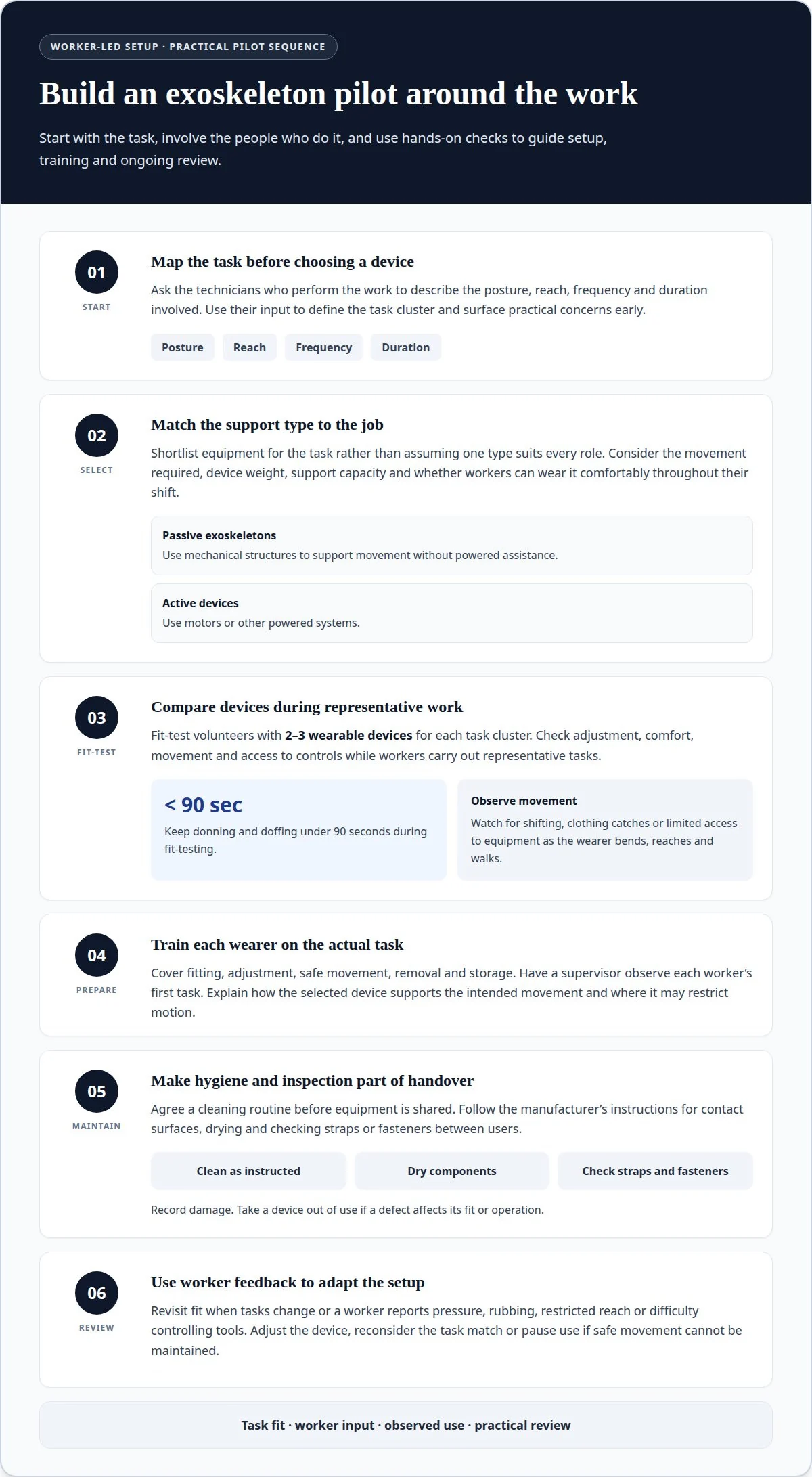
Begin with the task, not the device. Ask technicians who perform the work to describe the posture, reach, frequency and duration involved, then shortlist equipment for that task cluster. Use that input to identify practical concerns early, such as restricted movement, interference with tools or difficulty moving between workstations.
Fit-test volunteers with 2-3 wearable devices for each task cluster. Check adjustment, comfort, movement and access to controls while workers perform representative tasks. Keep donning and doffing under 90 seconds during fit-testing, and record whether the device shifts, catches on clothing or limits access to equipment. A comfortable fit at rest is not enough; observe the wearer bending, reaching and walking through the actual work area.

Passive exoskeletons use mechanical structures to support movement without powered assistance. Active devices use motors or other powered systems. Choose between them based on the task, the movement required, the device’s weight and support capacity, and whether workers can wear it comfortably throughout their shift. Match the technology to the physical demands instead of assuming one type suits every role.
Training should cover fitting, adjustment, safe movement, removal and storage, with a supervisor observing each worker’s first task. Explain how the selected device supports the intended movement and where it may restrict motion. For rehabilitation exoskeletons in Europe, CE marking requirements apply under the Medical Device Regulation. Treat standards and product instructions as part of the site’s equipment review.
Agree on a cleaning routine before equipment is shared. Follow the manufacturer’s instructions for cleaning contact surfaces, drying components and checking straps or fasteners between users. Record damage and take a device out of use if a defect affects its fit or operation. Common barriers include discomfort, a poor task match, restricted movement and uncertainty about safe use. Worker feedback and task observation can help teams address these issues during setup and training.
Keep setup grounded in how the work is actually done. Revisit fit if a worker changes tasks or reports pressure, rubbing, restricted reach or difficulty controlling tools. Use these observations to adjust the device, reconsider the task match or pause use if safe movement cannot be maintained. Make it clear that workers can raise concerns at any time, not only during a scheduled review. Supervisors should listen for reports of discomfort and observe whether workers can put on, adjust, remove and store equipment as instructed.
Make cleaning and inspection part of the handoff between users, and revisit training if worker feedback suggests that setup or movement needs clarification.
Regulation, testing and operator training
Start by identifying the device’s intended use and classification. Rehabilitation exoskeletons and industrial support devices may fall under different regulatory frameworks. In Europe, medical rehabilitation exoskeletons are subject to CE marking requirements under the Medical Device Regulation. Keep product documentation, intended-use information and operating instructions with the workplace assessment so managers understand what the device is designed to do.
For industrial equipment, distinguish mechanical support from powered operation. Check the device’s applicable documentation and intended use as part of the standards review.
Assess the work system before introducing equipment. ISO 6385:2016 sets out fundamental ergonomics principles for work-system design, according to the International Organization for Standardization. Map the task, operator movement, surrounding machinery and interaction with tools. Then test the device during the actual operation, including transitions such as stepping, turning, reaching and moving between workstations.
Use a controlled trial to observe the device under normal working conditions. Note whether straps shift, joints restrict movement or mechanical parts contact nearby equipment. For an electric model, include its power controls and charging routine in the operating review. Check whether it affects access to emergency stops, protective clothing or other required equipment. These practical checks can reveal conflicts that a demonstration may not show.
Material contact also matters. Review the materials that touch the wearer, especially where workers share devices or wear them for extended tasks. Include cleaning instructions and inspection points in the site procedure. Record concerns such as skin irritation, heat build-up or pressure points, then feed them into the trial decision.
Make operator training practical and specific to the task. Before routine use, have each wearer demonstrate fitting, adjustment, start-up where applicable, safe movement and removal. A supervisor can observe a representative task and ask the operator to explain when to stop and report a fault. Record training completion, device identification and reported issues. These records support safe-use reviews, updates to instructions and decisions about further training.
A 90-day wearable pilot roadmap
Use a structured cycle: assess the task, involve workers, trial the wearable, review feedback and decide whether to adapt or scale. This gives change management for exoskeleton integration a practical framework, based on evidence from the workplace rather than a demonstration or first impressions.
Days 1-15: audit and match. Map the tasks, postures and work locations where support may be useful. The first 15 days are for task auditing and device matching. Record the work sequence, shift conditions, tools used and points where workers experience physical demand. Identify intended users and invite them to define what a workable trial must demonstrate. Set a baseline for task completion and current work methods, so the pilot has a clear comparison.
Days 16-35: prepare the trial. Confirm the device-task match and plan how it will fit into the work schedule. Tell participating workers what the pilot is designed to assess, how they can raise concerns and who will respond. Agree on a simple feedback method, such as a short check-in after use and a weekly review. Supervisors should record missed opportunities to wear the device, interruptions to work and any changes made to the task.
Days 36-60: run the live pilot. Use 3-5 recurring preventive-maintenance routes to test the wearable in routine conditions. Compare routes for access, duration and physical demands, and note where the same device performs differently. Track comfort measures weekly, including fit, pressure points, restricted movement and ease of transition between tasks. If one complaint becomes the leading barrier, address it within 7 days. A prompt adjustment can prevent an avoidable issue from shaping the whole pilot.
Days 61-90: review and decide. Bring operators, supervisors and HSE together to assess recorded feedback and operational observations. Separate device-related concerns from problems caused by task layout, scheduling or inconsistent instructions. Check whether workers continue using the wearable for intended tasks, and document reasons for non-use without treating it as misconduct. Then decide whether to continue, change the task-device match or stop the trial.
Make the decision criteria clear from the outset. Assess comfort, usability, task compatibility and the practical effort needed to support continued use. Compare worker feedback with observations of the work, rather than relying on one positive or negative account. At the final review, assign an owner to each action, record unresolved issues and explain what evidence supports the next decision. This makes change management for exoskeleton integration a controlled operational assessment, not an open-ended demonstration.
Ready to find the right device for your operation?
Monitoring adoption and technician satisfaction
Review adoption, worker acceptance, task performance and safety observations together. Track whether the device is used for its intended task, whether workers choose to wear it, and whether work quality or reported fatigue changes. No single measure can show whether an exoskeleton fits the operation or supports its ergonomic goals.
Record a baseline before introducing the device. For example, note task completion, pauses, reported fatigue and relevant safety observations for the same work process. During the pilot, compare like with like: the same task under similar conditions, with device use recorded. Separate changes associated with the wearable from those caused by staffing, workload or process adjustments.
Use a compact set of measures that supervisors and workers can maintain during normal operations:
- Adoption: record device use against occasions when the target task occurs, and note reasons for non-use.
- Acceptance: ask technicians about comfort, fit, ease of movement and willingness to keep using it.
- Operational impact: compare task completion, interruptions, rework and workflow fit with the baseline.
- Ergonomics and safety: document discomfort, restricted movement, near misses and any change in work technique.
Interpret those measures together. A high use rate alongside repeated discomfort is not success; it signals a fit or task issue to investigate. Conversely, positive feedback without consistent use may point to a scheduling, storage or training barrier.
Ask workers directly, and explain how their feedback will be used. Make clear whether monitoring captures device use, task observations or worker-reported fatigue, and keep the discussion focused on ergonomics and process improvement. Avoid individual performance comparisons that can undermine trust.
Acceptance alone cannot establish operational suitability, so read it alongside task compatibility and safety observations. If acceptance is low, review fit, movement, task selection and worker understanding before deciding whether to adapt the trial.
Review results with workers and supervisors, then assign an action to each recurring concern. If workers report shoulder fatigue after an overhead task, inspect the task-device match and observe the movement before changing the setup. This turns feedback into a practical improvement cycle. Clear records also help managers distinguish a lasting change in the work experience from a short-lived novelty effect, and support a reasoned decision to continue, adapt or stop.
Responsibility, accountability and financing
Assign one accountable owner before an exoskeleton enters the workplace. The operations lead can coordinate the pilot, while HSE reviews ergonomic and safety observations. Procurement manages commercial terms, and finance assesses the investment case. A supervisor handles daily use, with technicians reporting fit and workflow concerns directly.
Make each responsibility specific. For example, in an automotive assembly area, the line manager can record task interruptions while HSE reviews movement restrictions and discomfort reports. Procurement tracks device documentation and agreed service arrangements. Finance compares expected operational value with purchase and implementation costs. A named decision owner brings these inputs together at each review.
Keep operational accountability separate from device support. The employer’s team owns workplace procedures, worker participation and the decision to continue, adapt or stop a pilot. Manufacturers provide device onboarding, training and service. Record who receives fault reports, who takes equipment out of use when needed, and who communicates changes to affected workers. Clear handovers stop issues from falling between departments.
Build the investment case around the task, not a general promise of higher productivity. Compare the current process with pilot observations, including task completion, workflow interruptions, reported fatigue and worker acceptance. Account for time spent fitting, instructing and cleaning the device, as well as managing shared equipment. If it supports one task but disrupts another, include both effects in the operational assessment.
How much do industrial exoskeletons cost, including training and maintenance? There is no single total: the price depends on the device, quantity, training, maintenance arrangements and expected use. Budgeting should account for implementation effort as well as equipment, then compare those costs with task-specific operational benefits.
Use a decision record to connect evidence with spending authority. Capture the selected task, participating teams, worker feedback, operational measures and unresolved concerns. Finance can assess whether the proposed purchase meets the organisation’s investment criteria. Procurement can document the commercial route, while HSE records any conditions needed for safe use in the workplace.
Before committing funds, compare devices against the same task requirements and cost assumptions. A vendor-independent exoskeleton comparison can help structure that decision alongside task-specific ROI considerations. Keep the final approval with the organisation’s named decision owner, supported by input from technicians, operations, HSE, procurement and finance.
Not sure which exoskeleton fits your task? Let the Ryggo advisor match it independently.
Ryggo: Trial programmes for exoskeletons (called Deploy & Decide)
Ryggo helps organisations move from workplace assessment to an informed exoskeleton decision. Its Deploy & Decide programme lets companies trial devices in their own operations before purchasing, so teams can assess task fit and worker feedback in practice.
Use the programme when devices look suitable on paper but the right option remains unclear. Ryggo Advisor provides a vendor-independent recommendation, and Ryggo compares devices on the same basis to help match options to workplace needs. ROI calculations can support the investment decision. Healthcare organisations can use Ryggo’s exoskeleton matching for settings such as hospitals and care environments.
The trial helps teams evaluate whether a device supports ergonomics and fits real operations before deciding what follows. To explore the options for your workplace, visit ryggo.ai.
Turn pilot learning into a workplace decision
Make the pilot’s lessons part of future work planning. Give workers a clear way to raise concerns, make ownership visible and include new evidence in later equipment decisions. This keeps exoskeleton use connected to the task and the people doing it, rather than treating adoption as a one-off project.
Effective change management for exoskeleton integration also means being ready to adjust course. A device may suit one task but not another, and worker feedback can show where procedures, task selection or equipment choice need refinement. Use those lessons to guide the next operational decision, whether to continue the current trial or consider another approach.
For support with evaluating options for your workplace, discuss your exoskeleton integration plans with Ryggo. Take the next step with a clear view of the work to be done and the people who will do it.
Frequently Asked Questions
What are the key steps for integrating exoskeletons into workplace operations?
Integrate an exoskeleton through a controlled sequence: define the target task and operating limits, involve workers, check compatibility with existing PPE and workstations, then authorise a limited operational trial. Name an owner for incidents, adjustments and review decisions. Before routine use, update local procedures, storage arrangements and shift handovers. This helps prevent informal use from getting ahead of safety and procurement processes.
How should organisations assess tasks and workers for exoskeleton suitability?
Assess the physical task and the fit between wearer and device together. Map movements, tools, work height and space constraints, then consider whether the wearer can move naturally and use required equipment. For example, a worker moving between a picking aisle and a vehicle may need a different fit from someone at a fixed assembly station. Involve people who regularly perform the task, and seek specialist ergonomic judgement where needed.
How can employees be involved in exoskeleton selection and rollout?
Ask employees who perform the target work to define selection criteria before choosing a device. Have them identify practical deal-breakers, such as contact with a workstation, interference with clothing or difficulty moving between tasks. During rollout, provide a clear way to report concerns and explain who will respond. Include different roles and shifts so decisions reflect actual work patterns, not just one team’s experience.
What training is required for workers and supervisors using exoskeletons?
Workers need instruction on fitting, adjustment, operating limits, inspection and removal, following the manufacturer’s instructions for the specific device. Before normal use, ask each wearer to demonstrate these steps. Supervisors should know how to recognise fit or movement concerns, pause use and report the issue to the responsible person. Keep a simple record of who completed the instruction and which device they learned to use.
How should organisations pilot and evaluate workplace exoskeletons?
Before the pilot, document the task, normal working conditions and decision criteria. During use, record how the device fits the process, what workers report and whether workflow changes affect observations. At review, distinguish equipment concerns from changes in staffing or workload. Decide whether to continue, adjust the task-device match or stop, and document the evidence behind that decision. This makes the pilot useful for procurement and future workplace decisions.
Find the right device before you trial anything
The Ryggo advisor maps your task, environment, and requirements to compatible devices — independently, across the full European market.