What the evidence shows
The case in favour is simple enough. Industrial exoskeletons aim to take load off the back or shoulders during demanding tasks. That can mean less physical strain, and it can help offset declining physical capacity in an ageing workforce. A 2026 systematic review of sensor-integrated industrial exoskeletons reports drops in muscle activation of 13% to 68.2% and reductions in spinal loading of 8% to 34%, depending on body region and measurement method. These are laboratory figures. Don't read them as the improvement you will see on your own shop floor.
The concerns are just as real. IOSH cautions that benefits are often overrated and that devices are sometimes brought into working life too quickly, adding that their benefit is not yet scientifically proven. A systematic scoping review of occupational exoskeleton use finds the evidence for commercially available devices uneven across real and simulated work settings. Its conclusion is that success at work depends on context-sensitive ergonomics, not on reduced muscle activity measured in a lab.
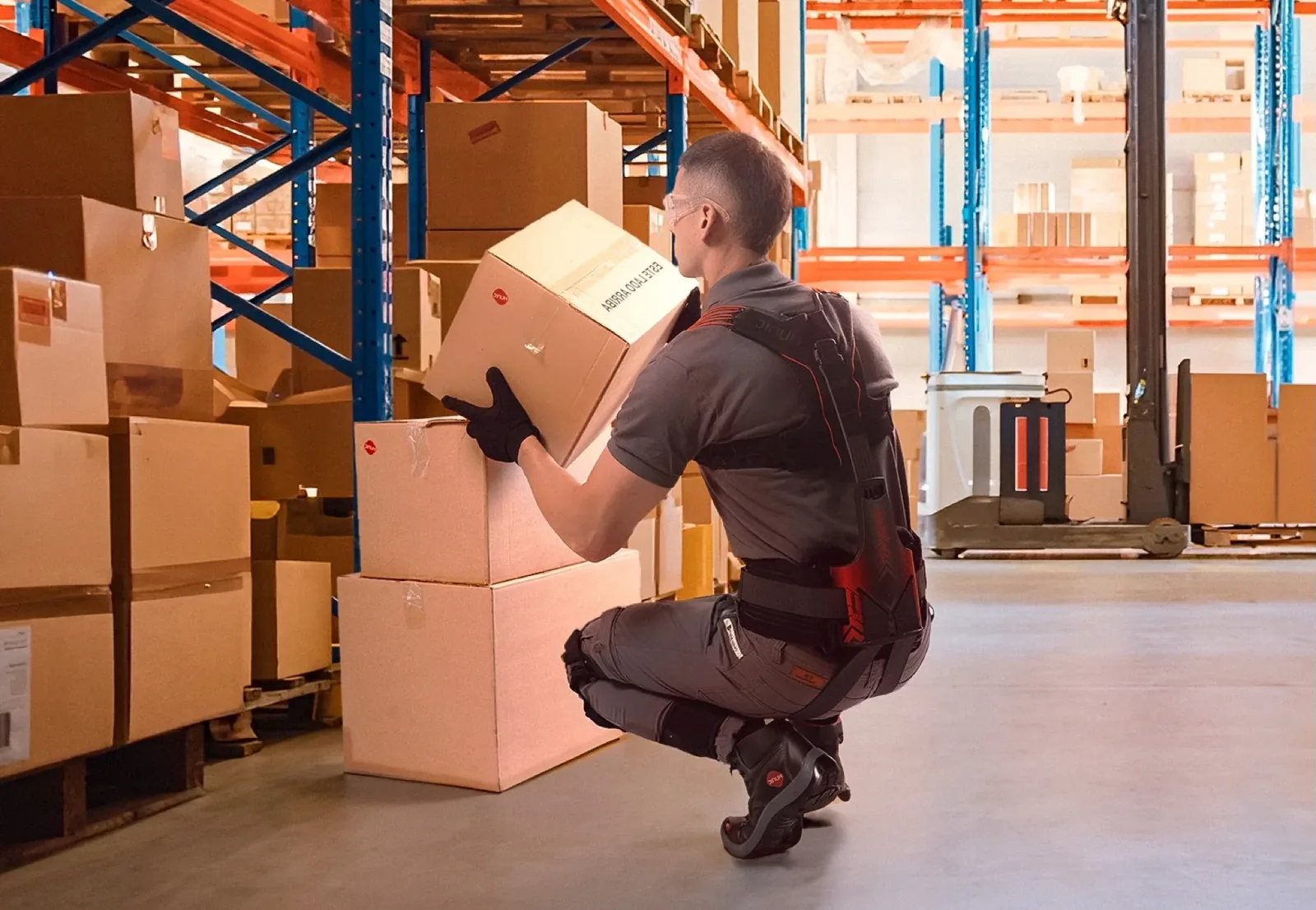
Comfort and acceptance matter as much as biomechanics. Field research summarised in a Frontiers paper on user experience in occupational settings shows that how a device feels and fits decides whether people keep wearing it. In one logistics facility, some workers felt constrained, not relieved. A device that cuts load on paper but comes off after an hour delivers nothing.
It helps to keep three tiers of evidence apart: laboratory results, field studies in real workplaces, and vendor-reported outcomes. Each answers a different question, and blending them gives a muddled picture. For a buyer, the practical conclusion is that published evidence shows where devices are plausible, while your own trial shows whether they work for your people.
Matching the device to the task: static, repetitive and dynamic work
Task fit is the biggest single factor in whether an exoskeleton pays off. As Mensura's expert opinion puts it, use for static and repetitive tasks can mean less physical strain, less fatigue and better performance, while dynamic work such as walking, or climbing stairs or a ladder, gets harder with a device on.
Static and repetitive work is where most passive devices belong. Think of sustained forward bending at an assembly station, repeated lifting from a fixed position, or overhead work held for long periods. Back-support devices suit repeated bending and lifting; shoulder-support devices suit sustained arm elevation. Passive designs are also the most studied category. A systematic review of passive industrial exoskeletons examined target tasks and supported body postures, and the most-evaluated device had twelve studies behind it.
Dynamic work is the weak spot. If a role involves frequent walking, stairs, ladders, crawling or confined spaces, a worn device can limit mobility. The EU-OSHA discussion paper also notes that a fall could have worse consequences than without one. Mixed jobs that alternate heavy handling with travel are a middle case and need careful observation.
A practical sequence for matching device to task:
- Identify the body region at greatest risk: lower back, shoulders or both.
- Classify the task: static hold, repetitive cycle or dynamic movement.
- Check the environment: space, floor surfaces, ladders, vehicles and any PPE that must be worn alongside.
- Consider the worker: body size, comfort tolerance and any health conditions.
If you are unsure where to start, the Exoskeleton Advisor recommends back or shoulder devices based on your operation, and the free ergonomic analysis scores posture risk from a short video of the task. You can then browse the listed exoskeletons by body region. Begin with the task and its risk, not with a product.
Ready to find the right device for your operation?
Testing before you buy: designing a trial in your own workplace
Laboratory evidence doesn't transfer reliably. So the most defensible way to decide whether exoskeletons are worth it at work in your own context is to trial them there. A study that benchmarked commercially available soft and rigid passive back exoskeletons on tasks resembling a real industrial workplace recommends exactly this: benchmark devices against the intended use before you commit.
A good trial has a design, not just a delivery date. Consider these elements:
- A clear question. For example: "Does this device reduce reported back strain during pallet building without slowing the task?" A vague goal produces a vague result.
- Baseline measures. Before anyone puts a device on, record the current state: posture risk scores, task cycle times, reported discomfort and recent absence data for the role.
- A realistic duration. A few hours shows novelty effects. Several weeks show whether people adapt, whether fit problems emerge and whether the device survives a full shift pattern. Ryggo's Deploy & Decide programme offers 2, 4 or 8-week trials for this reason; how a trial works explains the steps.
- A representative group. Include different body sizes, experience levels and sceptics as well as volunteers.
- Structured feedback. Ask about comfort, restriction, fatigue and whether people would choose to wear it. Self-reported perception is useful, but it is perception, not proof of risk reduction.
Understand the financial side of a trial in advance. Read the guide to the cost of exoskeleton trials and the wider try-before-you-buy guide before agreeing anything.
Set success criteria before the trial starts: a target reduction in reported strain, no increase in cycle time, a minimum share of participants who want to continue. Deciding afterwards invites wishful reading. A trial that ends in a clear "no" is still a good outcome, because it cost a fraction of a full purchase.
Not sure which exoskeleton fits your task? Let the Ryggo advisor match it independently.
Building a fair business case: ROI, sick leave and worker buy-in
A credible business case starts with the problem you are paying to reduce. For your decision, your own absence records, injury costs and turnover data matter far more than EU-wide totals.
A fair model weighs both sides honestly:
- Costs: device purchase or subscription, training, fitting time, maintenance, and the time of the people running the trial and rollout.
- Potential benefits: fewer strain-related absences, lower injury and compensation costs, reduced turnover in physically demanding roles, and the ability to keep experienced older workers on demanding tasks.
- Uncertainties: how much of the lab effect carries over, adoption rates, and whether the benefit covers the whole shift or only part of it.
Be wary of headline return figures: returns depend heavily on task fit. Build your own numbers and test them against a conservative scenario. The payback period guide walks through the calculation. Ryggo's pricing page outlines how purchase and trial options are structured.
Worker buy-in belongs inside the business case, not after it. A device nobody wears has a payback of never. Involve operators in choosing the task and the device. Explain what it is for: reducing load, not monitoring or replacing anyone. Allow time to adjust, and act on fit complaints quickly. Adoption multiplies every other figure in your model.
EU safety obligations, risk assessment and moving from pilot to rollout
In Europe, introducing an exoskeleton is a workplace change that must go through your normal risk assessment. The EU-OSHA discussion paper on exoskeletons and OSH is the best plain starting point. It flags that a device can introduce new hazards, such as restricted movement, altered balance or worse consequences from a fall, even as it reduces another risk. A survey-based study on hazards in exoskeleton applications examines how relevant these hazards are in practice.
On regulatory status, classification varies by device and use, so ask each vendor for its declaration of conformity. Confirm current requirements with your national authority or a competent adviser before relying on any assumption.
A sound risk assessment should cover the task, the device, the worker and the environment. It should also look at the effect on emergency egress and PPE compatibility, and be reviewed after the trial using real feedback. Document who is responsible for fitting, training, inspection and withdrawing a device that causes problems.
Moving from pilot to rollout is where many projects stall. To avoid pilot purgatory:
- Agree success criteria and a decision date before the pilot begins.
- Limit rollout to the tasks and teams where the trial showed a benefit.
- Plan sizing, spare units, cleaning and maintenance before scaling.
- Keep measuring after rollout so you can see whether benefits persist.
If the answer for your operation is a qualified yes, scale deliberately. If it is no, you have avoided an expensive mistake and can pursue other ergonomic controls, which should stay the first line of defence in any case.
Find the right device before you trial anything
The Ryggo advisor maps your task, environment, and requirements to compatible devices — independently, across the full European market.