Key Takeaways
- Assess water protection alongside task demands, movement, and exposure conditions; a label alone cannot establish suitability for outdoor duties.
- Distinguish independent validation from a manufacturer’s performance claims, and examine what the evidence actually tested.
- Use the IP rating and its supporting documentation to understand the protection claimed, then consider how the device will be used in practice.
- For a practical way to assess fit before purchase, Ryggo’s Deploy & Decide trials let teams evaluate exoskeletons in their work setting.
Table of Contents
- Third-party validation and certifications
- Which occupational exoskeletons are rated waterproof or water resistant?
- What IP ratings do outdoor work exoskeletons have?
- Which outdoor industries use waterproof exoskeletons, such as construction, agriculture, and utilities
- Ryggo: Trial programmes for exoskeletons (called Deploy & Decide)
Third-party validation and certifications
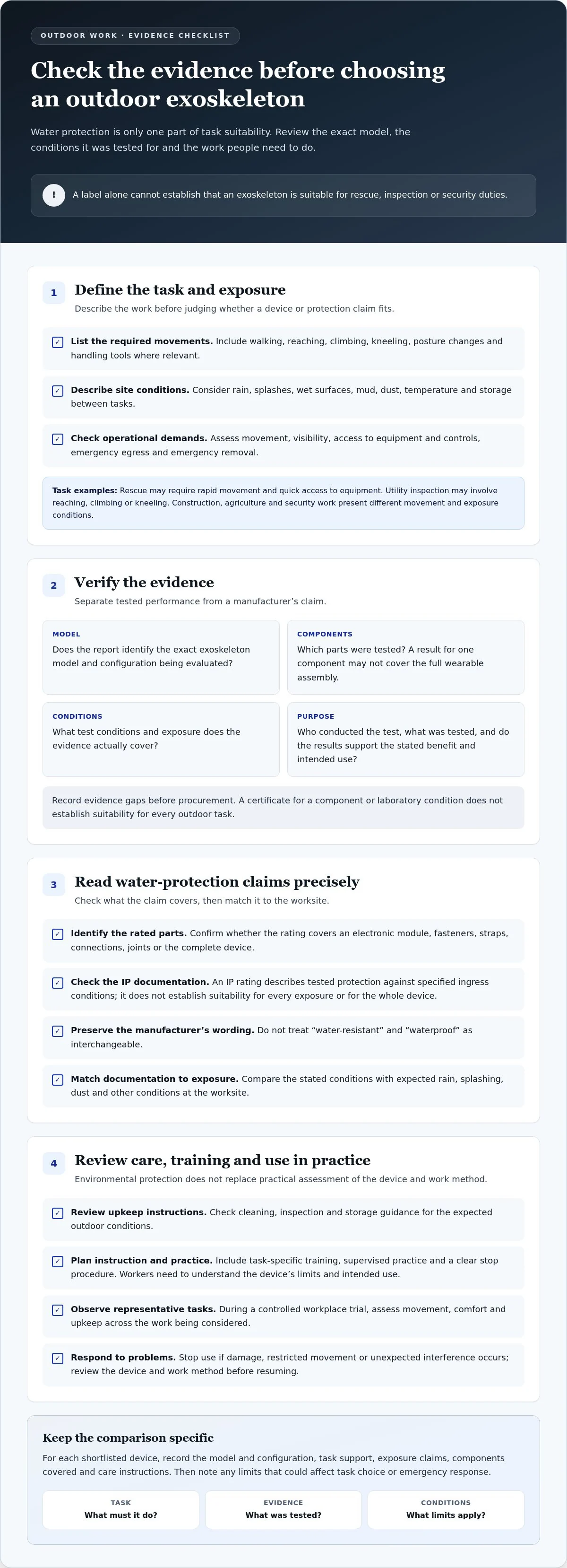
Outdoor use requires evidence that matches the task, exposure and exact exoskeleton model. A label alone cannot show that a device suits rescue, inspection or security work.

Validation and certification evidence
Third-party validation can help distinguish tested performance from manufacturer claims. Check the report for the exact model, components, test conditions and intended use. A certificate covering one component or laboratory condition does not establish suitability for every outdoor task.
Compare the evidence with the work itself. For inspection, check whether the device allows the reaching, walking and climbing required. For rescue duties, consider rapid movement, access to controls and emergency removal. Ask what was tested, who conducted the test and whether the results support the claimed benefit. Record any gaps before procurement.
Waterproof and water-resistant ratings
Water protection varies by device and component. A rating for an electronic module may not cover the entire exoskeleton, including its fasteners, straps or connections. Identify the exact model and confirm which parts the rating covers. Don’t treat “water-resistant” and “waterproof” as interchangeable.
Rain can wet fabric, affect grip and leave moisture around joints or connections. Mud and dust can collect around moving parts, increasing cleaning needs or interfering with movement. Temperature can also affect materials and powered components. Compare the manufacturer’s operating and care instructions with expected conditions, including wet shifts and storage between tasks.
IP ratings for outdoor work
An IP rating describes a tested level of protection against specified ingress conditions. It does not, by itself, establish suitability for every exposure or for the whole device. Check the product documentation for the rating’s scope, including the component tested and conditions covered. Match that evidence to the rain, dust or splashing expected at the worksite.
For waterproof exoskeletons for outdoor work, use a simple evidence review:
- Match the model and rated components to the product being evaluated.
- Compare the documented exposure conditions with the actual task environment.
- Review cleaning, inspection and storage instructions for outdoor use.
- Record any limits that could affect task choice or emergency response.
Workers should understand the device’s limits before deployment. An exoskeleton may affect balance, movement, posture or access to tools. Include task-specific instruction, supervised practice and a clear stop procedure in the evaluation.
Rain, mud, dust and temperature can affect comfort, movement and upkeep. During a controlled workplace trial, observe how the device performs across representative tasks. Stop use if damage, restricted movement or unexpected interference occurs, then review the device and work method before resuming.
Which occupational exoskeletons are rated waterproof or water resistant?
Water protection is specific to a model, not an occupational category. A back-support exoskeleton used during outdoor inspection cannot be assumed suitable for rain simply because it supports lifting. Check the exact device and components against documented exposure conditions.
Start by separating devices according to the assistance task. A passive back-support suit, an arm-support device for overhead work and a powered walking aid have different designs and components. None is automatically waterproof or water-resistant because it is passive, powered, wearable or intended for industrial work. Product documentation must support the protection claim for the specific configuration.
For rescue teams, task fit includes movement between locations, access to equipment and the ability to respond quickly. An exoskeleton that supports lifting may not suit rapid movement or tasks requiring frequent posture changes. For utility inspections, consider whether workers need to reach, climb, kneel or handle tools while wearing the device. These requirements matter alongside exposure to rain.
Construction and agricultural work involve different kinds of contact. A construction worker may kneel beside wet materials, while an agricultural worker may cross muddy ground or handle damp equipment. Security staff may walk for extended periods and need freedom of movement. These are different evaluation scenarios, not proof that a particular exoskeleton has a water-protection rating.
Compare the exact model and configuration
Build a shortlist around the task, then assess the water-protection evidence. Record the model name, power source, worn components and any accessories in the configuration. A claim that applies to a control unit, for example, does not necessarily cover the straps, joints or complete wearable assembly.
Use a comparison table with separate fields for task support, exposure claims, covered components and care instructions. Preserve the manufacturer’s wording, distinguishing “water-resistant” from “waterproof”. This prevents broad sales language from being mistaken for evidence covering the whole device.
Match the claim to the worksite
Describe the outdoor task in practical terms before selecting a device. Note whether workers encounter rain, splashes, wet surfaces or mud, and identify the movements repeated during a shift. Then compare those conditions with the model’s stated use and maintenance instructions.
During a workplace evaluation, observe whether workers can complete representative duties without changing essential work methods. Record comfort, movement, cleaning needs and interruptions caused by the device. This evidence helps distinguish a potentially suitable work aid from one whose task support or stated environmental limits do not fit the job.
What IP ratings do outdoor work exoskeletons have?
Outdoor work exoskeletons do not share one IP rating. The rating applies to a specific product or component, so compare the exact model’s documentation with the conditions workers encounter.
IP stands for ingress protection. The International Electrotechnical Commission’s IP code uses characters to indicate protection against solid objects and water. The first digit relates to solids; the second relates to water. Read both parts instead of treating “IP rated” as a complete description. A rating for a controller, for example, does not automatically cover the frame, straps, connectors or battery.
Start with the product documentation. Find the exact model and configuration, then note which parts the stated rating covers. Check whether the evidence applies to the complete wearable device or just one component. This distinction matters for powered exoskeletons, where the battery and control unit may have separate housings from the mechanical structure.
Next, describe the worksite exposure. A security patrol in light rain differs from utility work near splashing water. Construction involving wet surfaces differs from agricultural work in mud. These examples help define the procurement question: do the documented test conditions resemble the actual task? Don’t infer suitability from the letters “IP” alone.
Use the rating as one procurement input
An IP rating addresses ingress protection, not every outdoor operating condition. It doesn’t establish whether a device will remain comfortable during a long shift, move freely over uneven ground or suit a rescue task. Review operating and care instructions alongside the rating, especially for cleaning after exposure to dust or mud.
Keep a record for each model. Include the rating, protected components, test conditions stated in the documentation and any relevant limits. If a supplier describes the entire exoskeleton as protected, compare that claim with the components named in its supporting documents. This creates a clear basis for technical review without turning a component rating into a whole-device claim.
Verify practical fit in the task
Use a controlled workplace evaluation to observe the device under representative conditions. For example, assess whether an inspection worker can reach tools, walk the route and complete the task in expected weather. Record movement restrictions, cleaning requirements and signs of damage. Treat these observations as evidence of task fit, not a substitute for rating documentation.
Use a straightforward decision sequence: identify the exposure, match it to the documented rating, confirm which components it covers, then evaluate task performance. If any step reveals a mismatch, revise the shortlist before purchasing. This keeps waterproofing claims separate from broader decisions about ergonomics and outdoor suitability.
Ready to find the right device for your operation?
Which outdoor industries use waterproof exoskeletons, such as construction, agriculture, and utilities
Outdoor work involves different tasks and exposure conditions. Construction, agriculture and utility maintenance are possible use cases, not proof of universal fit. Assess the movements first: lifting, reaching, carrying, walking or holding a posture. Then consider rain, mud, dust and the device’s documented limits.
On a construction site, a worker may carry materials, use tools or work with raised arms. A back-support device could be considered for repeated lifting, while an arm-support design may better match overhead tasks. Wet surfaces and changing work areas also affect mobility. Evaluate the exact task and equipment combination rather than treating “construction” as a single workload.
Agricultural work can involve handling containers, maintaining equipment or working near crops and soil. A worker moving supplies, for example, may need different support from someone reaching into a crop row. Mud, moisture and cleaning routines matter in both cases. Check whether the device’s documented environmental limits and care instructions suit those conditions.
Utility teams may inspect outdoor assets, handle tools or maintain infrastructure. Field inspections can involve walking between locations, reaching controls and carrying equipment. An exoskeleton intended for stationary lifting may not suit that sequence. Map the full task, including transitions, before considering assistance for one movement.
Forestry and grounds maintenance offer other evaluation scenarios. Workers may carry tools over uneven ground, clear vegetation or maintain outdoor spaces. Security patrols also require walking, turning and access to equipment. These examples underline the need to assess balance, movement and task changes, not just rain exposure.
Match support to the task
Write a practical task description for each role. Record movements, load handling, posture, tools and environmental exposure. This makes it easier to compare candidates without assuming one device can serve every team. For example, assess overhead maintenance separately from carrying supplies across a field.
- Identify the repeated movement and the work location.
- Note exposure to rain, mud, dust or wet surfaces.
- Compare the device’s intended task and documented limits.
- Observe movement and usability during representative duties.
Evaluate before wider deployment
Run a controlled workplace evaluation using representative tasks. A construction crew can assess tool handling and movement between work areas. An agricultural team can observe cleaning needs after muddy work. Utility workers can assess walking, reaching and access to equipment. Record worker feedback and task interruptions consistently.
Choose based on the task and conditions, not sector labels. A device suited to one lifting task may not suit patrols or field inspections. Compare the evidence and workplace observations before selecting equipment for a wider group.
Include work areas and transitions, then review comfort, fit and any effect on the worker’s ability to complete the task. Treat a listing as a cost reference, not proof that the device suits a particular outdoor role. Compare its intended use and environmental limits with the working conditions, and involve workers in the evaluation. If the task or exposure changes, reassess the match before extending use to other duties or teams.
Not sure which exoskeleton fits your task? Let the Ryggo advisor match it independently.
Ryggo: Trial programmes for exoskeletons (called Deploy & Decide)
Ryggo helps teams compare exoskeletons and assess task fit through Deploy & Decide trials. For outdoor work, this means evaluating a suitable device against actual duties and working conditions before purchase, rather than relying on a product description alone.
Ryggo’s AI-powered recommendations, vendor-neutral device comparisons and ROI calculations help structure the decision. Teams can use a trial to observe how an exoskeleton fits representative tasks, including movement, comfort and practical outdoor use. The trial supports an informed ergonomics decision; it does not replace reviewing environmental documentation or workplace procedures.
If you’re assessing exoskeletons for an outdoor team, visit ryggo.ai to explore the next step.
Turn outdoor requirements into a practical evaluation plan
Before selecting equipment, agree on how your team will judge its fit. Define the tasks it must support, the conditions workers encounter and the evidence needed for a purchasing decision. Include worker feedback and a process for recording problems or changes in task performance. Clear criteria keep the decision focused on operational needs rather than a product label alone.
For waterproof exoskeletons for outdoor work, assess task suitability separately from exposure suitability. A device may support a particular movement yet still be unsuitable for the way your team works outdoors. Make that distinction explicit in procurement discussions and workplace evaluations.
Ryggo can help structure the next step with device recommendations, vendor-neutral comparisons and ROI calculations. Discuss your outdoor exoskeleton requirements with Ryggo and move towards a decision grounded in your work, your team and the evidence available. A measured evaluation gives you a clearer basis for proceeding.
Frequently Asked Questions
How do waterproof exoskeletons compare for lifting, walking, and overhead work?
Compare the assistance each device provides, because water protection does not determine task fit. For repeated lifting, assess support while bending and returning upright. For walking, check whether the design allows a comfortable stride, turning and access to carried equipment. For overhead work, focus on arm support and freedom to reach. A maintenance worker alternating between carrying tools and reaching controls needs a different assessment from someone repeating one movement.
What cleaning, drying, and maintenance do waterproof work exoskeletons require?
Follow the model’s cleaning, inspection and storage instructions, especially after exposure to mud or dust, which can collect around moving parts. Review the manufacturer’s care instructions for outdoor use; no specific drying procedure is provided.
Find the right device before you trial anything
The Ryggo advisor maps your task, environment, and requirements to compatible devices — independently, across the full European market.