Key Takeaways
- Start with the task, posture, environment and workforce, not a device’s headline claims.
- Use workplace evidence and DGUV 208-062 selection guidance to build a clear rationale for a task-based recommendation.
- Check that vendor-neutral exoskeleton recommendations are based on fit, and that commercial incentives are transparent.
- Record worker experience, workflow compatibility and ergonomic objectives so the decision can be reviewed.
- Use a workplace trial to assess whether the recommended exoskeleton supports ergonomics in practice before purchasing.
Table of Contents
- Why vendor-neutral exoskeleton recommendations matter for buying decisions
- How task evidence informs a vendor-neutral exoskeleton recommendation
- How to assess whether exoskeleton advice is genuinely independent
- How to turn a neutral exoskeleton recommendation into a sound decision
- How Ryggo’s Deploy & Decide process supports a confident purchase
Why vendor-neutral exoskeleton recommendations matter for buying decisions
Match the exoskeleton to the work before committing to a purchase. A device can have appealing features and still be a poor fit for a particular task, workforce or site. The key question is not simply what a device can do, but whether its support suits the movements workers repeat, the postures they adopt and the conditions in which they work.
That calls for evidence from the job itself. A warehouse task involving frequent handling at different heights presents different demands from sustained overhead work in a factory or patient handling in a healthcare setting. Even a basic overview of what exoskeletons are distinguishes between passive and active systems, but that distinction alone cannot establish whether either type suits a specific workplace.

Evaluate exoskeletons as potential ergonomic support, not as a guaranteed way to prevent injury. Consider task fit and worker experience, then use a trial to assess whether the device supports ergonomics in practice.
What makes an exoskeleton recommendation useful?
A useful recommendation connects to observable work: the movements involved, loads handled, task frequency, working heights and relevant environmental conditions. The same job title can cover different physical demands across sites, shifts or workstations. Selection should reflect the task being assessed, not a broad assumption about an occupation.
Decision-makers also need a rationale they can discuss with workers, HSE colleagues and procurement. DGUV 208-062 provides guidance for structuring selection. An automated RULA-based screening estimate from a workplace video can inform the initial picture, but it is not a certified assessment and does not replace professional ergonomic consultancy.
Why product-first selection can leave buyers uncertain
Feature lists describe a device, not how it will feel or function during a specific shift. Comfort, mobility and workflow compatibility need to be checked in the workplace, where workers can assess whether the device interferes with movements or tasks. A trial before purchase helps answer these practical questions instead of relying on claims alone.
Buyers also need to understand whether commercial incentives influence a recommendation. Vendor-neutral exoskeleton recommendations should make their basis clear: is the device recommended because it fits the task, or because of a commercial relationship? Without a transparent rationale and workplace validation, decision-makers have limited operational evidence for the commitment.
Build the decision around task evidence, worker feedback and workplace validation. This gives HSE, operations and procurement teams a shared basis for judging whether an exoskeleton is worth taking to the next stage.
How task evidence informs a vendor-neutral exoskeleton recommendation
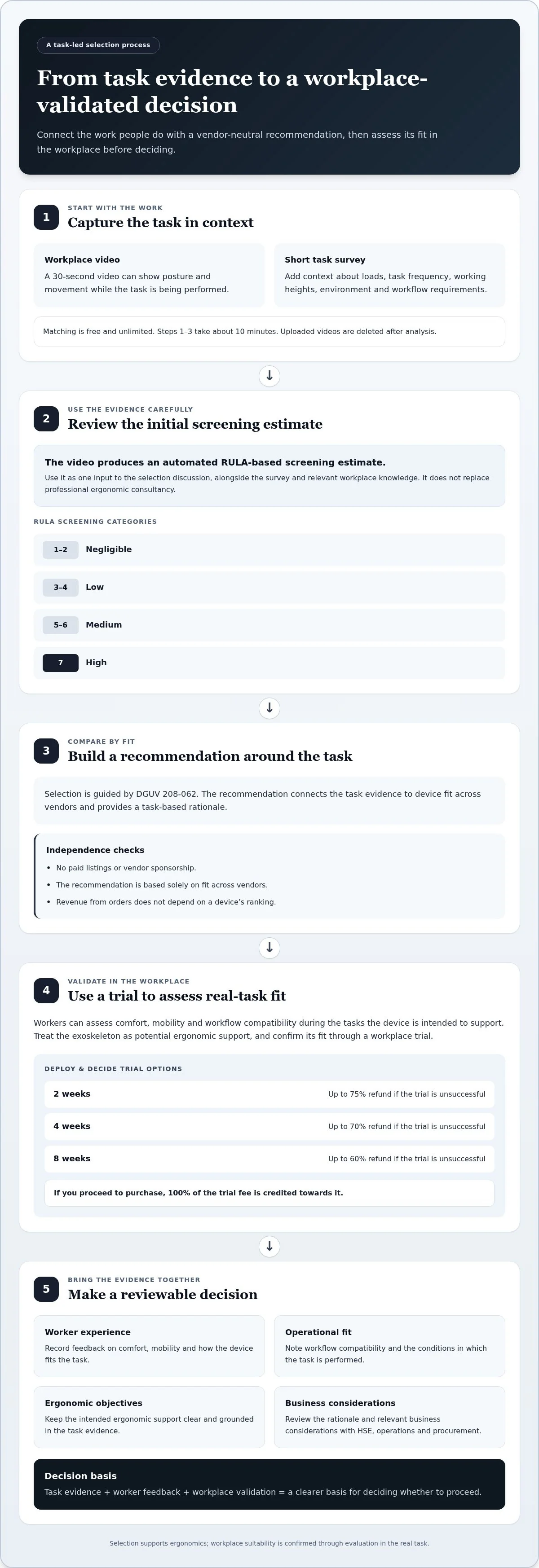
A recommendation is only as useful as the workplace information behind it. A short task survey and a 30-second workplace video give the matching process a view of the work being done, rather than relying on a job title or product description alone. Matching is free and unlimited, and steps one to three take about 10 minutes. Uploaded videos are deleted after analysis.
What the workplace video and task survey contribute
The video can show posture and movement during a task; the survey adds context a brief recording may not capture. Describe loads, how often the task occurs, the work environment and relevant workflow requirements. Together, these inputs structure task information using DGUV 208-062 selection guidance and inform the rationale for the recommendation.
This evidence matters because the same task label can conceal different physical demands. The survey can clarify whether workers handle loads at varied heights, repeat a movement or work in a constrained area. The video shows how the movement happens in practice. Neither provides a complete picture of every task or shift, so add relevant workplace knowledge when reviewing the recommendation.
How to interpret an automated RULA-based screening estimate
The video produces an automated RULA-based screening estimate. Its categories are 1-2 negligible, 3-4 low, 5-6 medium and 7 high. Treat the estimate as an initial input to a selection discussion, not as a certified assessment, a complete ergonomic audit or a substitute for professional ergonomic consultancy.
Use the result alongside the task survey and workplace knowledge. It can help focus attention on the task and inform what support may be relevant, but it cannot determine by itself whether a device will be comfortable or compatible with the workflow. The CDC/NIOSH discussion of exoskeleton safety and health also underscores why workplace evaluation is part of responsible selection.
Using these inputs, Ryggo provides one recommendation with a rationale based on task fit across vendors. This gives HSE, operations and procurement a clearer basis for deciding whether to proceed to a workplace trial, where workers can assess fit during real tasks. To begin a task-based match, use Ryggo’s exoskeleton recommendation process.
Ready to find the right device for your operation?
Find my exoskeleton →How to assess whether exoskeleton advice is genuinely independent
It’s reasonable to ask whether commercial incentives can influence which device is recommended. A claim of independence is more useful when buyers can see how the recommendation is made and how the business earns revenue. Ryggo does not accept paid listings or vendor sponsorship. Recommendations are based solely on fit across vendors, with one neutral recommendation for the task rather than a ranked set of competing suggestions.
Ryggo earns revenue from orders placed through its exchange, but the rates do not depend on a device’s ranking. The recommendation logic points to task evidence, not the commercial value of promoting one device. For buyers assessing vendor-neutral exoskeleton recommendations, transparency about both the selection basis and revenue model gives procurement and HSE teams a clearer basis for scrutiny.
Questions buyers can use to examine recommendation logic
Look for a rationale that explains how the work relates to device suitability. It should be possible to trace the recommendation back to task demands and relevant workplace conditions, rather than broad claims that a device is “best” or “most advanced”. Useful questions include:
- Which task characteristics informed the recommendation?
- What makes the device a relevant fit for those demands?
- Which aspects still need to be validated with workers during a trial?
These questions help distinguish a fit-based recommendation from a vendor’s own product guidance. A vendor can provide important device information, but the recommendation should explain why that information matters for the specific task. Industry work on evaluation frameworks is also developing, including through ASTM Committee F48 on Exoskeletons and Exosuits.
How Ryggo handles vendor-submitted device information
Vendors submit device specifications through a standard form. Ryggo reviews the information before a device is listed and corrects it if a fault is found later. This provides a consistent basis for comparison while keeping vendor-submitted specifications separate from the task-fit decision. A submission does not determine a device’s ranking or override workplace evidence.
For buyers, the practical test is whether the recommendation’s rationale remains clear from assessment through trial. If it does, the team can discuss the fit, record unresolved questions and use workplace experience to inform the purchase decision.
How to turn a neutral exoskeleton recommendation into a sound decision
A recommendation is a starting point, not a purchase decision. Use a workplace trial to check whether the proposed exoskeleton supports ergonomics during the actual task and fits the way work is organised. Treat strain reduction, comfort and operational benefits as outcomes to assess, not guaranteed results.
Keep a decision record linking the original task rationale to what workers and managers observe during the trial. This makes the reasoning clear for HSE, operations and procurement, including where the device fits, where it creates friction and whether it supports the objectives set before testing.
What to observe during workplace validation
Gather structured feedback from the people performing the task. Compare their experience with the conditions described during matching, and record observations such as:
- Fit and comfort: Does the device remain comfortable during the task, and do workers report pressure or movement restrictions?
- Mobility: Can workers perform the required movements and transitions as expected?
- Workflow compatibility: Does the device fit with the workstation, tools, clothing and sequence of work?
- Practical limitations: What adjustments or task conditions affect its use?
Record what happened rather than making broad safety claims. If a task, shift or working condition differs from the original description, note the difference. This helps the team distinguish a device-fit issue from a change in the work being assessed.
How to make the purchase decision defensible
At the end of the trial, compare observations with the recommendation rationale and the objectives agreed beforehand. Include worker feedback, workflow compatibility and professional ergonomic input where appropriate. A clear record should show what was tested, what the team learned and which considerations informed the decision to proceed, adjust the approach or stop.
For further practical guidance, see Exoskeleton Try-Before-You-Buy Programs: A Buyer’s Guide for the trial decision and Industrial Exoskeleton Trial Program: The Operational Guide to Pilot Success for pilot planning. Together, these steps turn vendor-neutral exoskeleton recommendations into an operational decision grounded in workplace evidence.
Use Deploy & Decide workplace trials to validate an exoskeleton recommendation before purchase.
How Ryggo’s Deploy & Decide process supports a confident purchase
Ryggo is Europe’s first independent exoskeleton exchange. Its matching process turns information about a real workplace task into one vendor-neutral recommendation with a rationale. Buyers can then decide whether to trial the recommended device in their own operation before making a purchase commitment.
The steps are straightforward: upload a 30-second workplace video, complete a short task survey, review the recommendation, then decide whether to proceed with a Deploy & Decide trial. Matching is free and unlimited, and steps one to three take about 10 minutes. Uploaded videos are deleted after analysis.
What happens after a recommendation
A recommendation identifies a device to evaluate against the task. Deploy & Decide gives the team an opportunity to check its fit with workers and workflow before deciding whether to buy. Trials are available for 2, 4 or 8 weeks under one cost formula, with the terms clear before the trial begins.
Devices ship directly from their manufacturers, which provide onboarding, training and service. Ryggo operates in 23 European countries under one set of commercial terms, helping organisations assess recommendations across locations with consistent conditions.
Choose the next step with clear terms
If a trial is unsuccessful, the applicable refund is up to 75% for a 2-week trial, 70% for a 4-week trial or 60% for an 8-week trial. If the buyer proceeds to purchase, 100% of the trial fee is credited towards it, so the fee is not paid twice.
These terms make the next step easier to evaluate, but the purchase decision should still rest on workplace evidence: task fit, worker feedback and whether the trial supports the intended ergonomic objectives. That is how vendor-neutral exoskeleton recommendations move from a considered match to a decision grounded in the operation.
Get a neutral exoskeleton recommendation and decide whether a Deploy & Decide trial is right for your task.
Not sure which exoskeleton fits your task? Let the Ryggo advisor match it independently.
Find my exoskeleton →Make the next decision with workplace evidence
A sound exoskeleton decision starts with the task, not the sales pitch. Use workplace evidence to guide selection, then involve workers and validate fit, comfort and workflow compatibility in a trial. Treat potential strain reduction and operational benefits as outcomes to assess, not promised results.
Vendor-neutral exoskeleton recommendations are more credible when the rationale is clear and commercial influence is transparent. Ryggo’s recommendations are based solely on fit across vendors; paid listings and vendor sponsorship are not accepted. Deploy & Decide offers 2-, 4- or 8-week trials. If a trial is unsuccessful, refunds are up to 75%, 70% or 60%, respectively. If you proceed to purchase, 100% of the trial fee is credited towards it.
Move from comparison to practical validation with a clear basis for your decision. Get a neutral exoskeleton recommendation and identify a suitable next step for your workplace. A careful trial can help your team make that decision with greater confidence.
Frequently Asked Questions
What does vendor-neutral mean when choosing an exoskeleton?
Vendor-neutral means the recommendation is based solely on how well a device fits the task, rather than on paid placement or vendor sponsorship. Ryggo does not accept paid listings or vendor sponsorship. It provides one recommendation for the task across vendors, with a rationale buyers can review. Ryggo earns from orders, but its revenue rates do not depend on a device’s ranking, keeping the recommendation separate from commercial incentives.
How does Ryggo recommend an exoskeleton for a workplace task?
Ryggo uses a 30-second workplace video and a short task survey to understand the work, including loads, movements and environment. The survey is structured using DGUV 208-062 selection guidance. Steps one to three take about 10 minutes, and matching is free and unlimited. The information informs one vendor-neutral recommendation with a rationale and ROI, helping the buyer decide whether to proceed to a workplace trial.
Is Ryggo’s RULA result a certified ergonomic assessment?
No. The video produces an automated RULA-based screening estimate, not a certified assessment. RULA categories are 1-2 negligible, 3-4 low, 5-6 medium and 7 high. Treat the result as an initial input to the selection discussion, alongside task information and workplace expertise. It is not a complete ergonomic audit and does not replace professional ergonomic consultancy.
What happens to workplace videos uploaded for exoskeleton matching?
Uploaded workplace videos are deleted after analysis. The short video produces an automated RULA-based screening estimate and informs the matching process alongside the task survey. The survey captures context such as loads, movements and the work environment. The video and estimate support an initial view of the task, but they do not establish device suitability on their own or replace professional ergonomic consultancy.
How long can an exoskeleton trial last through Deploy & Decide?
Deploy & Decide offers trials of 2, 4 or 8 weeks. A trial lets workers and decision-makers assess the recommended device in their own operation, including its fit, comfort, mobility and compatibility with the workflow. Compare workplace observations with the original task rationale and objectives. This provides practical evidence for a purchase decision instead of relying on product claims alone.
Can the exoskeleton trial fee be applied to a purchase?
Yes. If you proceed to purchase, 100% of the trial fee is credited towards it, so you don’t pay the fee twice. If a trial is unsuccessful, refunds are up to 75% for 2 weeks, 70% for 4 weeks or 60% for 8 weeks. These are maximum refund rates, not a promise of a full refund. Compare the trial outcome with workplace observations before deciding.
Does an exoskeleton guarantee injury prevention or safer work?
No. An exoskeleton cannot be described as guaranteeing injury prevention or safer work. Its potential role is to support ergonomics or reduce strain, and those outcomes need to be assessed in the specific workplace. Evaluate task fit, worker experience and workflow compatibility during a trial. Use professional ergonomic input where appropriate, and do not treat an exoskeleton as removing risk or replacing wider workplace risk management.
Find the right device before you trial anything
The Ryggo advisor maps your task, environment, and requirements to compatible devices — independently, across the full European market.
Find my exoskeleton →