Key Takeaways
- How an exoskeleton for overhead assembly transfers static muscular strain away from the shoulder complex directly to the pelvic girdle without impeding arm mobility.
- The practical trade-offs between passive mechanical architectures under three kilograms and powered systems, including maintenance overhead and shift duration constraints.
- Critical spatial clearance and cycle-synchronisation criteria to prevent equipment snagging in tight vehicle cabins or resisting operators during downward motions.
- A structured integration pathway using automated postural screening to baseline strain against DGUV 208-062 guidance before deploying units on live lines.
- Methods to escape pilot purgatory by evaluating concrete operational metrics, protecting shift continuity, and validating measurable health and safety returns.
Table of Contents
- What Is an Exoskeleton for Overhead Assembly and How Does It Work?
- Passive vs. Active Shoulder Exoskeletons: Architecture Comparison
- Technical Selection Criteria for Industrial Assembly Lines
- Integrating Overhead Exoskeletons Without Disrupting Production
- Validating Overhead Exoskeleton ROI: Escaping Pilot Purgatory
What Is an Exoskeleton for Overhead Assembly and How Does It Work?
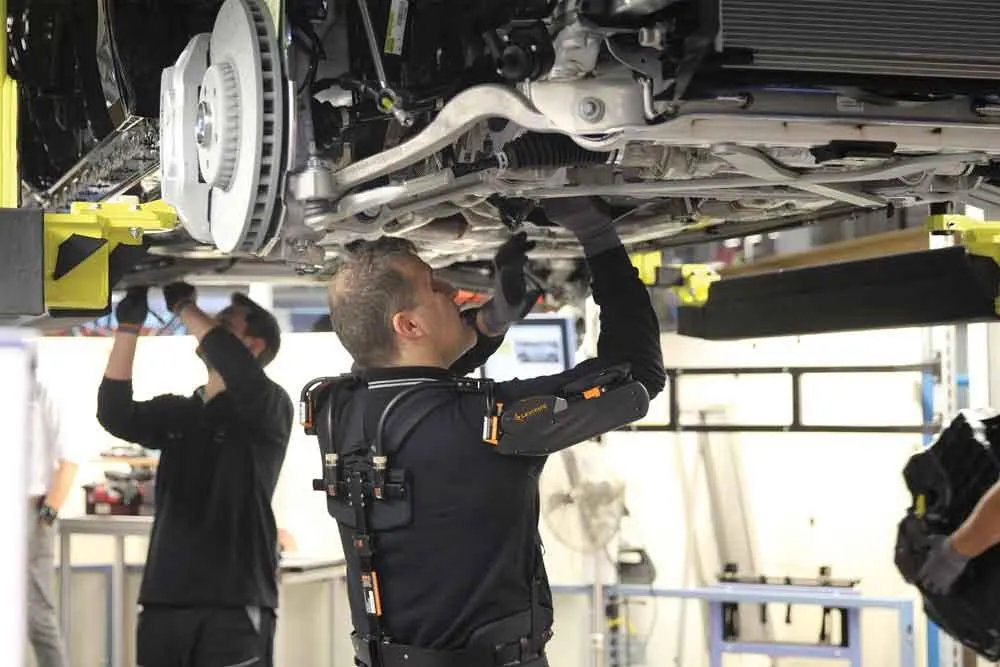
An industrial exoskeleton for overhead assembly is a wearable, ergonomic structure designed to support the arms during continuous upward tasks. Unlike overhead tool balancers that tether a worker to an overhead gantry or fixed rail, wearable upper-limb suits move with the operator across the workstation. They transfer mechanical strain away from vulnerable shoulder joints directly down to the pelvic girdle. This redirection offloads the anterior deltoid and trapezius muscles during static working angles, protecting workers without restricting spatial mobility.
The Biomechanics of Overhead Shoulder Fatigue
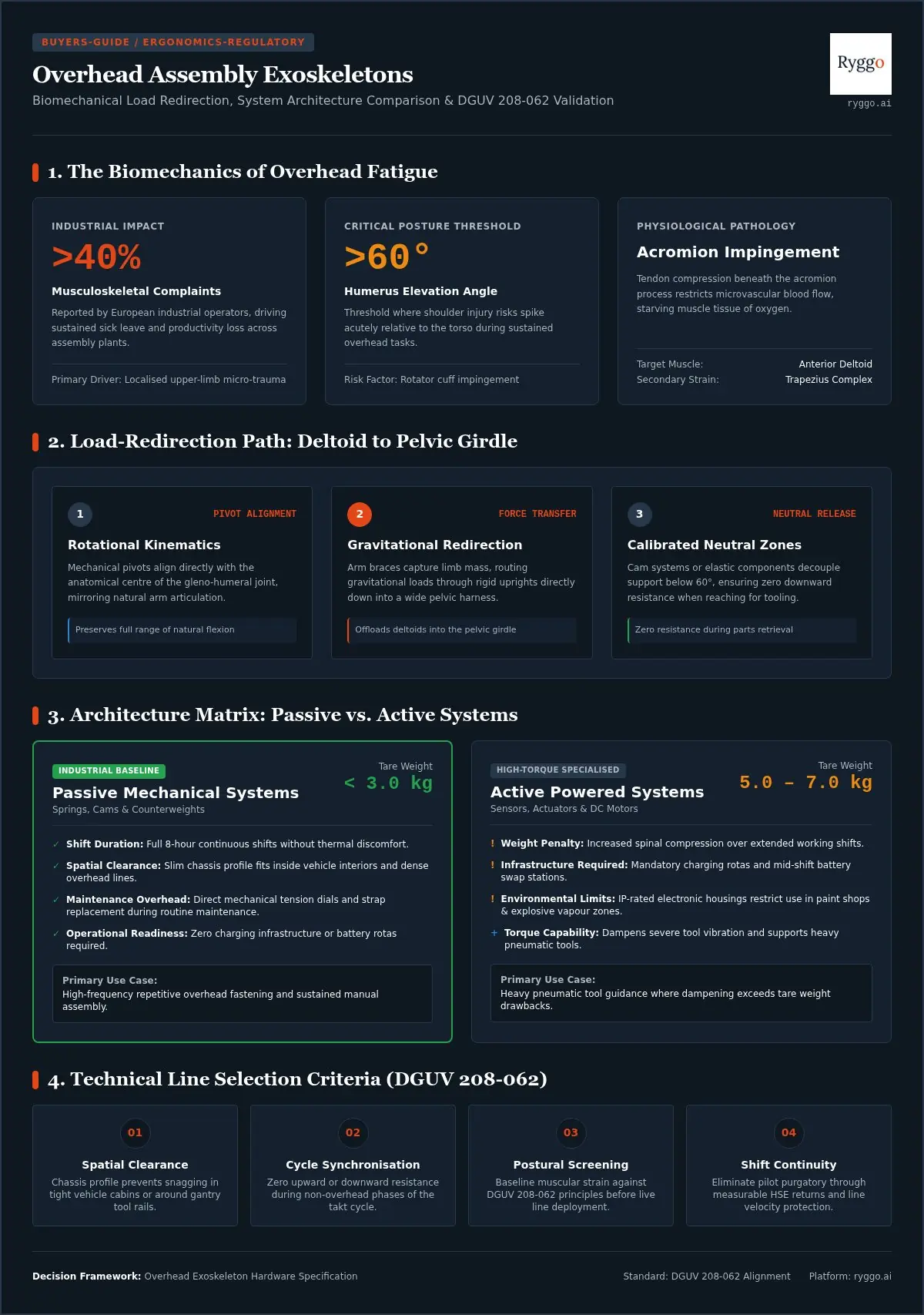
Shoulder injury risks spike whenever the humerus rises past sixty degrees relative to the torso. In this posture, the rotator cuff tendons undergo acute mechanical impingement beneath the acromion process. Sustained muscular contraction restricts microvascular blood flow, starving muscle tissues of oxygen and accelerating fatigue. Over repetitive shifts, this localized strain leads to micro-trauma, driving the high musculoskeletal absenteeism rates that disrupt European manufacturing facilities.
Load-Redirection Mechanics: From Deltoid to Pelvis
Modern upper-body wearable systems rely on precise structural load paths to offload targeted muscle groups:
- Rotational alignment: Integrated mechanical pivots align directly with the anatomical centre of the gleno-humeral joint, mirroring natural articulation through arm flexion.
- Force redirection: Arm braces capture the physical mass of the elevated limb, routing gravitational force through rigid or semi-rigid structural uprights into a wide pelvic harness.
- Calibrated neutral zones: Cam systems or elastic components decouple support below sixty degrees, ensuring zero resistance when workers reach down for parts or tools.
By routing the physical weight of elevated arms down to the hips, an exoskeleton for overhead assembly preserves upper-limb capacity throughout demanding takt cycles.
Passive vs. Active Shoulder Exoskeletons: Architecture Comparison
Choosing an exoskeleton for overhead assembly requires balancing kinematic simplicity against adaptive power. Plant managers typically choose between purely mechanical spring systems and battery-powered electromechanical architectures. While powered models promise adjustable assistance profiles, passive units remain the industrial baseline across European manufacturing plants due to low tare weight and minimal maintenance requirements.
Passive Mechanical Systems: Springs, Cams, and Counterweights
Passive systems store gravitational energy during arm lowering, then release it when the operator raises their limbs. Because they operate without batteries or electronics, passive units weigh under three kilograms. This low mass makes continuous eight-hour shifts practical without introducing thermal discomfort. Their slim chassis profiles allow operators to fit inside vehicle interiors or navigate dense overhead tooling lines. Maintenance remains straightforward; mechanics adjust tension dials or replace mechanical friction straps during routine line maintenance windows.
Active Powered Systems: Sensors, Actuators, and Dynamic Assist
Active suits integrate onboard inertial measurement units and brushless DC motors to deliver variable torque assistance. These systems excel at dampening vibration and supporting heavy pneumatic fastening equipment over head height. However, active models add significant trade-offs:
- Tare weight penalty: Battery packs and servomotors raise chassis weight to between five and seven kilograms, increasing spinal compression over long shifts.
- Charging infrastructure: Operations teams must establish charging rotas and battery-swap stations to avoid mid-shift downtime.
- Operating environments: Electronic housings require IP-rated sealing, limiting use in paint shop zones or cleanroom applications where explosive vapour or particulate risks exist.
For most repetitive overhead fastening tasks, the reduced weight and mechanical reliability of passive hardware outweigh the higher torque delivered by motorized units. To evaluate these mechanical trade-offs against your specific line layout, explore the vendor-neutral exo-advisor tool to calculate operational fit before committing to hardware trials.
Ready to find the right device for your operation?
Find my exoskeleton →Technical Selection Criteria for Industrial Assembly Lines
Specifying an exoskeleton for overhead assembly requires auditing the physical workstation alongside the human operator. While bench tests evaluate mechanical assist levels, live automotive plants and aerospace cells introduce strict spatial and operational boundaries. Ground your screening in established frameworks such as DGUV 208-062, which outlines step-by-step checklists to verify that wearable devices integrate safely without creating secondary operational hazards.
Cycle Times, Spatial Clearance, and Snag-Point Prevention
Workstation architecture dictates hardware geometry. Tight spaces turn bulky suits into productivity liabilities:
- Clearance profiles: Operators entering car body shells, airframe fuselages, or underbody pits need a low-profile chassis. Structural protrusions should not extend beyond the operator's natural shoulder width, preventing costly paint scratches or structural collisions.
- Cycle synchronisation: High-speed assembly cycles demand unrestricted motion. The mechanical assist must engage smoothly during elevation but disengage instantly during lowering. If an operator must push down against stiff spring tension to grab fasteners, the suit creates muscular antagonism and slows line velocity.
- Snag-free architecture: Exposed mechanical linkages, release cords, or wide tension dials easily catch on overhead crane cables and conveyor carriers. Insist on internalised cable routing and recessed adjustment dials.
Harness Modularity and Multi-Shift Hygiene Standards
Industrial deployment falls apart when equipment cannot transition smoothly between shifts. In facilities operating two or three shifts per day, individual chassis allocations are rarely cost-effective. Shared hardware requires rapid modular adjustment:
- Indexing systems: Mechanical arms and torso frames need clear numerical indexing. Workers should be able to resize spine lengths and arm brackets in under sixty seconds during shift changeovers.
- Sanitary interfaces: Textile liners absorb sweat during intensive physical labour. Devices must feature detachable, machine-washable padding kits. Providing individual workers with personal strap sets while sharing the rigid load-bearing chassis maintains strict hygiene standards and worker buy-in.
- Anthropometric range: A suitable exoskeleton for overhead assembly must accommodate diverse statures across the European workforce, typically fitting users ranging from 155 cm to 195 cm without compromising the anatomical alignment of the shoulder pivot.
Integrating Overhead Exoskeletons Without Disrupting Production
Dropping wearable hardware directly onto an active line without preparation guarantees resistance from both operators and production supervisors. Takt times cannot pause for trial-and-error adjustments. Successfully integrating an exoskeleton for overhead assembly requires an empirical four-step roadmap that protects line output while giving technicians the necessary time to adapt physically and operationally.
Step 1 & 2: Task Screening and Posture Baseline Audits
Begin by isolating specific assembly workstations where cycles require operators to hold their arms above chest height continuously. Record short 30-second operational videos of the task to generate an automated screening estimate using RULA scoring. Benchmarking these movement profiles against DGUV 208-062 selection guidance categorises postural risk into four functional tiers: negligible, low, medium, or high. This initial baseline confirms whether wearable assistance is an appropriate intervention or whether physical jig re-engineering should take priority under standard health and safety principles.
Step 3 & 4: Progressive Acclimatisation and Torque Calibration
Rushing into full-shift wear leads directly to device abandonment. When an operator first wears an upper-body support system, stabilizing postural muscles must adapt to the altered physical load transfer. Deploying an exoskeleton for overhead assembly requires structured onboarding:
- Progressive wearing intervals: Cap initial use at one to two hours per shift during the opening two weeks. Schedule these blocks during high-fatigue periods, such as the final third of a shift.
- Precise torque calibration: Fine-tune spring tension so elevated tools feel neutrally buoyant, while confirming the mechanics produce zero upward resistance when workers reach down to grab components.
- Daily feedback loops: Conduct five-minute check-ins at shift handover to address harness contact points, strap tightness, and thermal breathability.
Involving shop-floor safety representatives and team leads from day one removes suspicion and builds collective ownership. To benchmark your current line processes against proven hardware configurations, consult the exo-advisor to match station requirements with validated trial frameworks.
Validating Overhead Exoskeleton ROI: Escaping Pilot Purgatory
Industrial trials frequently stall when sample units end up locked in shift cupboards. Without concrete operational metrics or structured evaluation paths, teams get trapped in pilot purgatory, running indefinite tests with no conclusive procurement decision. Investing in an exoskeleton for overhead assembly must be justified on clear financial and operational returns, linking physical strain reduction directly to plant KPIs rather than treating hardware as an experimental novelty.
Measuring Tangible Operational and Ergonomic Gains
Evaluate trial performance across measurable safety and production metrics rather than relying solely on anecdotal feedback:
- Sick leave and absenteeism: With European workers reporting widespread upper-body musculoskeletal complaints, model cost savings by tracking lost-time shifts and chronic shoulder strain claims against EU-OSHA occupational benchmarks.
- Assembly precision and rework rates: Sustained arm elevation causes subtle muscular micro-tremors during fastening. Stabilising arm mass maintains tightening torque consistency and reduces cross-threading errors across full eight-hour shifts.
- Operator endurance: Track fatigue curves through end-of-shift physical discomfort surveys, monitoring grip strength and voluntary adoption rates on active stations.
The Deploy & Decide Framework: Structured Line Trials
Overcoming trial paralysis requires an empirical try-before-you-buy methodology. Through the Deploy & Decide programme, plants test shortlisted systems directly on live lines for defined periods of 2, 4, or 8 weeks. This structure ensures operators evaluate an exoskeleton for overhead assembly under actual takt times without premature capital expenditure.
Unified commercial terms eliminate procurement friction. Exactly 100% of trial fees credit directly toward eventual equipment purchases. If a device fails to satisfy shop-floor requirements, structured refunds mitigate the downside: 75% for 2-week trials, 70% for 4-week trials, and 60% for 8-week trials. Plant leaders can assess hardware across 13 industrial devices from 6 European manufacturers without vendor bias. Use the Ryggo exoskeleton advisor to model operational fit, calculate projected ROI, and launch an objective line evaluation.
Not sure which exoskeleton fits your task? Let the Ryggo advisor match it independently.
Find my exoskeleton →Securing Shop-Floor Buy-In with Objective Trial Frameworks
Protecting overhead assembly technicians requires balancing biomechanical relief against line speed. Long-term ergonomic success never hinges on maximum motor power; it depends on zero downward resistance, chassis clearance within tight workstations, and rapid multi-shift adjustability. Selecting the right exoskeleton for overhead assembly means verifying these kinematic realities on your active line before allocating capital expenditure.
You don't have to navigate procurement alone or risk pilot purgatory. Start by generating an automated video screening estimate mapped to DGUV 208-062 ergonomic standards. Compare 13 devices from 6 leading European manufacturers through an independent, vendor-neutral exchange. With risk-mitigated Deploy & Decide trial terms offering up to 75% refunds, you can test shortlisted systems under actual takt times with complete financial peace of mind. Take the first step toward lasting worker protection and find the right overhead assembly exoskeleton for your line today.
Frequently Asked Questions
How much physical shoulder relief does an overhead assembly exoskeleton provide?
Upper-extremity exoskeletons typically reduce electromyographic deltoid strain by 20% to 40% during sustained overhead tasks. By transferring elevated arm weight directly through structural struts down to the pelvis, the suit converts localized muscular fatigue into broad compressive load. This offloading preserves operator stamina during static elevation. However, actual relief depends on precise spring calibration and whether the task angle consistently exceeds sixty degrees.
Can an overhead assembly exoskeleton restrict an operator's natural range of motion?
A properly fitted exoskeleton for overhead assembly will not restrict natural functional movement on the line. Modern mechanical pivots decouple below sixty degrees of elevation, allowing unrestricted reaching into parts bins at waist height. However, poorly adjusted chassis uprights or excessive protrusion profiles can hinder torso twisting and make entering confined vehicle cabins awkward, reinforcing the need for active line clearance testing.
Is a passive mechanical exoskeleton sufficient for supporting heavy overhead tools?
Passive mechanical systems easily support sustained arm posture alongside tools weighing up to three or four kilograms. For considerably heavier assembly tools, such as large pneumatic impact wrenches exceeding five kilograms, passive suits can prove insufficient on their own. In those specific scenarios, pairing a passive wearable suit with an overhead articulating tool balancer or exploring powered active units delivers the best operational outcome.
How do manufacturing plants manage hygiene when multiple workers share an exoskeleton?
Facilities maintain high sanitary standards by assigning each operator a personal, detachable soft-goods kit. While the external load-bearing chassis is shared across rotating shifts, all machine-washable foam padding, chest straps, and waist harnesses detach in under sixty seconds. This approach eliminates cross-contamination and sweat absorption between workers without requiring plant procurement teams to purchase individual structural frames for every employee.
What happens if assembly operators resist wearing an exoskeleton on shift?
Shop-floor resistance usually occurs when devices are mandated without prior worker consultation or introduced without a progressive acclimatisation schedule. Forcing compliance leads directly to abandoned gear. Involve health and safety representatives early, let operators trial devices voluntarily, and establish five-minute daily feedback check-ins. If resistance persists, re-evaluate workstation clearance and ensure mechanical torque isn't actively fighting downward arm movement.
How long does an industrial worker take to adapt to wearing a shoulder exoskeleton?
Most line technicians adapt to an exoskeleton for overhead assembly within two to three weeks of structured use. Initial wearing intervals should remain capped at one to two hours per shift, letting stabilizing core and postural muscle groups adapt to the altered load transfer. Natural movement coordination and familiarity with harness adjustments usually stabilize fully by the end of the second week.
Can overhead assembly exoskeletons be worn while operating warehouse tuggers or forklifts?
Wearing shoulder-support exoskeletons while driving industrial vehicles is generally inadvisable. Rigid frame structures and pelvic harnesses interfere with ergonomic seating postures, impede seatbelt latches, and risk snagging on roll cages during cab ingress and egress. Unless a specific system incorporates a low-profile seated decoupling mode, operators must unclip and remove their wearable chassis before operating forklifts or tugger trains.
Find the right device before you trial anything
The Ryggo advisor maps your task, environment, and requirements to compatible devices — independently, across the full European market.
Find my exoskeleton →