Key Takeaways
- Compare devices against the real task, movement, load and work environment, not specifications alone.
- An independent exoskeleton comparison platform should explain how it matches tasks to devices and disclose whether paid listings influence recommendations.
- Use video-based RULA results as automated screening estimates, not certified ergonomic assessments.
- Assess trial options by how well they reflect normal work and capture worker feedback. Ryggo offers 2-, 4- or 8-week trials, with the fee fully credited towards purchase, so there’s no double payment.
- Before choosing a device, look for a clear recommendation rationale and practical next steps for testing the match in your operation.
Table of Contents
- What should an independent exoskeleton comparison platform actually compare?
- How does a vendor-neutral exoskeleton comparison platform reach a recommendation?
- How can buyers verify that an exoskeleton comparison platform is independent?
- How should you compare trial options before choosing an exoskeleton platform?
- When is Ryggo a suitable independent exoskeleton comparison platform?
What should an independent exoskeleton comparison platform actually compare?
An independent exoskeleton comparison platform should work as a decision service, not just a catalogue. It should connect the demands of a specific job to suitable device options and explain the basis for its recommendation. The aim is not to adopt new equipment for its own sake, but to support an informed ergonomics, health and operational decision.
Start with the work. Identify the body region that needs support, the movements involved, the loads handled and how often the task is performed. Then consider the working environment and operating conditions, including how the device might interact with workers’ clothing, tools, access routes and other equipment. These details help distinguish a device feature from evidence that it could suit the job.

Which comparison criteria matter to an industrial buyer?
Compare each option against the same questions. The answers will depend on the task, not simply on the device category.
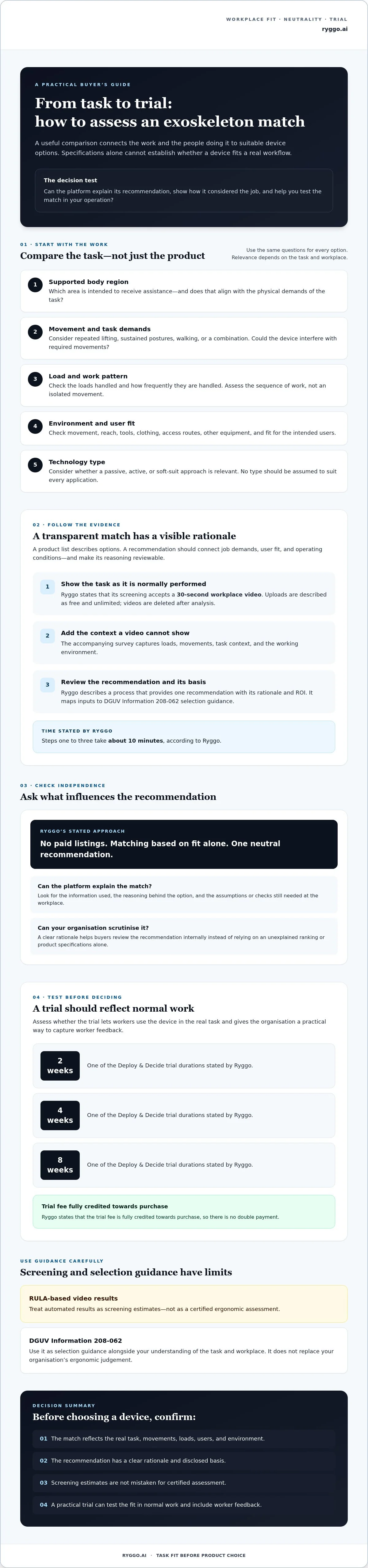
- Supported body region: Which area is intended to receive assistance, and does that align with the physical demands identified in the task?
- Movement and task demands: Does the work involve repeated lifting, sustained postures, walking or a combination? Could the device interfere with movements workers need to complete?
- Load and work pattern: What loads are handled, and how frequently? Does the device appear relevant to the actual sequence of work rather than an isolated movement?
- Environment and fit: Can workers move, reach and use their tools comfortably in the spaces where the task happens? Is the fit suitable for the intended users?
- Technology type: Is a passive, active or soft-suit approach worth considering for this task? None should be assumed to suit every application. For background on what exoskeletons are, including broad technology types and applications, see the overview.
Use DGUV Information 208-062 as selection guidance alongside your understanding of the task and workplace. A comparison can help structure the decision, but it shouldn’t replace your organisation’s own ergonomic judgement.
Why a product list is not a recommendation
A specification can describe a device, but it can’t establish on its own that the device suits a particular workflow. A catalogue may help buyers identify options. A recommendation should show how task demands, user fit and operating conditions informed the match.
Look for a clear rationale rather than promotional claims or unexplained rankings. Can the platform explain why an option is relevant, what assumptions it used, and what still needs to be checked in the workplace? Without that information, the buyer has to bridge the gap between product features and job suitability.
How does a vendor-neutral exoskeleton comparison platform reach a recommendation?
A useful match starts with the work, not a preferred device. Ryggo’s process moves from a short workplace video to a survey, then provides one recommendation with its rationale and ROI. The buyer can then decide whether to proceed to a trial. Steps one to three take about 10 minutes, according to Ryggo.
This approach makes the decision process more transparent than an unexplained ranking. Ryggo states that it doesn’t accept paid listings and matches on fit alone. When assessing an independent exoskeleton comparison platform, check what information informs the recommendation and whether the reasoning is clear enough to review internally.
What information should buyers provide for a useful match?
The video should show the task as it is normally performed. Ryggo’s screening accepts a 30-second workplace video, with free, unlimited uploads. Videos are deleted after analysis. A video can show posture and movement, but it needs context to support a useful task match.
The accompanying survey captures details such as loads, movements, task context and the working environment. These inputs are mapped to DGUV Information 208-062 selection guidance. Accurate information about the actual operation helps make the recommendation rationale and ROI calculation more relevant. A recommendation is a starting point for evaluation, not proof that a device will suit every worker or shift.
For a broader framework on testing factors such as fit, comfort, mobility and task efficiency, see the National Institute of Standards and Technology’s exoskeleton evaluation methods.
How to interpret automated RULA screening
The video-based RULA result is an automated screening estimate, not a certified assessment. Ryggo presents the score categories as follows:
- 1-2: negligible
- 3-4: low
- 5-6: medium
- 7: high
Use these categories as an initial screening signal, not a final judgement about risk or device suitability. If the task needs a broader or formal ergonomics review, involve a qualified professional. The estimate does not constitute a certified ergonomic assessment or replace professional ergonomic consultancy.
Once you’ve reviewed the recommendation, a workplace trial can help assess the match in real conditions before deciding whether to purchase. When reviewing Ryggo’s task-matching process, consider how its video, survey and recommendation fit your evaluation workflow.
Ready to find the right device for your operation?
Find my exoskeleton →How can buyers verify that an exoskeleton comparison platform is independent?
Independence is more than a label. Check how the platform earns revenue, which devices it considers and how it reaches its recommendation. A vendor-led service, a product directory and an independent matching platform can all help buyers find information, but they may serve different purposes. Verify the commercial model and decision process rather than assuming how they work.
Questions to ask about neutrality and vendor coverage
Ask whether manufacturers pay for listings, placement or referrals, and whether those arrangements can affect which devices are shown. Then check the range of technologies considered. Does the platform assess passive, active and soft-suit options across relevant body regions, or only products available through particular suppliers?
The recommendation should relate to your defined task and explain why an option was selected. Look for one neutral recommendation, with a rationale clear enough for HSE, operations and procurement teams to review together.
What a fair platform comparison should disclose
Use the table as a procurement prompt, not a verdict. Ask each provider to confirm its approach and note any limitations that could affect your operation, such as a restricted vendor range or lack of trial access.
| Approach | Incentives to verify | Vendor coverage | Matching rationale | Trial access |
|---|---|---|---|---|
| Vendor-led advice | Ask how the advice is funded and whether the supplier represents particular devices. | Confirm which brands and technologies are included. | Request a task-specific explanation, not only product benefits. | Check whether a workplace trial is available and on what terms. |
| Product directory | Check whether listings are paid, sponsored or ordered by another method. | Establish how complete and current the catalogue is. | Determine whether it matches tasks or simply displays specifications. | Confirm whether trial arrangements are offered or must be sourced separately. |
| Independent matching platform | Ask for a clear account of revenue and placement policies. | Check which technologies and vendors can be considered. | Look for transparent criteria and a reasoned recommendation for your task. | Verify whether the platform can arrange a trial relevant to your workplace. |
Ryggo states that it accepts no paid listings and bases matching on fit alone. Consider this claim alongside the platform’s coverage, criteria and trial arrangements. A fair comparison makes its method and limitations visible, giving buyers a clearer basis for judging whether an independent exoskeleton comparison platform can support a decision for their operation rather than simply provide another product list.
How should you compare trial options before choosing an exoskeleton platform?
A trial is useful only if it tests the work the device is meant to support. Compare trial partners on whether workers can use the equipment in the actual operation, how feedback will be gathered, what criteria will guide the decision and what happens when the trial ends. Agree on these points in advance so the result informs a purchase decision rather than producing impressions that are difficult to compare.
What should an operational exoskeleton trial evaluate?
Involve HSE, operations and participating workers in the planning. Select the task and working conditions to observe, then agree how the team will assess:
- Fit and comfort: Can workers wear and adjust the device comfortably during the relevant work?
- Task compatibility: Does it support the intended movement without obstructing other essential movements?
- Workflow practicality: Can workers use it alongside normal tools, clothing and work processes?
- Worker feedback: What do users find helpful, awkward or difficult, and does the experience vary across participants?
Record observations against the criteria agreed in advance. Don’t assume a trial will reduce injuries or improve productivity; those outcomes need evidence from the operation. Treat the trial as a structured way to assess suitability, worker acceptance and practical constraints before procurement proceeds.
How to assess trial terms without confusing the purchase decision
Ryggo’s Deploy & Decide trials are available for 2, 4 or 8 weeks. The trial fee is fully credited towards the eventual purchase, so no double payment is required. For an unsuccessful trial, refunds are up to 75% for 2 weeks, 70% for 4 weeks or 60% for 8 weeks.
Read the terms alongside the evaluation plan. Confirm what counts as an unsuccessful trial and how the applicable refund is determined. Vendors provide delivery, onboarding and training, and service. Check the arrangements for the specific device and confirm responsibilities before the trial begins.
Choose a duration that gives workers a meaningful opportunity to use the device during representative tasks while keeping the evaluation focused. Set a review point and agree who will decide whether to purchase or stop. This helps an independent exoskeleton comparison platform’s recommendation lead to a clear, evidence-informed next step.
Review Ryggo’s exoskeleton trial options to understand how the programme could fit your evaluation plan.
When is Ryggo a suitable independent exoskeleton comparison platform?
Ryggo may suit organisations that have identified a physically demanding task and want a vendor-neutral match before purchasing a device. It is particularly relevant when a buyer needs help narrowing options across technologies, wants a clear recommendation rationale and plans to assess suitability in the workplace rather than rely on specifications alone.
The process moves from task information to a decision point: upload a short video of the work, complete a survey, review one recommendation, then decide whether to proceed with a trial. Ryggo states that it does not accept paid listings and that matching is based on fit alone. Its AI-driven recommendation includes rationale and ROI. Buyers should consider that information alongside their own operational assessment and worker feedback.
Ryggo also offers free, unlimited automated RULA screening estimates from uploaded videos. These can help inform the type of exoskeleton to consider, but they are screening estimates, not certified ergonomic assessments. They don’t replace a broader review by a qualified ergonomics professional where one is needed.
What Ryggo provides, and what it does not
Ryggo arranges Deploy & Decide trials and offers the opportunity to try listed exoskeletons before purchase. It doesn’t manufacture devices, provide hardware repairs or deliver certified ergonomic assessments. Vendors provide hardware onboarding and training, so confirm the arrangements and responsibilities for the specific device before a trial begins.
Ryggo operates in 23 European countries under one set of commercial terms. Customers sign up once and can order across borders.
How to take the next step with a platform comparison
Before submitting a task, define what you want the comparison to resolve: which body region needs support, what movements are involved, and what conditions a device must accommodate. Share an accurate task description and video, then check whether the recommendation rationale addresses those requirements. If you proceed to a trial, agree on evaluation criteria with HSE, operations and participating workers, and use the results to inform, not predetermine, the purchase decision.
For a task-specific comparison, start comparing exoskeleton options with Ryggo. Review the recommendation and trial terms against your operation before deciding on the next step.
Not sure which exoskeleton fits your task? Let the Ryggo advisor match it independently.
Find my exoskeleton →Make the next decision evidence-led
Before moving from comparison to procurement, make sure your decision record connects the task requirements to the recommended device, captures any assumptions and identifies what your team still needs to validate. That gives HSE, operations and procurement a shared basis for reviewing the choice. A useful independent exoskeleton comparison platform should support the process with reasoning your team can examine, not ask you to accept a recommendation without context.
Keep the final decision grounded in evidence from your own operation. Document worker feedback, practical constraints and the criteria used to assess the match. This creates a clearer path from an initial recommendation to a considered purchasing decision without assuming outcomes that haven’t been demonstrated at your workplace.
To assess a task against suitable options, start comparing exoskeleton options with Ryggo and use the results to guide your team’s next review.
Frequently Asked Questions
What is an independent exoskeleton comparison platform?
An independent exoskeleton comparison platform helps buyers match workplace tasks with suitable devices rather than simply displaying product specifications. It should explain the criteria behind its recommendation, including task demands and working conditions, so HSE and procurement teams can assess the match. Ryggo describes its AI-driven process as providing one neutral recommendation based on fit alone, followed by the option to consider a workplace trial.
How can I tell whether an exoskeleton comparison platform is vendor-neutral?
Ask how the platform is funded, whether paid placement can affect which devices appear, and which vendors and technologies it considers. Then check whether the recommendation explains why a device fits your task rather than relying on a ranking without clear criteria. Ryggo states that paid listings are not accepted and that matching is based on fit alone. Review the platform’s terms as part of your evaluation.
Can an AI RULA score replace a certified ergonomic assessment?
No. Ryggo’s video-based RULA result is an automated screening estimate, not a certified ergonomic assessment. It can offer an initial indication to help inform exoskeleton selection, but it isn’t a formal assessment or a replacement for professional ergonomic consultancy. If your operation needs a broader or formal review, involve a qualified ergonomics professional and consider the full task and workplace context.
How long does Ryggo’s exoskeleton matching process take?
Ryggo says steps one to three take about 10 minutes. These steps involve uploading a short workplace video, completing a survey about loads, movements and the working environment, and receiving one recommendation with rationale and ROI. This estimate covers the matching process, not a workplace trial or the time your team may need to review the recommendation and decide on next steps.
What happens to a video uploaded for Ryggo’s ergonomics screening?
Ryggo states that uploaded videos are deleted after analysis. The video is used as part of its screening and task-matching process, alongside the survey information supplied by the buyer. When preparing a submission, show the relevant task clearly and provide accurate context in the survey. The resulting RULA score remains an automated screening estimate, not a certified assessment.
What refund does Ryggo offer if an exoskeleton trial is unsuccessful?
For an unsuccessful trial, Ryggo offers a refund of up to 75% for a 2-week trial, up to 70% for a 4-week trial, or up to 60% for an 8-week trial. The refund depends on the selected trial period and is not a guaranteed full refund. Review the applicable trial terms before starting, and agree how your team will evaluate whether the device meets the task requirements.
Can the Ryggo trial fee be applied to buying the recommended exoskeleton?
Yes. Ryggo states that the trial fee is fully credited towards the eventual purchase, so no double payment is required. A trial lets your team assess the recommended device in the operation before deciding whether to buy. Review the terms for the specific trial and device, then use your agreed evaluation criteria and worker feedback to inform the purchase decision.
Find the right device before you trial anything
The Ryggo advisor maps your task, environment, and requirements to compatible devices — independently, across the full European market.
Find my exoskeleton →