Key Takeaways
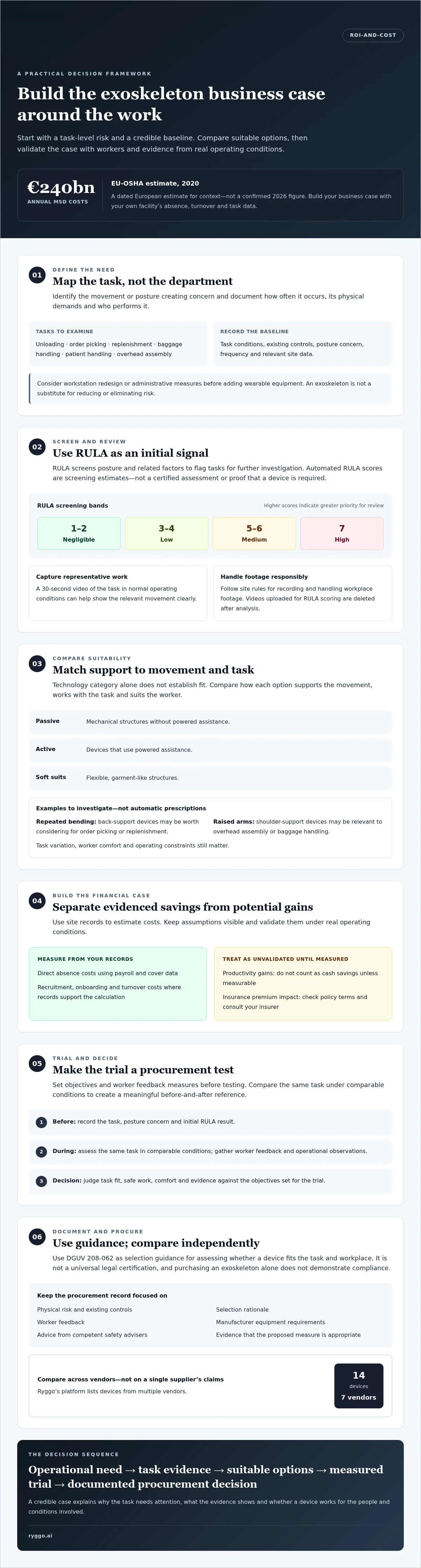
- Use EU-OSHA’s 2020 estimate of €240 billion in annual MSD costs as context, then build your case around the risks and operational needs at your own site.
- Start with task-level evidence. RULA-based automated screening estimates can flag postures for further review, but they are not a certified assessment.
- Separate measurable savings, such as absence and cover costs, from potential productivity gains. Validate assumptions in real operating conditions.
- Set trial objectives and worker feedback measures before testing devices, so the trial supports a structured procurement decision.
- Compare suitability across vendors rather than relying on a single supplier’s claims. Ryggo’s platform lists 14 devices from 7 vendors (and more to come).
Table of Contents
- The Strategic Drivers: Why Exoskeletons Matter in 2026
- Data-Backed Needs Assessment: From Video to RULA Scores
- Calculating the ROI of Industrial Exoskeletons
- The Trial Strategy: Implementing "Deploy & Decide"
- Selecting the Right Partner: Neutrality and Independence
The Strategic Drivers: Why Exoskeletons Matter in 2026
Exoskeleton procurement should begin with a work-related risk, not an interest in new hardware. The European Agency for Safety and Health at Work (EU-OSHA) estimated in 2020 that work-related MSDs cost the EU €240 billion annually. Treat this as a dated European estimate, not a confirmed 2026 figure. For your business case, use your facility’s own absence, turnover and task data.
Exoskeletons may support workers during specific tasks, but they are not a substitute for redesigning work to eliminate or reduce risk. They can be powered or passive exoskeletons, with soft-suit technologies also available. The practical question is whether a device suits the movement, task and worker. In logistics, reducing physical demands may be relevant to workforce planning and retention, but that is a potential benefit to assess, not a guaranteed result.

The Cost of Inaction in European Operations
Build your baseline before estimating benefits. Use your own payroll and cover data to calculate direct absence costs. Add recruitment, onboarding and turnover costs only where your records support the calculation. Don’t count estimated productivity gains as cash savings unless you can measure them. Insurance premiums may be influenced by several factors, so check policy terms and consult your insurer before including any expected premium impact.
Map tasks rather than whole departments. Examine activities such as unloading, order picking, replenishment, baggage handling, patient handling or overhead assembly where repeated handling or sustained postures may raise ergonomic concerns. Record how often the task occurs, the physical demands involved and who performs it. A specific task definition gives procurement something concrete to address and provides a baseline for comparing trial results.
Regulatory Alignment with DGUV 208-062
Use DGUV 208-062 as guidance when structuring exoskeleton selection. It can help teams assess whether a device fits the task and workplace. Don’t present it as a universal legal certification or assume that buying an exoskeleton alone demonstrates compliance. Confirm equipment requirements with the manufacturer and your competent safety advisers.
For a defensible procurement record, document the physical risk, existing controls, selection rationale and worker feedback. Consider whether workstation redesign or administrative measures could address the exposure before adding wearable equipment. Don’t assume a safety audit follows a new exoskeleton-specific rule. Instead, make sure your risk-management evidence explains why the proposed measure is appropriate.
That sequence is central to how to write a business case for exoskeletons 2026: establish the operational need, use DGUV 208-062 to guide selection, then test whether a suitable device works in real conditions.
Data-Backed Needs Assessment: From Video to RULA Scores
Start with the movement that creates the ergonomic concern, not a device category. The Rapid Upper Limb Assessment (RULA) is a screening method that scores posture and related factors to flag tasks for further investigation. Ryggo’s RULA scores are automated screening estimates, not a certified assessment. The risk bands are 1–2 negligible, 3–4 low, 5–6 medium and 7 high. Use the result to guide further review, not as proof that a particular exoskeleton is required.
A practical starting point is a 30-second video of the task in normal operating conditions. Capture the relevant movement clearly, such as repeated reaching during replenishment or sustained arm elevation during assembly. Follow your site’s rules for recording and handling workplace footage, and make sure the clip represents typical work rather than a staged demonstration. Videos uploaded for RULA scoring are deleted after analysis.
Map Movements to Device Categories
Different technologies support the body in different ways. Passive devices use mechanical structures without powered assistance; active devices use powered assistance; soft suits use flexible, garment-like structures. These categories don’t determine suitability on their own. Match the support to the movement and task, then check that the device doesn’t interfere with safe work.
For example, a back-support device may be worth considering for order picking or replenishment involving repeated bending. A shoulder-support device may be relevant to overhead assembly or baggage handling where workers repeatedly hold their arms raised. These are starting points for comparison, not automatic prescriptions. Task variation, worker comfort and operating constraints still matter.
Build a Baseline for Your Business Case
Record the task, the posture concern and the initial RULA result before a trial. Then assess the same task under comparable conditions during testing. This creates a useful before-and-after reference. Worker feedback and operational observations add context, helping you assess whether the device is practical to wear and use.
Ryggo’s platform lets a company upload a 30-second workplace video for a free, unlimited RULA screening estimate, then complete a short questionnaire about loads, movements and the work environment. The questionnaire is mapped to the DGUV 208-062 selection framework. The matching process, including the video, survey and recommendation steps, takes about 10 minutes. The output is an initial screen and a vendor-neutral recommendation with rationale and ROI, not a certified assessment. Use appropriate ergonomics and safety expertise for decisions that require a fuller assessment.
This gives you a more defensible starting point for how to write a business case for exoskeletons 2026: document the task and its baseline, identify the movement a device needs to support, and test whether the recommendation fits real working conditions.
Ready to find the right device for your operation?
Find my exoskeleton →Calculating the ROI of Industrial Exoskeletons
A credible ROI calculation starts with evidence from your facility, not a market-growth forecast. Separate potential direct savings, such as reduced absence, from indirect benefits, such as steadier throughput during demanding shifts. Then compare them with the total cost of ownership (TCO), and state which assumptions still need testing.
For an exoskeleton business case, ROI means the value of measurable reductions in work-related costs and operational disruption over time compared with the full cost of the intervention. Be clear about what you can measure now and what a trial would need to validate.
Direct vs. Indirect Financial Benefits
For direct costs, calculate what one day of absence costs at your site. Use actual payroll and cover arrangements, and include replacement or overtime costs only where you can substantiate them. Compare absence records for the relevant task or group over a suitable period. Don’t assume an exoskeleton will reduce sick days before you have trial evidence.
Indirect benefits need equal care. Physical fatigue may contribute to extra pauses or slower work, including short, informal “micro-breaks”. Observe the task during comparable shifts and record pauses, output and relevant operating conditions before and during a trial. Treat any throughput difference as an indicator to investigate, not proof that the device caused it.
For longer-term outcomes, consider whether sustained ergonomic improvements could support workers to remain in their roles or reduce risks such as disability-related absence or early retirement. Treat these as potential benefits, not guaranteed savings, and avoid assigning them a monetary value without reliable internal evidence.
Include the Full Cost of Ownership
For a deployment spanning multiple countries, model costs by site and country rather than assuming one figure applies everywhere. Ryggo operates in 23 European countries under one set of commercial terms, with customers able to sign up once and order across borders. Still, check the selected device’s purchase cost, trial terms, vendor-provided onboarding and training, service and any other costs that apply to your proposal. Confirm which costs are recurring and which are one-off.
- Direct savings: verified absence and cover costs that could be avoided.
- Operational indicators: measured output, pauses and task quality, reported separately from cash savings.
- TCO: confirmed costs across the sites and countries included in the proposal.
Account for Procurement Complexity
Exoskeleton selection can take up to 6 months from idea to committed purchase, with 2–3 months spent deciding what to test. A vendor-neutral recommendation can help narrow the options earlier. Ryggo’s matching process takes about 10 minutes for the video, questionnaire and recommendation steps. That initial match is not a replacement for safety review, a workplace trial or procurement approval.
For a cross-border purchase, clarify how the shared commercial terms apply to the sites involved and confirm any other requirements with your procurement team. This evidence-led approach is central to how to write a business case for exoskeletons 2026: quantify what you can verify, label uncertain benefits clearly and validate operational fit before committing.
The Trial Strategy: Implementing "Deploy & Decide"
A vendor demonstration can show how a device works. On its own, it can’t establish whether workers will use it consistently or whether it suits the task across a normal shift. Without pre-agreed measures and comparable conditions, a demonstration risks becoming a showcase rather than evidence for a procurement decision.
Ryggo’s Deploy & Decide programme gives companies a structured way to trial selected devices in their own operations. Choose a 2-, 4- or 8-week period, define the task and users, and record findings against the same criteria throughout. A longer trial isn’t automatically better. Choose the offered period that gives workers a fair opportunity to use the device in representative conditions and supports a clear decision.
Set Success Criteria Before the Trial
Agree what would count as a suitable operational fit before the trial begins. Measures might include worker willingness to wear the device, comfort feedback, task compatibility and changes in RULA screening estimates. Because RULA scores are automated screening estimates, not a certified assessment, use them as one indicator rather than a stand-alone measure of success.
Where practical, compare suitable devices side by side against the same task and conditions. Keep the assessment fair: gather feedback privately, ask the same questions about comfort and restrictions, and record reasons for non-use as carefully as positive responses. Ryggo’s recommendation is based on fit alone across vendors, and paid listings are not accepted.
Understand the Financial De-risking
If a Deploy & Decide trial is unsuccessful, the refund is up to 75% for a 2-week trial, 70% for a 4-week trial and 60% for an 8-week trial. The trial fee is fully credited toward the eventual purchase, so no double payment is required. Include the applicable refund rate and purchase credit in your business case, and confirm the trial conditions and how an unsuccessful trial is determined before starting.
At the end of the trial, make a clear decision: proceed with a purchase, test another suitable option or stop because the device hasn’t met the agreed criteria. That decision gate helps prevent pilot purgatory. Document the evidence, including worker feedback and any changes in task performance, so the trial contributes to a defensible business case instead of ending with a vague recommendation.
This is a practical step in how to write a business case for exoskeletons 2026: test operational fit before committing capital, and make the decision criteria visible to workers, safety teams and budget holders. Explore the Deploy & Decide trial programme to review the approach and terms.
Selecting the Right Partner: Neutrality and Independence
The comparison process shapes which devices reach your shortlist. If it begins with one manufacturer’s range, you may miss alternatives that better fit the task or worker. Vendor-neutral matching shifts the focus from brand preference to operational fit. A clear record of selection criteria also lets HSE, operations and procurement teams review the recommendation.
Ryggo’s platform lists 14 devices from 7 vendors (and more to come) and matches workplaces with exoskeletons based on fit alone. Paid listings are not accepted. Its exoskeleton exchange gives buyers a shared starting point for comparing options rather than relying on separate supplier demonstrations. The platform covers passive, active and soft-suit technologies for back or shoulder support.
Avoid Vendor Lock-in
Committing to one manufacturer before defining the task and comparing suitable alternatives can narrow your choices. For multi-country operations, confirm how the 23-country coverage and single set of commercial terms apply to the sites involved. Check the selected vendors’ onboarding, training and service arrangements as part of procurement planning.
Use DGUV 208-062 as selection guidance when documenting your decision. Record why the recommended option fits the movement, work environment and user needs. Explain any relevant constraints, and make clear how the trial will test fit in the actual operation. A device comparison supports selection, but it does not replace your workplace risk assessment.
Finalise the Board Proposal
Keep the executive summary concise and make the evidence and assumptions easy to review:
- Need: the task and ergonomic concern, supported by baseline information and RULA-based automated screening estimates, not a certified assessment.
- Financial case: your ROI calculation, separating verified direct savings from potential productivity and longer-term benefits.
- Decision plan: the proposed Deploy & Decide trial, agreed success measures, worker feedback process and criteria for proceeding or stopping.
That structure turns how to write a business case for exoskeletons 2026 into a practical decision process: show the operational need, explain the recommendation and comparison, and make uncertainties explicit. To begin the matching process, start your exoskeleton device matching.
Not sure which exoskeleton fits your task? Let the Ryggo advisor match it independently.
Find my exoskeleton →How to Write a Business Case for Exoskeletons 2026: Turn Evidence into a Procurement Decision
A defensible exoskeleton business case connects a documented ergonomic need to measurable operational outcomes. Start with task-level evidence, separate confirmed savings from benefits that still need validation, and set clear criteria for a real-world trial. That’s how to write a business case for exoskeletons 2026 without confusing an engaging demonstration with proof of fit.
Keep the decision grounded in worker acceptance and independent comparison. Ryggo provides vendor-neutral matching across 14 devices from 7 vendors (and more to come) and operates in 23 European countries under one set of commercial terms. Its platform uses DGUV 208-062 as selection guidance, and Deploy & Decide offers refunds on unsuccessful trials of up to 75% for a 2-week trial, 70% for a 4-week trial and 60% for an 8-week trial. The trial fee is fully credited toward a purchase, so no double payment is required.
Ready to move from assessment to a shortlist? Start your vendor-neutral exoskeleton matching.
Frequently Asked Questions
How long does it take to build a business case for exoskeletons?
The matching process takes about 10 minutes for the video, questionnaire and recommendation steps. A complete business case takes longer because it depends on your site data, approvals and trial findings. Exoskeleton selection can take up to 6 months from idea to committed purchase, with 2–3 months spent deciding what to test. A Deploy & Decide trial lasts 2, 4 or 8 weeks.
Are RULA scores from video analysis legally binding for safety audits?
Ryggo’s RULA results are automated screening estimates, not a certified assessment. Don’t present them as a certified assessment or as a replacement for your workplace risk-management process. RULA scores can help identify postures for further review. Ryggo uses these risk bands: 1–2 negligible, 3–4 low, 5–6 medium and 7 high. Use the result as an initial screening input alongside appropriate professional judgement.
What is the average price range for an industrial exoskeleton in 2026?
Ryggo’s listed device prices range from €825 to €8,990 per device. This is a catalogue range, not an average or a quote for a particular task. Prices depend on the device selected. For a meaningful budget, compare suitable options and confirm current pricing and applicable trial terms before presenting a figure to procurement.
How do I handle worker resistance to wearing exoskeletons?
Involve workers before selecting a device, and describe it as an ergonomic aid to test, not equipment they must accept without input. Ask what feels uncomfortable, restricts movement or conflicts with the task. Set clear trial criteria, collect feedback consistently and give workers a genuine opportunity to assess suitable devices. If a device doesn’t fit the work or isn’t accepted by users, record that evidence and revisit the recommendation.
Can the trial fee be refunded if the device is not suitable for our task?
If a Deploy & Decide trial is unsuccessful, the refund is up to 75% for a 2-week trial, 70% for a 4-week trial and 60% for an 8-week trial. The trial fee is fully credited toward the eventual purchase, so no double payment is required. Confirm the applicable trial conditions and how suitability is determined before starting, then use agreed success criteria to support the decision.
Which European countries does Ryggo support for trial deployments?
Ryggo operates across 23 European countries under one set of commercial terms. Customers sign up once and can order across borders. Confirm whether a particular workplace location is supported before planning a trial, and coordinate the trial plan with the relevant local teams.
What happens to the video data I upload for ergonomics scoring?
Videos uploaded for ergonomics scoring are deleted after analysis. Ryggo uses a short workplace video to generate an automated screening estimate, alongside a questionnaire about the task, loads, movements and work environment. Before uploading, follow your organisation’s procedures for recording and handling workplace video, including relevant internal privacy requirements.
Do I need a certified ergonomist to start an exoskeleton pilot?
You can begin the matching process with a workplace video and task questionnaire. Ryggo provides automated RULA screening estimates to help identify a possible device fit, but these are not a certified assessment and do not replace professional ergonomic consultancy. Whether you need a certified ergonomist or other specialist input depends on your workplace assessment process and the decisions being made. Use DGUV 208-062 as selection guidance and seek appropriate expertise where your risk assessment requires it.
Find the right device before you trial anything
The Ryggo advisor maps your task, environment, and requirements to compatible devices — independently, across the full European market.
Find my exoskeleton →