Key Takeaways
- Anchor the proposal in a specific task, workforce and operational concern so leaders can assess its relevance.
- When presenting exoskeleton benefits to c-suite decision-makers, turn each proposed benefit into a question that can be evaluated during a workplace trial.
- Separate established facts, local measurements and hypotheses. Make investment assumptions visible rather than promising savings or payback.
- Structure the presentation around five points: task, rationale, evidence, uncertainties and the decision requested.
- Use fit-led matching to inform the next step. Treat a video result as an automated RULA-based screening estimate, not a replacement for professional ergonomic consultancy.
Table of Contents
- Start with the operational problem, not the exoskeleton
- Translate exoskeleton benefits into testable executive questions
- Build an evidence and investment case without overstating ROI
- Structure the presentation around a decision, not a product pitch
- Move from the executive case to a fit-led exoskeleton trial

Start with the operational problem, not the exoskeleton
A proposal earns attention when it begins with work executives recognise: who performs the task, what it demands, and why it merits review. An exoskeleton is not the starting point. Start with a defined ergonomic or operational concern, such as repeated reaching, sustained bending or manual handling in a particular process. This keeps the discussion focused on whether support may suit the work, rather than on the novelty of a device.
Choose a task executives can recognise
Be precise. “Warehouse work” is too broad; “repeatedly lifting cartons from low pallet layers during order picking” gives leaders something concrete to assess. Describe the posture, movement or load involved, how the task fits into the workflow, and which workers perform it. For overhead assembly, for example, explain how often workers reach above shoulder height and for how long, using observed workplace information rather than assumptions.
Scope matters. A blanket proposal can obscure the fact that different tasks involve different movements and may need different ergonomic responses. A defined task gives the organisation a manageable question: could an exoskeleton support this activity without disrupting the work? It also sets a clear boundary for assessment, worker feedback and any trial. Keep other tasks out of the initial case unless they are evaluated separately.
Connect workforce needs to operational priorities
Link the physical demands of the task to workforce wellbeing without claiming that they caused a particular injury or absence. State what is known, such as a repeated posture identified in a task review, and distinguish it from concerns that still need investigation. For context, musculoskeletal disorders cost €240 billion annually (EU-OSHA). This is a European-level figure, not a forecast of savings for an individual employer.
Then define the decision leadership must make. Is the organisation being asked to approve a task assessment, a workplace trial or wider procurement? For an initial proposal, ask executives to consider whether the task merits evaluation and explain what evidence would inform the next decision. This is the practical core of presenting exoskeleton benefits to c-suite leaders: connect an ergonomic need to an operational question, not an assumed return.
Keep the case grounded in the work. An overview of human exoskeletons can help readers understand the range of devices and uses, but it cannot establish suitability for a particular workplace. That depends on the task, the wearer and the working environment. The case is to investigate fit and potential ergonomic support, not to promise injury prevention or a predetermined outcome.
Translate exoskeleton benefits into testable executive questions
A benefit becomes useful to decision-makers when it can be evaluated against the task and its actual working conditions. Avoid presenting “less strain” or “higher productivity” as established outcomes. Instead, state what the device is intended to support, what evidence might indicate a difference, and what result would leave the question unresolved. An exoskeleton benefit is a hypothesis to test, not a guaranteed result.
Link ergonomic aims to observable indicators
Set a baseline before introducing a device. Record how the task is normally performed, including relevant movements, workflow conditions and workers’ experience of physical demand. Use the same definitions and observation approach during the trial. Without a baseline, it is difficult to interpret an apparent change.
Choose indicators that match the ergonomic aim. For a task involving repeated reaching, the team might observe whether workers can carry it out comfortably and whether the device affects their movement or ability to complete the work. Ask workers to describe perceived exertion or discomfort using a consistent method. These measures can inform the evaluation, but they do not establish a medical outcome or prove that the device caused a change.
If an automated RULA-based screening estimate is available, treat it as an initial screening aid, not a certified ergonomic assessment. It does not replace professional ergonomic consultancy. Use appropriate expertise to interpret the workplace context and decide whether further assessment is needed.
Keep productivity and workforce claims evidence-led
Operational measures matter, but frame them as questions rather than promises. Depending on the task, leadership might ask whether cycle time, completed work or interruptions changed during the trial. Keep measurements relevant to the job and record conditions that could affect comparison, such as a change in task mix or workflow. Do not use a competitor’s result or an industry average as a forecast for your own site.
Worker experience belongs alongside operational data. Ask whether the exoskeleton feels acceptable during the task, whether it interferes with movement, and whether workers would choose to use it again in comparable conditions. Feedback can help explain an operational result, including why a device was not used consistently. Report it as feedback from the trial, not as a finding about the entire workforce unless the evidence supports that conclusion.
Before the trial, agree which indicators matter, how they will be recorded, and what the findings can and cannot support. A concise benefit-to-question map can keep the discussion disciplined:
- Ergonomic support: What change, if any, do workers report in perceived physical demand during the defined task?
- Task compatibility: Can workers complete the task while wearing the device without unacceptable interference?
- Operational effect: Do the selected workflow measures change, and could other conditions explain the difference?
This evidence-led approach makes presenting exoskeleton benefits to c-suite decision-makers more credible. It replaces broad claims with local questions, measurable observations and clearly stated uncertainties.
Ready to find the right device for your operation?
Find your exoskeleton →Build an evidence and investment case without overstating ROI
A persuasive investment case shows executives what is known, what the workplace still needs to measure and what remains a hypothesis. Keep those categories distinct. A result observed during a pilot is not automatically a forecast of savings across a site, shift pattern or workforce.
Separate baseline, pilot evidence and assumptions
Record task conditions before the trial, then use the same definitions when reviewing the task with an exoskeleton. A compact evidence table makes the limits of the case visible instead of burying them in a headline ROI figure:
| Evidence category | What to show | How to interpret it |
|---|---|---|
| Established facts | The task scope, observed work conditions and information already documented about the proposed device. | State the source and avoid extending a fact beyond what it establishes. |
| Local measurements | Baseline and trial observations, including the task-specific measures and worker feedback. | Report what was observed in the trial conditions, including limitations. |
| Hypotheses and assumptions | Possible wider effects, such as changes to output, absence or future operating costs. | Label these as unverified and identify the inputs that still need validation. |
Keep any financial model equally transparent. Show the inputs used, their source and whether they are measured, quoted or assumed. Depending on the decision, relevant inputs may include the purchase cost, intended use and operational measures that could affect value. If an input has not been established, mark it as an assumption rather than filling the gap with an industry average. Do not claim a payback period or avoided cost without evidence to support the calculation.
European context can explain why ergonomics deserves attention, but it cannot be converted into a company-level saving. The EU-wide cost of musculoskeletal disorders is not an estimate of what one device or employer will save.
A pilot result describes what was observed under trial conditions; a projected business benefit estimates what might happen beyond them and must be labelled as a forecast.
Present the decision in executive terms
End with a concise decision summary: the operational question, the evidence available, the remaining uncertainty and what the proposed next step would resolve. A pilot may help leaders judge whether a device fits the defined task and merits a broader business case. On its own, it cannot promise a financial return or establish results for work that was not included.
For industrial exoskeleton trial planning, set out the task, measures and review criteria before testing begins. This makes presenting exoskeleton benefits to c-suite decision-makers a disciplined investment discussion: leaders can approve an evidence-gathering step without treating an uncertain outcome as a settled saving.
Structure the presentation around a decision, not a product pitch
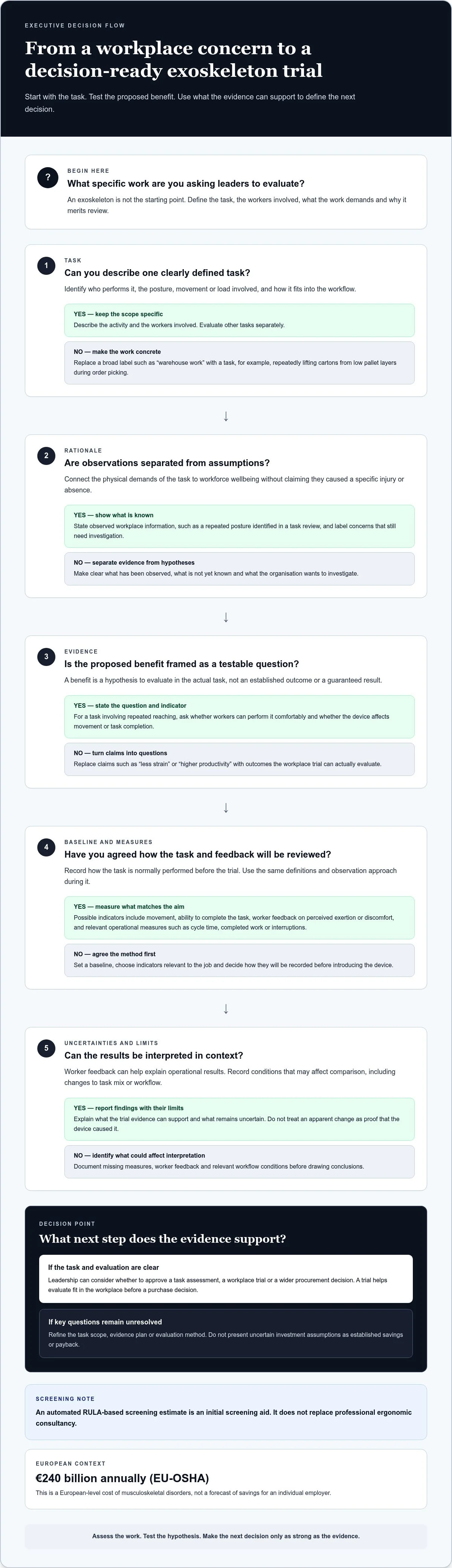
Executives need to know what they are being asked to approve and what that decision will establish. Organise the presentation as a short sequence, moving from the work problem to a proportionate next step. This keeps the discussion centred on operational fit rather than device features.
- Task: Name the specific activity and the workforce involved. Set clear boundaries so the proposal does not imply that every role or process needs an exoskeleton.
- Rationale: Explain why this task merits evaluation. Describe the ergonomic concern and its relevance to the operation, distinguishing documented observations from issues that still need investigation.
- Evidence: Summarise what is already known and what the workplace will measure. Keep proposed indicators tied to the task, and state what the available evidence can and cannot establish.
- Uncertainties: Be open about what remains unknown, including task compatibility, worker experience and wider operational or financial effects. Explain how the evaluation will address those questions.
- Decision requested: Ask for approval to assess fit or run a defined trial, not for a commitment to purchase or roll out devices across the operation.
Anticipate the questions decision-makers will ask
Prepare direct answers to three questions: Why this task? What evidence supports evaluating it? What will the next decision depend on? Make the limits clear. A trial can show how a device performs under the conditions observed; it cannot guarantee the same result elsewhere or establish a future financial return. The recommendation to proceed should depend on evidence of practical fit, not enthusiasm for the technology.
Worker input is part of that evidence. Explain how workers will help evaluate comfort, movement and compatibility with the task, and how concerns will be recorded. Do not present participation or acceptance as assured. Also address practical implementation, including how the trial will fit into the workflow and what onboarding or support arrangements apply.
Make the approval request specific
State the task, proposed evaluation and review criteria in language that operations, HSE and finance leaders can all follow. A clear request might be approval to assess whether an exoskeleton suits one defined activity, then review the findings before deciding whether further consideration is justified. For context on evaluating devices before purchase, consult a guide to trying exoskeletons before buying.
This structure makes presenting exoskeleton benefits to c-suite decision-makers a decision conversation, not a sales pitch. To identify a suitable next step for your workplace, use Ryggo’s vendor-independent exoskeleton matching.
Move from the executive case to a fit-led exoskeleton trial
Once leaders agree that a task merits evaluation, identify an exoskeleton that may suit the work before committing to a purchase. Ryggo, Europe’s first independent exoskeleton exchange, combines workplace task information with vendor-neutral device matching and the Deploy & Decide trial programme. This gives decision-makers a practical route from an operational question to workplace evidence.
Use neutral selection to narrow the decision
Ryggo’s free, unlimited matching process uses a 30-second workplace video and a short task survey to produce one neutral recommendation based solely on fit across vendors. Selection is guided by DGUV 208-062. Paid listings are not accepted, and there is no vendor sponsorship. Matching steps 1-3 take about 15 minutes.
The video produces an automated RULA-based screening estimate. It is not a certified assessment and does not replace professional ergonomic consultancy. Treat it as an initial screening input to inform device selection, not as proof that an exoskeleton will deliver an ergonomic or operational result. Uploaded videos are deleted after analysis.
Vendor-submitted device specifications are reviewed before a device is listed and corrected if a fault is found later. A recommendation narrows the choice; the workplace trial evaluates it. The team can assess the device against task conditions, agreed measures and worker feedback before deciding whether the evidence supports a purchase proposal. Matching informs which option may fit, while a trial lets the organisation evaluate its use in the actual work setting.
Make the next step clear and low-friction
Deploy & Decide offers 2-, 4- or 8-week trials. If the organisation proceeds to purchase, 100% of the trial fee is credited towards it, so there is no double payment. If the trial is unsuccessful, the refund is up to 75% for a 2-week trial, 70% for a 4-week trial or 60% for an 8-week trial.
Present this as a staged decision rather than an implied rollout: define the task, use the fit-based recommendation to select a candidate, evaluate it in a trial, then review the evidence. The result may support moving forward, refining the approach or deciding that the device is not suitable for the task. Each outcome gives leadership a clearer basis for the next step without treating potential strain reduction or operational benefit as guaranteed. Devices ship directly from manufacturers, who provide onboarding, training and service.
To move from the case to a workplace-specific recommendation, get a neutral exoskeleton recommendation.
Not sure which exoskeleton fits your task? Let the Ryggo advisor match it independently.
Find your exoskeleton →Make the next decision evidence-led
The value of a workplace evaluation is not limited to whether one device appears suitable. It can also show what your organisation needs to learn before considering wider use: which tasks warrant closer attention, what workers need from ergonomic support, and what evidence operations and HSE teams should bring to future decisions.
Keep that learning practical. After reviewing the trial, record what the findings support, what remains uncertain and whether the same conditions apply elsewhere. A clear boundary between observed results and assumptions helps procurement and leadership decide whether to stop, refine the evaluation or develop a separate case for a next step.
That is the purpose of presenting exoskeleton benefits to c-suite decision-makers: not to secure approval for a predetermined outcome, but to make the next choice more informed. If a specific workplace task is ready for a fit-led assessment, get a neutral exoskeleton recommendation and give your team a sound starting point for evaluation.
Frequently Asked Questions
Is an exoskeleton guaranteed to reduce injuries?
No. An exoskeleton cannot be presented as preventing injury, guaranteeing safety or removing risk. Its potential role is to support ergonomics and reduce strain in a task where it fits, but the workplace needs to evaluate its practical effects. A device that seems suitable during a demonstration, for example, may not suit the pace or movements of the actual job. Base decisions on workplace evidence, not an assumed outcome.
Can an exoskeleton improve productivity?
It may be relevant, but do not assume productivity will improve. Choose a measure that reflects the task, such as completed picks during a defined work period, and compare like with like. Consider whether any change coincided with different staffing, workload or process conditions. Worker feedback can help explain the result. When presenting exoskeleton benefits to c-suite leaders, describe findings as specific to the evaluated task and conditions, not as a universal forecast.
Does an automated RULA score replace a professional ergonomic assessment?
No. Ryggo’s video output is an automated RULA-based screening estimate, not a certified assessment, and it does not replace professional ergonomic consultancy. It can help frame an initial discussion about a task, but it is not a complete ergonomic audit or proof that a device will achieve a particular result. If the work presents complex ergonomic questions, use appropriate professional expertise to interpret the workplace and determine the next assessment steps.
Can the same exoskeleton recommendation apply to every job?
No. A recommendation should reflect the task and workplace information provided, not assume that one device suits every role. Order picking, overhead assembly and patient handling involve different movements and working conditions. Describe the activity, loads, posture and environment accurately when seeking a match. Then evaluate the recommendation against the actual task and workers’ experience of using the device.
Does Ryggo operate across Europe?
Yes. Ryggo operates in 28 European countries under one set of commercial terms. For organisations with operations in several of those countries, this provides a consistent commercial framework for considering an evaluation across locations. Keep the case specific to the sites and tasks involved: results from one workplace should not automatically be treated as evidence of fit at another with different working conditions.
Should an executive presentation include worker feedback?
Yes. Worker feedback helps decision-makers understand practical fit alongside task observations and operational measures. Ask workers about performing the defined activity, including whether the device affects movement or feels acceptable during the work. Report feedback accurately and in context. Responses from a small group should not be treated as representative of everyone, and positive feedback should not be presented as proof that the wider workforce will accept the device.
Find the right device before you trial anything
The Ryggo advisor maps your task, environment, and requirements to compatible devices — independently, across the full European market.
Find your exoskeleton →