Key Takeaways
- Combine safer work methods with equipment and workstation changes to address demanding shipyard tasks at their source.
- Match exoskeletons and high-payload robots to specific tasks, movements and working conditions rather than treating them as universal solutions.
- Review repetitive activities such as grinding and overhead work to identify where changes to tools, component positioning or task design could ease physical demands.
- Use task-based trials to assess whether an exoskeleton supports ergonomics in real working conditions before deciding to purchase.
- Compare devices on suitability and operational value; Ryggo offers vendor-neutral comparison, ROI calculation and Deploy & Decide trials.
Table of Contents
- Worker safety and health
- Exoskeletons and high-payload robots to reduce physical strain
- Physical strain and repetitive-strain injuries
- What ergonomic controls reduce lifting, bending, kneeling, and overhead work in shipyards?
- How can shipyard workstations and tools be redesigned to reduce physical strain?
- Ryggo
Worker safety and health
Shipyard health programmes work best when training, task design and early reporting reinforce one another. Welding, painting and confined-space work place different ergonomic demands on workers, so controls should match the task.
Ergonomics Training and Injury Prevention
Effective training teaches shipyard workers to recognise early musculoskeletal symptoms, report them and identify the task involved. Supervisors can then review whether repeated postures, forceful grips or poorly positioned components contribute to discomfort. Prompt attention gives teams a chance to adjust work before symptoms become more serious.
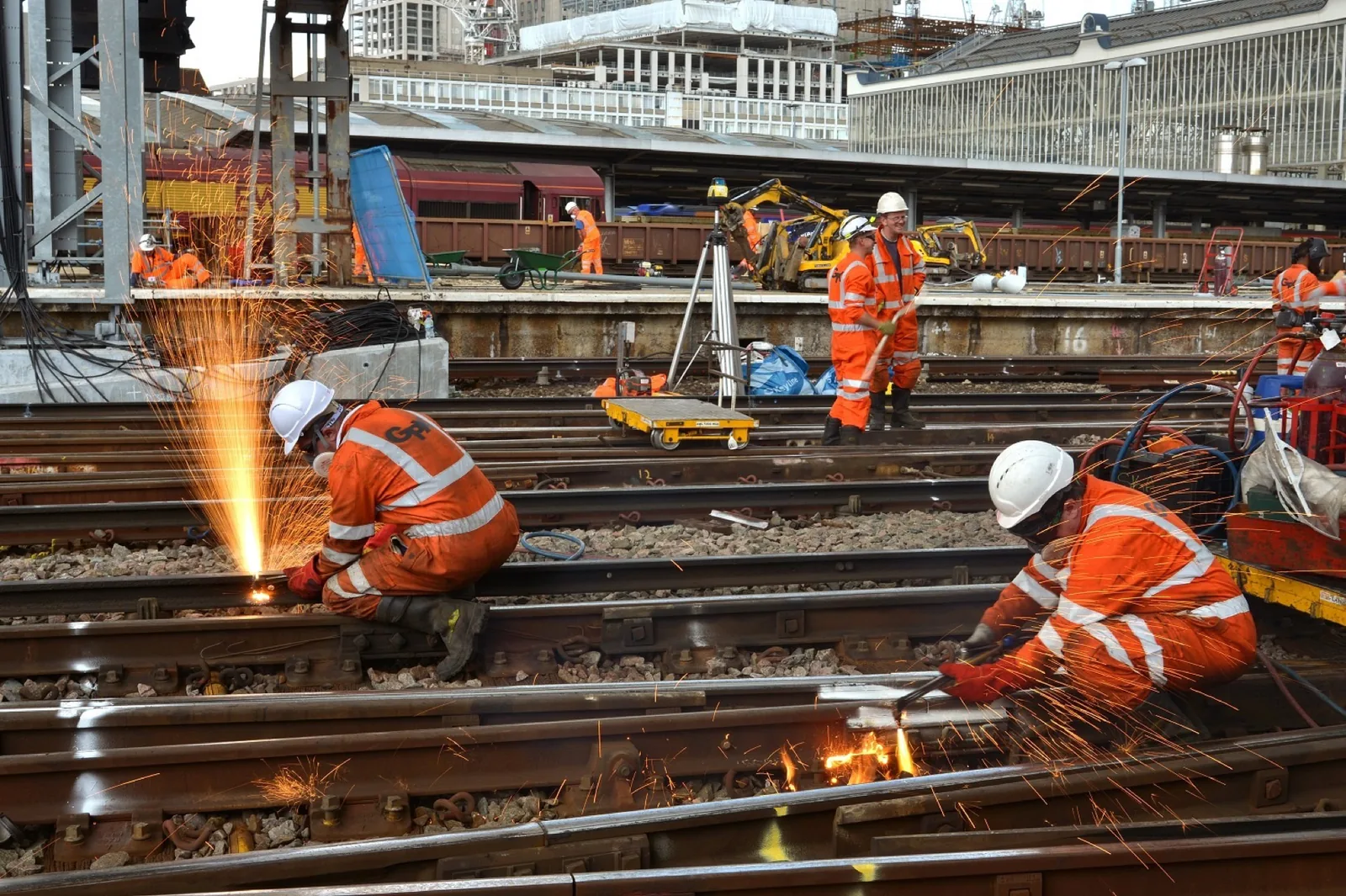
Build training around real tasks, such as overhead welding, repeated grinding and handling paint equipment. Ask workers to identify where they reach, kneel, twist or hold tools away from their bodies. Reinforce reporting procedures during task briefings, and make sure supervisors know how to record concerns and arrange appropriate follow-up. Review reports for patterns across tasks and work areas.
Strain-Reducing Practices for Shipyard Tasks
Ergonomic practices can reduce awkward postures and sustained force during welding, painting and confined-space work. For welding, position the workpiece and equipment to limit prolonged reaching where the layout allows. For painting, arrange hoses and tools so workers can move without an unnecessarily strained grip or posture. In confined spaces, plan access, tool placement and the work sequence before entry.
Task-specific changes matter because the same control will not suit every shipyard activity. Welding may allow an adjustment to the workpiece or support, while confined-space work may call for a different sequence and tool arrangement. Discuss these conditions with workers before the task starts, then record practical adjustments that may help with similar work.
Injury-prevention plans must also address hazards that ergonomic controls cannot manage alone. Carbon-arc gouging exposes operators to airborne carbon dust, fumes and high noise levels. A task review should consider both physical demands and the wider work environment, not posture alone. Where exposure controls and ergonomic changes intersect, coordinate them in the job plan.
When a worker reports discomfort, identify the task, observe the relevant movement, discuss their experience and consider an adjustment. Repeated grinding, for example, can involve sustained tool pressure and repeated arm movements. Review task rotation, tool handling and whether the work sequence can change. Record the action and revisit it in a later briefing.
Training should connect directly to everyday supervision. A toolbox talk about early symptoms has limited value if workers lack a clear way to report them or recurring concerns go unreviewed. During job planning, supervisors can ask: Which movements will be repeated? Where will workers need to reach? What makes the task difficult? The answers help target controls to the task instead of assuming every worker has the same needs.
Exoskeletons and high-payload robots to reduce physical strain
Exoskeletons and high-payload robots can support shipyard tasks that place repeated demands on workers. Mari4_YARD identifies both technologies as ways to reduce physical strain and support a safer shipyard environment.
Neither option suits every job. Wearable devices can restrict movement or feel unsuitable for a particular task, so assess fit, mobility and the work environment before adopting one.
Ergonomic Controls for Strenuous Work
Ergonomic controls change how demanding tasks are performed, using equipment or task adjustments to reduce physical effort. The right approach depends on the work: lifting, bending, kneeling and overhead activity call for different interventions.
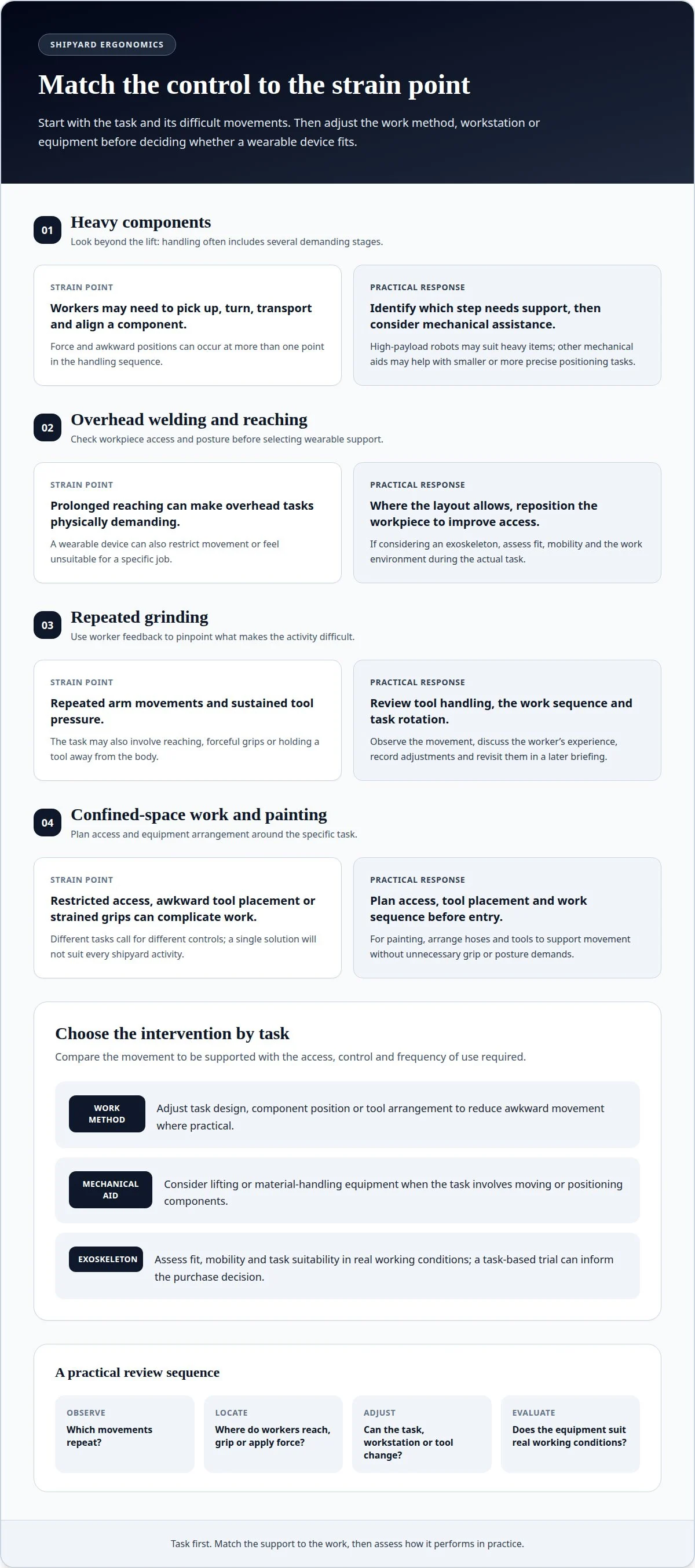
A worker positioning a heavy component, for example, may benefit more from mechanical assistance than a wearable device. For overhead work, consider whether repositioning the workpiece could help before selecting support. This task-first approach avoids treating an exoskeleton as a substitute for changing an unsuitable work method.
Lifting Aids and Material-Handling Equipment
Lifting aids and material-handling equipment can reduce the manual effort needed to move or position components. High-payload robots may suit tasks involving heavy items, while other mechanical aids can help with smaller or more precise positioning jobs.
Assess the entire handling sequence, not just the lift. A component may need to be picked up, turned, transported and aligned before work begins. Identify where workers apply force or hold awkward positions, then consider whether an aid can support that step without creating new access or control problems.
Redesigning Workstations and Tools
Workstation and tool redesign changes equipment position, reach or handling methods to better suit the task. This matters because no device can compensate for every poorly arranged work area or repeated awkward movement.
Review where workers stand, where components are held and how tools are reached. A welding task, for instance, may be easier when the workpiece is positioned for access instead of requiring prolonged reaching. Tool choice matters too: select equipment workers can control throughout the task without unnecessary effort.
Equipment Costs and Benefits
Equipment costs vary by type and application, so compare the purchase or deployment cost with the task it supports.
Potential benefits include reducing manual-handling demands and making repeated tasks easier to perform. A sound evaluation considers the tasks supported, worker acceptance, access constraints and how often equipment will be used. For exoskeletons, a task-based trial can show whether the support suits actual shipyard work before a purchase decision.
For an exoskeleton, suitability depends on movement, posture, duration and access requirements. A device intended to support one posture may not suit a worker who must frequently crouch, turn or enter a confined area. A task-based exoskeleton assessment can help narrow the ergonomic requirements before comparing devices.
Physical strain and repetitive-strain injuries
Repeated force, awkward postures and sustained tool use can place physical demands on shipyard workers. Grinding deserves close attention, since tool handling and repeated arm movements can demand sustained effort.
Assess workload by observing each task from start to finish. Note the movements, force, posture, tool handling and recovery opportunities involved in grinding, welding or component handling. Ask workers which steps feel most demanding, then compare their feedback with direct observation. Reducing physical strain in shipbuilding means examining the task sequence and conditions, not just one isolated movement.
Look beyond a single lift or tool action. A worker might grip a grinder, reach across a panel and keep their arm in a similar position while finishing a surface. Record which actions recur and where awkward postures arise. Review the sequence too: access, component position and task order can affect the reaching and force required.
Early reporting works best when workers know whom to tell and what details to share. They can report new discomfort or changes associated with tasks such as grinding or prolonged overhead welding. Supervisors can record the activity and work conditions, discuss practical adjustments and follow up. This information helps reveal recurring patterns across similar jobs.
Use worker reports alongside observations. If several workers describe difficulty with the same finishing task, review the grinding process, tool handling and access to the component. The aim is to identify where repeated effort occurs and consider a task-specific change.
Keep the assessment tied to the job. Compare the task when the component position, tool or sequence changes. Record the adjustment and ask workers whether the movement feels different. Then review the task under normal working conditions. A change that helps one operation may not suit another work area, so avoid treating it as a universal solution.
Reducing physical strain in shipbuilding starts with identifying the movements or postures that create repeated effort. Those observations can also show whether an exoskeleton may support the task, considering its movements, access and working conditions.
Training can make early recognition part of the same task-focused approach. Shipyard employers should train employees to recognise musculoskeletal disorder symptoms early and address them before serious injury develops. Use tasks already under review, such as grinding, welding or component handling, to discuss how to notice symptoms and report them promptly, rather than waiting until the work becomes difficult to complete.
Supervisors can reinforce this approach by giving employees space to describe what they notice and which activity was involved. Prompt attention allows the employer to consider the task and its conditions when reviewing physical strain.
Ready to find the right device for your operation?
What ergonomic controls reduce lifting, bending, kneeling, and overhead work in shipyards?
Choose controls by observing where a task requires workers to lift, bend, kneel or reach overhead. A shipyard job plan should identify the component, work position and tools before an adjustment is selected. This helps distinguish a handling problem from a workstation layout issue and target the change to the source of effort.
For lifting, examine how the component is collected, moved and aligned. Reduce unnecessary manual handling by planning the route and destination in advance. Prepare the landing area and coordinate the movement so workers do not have to hold a component while clearing obstacles. For alignment, consider whether a fixture or adjustable support can hold the item while the team completes the next operation.
For bending, review the work surface height and access. A low-level repair may require repeated bending if tools and materials are left on the deck. Arrange commonly used items within reach from the worker’s position. If the component can be repositioned, plan the change before work begins instead of asking workers to manage repeated awkward reaches.
Kneeling may be reduced by changing the working position or bringing the task to a more accessible height. A small assembly or inspection task, for example, may be completed at a bench or on a supported surface if the component can be moved safely. For repairs that must stay low, organise tools and parts within reach to limit repeated rising, searching and repositioning.
Overhead work requires attention to both duration and access. Review whether the task can be completed in a different sequence or from another position. For overhead assembly, place fasteners and tools where workers can retrieve them without repeated stretching. Suitable access should let them control the tool and reach the work area without excessive leaning.
Use a task review to compare the original setup with a proposed adjustment. Record which movements change, whether workers can access the work and whether the component remains stable during the operation. Ask workers to describe difficulties that may not be apparent during a brief observation. Keep the review specific to the job: a control for assembly may not suit inspection or repair.
Reassess once the change becomes part of normal work. Check whether workers still need to lift, bend, kneel or reach repeatedly, and whether the adjustment creates new handling demands elsewhere in the sequence. Keep changes that suit the task and work area, and revise those that make access or control harder.
How can shipyard workstations and tools be redesigned to reduce physical strain?
Start with the work sequence, not the equipment catalogue. At a welding station, observe how workers position the workpiece, retrieve tools and change working sides. Redesign the setup to reduce unnecessary reaching, twisting and repositioning. Involve the people who use the station, since they can spot access issues a drawing or walkthrough may miss.
Position materials and controls around the task. Place frequently used welding tools within easy reach, for example, and route cables so they do not obstruct movement. Keep consumables near the work area to avoid repeated trips across the station. Make the workpiece accessible from the positions needed for the job, and consider whether repositioning it could improve access.
Tool choice and setup matter too. During grinding, workers need to guide and control the tool across a surface. Review the grip, balance and access required for that movement. If tool balancers are used, position them so workers can reach and return the tool without being pulled off balance. Check that the balancer does not restrict access to the component.
Workstations should accommodate changes in the task. A large panel may require work across several areas, so consider whether fixtures or supports can hold it in a useful position. Plan access to each section before work begins. A setup that improves access on one side may create excessive reaching when the panel is turned.
For painting, review where hoses, containers and tools are placed during the job. Keep the immediate work area organised so workers can move along the surface without repeatedly reaching around equipment. For assembly, arrange fasteners and tools in the order they are used. These adjustments can simplify the sequence and reduce unnecessary handling between operations.
Use a simple workstation review: observe a complete task, note the movements and tool changes, then identify parts of the setup that cause extra effort. Discuss proposed changes with the people who perform the job. Trial the revised arrangement during normal work, checking access, movement and whether the sequence remains practical. Record useful adjustments for similar stations, but assess each work area according to its own layout and task demands.
Redesign does not mean adding equipment by default. A different component position, clearer tool layout or revised work sequence may address the main difficulty. Focus on the specific task: a setup that supports overhead assembly may not suit painting or surface finishing. Review the arrangement if the component, tool or work method changes.
Successful ergonomic improvements carefully evaluate the task and the effort it requires.
Highlighting how new tools simplify tasks and create opportunities for innovation can make the industry more appealing to younger generations. The Mari4_YARD project identifies demonstrating the benefits of new processes and technologies and addressing concerns as ways to help managers and operators overcome resistance to change in shipyards, aligning with the modern workplace standards advocated by Ryggo.
Not sure which exoskeleton fits your task? Let the Ryggo advisor match it independently.
Ryggo
Ryggo helps shipyard teams find exoskeleton options suited to their tasks and working environments. Its AI-powered recommendation and vendor-neutral device comparison support decisions based on ergonomic fit and operational value, not technology alone.
For teams considering wearable support, Ryggo’s Deploy & Decide programme offers a trial before purchase. Workers can evaluate a selected exoskeleton in real shipyard tasks before the organisation decides whether to buy. A trial is useful when observations point to a specific posture or movement to support, but the device’s practical fit is still uncertain.
Ryggo can also provide ROI calculations to inform procurement decisions. Contact Ryggo to discuss matching an exoskeleton to your shipyard tasks.
Turn task observations into a considered decision
Reducing physical strain in shipbuilding is an ongoing operational decision, not a one-off equipment purchase. Begin each review with a clearly defined task and the movement or posture workers need support with. Then assess whether a proposed device fits the work, workspace and normal sequence. Practical suitability matters as much as the device’s intended function.
Ryggo supports these decisions with AI-powered recommendations, vendor-neutral device comparisons and ROI calculations. Its Deploy & Decide programme lets organisations evaluate an exoskeleton in relevant work before purchasing. Use these tools to connect ergonomic needs with procurement evidence, rather than choosing on specifications alone.
Contact Ryggo to discuss support for assessing exoskeleton options for shipyard tasks. A clear task definition is a strong starting point for a practical, worker-centred decision.
Frequently Asked Questions
What tasks in shipbuilding cause the most physical strain and musculoskeletal injuries?
No single task creates the greatest strain for every shipyard team; demands depend on the movement, duration and access involved. Repeated grinding can load the arms through sustained tool control, while component handling may combine force with twisting or awkward holds. Overhead welding, low-level repairs and confined-space work also merit review. Compare observations with worker feedback to decide which tasks need attention first.
Find the right device before you trial anything
The Ryggo advisor maps your task, environment, and requirements to compatible devices — independently, across the full European market.