Key Takeaways
- Assess whether a device supports the specific movements and tasks on your line, rather than choosing by lifting capacity alone.
- Include fit, adjustment and worker comfort in workplace analysis; poor alignment can undermine the intended ergonomic support.
- Consider how support during lifting or holding equipment affects movement, task quality and concentration across the work cycle.
- Match battery life and wearable specifications to the shift and task pattern, then use a workplace trial to assess practical fit.
- Use Deploy & Decide to compare suitable options and evaluate them in real work before making a purchase decision.
Table of Contents
- Concentration, work quality, and productivity
- Ergonomic adjustment and workplace analysis
- Support for lifting and holding heavy equipment
- Battery life and wearable-device specifications
- Ergonomic challenges in automotive assembly
- Ryggo
Concentration, work quality, and productivity
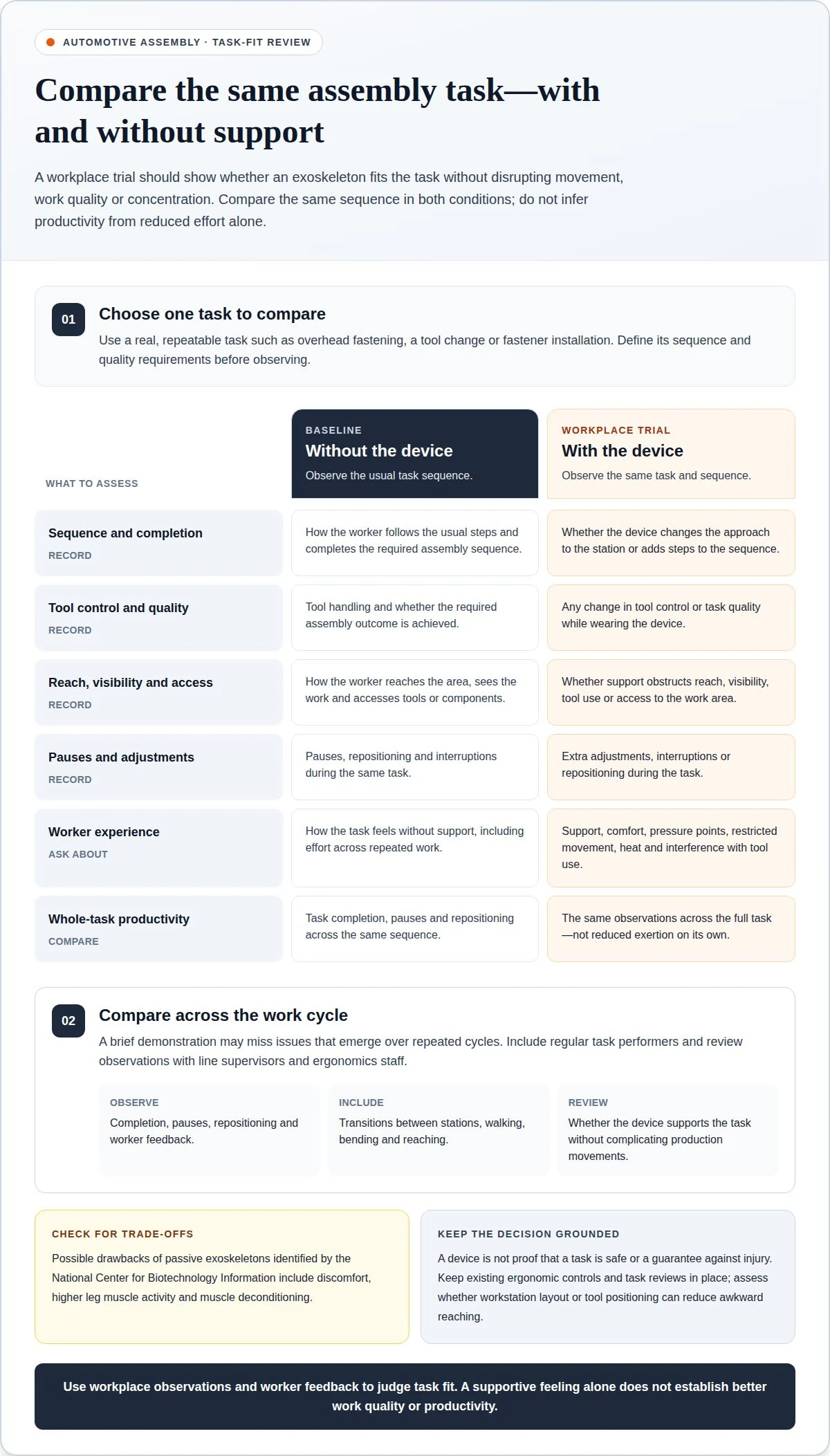
On an automotive line, repeated overhead work can demand sustained physical effort. An upper-body exoskeleton supports movement, but the worker remains in control of each action. The device should assist without disrupting concentration, visibility, reach, timing, or access to tools. A tool change or fastener installation offers a practical task to assess.
Assess work quality through outcomes that already matter on the line. For example, observe whether workers retain tool control, complete the required assembly sequence, and access components as needed. Track interruptions and adjustments during the trial. These observations help distinguish a genuine task fit from a device that feels supportive on its own but complicates production movements.

Assess productivity across the whole task, rather than inferring it from reduced exertion alone. Compare the same sequence with and without the device, noting completion, pauses, repositioning, and worker feedback. A brief demonstration may miss issues that emerge over repeated cycles. Include regular task performers and review the findings with line supervisors and ergonomics staff.
What do automotive workers report about comfort, fit, productivity, and acceptance? Experience varies by task and by how the device fits and moves with the wearer, so collect feedback during actual work. Ask about pressure points, restricted movement, heat, and interference with tool use. The National Center for Biotechnology Information identifies possible drawbacks of passive exoskeletons, including discomfort, higher leg muscle activity, and muscle deconditioning.
Use a structured trial to bring those observations together. First, define the target task and its quality requirements. Next, observe workers completing the sequence with the device, recording adjustments, interruptions, and feedback. Finally, compare the findings with the same task performed without support. This gives production and HSE teams a clearer basis for deciding whether the device supports concentration, quality, and output on their line.
Ergonomic adjustment and workplace analysis
Start with the task, the worker, and the production layout. An overhead fastening station and a low-level inspection task place different demands on movement and fit.
Ergonomic Workplace Assessment
Map the task sequence before selecting support. At an overhead fastening station, note arm position, reach, tool handling, visibility, and how often workers change posture. Assess the device on someone performing the task, not just on a demonstration wearer. Adjust contact points and support to follow the movement without obstructing access to components or controls.
Observe the full work cycle, including transitions between stations. A device that supports one position may hinder walking, bending, or reaching elsewhere. Record where workers pause to adjust it and whether the support remains aligned during normal movements. Selection guided by DGUV 208-062 can inform device matching, while workplace observation establishes whether the chosen support suits the actual task.
Fatigue and Injury Prevention
Fatigue can build through repeated postures and sustained effort. Compare worker feedback and movement during the target task, both early and later in a shift. Note discomfort, pressure points, restricted movement, and changes in tool handling. These observations help show whether support may reduce strain or introduce a different physical demand.
An exoskeleton is not proof that a task is safe or a guarantee against injury. Keep existing ergonomic controls and task reviews in place. For example, assess whether workstation layout or tool positioning can reduce awkward reaching before adding wearable support. Consider the complete task rather than treating a device as a replacement for broader workplace improvements.
Safety Requirements
Review each production step for possible interference. Check, for example, whether the device affects a worker’s ability to enter a workstation, move between tasks, or respond to changing production conditions. Document the review and give affected workers practical instructions for use. Assess the device in operation, not just by its specifications or intended use.
Workplace Risks and Limitations
A device can introduce new demands as well as support movement. The National Center for Biotechnology Information identifies possible passive exoskeleton effects including discomfort, higher leg muscle activity, and muscle deconditioning. In a trial, ask workers to report pressure, restricted movement, and any extra effort elsewhere in the body. Record where and during which task each issue occurs.
Fit can vary between workers and tasks. Support suited to one person may not suit another, and a device designed for overhead work may interfere with bending or walking. Stop and reassess if workers change their usual technique to accommodate it. Continue only when observed fit and movement support the task without creating an unacceptable new burden.
Support for lifting and holding heavy equipment
Automotive assembly tasks vary: workers may raise a component, hold a tool overhead, or handle equipment near waist height. Suitable support depends on the movement and body area involved, not just the load’s weight.
Automotive lines use upper-body and shoulder-support exoskeletons for tasks involving raised arms. Back-support exoskeletons may be considered for tasks that load the back during bending or lifting. These categories address different postures, so match the choice to the actual work sequence.
For overhead work, such as fastening a component beneath a raised vehicle, assess whether upper-body support accommodates the worker’s reach and tool handling. Observe the full action, from picking up the tool to completing the fastening. Check for interference with visibility, access to the work area, or repositioning between operations.
For equipment handled at lower heights, map when workers bend, lift, carry, and return to a neutral position. A back-support device may suit some bending or lifting tasks, but the task pattern determines its fit. Record how often workers change posture and whether the device restricts transitions, such as moving from a low component to a standing inspection.
Distinguish lifting from holding. Raising an object differs from maintaining an elevated arm position while fastening a part. In a line-side trial, observe the beginning and end of each action, the worker’s posture, and any change in tool control or access. If a task combines lifting and sustained holding, assess both phases.
Use a simple task record to compare device fit across workers and operations:
- Task: note the component, tool, and work position.
- Movement: record lifting, holding, bending, and transitions.
- Fit: observe pressure, restriction, and alignment during the task.
- Work effect: capture any change to reach, handling, or task sequence.
This comparison helps distinguish a suitable support type from a device that fits only one part of the job. For an exoskeleton for automotive assembly line tasks, assess the real operation, not the equipment category in isolation.
The user controls the exoskeleton, which supports their movement but does not perform the movement for them. During assessment, workers should carry out the action themselves while wearing the device, rather than judging it by how supportive it appears when stationary. Observe whether they can initiate, guide, and stop the movement, and retain control of the tool and component throughout. Compare the supported action with the full task sequence, including repositioning and transitions, to assess the device as an aid to movement, not a replacement for it.
Ready to find the right device for your operation?
Battery life and wearable-device specifications
Battery requirements depend on the exoskeleton design and production task. Passive devices do not rely on a powered battery, while active models need power for their assistance. First identify the type under consideration. Then compare its operating requirements with the line’s shift pattern, work sequence, and charging arrangements.
Battery-life figures are useful only when tied to a specific device and operating condition. Runtime can vary with use, so compare the manufacturer’s stated specification with the intended task. A device used intermittently at one station, for example, may face different demands from one supporting repeated work across a shift. Record expected use and charging needs before comparing options.
Check the complete wearable specification, not just the power source. Relevant details include device mass, adjustment method, contact points, range of movement, and how to put on and remove the device. On an automotive line, assess whether the wearer can reach tools, move between stations, and work around components. Confirm that the device does not obstruct required personal protective equipment.
A specification sheet describes a device; a production-line trial shows how it fits the operation. Use a representative task, such as overhead fastening or repeated handling, and note when the device is worn, adjusted, or removed. Observe whether charging or battery changes interrupt the work sequence. Include the workers who perform the task, since their feedback can reveal fit or access issues that a stationary inspection may miss.
Use a consistent comparison record for each candidate. Capture the following details alongside task observations:
- Power: identify whether the design is passive or battery-powered.
- Runtime: record the stated operating conditions and charging requirements.
- Wearability: note mass, adjustment, and compatibility with protective equipment.
- Task fit: observe movement, access, and interruptions during actual work.
- Shift fit: compare the device’s operating requirements with the planned work pattern.
Compare like with like. If one candidate is passive and another powered, assess their different operational requirements rather than treating them as equivalent. For a powered model, include battery management in the trial plan. For either type, record worker adjustments and any changes to movement or workstation access.
Procurement teams can use this evidence to distinguish technical specifications from practical fit. Battery runtime, charging arrangements, device mass, and task compatibility all affect deployment decisions. A clear record also supports comparisons between candidates and helps operations, procurement, and HSE teams align on requirements before purchase.
Ergonomic challenges in automotive assembly
Automotive assembly combines repeated movements, constrained access, and changing work heights. Start the assessment at a specific station, focusing on the movements workers perform there.
Which automotive assembly tasks are most relevant for exoskeleton assessment? Consider tasks involving sustained overhead reaching, repeated elevated-arm work, or prolonged bent postures. Match support to the movement and work area, then observe access, mobility, and tool handling throughout the task.
Passive and powered exoskeletons provide support differently. Passive designs use mechanical structures rather than powered assistance, while powered models use motors and require a power source. The right choice depends on the task, device specifications, and operational requirements, so compare options in the intended work setting.
Assembly ergonomics rarely depend on a single movement. At one station, a worker may reach for a component, position it, use a tool, and move aside for the next operation. Assess each phase. Support that helps during overhead work may restrict turning or reaching sideways.
Start workplace analysis by documenting the station’s physical demands. Note, for example, the work-area height, direction of reach, duration of each posture, and whether workers handle tools and components at the same time. Then identify the movement that creates the main ergonomic concern. This helps distinguish a task suited to shoulder support from one that calls for assessing back support or another approach.
Include the workers who perform the operation in the evaluation. Ask them to complete their usual sequence, not a simplified demonstration. Observe whether the device changes reach, balance, visibility, or movement between tasks. Record where it shifts, obstructs access, or needs adjustment. The production team can then assess whether the support fits actual line conditions.
Do not treat an exoskeleton as a substitute for workstation design. If a component’s position forces awkward reaching, assess whether its placement or the task sequence can be improved. A device may support ergonomics, but the wider assessment should also cover the workstation, tools, component handling, and movement demands.
For a practical comparison, select a clearly defined task and assess candidates against the same work sequence. Track posture, access, transitions, and worker feedback. Compare exoskeleton options against the specific movements and demands identified in your assembly operation.
Not sure which exoskeleton fits your task? Let the Ryggo advisor match it independently.
Ryggo
Ryggo helps automotive teams turn task analysis into a practical exoskeleton decision. Its AI-powered recommendation and vendor-neutral device comparisons help identify options suited to the movements, workstations, and operating needs on your production line. ROI calculations add an operational perspective to the assessment.
When a likely fit needs validation, Ryggo’s Deploy & Decide trial programme lets companies test exoskeletons before purchase. Workers and decision-makers can assess support during real tasks, including reaching, moving, and handling equipment. The aim is to evaluate ergonomic fit in context, not assume one device suits every station.
If your team is weighing options for automotive assembly, contact Ryggo to discuss the task requirements and possible next steps.
Turn the assessment into a clear next step
Before a wider rollout, define what a successful production-line trial must demonstrate. Set the task boundaries, identify who will evaluate the results, and agree how worker feedback will inform the decision. This keeps the discussion grounded in operational needs rather than general impressions.
For an exoskeleton for automotive assembly line work, connect ergonomic fit with practical deployment. Consider whether the device suits the intended task, how workers experience it during normal operations, and what changes integration would require. A trial can help establish that evidence; the right choice depends on what happens in your workplace.
Ryggo can help your team move from a defined assembly task to a structured trial decision. Contact Ryggo about an assembly line trial and take the next step with a clear operational question in mind.
Frequently Asked Questions
How effective are exoskeletons at reducing worker fatigue and musculoskeletal injuries?
Exoskeletons can support specific movements and may reduce physical strain, but their effectiveness depends on task, fit, and sustained use. They should not be treated as preventing injuries. Assess fatigue through worker feedback and observed task performance, while monitoring discomfort and new movement demands. For example, compare how workers feel and move during repeated overhead fastening, then review whether the device helps without disrupting normal work.
How should a manufacturer assess, pilot, and deploy exoskeletons on an assembly line?
Assign an evaluation owner and agree how the team will record worker feedback, task fit, and operational effects. During the pilot, include workers who regularly perform the target task and capture issues as they arise, rather than relying on end-of-trial impressions. Before wider deployment, review findings with operations and HSE, address practical concerns, and define how continued use will be monitored.
Find the right device before you trial anything
The Ryggo advisor maps your task, environment, and requirements to compatible devices — independently, across the full European market.