Key takeaways
- Choose an exoskeleton for warehouse workers by the task and movements involved, not by job title alone.
- Describe task demands, working conditions and intended users before deciding whether back or shoulder support may be suitable.
- Compare devices using consistent criteria, including task fit, movement, comfort, workflow compatibility and worker feedback.
- Set baseline observations and agree evaluation criteria with workers, operations and HSE before starting a workplace trial.
- Ryggo’s matching process uses a 30-second workplace video and a short task survey. Steps one to three take about 10 minutes, and uploaded videos are deleted after analysis.
Table of Contents
- Why an exoskeleton for warehouse workers must fit the task
- Which warehouse requirements should guide exoskeleton selection?
- How to compare warehouse exoskeleton options objectively
- How to validate an exoskeleton in a warehouse before buying
- How Ryggo helps find an exoskeleton for warehouse workers
Why an exoskeleton for warehouse workers must fit the task
An industrial exoskeleton is wearable support selected to assist with a specific physical task. Devices vary in how they support movement and which body areas they are intended to assist, so suitability depends on the work being done, not simply the setting. A neutral overview of the broader human exoskeleton concept can help clarify the range of applications, but warehouse selection needs to start with the task itself.
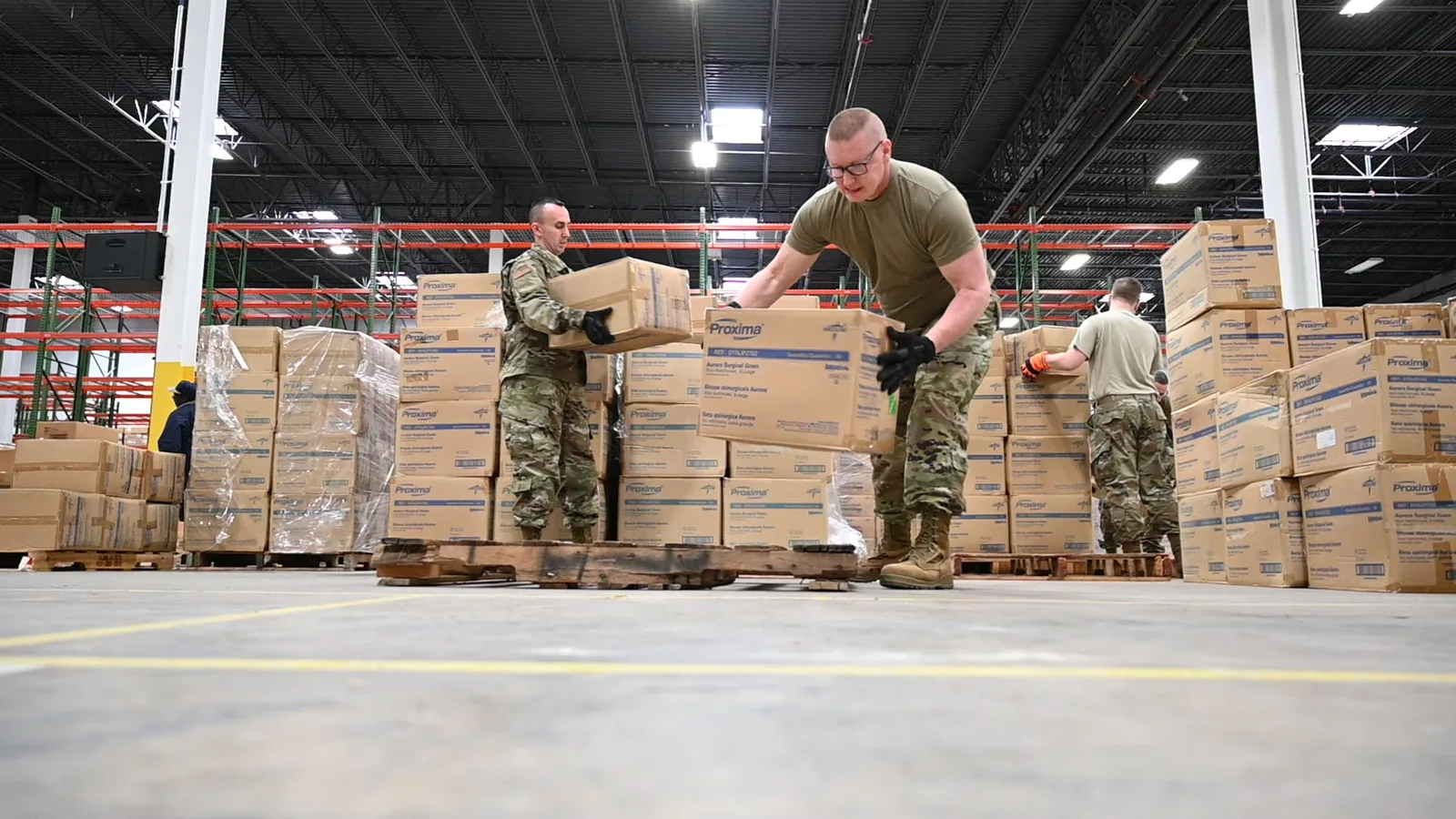
Task fit matters more than job title when selecting support. “Warehouse worker” could describe someone replenishing shelves, picking items, unloading deliveries or carrying out overhead assembly. These activities can involve different loads, postures, movement patterns and durations. Even workers with the same role may do different tasks across a shift. Choosing by job title alone risks overlooking actual physical demands or introducing a device that interferes with other work.
Start with the work, not the device
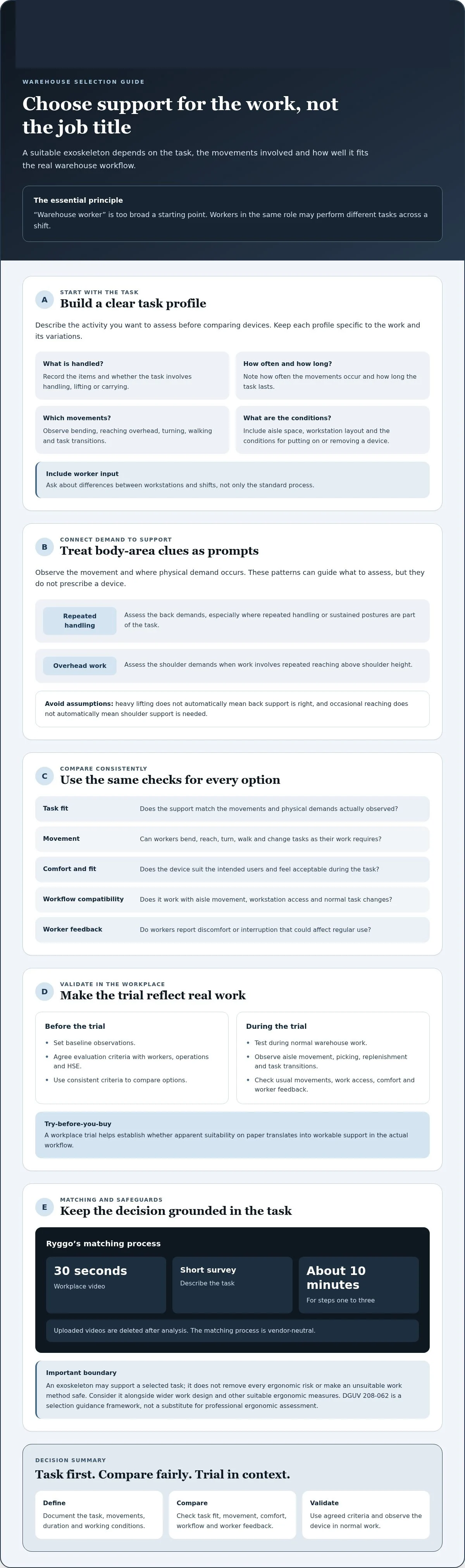
Define a separate task profile for each activity you want to assess. Record what is handled, how often lifting or carrying occurs, the movements involved, how long the task lasts and relevant conditions such as available working space. Note whether workers bend, reach overhead, walk between locations or switch repeatedly between activities. These observations help clarify whether back or shoulder support may be relevant, without assuming the answer in advance.
Keep each profile specific. Replenishment and unloading may both involve handling loads, but the working positions and movement demands can differ. Ask workers about variations between shifts and workstations, not only the standard process. That detail gives HSE, operations and procurement a shared basis for deciding what to assess and test.
Set a practical selection boundary
An exoskeleton may support a selected task; it doesn’t remove every ergonomic risk or make an unsuitable work method safe. Consider it within the wider approach to work design, alongside assessment of the task and other suitable ergonomic measures. Use DGUV 208-062 as a selection guidance framework, and involve appropriate workplace expertise rather than treating a device match as a professional ergonomic assessment.
For more detailed task and device matching, buyers can review warehouse exoskeleton selection guidance. Keep the decision grounded in observed work and worker feedback. A device that appears suitable on paper still needs to be checked in the real workflow before purchase.
Which warehouse requirements should guide exoskeleton selection?
Turn the task profile into a practical checklist before comparing devices. An exoskeleton for warehouse workers should match the physical demands and the conditions in which it will be used, not just the intended body area. Task fit is the alignment between the support provided, the worker’s movements and the conditions of the job.
- Task demand: Note repeated handling, sustained postures and work above shoulder height. Record which movements recur and when the physical demand is greatest.
- Movement: Check bending, reaching, turning, walking and transitions between tasks. Support that suits a static activity may not suit a worker who moves continuously.
- Environment: Consider aisle space, workstation layout and conditions that could affect wearing or removing the device during work.
- Intended users: Involve the workers who will use the device. Their tasks, fit needs and feedback may differ, even within the same role.
Match support to the movement pattern
Repeated handling or sustained postures may warrant closer assessment of back demands. Repeated overhead work may point to a need to assess shoulder demands. These are prompts for evaluation, not automatic prescriptions. Observe the task and determine which body area is under demand before choosing a support type. Don’t assume every heavy-lifting task calls for back support, or that occasional reaching in a warehouse role requires shoulder support.
Document the specific movement and when it occurs, such as frequent bending during replenishment or extended reaching during overhead work. This gives suppliers and evaluators a consistent description to assess, rather than relying on broad labels such as “picker” or “loader”.
Check operational compatibility
Evaluate the device during normal work, including aisle movement, picking, replenishment and transitions between activities. Observe whether workers can carry out their usual movements and access their work area without disruption. Ask directly about fit, comfort and usability, and record issues as they arise. Avoid setting arbitrary performance thresholds before you understand what the job requires.
Agree how feedback will be captured and who will review it, including workers, operations and HSE. Record the conditions during evaluation so comments can be interpreted in context. A vendor-neutral matching process can help identify an option to assess, but workplace testing remains important before purchase.
Ready to find the right device for your operation?
Find my exoskeleton →How to compare warehouse exoskeleton options objectively
A consistent comparison helps procurement, HSE and warehouse teams judge each option against the same operational needs. Build a simple comparison table for the task under review, then use the same headings and evidence sources for every device. This prevents a persuasive supplier claim from carrying more weight than what workers experience in practice.
- Task fit: Does the device address the physical demand identified in the task profile?
- Movement: Can workers complete the required movements and transitions?
- Comfort and fit: What do users report during normal work?
- Workflow compatibility: Does wearing the device affect picking, replenishment or movement through the warehouse?
- Evidence: Is each point based on observation, worker feedback or a supplier claim?
Label evidence clearly. For example, record “worker reported restricted reaching during replenishment” as feedback, and list a supplier’s stated intended use separately as a claim to verify. Neither, on its own, proves overall suitability. A useful comparison shows what was observed, under which task conditions and what remains uncertain.
Use the same evidence for each option
Evaluate selected devices against the same task and working conditions. If one is tried during a short, low-demand activity and another during a full routine, the results won’t be directly comparable. Capture worker feedback and workflow impacts consistently, but avoid setting a universal pass mark before the trial. The relevant decision is whether the device fits the defined task and users. For more detail, see the exoskeleton technology evaluation guide.
Ryggo’s recommendation is vendor-neutral and based solely on fit across vendors; paid listings are not accepted. This can support an independent comparison, but it doesn’t remove the need to validate a device in the warehouse before purchase.
Interpret screening results carefully
RULA output is an automated screening estimate, not a certified assessment. Its categories are 1-2 negligible, 3-4 low, 5-6 medium and 7 high. Treat the result as one input when considering whether a task warrants closer ergonomic review, not as a device approval or a complete account of warehouse risk. Screening doesn’t replace professional ergonomic consultancy.
Combine screening information with observed task demands, worker feedback and workplace evaluation. This gives the team a more balanced basis for deciding whether an option merits further testing, rather than relying on a score or supplier description alone.
How to validate an exoskeleton in a warehouse before buying
A workplace trial turns a promising option into evidence about its fit in your operation. Before introducing a device, record baseline observations for the selected task under normal working conditions. Note how the task is performed, the movements involved and any existing workflow constraints. Then agree with workers, operations and HSE what you’ll observe, so the decision isn’t shaped by impressions alone.
Plan a workplace test with clear criteria
Select the task and users that represent the work you’re assessing. If the intended use is replenishment, for example, evaluate the device during replenishment rather than relying on a demonstration of a different activity. Agree in advance what evidence would support keeping or returning the device. This could include worker feedback on fit and comfort, ease of movement and any disruption to the task. Define criteria that reflect your operation instead of setting universal success thresholds.
If you’re comparing selected devices, side-by-side testing in the same operation can make observations easier to compare. Keep the task, working conditions and feedback questions consistent. During normal work, record whether users can move through the task as expected, whether they report discomfort or fit issues, and whether the device affects workflow. Capture limitations as carefully as positive feedback.
Review the result before committing
At the end of the trial, gather views from participating workers, supervisors, operations and HSE, not just procurement. A short decision record can capture the task tested, who took part, baseline observations, feedback, workflow effects, limitations and the reason for the final decision. If the evidence is mixed, document what remains uncertain rather than treating the trial as a pass by default.
Ryggo’s Deploy & Decide trials offer a try-before-you-buy route for testing selected devices in your own operation. Trial periods are 2, 4 or 8 weeks. If a trial is unsuccessful, the refund is up to 75% for 2 weeks, 70% for 4 weeks and 60% for 8 weeks. The trial fee counts fully towards the eventual purchase, so no double payment is required.
Before starting, check the applicable trial terms and confirm that the evaluation plan reflects the task you need to assess. To test an exoskeleton for warehouse workers before deciding on purchase, explore a Deploy & Decide trial.
How Ryggo helps find an exoskeleton for warehouse workers
Once you’ve defined the task and the evidence you need, an independent matching process can help narrow the options. Ryggo uses workplace information to identify an exoskeleton that fits the task, rather than asking buyers to choose from product claims alone. Steps one to three take about 10 minutes.
What the matching process includes
Upload a 30-second workplace video and complete a short task survey. The survey captures relevant work details, including loads, movements and environment, and uses DGUV 208-062 selection guidance to inform the match. Ryggo also provides a free, unlimited RULA-based screening estimate from uploaded workplace videos. This is an automated estimate, not a certified ergonomic assessment, and it doesn’t replace professional ergonomic consultancy. Uploaded videos are deleted after analysis.
The process returns one vendor-neutral recommendation based solely on fit. It is intended to help you identify a suitable option to consider, not to approve a device or replace workplace validation. Test the selected exoskeleton in the actual task and assess worker feedback and workflow compatibility before deciding whether to purchase.
Choose a low-friction next step
Ryggo serves exactly 23 European countries under one set of commercial terms. For selected devices, the Deploy & Decide programme offers try-before-you-buy trials in the workplace for 2, 4 or 8 weeks. If a trial is unsuccessful, refunds are up to 75% for 2 weeks, 70% for 4 weeks and 60% for 8 weeks. The trial fee counts fully towards the eventual purchase, so no double payment is required.
Device onboarding, training, delivery and service are provided by the relevant vendor, not directly by Ryggo. Confirm the arrangements with the vendor and align them with your test plan, responsibilities and operational requirements before the trial begins.
If your task assessment is ready, get a neutral exoskeleton recommendation as a starting point for workplace testing. Use the result to guide evaluation, then base the purchase decision on evidence gathered in your warehouse.
Not sure which exoskeleton fits your task? Let the Ryggo advisor match it independently.
Find my exoskeleton →Make the next step a workplace test
Select an exoskeleton for warehouse workers by starting with the task, then compare suitable options using consistent criteria. Worker comfort, freedom of movement and workflow compatibility all need to be checked in the real operation before you commit.
A neutral recommendation can help narrow the field. Ryggo’s recommendations are based solely on fit, and paid listings are not accepted. The platform serves 23 European countries under one set of commercial terms. If you proceed to a Deploy & Decide trial, the trial fee counts fully towards the eventual purchase, so there’s no double payment.
Use the evidence from your task assessment to choose what to evaluate next. Get a neutral exoskeleton recommendation and identify an option to validate in your warehouse. A practical trial gives workers and decision-makers a clearer basis for the final choice.
Frequently asked questions
What type of exoskeleton is best for warehouse workers?
There’s no single best type for every warehouse task. Describe the work, movement patterns, working conditions and intended users before considering an option. Use DGUV 208-062 selection guidance, then assess whether the support fits the observed demand and allows workers to complete the actual workflow. A workplace screening estimate can inform selection, but it isn’t a certified ergonomic assessment and doesn’t replace professional ergonomic consultancy.
Can warehouse workers try an exoskeleton before buying it?
Yes. Ryggo’s Deploy & Decide programme offers trials of selected devices for 2, 4 or 8 weeks, allowing a company to evaluate a device in its own operation before deciding whether to buy. For unsuccessful trials, refunds are up to 75% for 2 weeks, 70% for 4 weeks or 60% for 8 weeks, subject to applicable terms. The trial fee counts fully towards the purchase.
How do I choose an exoskeleton for warehouse picking?
Describe the picking task first: the loads handled, movements required, work environment and how often workers switch activities. Then assess whether back or shoulder support matches the observed demand and whether the device allows the required movement. Compare options using the same criteria and involve workers in the evaluation. Apply DGUV 208-062 selection guidance; don’t choose solely on a product claim or job title.
Are RULA scores from Ryggo certified ergonomic assessments?
No. Ryggo’s RULA scores are automated screening estimates, not certified assessments, and they don’t replace professional ergonomic consultancy. The score categories are 1-2 negligible, 3-4 low, 5-6 medium and 7 high. Treat the result as one input when considering task demands and selection, alongside workplace observations and appropriate professional judgement. It isn’t, by itself, a device approval or a complete ergonomic assessment.
How long does it take to receive an exoskeleton recommendation?
Steps one to three take about 10 minutes. The process includes uploading a 30-second workplace video, completing a short survey about work demands and receiving one neutral recommendation with rationale and ROI. The survey maps task information to DGUV 208-062 selection guidance. Uploaded videos are deleted after analysis. Any later trial or purchase decision takes additional time according to your company’s process.
Can an exoskeleton trial fee be applied to the purchase?
Yes. If a trial is unsuccessful, the applicable refund is up to 75% for a 2-week trial, 70% for a 4-week trial or 60% for an 8-week trial. Refunds depend on the applicable terms, so confirm them before starting the trial and make sure the evaluation plan reflects the task being tested.
Find the right device before you trial anything
The Ryggo advisor maps your task, environment, and requirements to compatible devices — independently, across the full European market.
Find my exoskeleton →