Key Takeaways
- Map the tasks that involve sustained arm elevation, repetitive movement or static posture before assessing whether shoulder support is relevant.
- Compare changes in muscle activity with changes in posture: reduced activity in some muscles may come with increased shoulder flexion and abduction.
- Assess fit and usability during realistic clinical work, including the precision and freedom of movement each task requires.
- Compare the total cost with the practice’s workload and expected use, rather than relying on the purchase price alone.
- Use a trial to evaluate practical fit before purchasing; Ryggo’s Deploy & Decide programme supports this decision.
Table of Contents
- Ergonomic interventions for dental professionals
- Injury-risk reduction for medical workers
- Movement and dexterity in clinical settings
- Perceived exertion and device usability
- Shoulder exoskeleton effects on muscle activity and posture
- Ryggo: Trial programmes for exoskeletons (called Deploy & Decide)
Ergonomic interventions for dental professionals
Dental hygiene combines sustained postures with precise, repetitive movements, so any intervention should target a specific task. Edero and Paexo Shoulder are described as supporting shoulder load in operating theatres, but their suitability for dental hygiene needs to be assessed in the clinic.
Ergonomic Strain in Healthcare Work
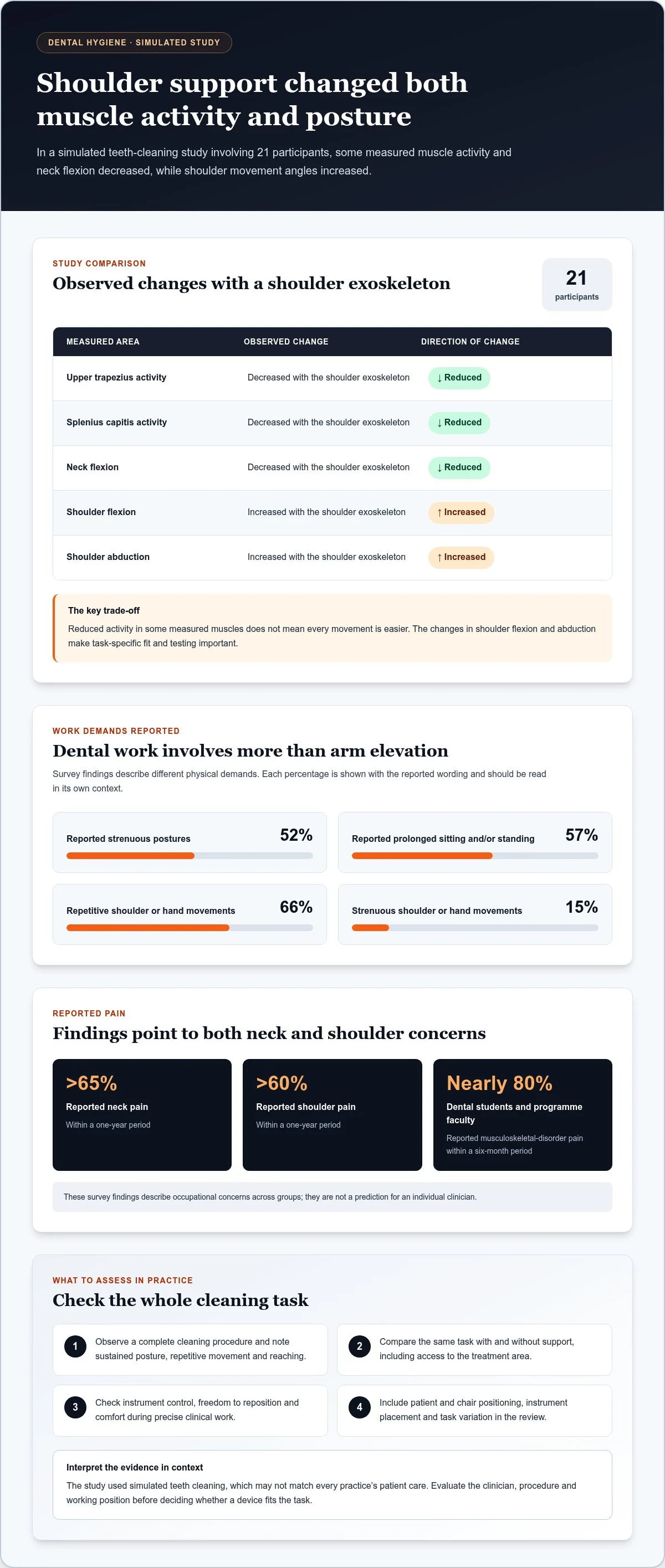
Dental professionals show a median neck-flexion angle of 40° during manual teeth cleaning. In a survey, 52% reported strenuous postures and 57% reported prolonged sitting and/or standing. These findings point to demands beyond arm elevation: a hygienist may hold the head forward while maintaining a stable working position and repeating fine hand movements.
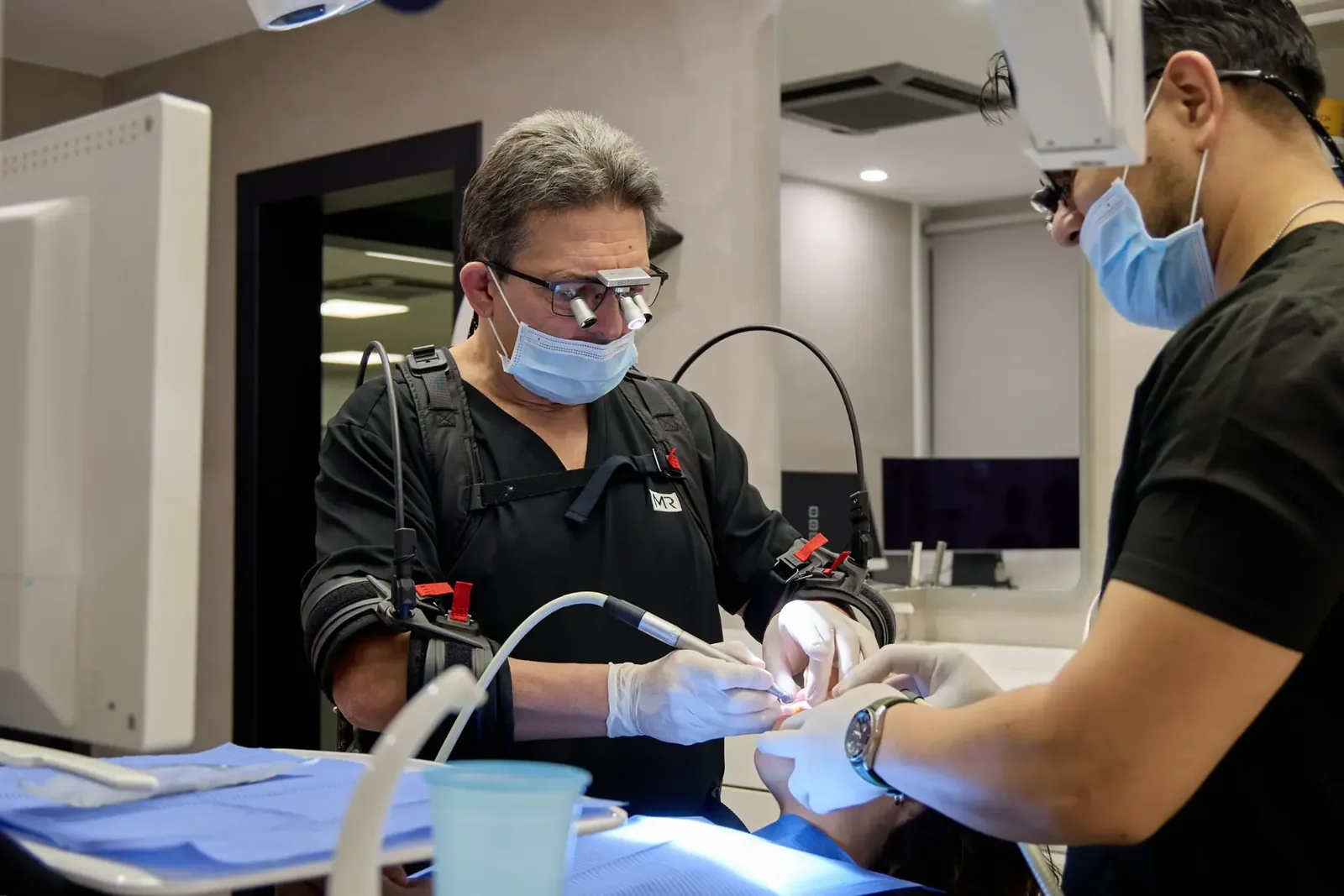
Start by observing a complete cleaning procedure. Note when the hygienist leans towards the patient, holds an instrument away from the body or stays in one position. Record how the task varies between patients, too. This practical review can help identify whether the main concern is sustained neck posture, static sitting, repetitive movement or a combination.
Potential Ergonomic Benefits
Choose an intervention to address the posture or movement you observed. If the hygienist holds their head forward while cleaning, assess neck position as well as shoulder demand. If sustained arm elevation is the priority, compare support during that movement. The goal is to understand how the intervention changes the task, not to assume one device suits every clinical role.
Clinical research on dental hygiene includes a simulated teeth-cleaning comparison involving 21 participants, with and without shoulder, back and neck exoskeletons. Use this as task-relevant evidence, while recognising that simulated cleaning is not identical to every practice’s patient care. A local assessment should consider the clinician, procedure and working position.
Compare the same task with and without support. Record whether the hygienist can reach the treatment area, control instruments and change position comfortably. Include adjustments to patient and chair positioning, which can affect working posture. If the intervention makes an essential movement harder, consider changing the workstation or workflow before adopting it.
Ergonomic improvements can combine equipment with practical changes. For example, adjust patient positioning to improve access, keep instruments within easy reach and vary tasks when the schedule allows. Review these measures alongside any device to identify which changes best support the work and reduce unnecessary physical demand.
Injury-risk reduction for medical workers
Dental hygienists report musculoskeletal pain in both the neck and shoulders. More than 65% reported neck pain within a one-year period, and more than 60% reported shoulder pain during that period. These figures describe a broad occupational concern, not a prediction for an individual clinician. For a practice, they justify examining which procedures repeatedly load the upper body and where ergonomic changes may be useful.
Survey responses also show why risk reviews should distinguish repetitive work from strenuous movements. Some 66% of dental professionals reported repetitive shoulder or hand movements, while 15% reported strenuous shoulder or hand movements. These are different demands. A hygienist repeatedly handling instruments may need a different intervention from someone whose task requires forceful reaching or sustained effort.
Begin with a specific procedure and a clear observation record. Note the task, the body areas involved, how often movements recur and whether the clinician reports discomfort during or after work. Compare routine cleaning with a procedure that requires more reaching. This makes the assessment actionable: your practice can target the relevant task instead of choosing equipment based only on a general concern about injury.
Upper-extremity exoskeletons used as part of a proactive ergonomics programme may address risk factors associated with work-related shoulder injuries. They are one possible element of a broader approach, not a substitute for reviewing how work is organised. A practice can also assess instrument placement, patient positioning and task variation, then determine whether assistance supports the intended movement without adding another awkward demand.
Include clinical training settings in the same assessment process. Nearly 80% of dental students and dental programme faculty reported musculoskeletal-disorder pain within a six-month period. That finding makes supervised practice a relevant setting for reviewing posture, instrument handling and work habits. Compare how experienced hygienists and trainees approach the same procedure, noting whether differences in technique affect their physical demands.
Use a consistent decision record for each intervention: identify the procedure, describe the main physical demand, gather wearer feedback and note any movement changes. Review the findings with the team before expanding use to other tasks. This helps distinguish perceived relief from a good fit with the workflow. It also makes follow-up more useful, as the team can compare the same procedure and observations over time.
Movement and dexterity in clinical settings
Dental procedures require controlled hand movements as the clinician adjusts position around the patient and chair. Assess an exoskeleton during the actual sequence of care, not just while standing. A device may support the arm during one movement but make close access or repositioning less practical during another.
A shoulder exoskeleton could interfere with infection control, patient care or dental equipment if it obstructs routine actions or makes contact with surrounding surfaces. Assess the specific device in the clinic, including hygiene routines, patient access and movement around the chair, light and instrument tray.
Break a representative appointment into observable actions. Note how the hygienist moves from reaching for an instrument to guiding it, changing hand position and moving the chair or light. Check whether the device changes the sequence or makes any action slower or less controlled. These observations help distinguish useful support from an added physical constraint.
Assess precision separately. Dentists may use arm-weight support during longer procedures to help maintain precision, and exoskeletons can support surgeons during precise operations. These examples make control an important consideration, but don’t establish whether a device suits dental hygiene. Check that the wearer can guide instruments and make small adjustments without the device resisting movement.
Include movement between tasks. Ask the clinician to turn towards the tray, reposition near the patient and stand or sit as needed. Watch for contact with the chair, light or nearby equipment. A device that works in one fixed posture may be less suitable when the hygienist needs to move freely around the treatment area.
Use a consistent observation sheet during a clinical trial. Record the procedure, actions completed, interruptions and any changes to the wearer’s technique. Compare the same sequence with and without the device. If the wearer needs to move equipment or change the order of care to accommodate the exoskeleton, document that operational effect.
Keep infection-control review specific to the device and clinic workflow. Check whether putting it on or removing it disrupts established hygiene steps, and decide how it will be handled between users. Follow the manufacturer’s instructions and the practice’s procedures rather than assuming every device can be cleaned or shared in the same way.
The practical question is whether support fits the entire clinical sequence. A trial should include close patient work, precise instrument handling and transitions around the chair. If any action becomes restricted or less controlled, reassess the fit and task suitability before considering wider use.
Ready to find the right device for your operation?
Perceived exertion and device usability
Compare devices by how their weight, range of motion and comfort affect a hygienist during the same clinical task. Research ranked the neck exoskeleton highest for usability, the back exoskeleton second and the shoulder exoskeleton third. That ranking doesn’t establish which device will feel best for every dental application.
Usability is practical, not cosmetic. A device may provide support yet feel intrusive when clinicians sit close to patients, turn towards instruments or reposition their arms. Assess how easily the wearer can put it on, adjust it, maintain a working posture and remove it between tasks.
For weight, consider the load the wearer feels throughout a procedure, not just the device’s listed mass. Check for pressure at contact points, shifting during forward leaning, and straps or frames that distract the clinician. Record feedback after representative patient care and compare it with feedback from a shorter fitting.
The range of motion should suit the work. Ask the hygienist to reach forward, move each arm across the treatment area and turn towards the instrument tray. Observe whether the device restricts these movements or changes the clinician’s usual working position. Repeat the same movements with different devices for a consistent comparison.
Comfort depends on the task. Shoulder-assist exoskeletons have been found to decrease shoulder discomfort among painters and welders, but those findings don’t establish the same result for dental work. Base your practice’s assessment on the wearer’s experience during its own procedures, rather than assuming findings transfer across occupations.
Track perceived exertion with a simple record after each trial task. Ask the wearer to note:
- Where support or pressure is felt during the procedure.
- Whether the device changes reach, hand control or seated posture.
- When discomfort or fatigue begins during the work period.
- Whether adjustment or removal interrupts patient care.
Keep the task and observation method consistent across users. A dentist and a hygienist may perform different procedures, so a device that suits one role may not suit another. Include routine cleaning and a task involving repeated reaching, then compare feedback immediately after each activity.
For procurement, judge usability alongside the ergonomic objective. A device that reduces perceived effort but limits movement around the patient may not suit the application. A structured trial helps your practice weigh comfort, freedom of movement and sustained use before making a purchasing decision.
Shoulder exoskeleton effects on muscle activity and posture
A simulated teeth-cleaning study involved 21 participants performing the task without an exoskeleton and with shoulder, back and neck exoskeletons. Exoskeleton use significantly affected electromyography and movement variables, with both reported at p < 0.001. The shoulder device reduced upper trapezius and splenius capitis activity and neck flexion, but increased shoulder flexion and abduction.
That combination matters for dental practices. Lower activity in selected muscles may offer relief, while increased shoulder movement changes the posture being used. Assess a shoulder exoskeleton for dental hygienists across several postures, rather than judging it by a single muscle reading or a brief standing demonstration.
The research also points to a task-specific trade-off. A hygienist may benefit during a procedure involving sustained arm elevation, yet show more shoulder flexion or abduction during another movement. Record the task, the clinician’s position and any change in movement. Distinguish seated cleaning from reaching, lifting equipment or moving around the treatment area.
Don’t assume OSHA or other U.S. workplace guidance provides a dental-specific exoskeleton fitting protocol. Base your practice’s decision on the actual procedure, observed posture and the user’s ability to move comfortably and control instruments.
Fit the device according to the manufacturer’s instructions, then check that its support aligns with the wearer and doesn’t restrict ordinary arm movement. Adjust it before the procedure and repeat the check with the clinician seated at the patient’s chair. If the device shifts, presses uncomfortably or changes reach, pause and readjust before continuing.
Cleaning requires the same practical care. Follow the manufacturer’s cleaning instructions and the clinic’s infection-control procedures; don’t assume a device can be cleaned using a method intended for dental instruments. Before sharing a device, establish who cleans it, when cleaning happens and how it is stored between users.
During a trial, compare the same procedure with and without support. Track muscle activity where appropriate, but also note neck and shoulder posture, instrument control, comfort and interruptions. Reduced neck flexion in the study doesn’t cancel out increased shoulder flexion and abduction. This balanced review helps your practice judge whether the device supports the intended task without creating a less suitable posture elsewhere.
Not sure which exoskeleton fits your task? Let the Ryggo advisor match it independently.
Ryggo: Trial programmes for exoskeletons (called Deploy & Decide)
Ryggo helps dental practices move from posture observations to a practical device decision through healthcare exoskeleton matching. Its AI-driven Ryggo Advisor provides a neutral recommendation based on fit, while vendor-neutral comparisons and ROI calculations support a cost-conscious review.
Ryggo’s Deploy & Decide programme lets your practice trial an exoskeleton before buying. Your team can assess fit, comfort, instrument control and posture during real procedures, rather than relying only on product specifications. The trial helps establish whether the device suits the work and whether its ergonomic value justifies the investment.
If your practice is weighing a shoulder exoskeleton, contact Ryggo or visit ryggo.ai to explore the next step.
Turn the findings into a practical decision
Before selecting a device, agree on what success should look like for your practice. Ask hygienists to identify the procedures that feel most demanding, then choose observable measures such as comfortable reach, steady instrument control and freedom to reposition. A shared assessment is more useful than relying on one person’s first impression.
Choosing a shoulder exoskeleton for dental hygienists should be a clinical-work decision, not a response to product specifications alone. A structured trial can show whether the device fits your team’s procedures and routines. Record feedback from the people wearing it, then use those observations to decide whether to proceed, adjust the approach or stop.
Ryggo’s Deploy & Decide trial programme supports testing before purchase, while its device recommendations, vendor-neutral comparisons and ROI calculations can help organise the decision. Contact Ryggo to discuss your practice’s needs and take a considered next step towards better-supported work.
Frequently Asked Questions
Can small practices afford it?
A small practice can assess affordability by comparing the device and trial costs with its workload and intended use. Deploy & Decide offers trials lasting 2, 4 or 8 weeks; if the trial is unsuccessful, the refund is up to 75%, 70% or 60%, respectively. If you proceed to purchase, the trial fee is credited in full. The total price depends on the device and case, and is provided after a quote request.
Does it restrict movement?
It can, depending on the device, fit and clinical task. Before choosing one, assess movements between patients as well as during treatment, such as standing up, moving the stool and reaching for instruments. Ask each wearer to flag restrictions promptly. A device that interferes with routine transitions may be impractical even if it feels acceptable during one procedure.
Is it comfortable for long use?
Comfort varies by wearer and task, so a brief fitting can’t show whether a device suits a full clinical schedule. During a trial, note pressure, rubbing, heat or fatigue, and when each begins. Compare feedback across procedures and team members. A device should feel manageable without prompting the wearer to change normal clinical movements or stop using it.
Will I need training?
Plan onboarding before clinical use. The device manufacturer provides onboarding and training to help users learn how to put on, adjust and remove the device. Your practice can then set a consistent fitting and cleaning process, with clear responsibility for each step. Users should practise the required movements before wearing the device during patient treatment.
Do shoulder exoskeletons reduce shoulder and neck strain in dental hygienists?
They may change muscle activity and posture, but they don’t necessarily reduce demands across both areas. In a simulated teeth-cleaning study with 21 participants, a shoulder exoskeleton reduced activity in the upper trapezius and splenius capitis and reduced neck flexion. It also increased shoulder flexion and abduction. Evaluate these effects against the hygienist’s own tasks and movements.
How much do shoulder exoskeletons for dental professionals cost?
There’s no single cost for every dental practice. The amount depends on the selected device and the trial or purchase arrangement. Compare the cost with the intended workload, number of users and procedures where support would be used. Ryggo’s cost calculator provides a case-specific figure, and a trial can help assess practical suitability before you decide to buy.
What are the risks, contraindications, or discomforts of wearing a shoulder exoskeleton?
Possible concerns include pressure, discomfort, restricted movement or altered posture. Powered exoskeletons can cause muscle strain if they move a user’s joints beyond their normal range of motion. Stop using the device if it causes pain or forces unnatural movement, and review its fit and suitability for the task before resuming. Consider the wearer’s mobility and the movements required during patient care.
Which passive exoskeleton models are suitable for seated dental procedures?
Edero and Paexo Shoulder support shoulder load in operating theatres. Assess their suitability for seated dental procedures during clinical work.
Find the right device before you trial anything
The Ryggo advisor maps your task, environment, and requirements to compatible devices — independently, across the full European market.