Key Takeaways
- Start by identifying the care tasks and movements that place physical demands on staff. Don’t assume one device should support every activity.
- Choose an exoskeleton for elderly care workers by matching its support area and type to the task being assessed.
- Compare devices against consistent criteria, including task compatibility, movement freedom, uniform and workflow.
- Use DGUV 208-062 to guide selection, then involve staff in a real-world trial before deciding whether to purchase.
- Ryggo Advisor provides a free, unlimited matching process using a short task survey and a 30-second workplace video.
Table of Contents
- What elderly care workers need an exoskeleton to support
- Match exoskeleton support to the care task and body area
- Compare exoskeleton options with consistent care-work criteria
- Plan an elderly-care evaluation before committing to purchase
- How Ryggo helps care teams find and trial a suitable exoskeleton
What elderly care workers need an exoskeleton to support
Choosing an exoskeleton for elderly care workers is a workplace ergonomics decision. It concerns wearable support for employees during their duties, not equipment intended to help a resident walk or recover mobility. The distinction matters: care settings use both occupational devices and rehabilitation equipment, but they address different users and needs. A general overview of exoskeletons covers these varied purposes. Workplace selection should focus on the worker’s task and physical demands.
Start with the work, not the device. Care duties vary across a shift, between residents and across care environments. Repeated bending, reaching, repositioning or holding a demanding posture may warrant an ergonomic review, but that does not mean every activity needs wearable support. Musculoskeletal disorders cost €240 billion annually (EU-OSHA), underlining the importance of assessing work-related physical demands without assuming an exoskeleton is the answer to every task.

Which care duties may warrant an ergonomic review?
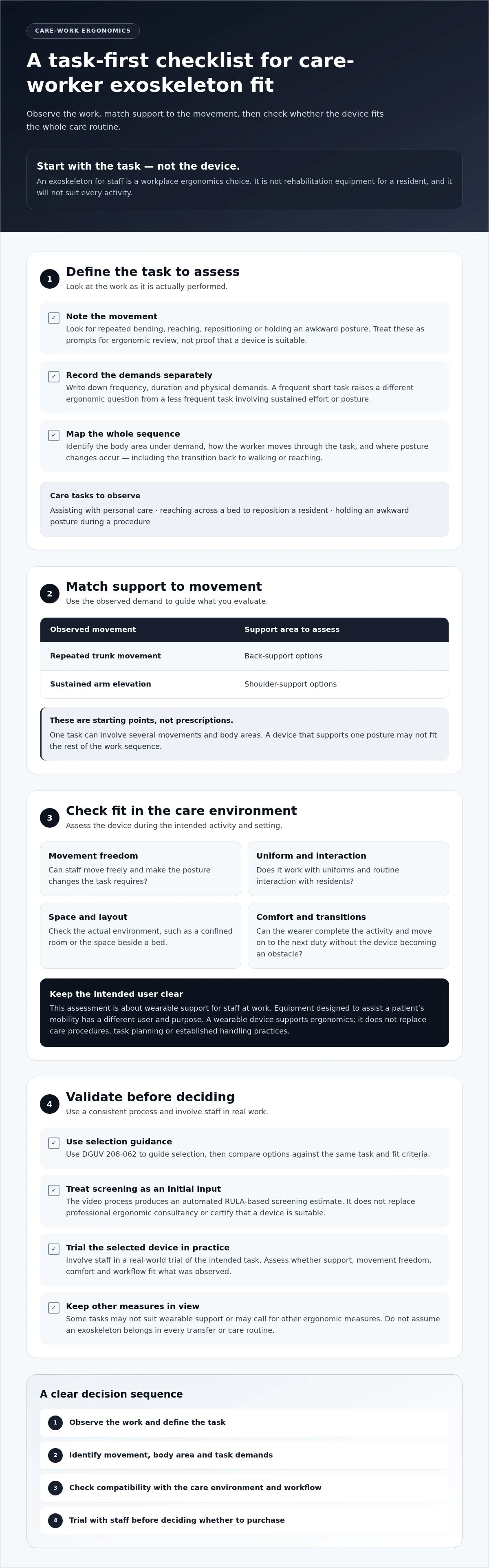
Observe how a task is actually performed. Staff may bend repeatedly while assisting with personal care, reach across a bed to reposition a resident, or hold an awkward posture during a procedure. Treat these as prompts for assessment, not proof that a particular device is suitable.
Record the task’s frequency, duration and physical demands separately. A movement performed often for short periods raises a different ergonomic question from a less frequent task involving sustained effort or posture. Note which body area is under load, how the worker moves through the task and whether the environment restricts movement. This creates a defined use case to assess, rather than treating all patient handling as one activity.
Some tasks may not suit wearable support or may call for other ergonomic measures. Select equipment after observing the work, not on the assumption that an exoskeleton belongs in every transfer or care routine.
Care-worker support is different from rehabilitation equipment
This guide concerns devices worn by staff while they work. Depending on the design, an occupational exoskeleton may support a particular body area during specific movements or postures. Suitability depends on the task, wearer and care environment, so evaluate the device in the activity it is intended to support.
Powered lower-limb equipment designed to assist a patient’s mobility has a different purpose and user. It should not be treated as a staff ergonomics solution simply because it is used in a healthcare setting. Keep the procurement question clear: is the device intended to support a care worker’s physical demands during work, or to assist a patient’s movement?
A wearable device supports ergonomics; it does not replace care procedures, task planning or established handling practices. Define the staff task first, then assess whether the device’s support matches the movement and setting. This helps avoid selecting equipment for the wrong user or purpose.
Match exoskeleton support to the care task and body area
Choose by observed movement, not by a preferred device category. Map the task from start to finish: where the worker bends, reaches or holds a posture, which body area is under demand, and how often the movement changes. This gives the team a practical basis for comparing support options without assuming one device suits every care activity.
Connect movement patterns with the relevant support area
Repeated trunk movement may prompt an evaluation of back-support options, while sustained arm elevation may warrant assessing shoulder-support options. These are starting points for ergonomic review, not prescriptions. The same task can involve several movements and body areas, and a device that supports one posture may not fit the rest of the work sequence.
Use a short observation record to make the assessment consistent:
- Movement: note the bending, reaching or holding pattern involved.
- Body area: identify where support is being considered and why.
- Task demand: record how long the posture lasts and how frequently the task occurs.
- Movement changes: note transitions, such as moving from a bent posture to walking or reaching.
A screening result can help focus an assessment, but it cannot certify that a device is ergonomically suitable. Ryggo’s video process produces an automated RULA-based screening estimate. It does not replace professional ergonomic consultancy. Use it as an initial input, then assess the task and confirm practical fit through a workplace trial.
Check whether the device fits the care environment
Fit involves more than the body area being supported. Consider how freely staff need to move, whether the task involves frequent posture changes, and whether the device works with uniforms and routine interaction with residents. The layout matters too: a device may feel different in a confined room or beside a bed than it does during a demonstration in an open space.
Include the complete work sequence in the evaluation. Can staff move from the assessed task to the next duty without the device becoming an obstacle? Does it remain comfortable during the activity, and can the wearer carry out the required movements? Treat comfort and task compatibility as questions to validate in use, not assumptions to make from a product description.
Keep the intended user clear as well. Resources such as IEEE’s Exoskeleton Technology for Seniors discuss mobility support for older people, which is distinct from selecting an occupational device for staff. For an exoskeleton for elderly care workers, compare the device with the worker’s movement demands and environment. Ryggo’s vendor-neutral exoskeleton matching can help identify a suitable option for evaluation.
Ready to find the right device for your operation?
Find your exoskeleton →Compare exoskeleton options with consistent care-work criteria
Once the task and support area are defined, compare devices against the same requirements. A side-by-side table helps keep the decision focused on care work rather than product labels. Include support area, technology type, compatibility with the observed task, freedom of movement and practical constraints in the care environment. Record what each device is intended to support, then assess those claims against the work sequence and staff feedback.
Compare passive, active and soft-suit approaches
These categories describe different approaches to providing support. Passive designs use mechanical elements, active designs use powered assistance, and soft suits use flexible wearable structures. The category alone does not establish whether a device will suit a particular care task or be comfortable and usable for every wearer.
Instead, ask how each approach relates to the movement and body area under review. If the assessment concerns repeated trunk movement, compare devices intended to support that area. If the task involves sustained arm elevation, assess devices designed for the relevant support area. These are comparison prompts, not recommendations. Suitability depends on the specific task, wearer and setting, and needs to be evaluated in use.
Use vendor-neutral criteria to assess shortlisted devices
Apply one set of criteria to every option under consideration. A practical comparison table can include:
- Support area: does the intended support correspond to the body area identified in the task assessment?
- Technology type: is the approach passive, active or soft-suit, and does it fit the team’s use case?
- Task compatibility: can staff complete the required movements and transitions while wearing it?
- Practical fit: does it work with uniforms, resident interaction and the physical care environment?
- Wearer feedback: what do staff report about comfort, movement and usability during the task?
Keep the task constant when comparing devices. If one is assessed during a different activity or sequence, the results will not provide a fair basis for selection. During a trial, record whether the device is worn as intended, how it affects movement through the task and whether staff can complete their duties without disruption. Treat any potential reduction in strain as something to validate, not an assumed outcome.
For an exoskeleton for elderly care workers, vendor-neutral assessment is useful when several types of device appear relevant. Ryggo’s recommendation is based solely on fit across vendors, helping teams focus on the care-work requirements rather than promotion or product category. Confirm practical fit with staff before making a purchase decision.
Plan an elderly-care evaluation before committing to purchase
A workplace evaluation should answer a defined question: does this device support the selected care task in a way staff can use consistently? Use DGUV 208-062 as the selection guidance framework, and keep the assessment centred on practical ergonomics. A trial can help validate fit and usability, but it cannot guarantee safety or establish that a device will prevent injury.
Set the scope before staff begin. This ensures observations relate to the same task and conditions, rather than becoming general impressions of the device.
- Select one task. Define the care activity and the movement or posture that prompted the evaluation. Avoid combining unrelated duties into one test case.
- Set fit criteria. Specify the support area being considered, the movements the worker must complete, and practical conditions such as uniform and interaction with residents.
- Involve staff. Include the people who perform the task. They can report how the device feels and whether it fits the work sequence.
- Review observations. Compare staff feedback and operational notes with the criteria agreed in advance. Decide whether the device warrants further consideration, needs a different use case or is not a practical fit.
Set evaluation criteria for staff and managers
Agree who will wear the device, which task they will perform and what the team will record. Ask staff about comfort, movement and compatibility with the task. Managers can note whether the work sequence proceeds as planned and whether the device creates practical constraints. Treat wearer feedback as valuable operational evidence, not clinical proof of ergonomic benefit.
Apply the same criteria to each option being evaluated. This makes comparisons more useful and reduces the risk of letting a positive first impression replace a task-based decision. Ryggo’s exoskeleton advisory process can help teams identify a suitable option and plan an evaluation before procurement.
Use a trial to validate practical fit
Product descriptions can indicate an intended support area, but they cannot show how a device fits a particular worker, uniform, care routine or room layout. A real-work trial can reveal whether staff can move through the selected task as required and whether the device is acceptable during use. Keep notes tied to the agreed criteria and record any conditions that affect the observations.
Base the decision on what staff and managers observe, not on an assumption that a device will reduce strain in every situation. Keep the evaluation focused on the selected task, then decide whether the evidence supports a purchase or whether to reconsider the option.
How Ryggo helps care teams find and trial a suitable exoskeleton
Once a care team has defined the task, support area and fit criteria, Ryggo Advisor can help identify a device to evaluate. Ryggo is Europe’s first independent exoskeleton exchange. Its free, unlimited matching process uses a 30-second workplace video and a short task survey to understand the work context. Steps 1-3 take about 10 minutes. Uploaded videos are deleted after analysis.
Understand the recommendation and screening estimate
Ryggo provides one neutral recommendation based solely on fit across vendors. Use it to focus the decision on the care team’s task and workplace requirements, then assess the recommended device against staff observations and the criteria agreed in advance. The recommendation guides selection; the team’s practical assessment remains central to the decision.
Know how Deploy & Decide works
Deploy & Decide lets teams try a selected exoskeleton before buying. Trial periods are 2, 4 or 8 weeks. If a trial is unsuccessful, the refund is up to 75% for a 2-week trial, 70% for a 4-week trial or 60% for an 8-week trial. If the team proceeds with a purchase, the full trial fee is credited towards it, so there is no double payment.
During the trial, assess the device against the task and fit criteria already set by the team. Record whether staff can complete the relevant movements, how the device fits the work sequence, and what wearers report about comfort and usability. This keeps the decision grounded in workplace experience.
Devices are shipped directly by their manufacturers, who provide delivery, onboarding, training and service. Ryggo supports matching and the trial process; the manufacturer provides device-specific support.
For a care team considering an exoskeleton for elderly care workers, this process connects task-specific matching with practical evaluation before procurement. Get a neutral exoskeleton recommendation to identify an option for your team to assess.
Not sure which exoskeleton fits your task? Let the Ryggo advisor match it independently.
Find your exoskeleton →Make the next step a task-based decision
A sound procurement decision starts with a clear workplace question, not a commitment to buy: which care task should the team assess, and what would make a device practical for the staff performing it? Keep that question central as you move from ergonomic review to evaluation. It gives managers and care workers a shared basis for deciding whether an exoskeleton for elderly care workers deserves further consideration.
Involve the staff who perform the task. Their experience can help shape a focused evaluation and identify what matters in day-to-day use. If a suitable option emerges, assess it in the work context before deciding whether it belongs in your procurement plan. A measured process makes room for both positive findings and reasons not to proceed.
Ready to explore a task-specific starting point? Start a neutral exoskeleton recommendation for your care team.
Frequently Asked Questions
Can an exoskeleton replace a hoist or other patient-handling equipment?
No. An exoskeleton is wearable support for a care worker’s ergonomics, not a substitute for a hoist, patient-handling equipment or established care procedures. A transfer that calls for mechanical assistance should still follow the workplace’s existing handling process. Assess any proposed wearable use alongside that process and professional ergonomic guidance. Do not assume it removes handling risks; decide whether it fits the specific task and setting.
Are Ryggo’s RULA scores certified ergonomic assessments?
No. Ryggo’s results are automated RULA-based screening estimates, not certified assessments. The score categories are 1-2 negligible, 3-4 low, 5-6 medium and 7 high. Use a score to flag a task for further consideration, not to decide on its own whether a worker needs support or a device is suitable. A qualified ergonomic review may be needed to interpret the work context and plan next steps.
What happens to a workplace video uploaded for RULA screening?
The video is analysed to produce an automated RULA-based screening estimate, then deleted after analysis. The matching process is free and unlimited. Choose footage that shows the movement the team wants to review, rather than unrelated activity. Treat the result as an initial screening input: it is not a certified assessment, does not replace professional ergonomic consultancy and cannot confirm how a device will perform at work.
How much does an exoskeleton trial cost?
The trial cost depends on the selected device and trial arrangement. Ryggo’s cost calculator shows the applicable amount, using one price model across devices. If the buyer proceeds with a purchase, the full trial fee is credited towards it, so it is not paid twice. Review the relevant cost in the calculator rather than relying on an example price that may not apply to your selection.
What refund applies if an exoskeleton trial is unsuccessful?
For an unsuccessful trial, the refund is up to 75% for 2 weeks, 70% for 4 weeks or 60% for 8 weeks. The applicable rate depends on the chosen trial length; it is not a guaranteed full refund. If the team decides to purchase the device, the full trial fee is credited towards that purchase. Keep the trial objective and evaluation notes clear so the outcome can be assessed against the team’s original requirements.
Who provides delivery, onboarding and training during a Ryggo trial?
The manufacturer ships the device directly to the customer and provides delivery, onboarding, training and service. Optional training can be arranged by video call or on site, with applicable charges shown during the order process. Ryggo supports vendor-neutral matching and the trial process, while the manufacturer provides device-specific support. This clarifies who is responsible for guidance during evaluation.
Does an exoskeleton suit every elderly care worker?
No. The same device may not suit every wearer or duty. Fit depends on the movement being supported, the body area involved, the workplace and the individual worker. A device considered for one care task may not be practical during duties that require different movements. Assess an exoskeleton for elderly care workers with the staff who will use it. Treat potential strain reduction as something to evaluate, not a guaranteed result.
Find the right device before you trial anything
The Ryggo advisor maps your task, environment, and requirements to compatible devices — independently, across the full European market.
Find your exoskeleton →