Key Takeaways
- Assess the movement, load and work pattern before considering an exoskeleton; the right fit depends on the task, not just the job title.
- Use an ergonomic trial to see how the device affects effort, comfort and normal work. Results from one task or worker may not transfer to another.
- Plan for worker training and follow-up so issues with fit, adjustment or task changes can be identified early.
- Use exoskeletons as ergonomic support, not as a replacement for PPE, suitable work methods or mechanical assistance for heavy loads.
- Compare options independently and trial before purchasing to make the decision on workplace fit as well as cost.
Table of Contents
- Exoskeleton applications across industries
- Potential effects on muscle effort and back strain
- Ergonomic assessment, trials, training, and follow-up
- Potential effects on worker well-being and absence costs
- Manual material handling tasks
- Ryggo
Exoskeleton applications across industries
Exoskeletons for manual handling are used where lifting, holding or reaching creates physical demands. Their suitability depends on the task and workplace, not simply the industry.
Manual handling risks across industries
Manual handling risks can arise when workers lift, carry, push, pull or hold loads, particularly alongside repeated movements or sustained postures. The same job title can involve very different demands: a warehouse operative may handle cartons, a construction worker may move materials, and a healthcare worker may assist with patient handling. Assess the work itself to identify where support might fit.

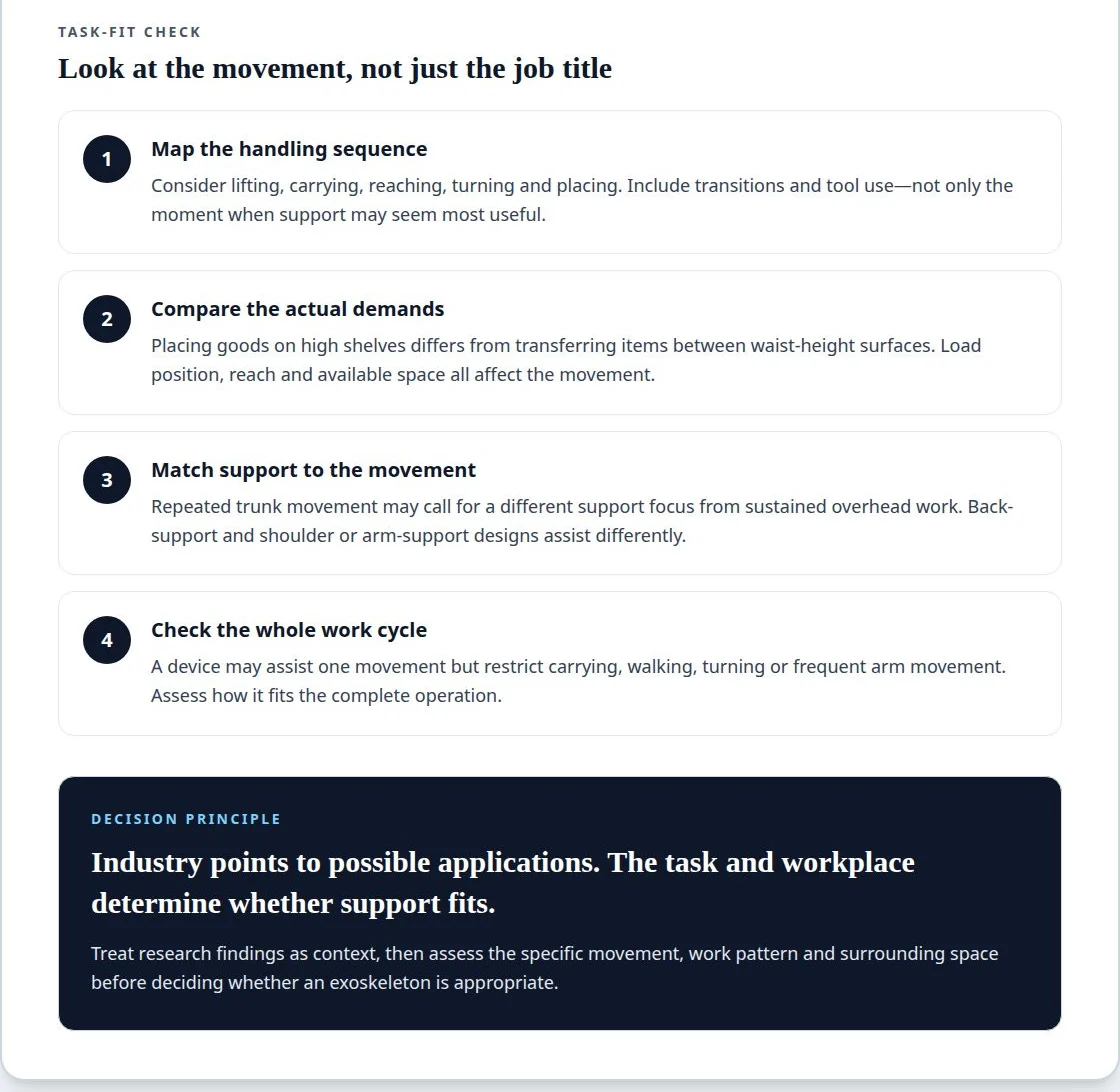
Task details matter even within one workplace. A warehouse worker placing goods on high shelves faces different demands from one transferring items between waist-height surfaces. Load position, reach and the surrounding space all shape the movement. Industry labels can point to possible applications, but they cannot replace analysis of the handling sequence.
Occupational exoskeleton types and use
Exoskeletons for lifting and material handling include back-support and shoulder or arm-support designs. Passive models use mechanical elements to provide support without powered assistance; active models use motors. Each design assists differently, so match the support area and movement to the work rather than choosing by category alone.
Repeated trunk movement during lifting may call for a different support focus from sustained overhead work. A device suited to one action may not suit carrying, turning or reaching within the same work cycle. Consider the full sequence, including transitions and access to tools, to see whether the device fits the operation without disrupting other movements.
Industry 5.0 and operator wellbeing
Industry 5.0 places human wellbeing alongside productivity and industrial performance. For a production-line operator, this means considering whether an exoskeleton supports the intended movement while allowing normal task execution. A lightweight design may suit some workflows, but weight alone does not establish suitability. Worker comfort and feedback are relevant decision factors.
An exoskeleton is ergonomic support, not personal protective equipment. Assess how it fits the task and workplace, rather than assuming it performs the role of protective clothing or equipment.
Potential effects on muscle effort and back strain
An exoskeleton may support selected muscles during specific movements. Its effect depends on the task, fit and the worker’s movements.
Support for back, shoulder, and arm muscles
Back-support designs can assist the trunk during repeated bending or lifting, while shoulder and arm supports target elevated or extended work. A device that supports the wrong body area may not address the main physical demand. For instance, lifting boxes from floor level calls for a different support focus from holding tools overhead.
Consider a complete work cycle: pick up a container, carry it, place it on a shelf, then return. Note where the worker bends, reaches or holds a load, and which muscles remain engaged. A back-support device may suit repeated trunk flexion but offer little help during long carries. An upper-limb design may assist sustained reaching yet interfere with tasks that require frequent arm movement.
Support changes how effort is distributed; it does not remove the task’s physical demands. A device that assists the shoulders may shift work to other body areas or restrict movement in a tight workspace. Compare the assisted movement with the complete cycle, including walking, turning and handling tools. This shows whether support fits the operation, not just one lift.
Muscle activity and physical fatigue
Muscle activity describes the effort muscles produce during movement; fatigue is the reduced capacity a worker may feel after sustained effort. Consider both: lower effort during one movement does not automatically mean less fatigue across a shift. Repeated box lifting, for example, may feel different from intermittent lifting mixed with walking and sorting.
During a workplace trial, compare the same task with and without the device. Record posture, pace, comfort and pressure points, alongside worker feedback at the end of the work period. If lifting feels easier but handling is slower, both observations matter. The aim is to understand the whole task, not treat one positive sensation as proof of overall benefit.
Physical fatigue can also reflect task duration, recovery opportunities and changing demands. A device may feel supportive during the first lifts but become uncomfortable with prolonged use. Note when discomfort appears, whether the worker adjusts or removes the device, and which movement triggers the change. This helps distinguish a useful fit from support that works only briefly.
Muscle activity findings need task context. An assessment may measure activity during a defined lift, but a warehouse or production shift also includes transitions, reaching and carrying. Treat a result as evidence about that movement, then assess comfort and performance across the wider work cycle. This keeps decisions focused on the actual job.
Ergonomic assessment, trials, training, and follow-up
An ergonomic assessment starts with the work, not the device. Task analysis, a structured trial and follow-up help determine whether support fits normal operations.
Ergonomic assessments and task analysis
Task analysis breaks a job into movements, loads, postures and transitions to clarify its main physical demands. This matters because a device that supports one lift may restrict the next movement.
For example, assess a warehouse task from pallet pick-up through carrying, shelf placement and return. Record when workers bend, reach, twist or hold a load, and how often each movement occurs during the work cycle. Include variations such as different shelf heights or product sizes. This gives the assessment a realistic basis for selecting and trialling support.
Define the purpose before testing: identify the movement the exoskeleton should support, then decide what evidence would show a practical fit. Observe comfort, freedom of movement, task completion and any need to change established work methods. Consider nearby equipment and workspaces too. A device that fits an open area may not suit a narrow aisle or workstation.
Assessment procedures
A structured assessment compares the task with and without the device, capturing worker feedback and operational observations. Using a consistent method helps separate device effects from changes in workload or task conditions.
Begin with the usual work method, then introduce the device with suitable instruction and a clearly defined task. Observe fit, adjustment, movement, comfort and whether the worker can complete the full cycle. Record comments during and after use. For example, note if shoulder support helps with overhead work but catches when the worker reaches for tools.
Training is part of the assessment. Workers need to learn how to put on, adjust and remove the device correctly; otherwise, poor fit can distort their feedback. Start with a clearly defined task, then assess other relevant movements before wider integration.
Follow up by revisiting the same criteria after workers have used the device in normal operations. Ask whether comfort changes, adjustments remain practical and work patterns have shifted. Record reasons for non-use as carefully as positive feedback. If the task, equipment or pace changes, reassess the fit. This creates a decision trail based on actual use, not a first impression.
Ready to find the right device for your operation?
Potential effects on worker well-being and absence costs
Workplace exoskeletons have limitations: fit, movement, comfort and task compatibility can affect their usefulness. They are not personal protective equipment (PPE) and should not replace PPE or other workplace controls.
Wear duration, PPE, and worker acceptance
Wear duration is how long a worker uses a device during the working day. It matters because comfort and acceptance can change over time. A handling exoskeleton may be worn for several hours, with use adapted to the person’s tasks and work rhythm. Possible use for several hours does not mean continuous wear suits every task or worker.
During a trial, record when the device is put on or removed, and why. For example, note whether a warehouse worker removes shoulder support before entering a narrow aisle, or whether straps become uncomfortable during repeated bending. Check that normal PPE remains usable alongside the exoskeleton. A device that conflicts with protective clothing or restricts a required movement is a poor operational fit.
Acceptance depends on practical experience, not procurement preference. Workers should be able to report discomfort, restricted movement and task interruptions without pressure to endorse a device. Compare their comments with observed work patterns. This makes comfort and continued use part of the decision, rather than assumptions made before workplace use.
Worker experiences and limitations
Limitations can include restricted movement, pressure points, extra effort elsewhere or difficulty combining the device with workplace equipment. These effects depend on the design and task. Record specific examples, such as difficulty turning with back support or reaching a tool while wearing arm support. Consider worker feedback alongside task performance, not as a substitute for it.
Absence costs strengthen the case for assessing ergonomic options, but they do not prove that an exoskeleton will reduce absence. Judge any proposed device through workplace evidence and worker experience.
Manual material handling tasks
Choose an exoskeleton by examining the handling task, not by matching a device to a job title. Identify where physical support might fit within the complete work cycle.
Manual handling includes lifting, placing, pushing, pulling, carrying and moving loads. A warehouse order-picker might lift a carton, carry it between locations and place it above shoulder height. A factory operative may repeatedly position components at a bench, while a construction worker carries materials across uneven ground. Each sequence creates different demands, so the same device may not suit all three settings.
Map the task from start to finish before selecting support. Record the load’s starting and destination positions, the worker’s posture, the direction of movement and how the item is gripped. Include transitions such as turning with a box or reaching into a container. A device that assists one lift may restrict the next movement, particularly if the worker must reach, rotate or move through a narrow aisle.
Separate tasks that may look similar. Lifting a box from floor level differs from transferring it between waist-height surfaces; carrying a load differs from holding it overhead. Note where the task repeats and where workers pause or change activity. This helps determine whether back, shoulder or arm support addresses the main physical demand, rather than simply adding equipment to the process.
An exoskeleton is not a substitute for a machine or mechanical assistance when handling heavy loads. Consider whether a lift table, conveyor or other workplace change addresses the task more directly. Use wearable support only for the remaining movements it is designed to assist. For example, a device might support repeated lifting at a workstation while mechanical assistance handles the heaviest transfer.
For a practical decision, define the target movement, distinguish wearable support from machine assistance, and assess the device in that task. Compare exoskeleton options for manual handling against the work demands before deciding what to trial.
Not sure which exoskeleton fits your task? Let the Ryggo advisor match it independently.
Ryggo
Ryggo helps organisations move from task analysis to an informed exoskeleton decision. Its AI-driven, vendor-neutral recommendations compare devices against the work, while ROI calculations support procurement decisions. The Deploy & Decide programme lets companies trial devices in their own operations before deciding whether to buy. Ryggo also matches exoskeletons for healthcare settings, where patient handling and clinical workflows shape device fit. This is useful when a warehouse, factory, construction site or healthcare team needs to compare options against real handling tasks, rather than choose on features alone. To assess your operation, start with Ryggo’s recommendation process and explore a Deploy & Decide trial.
Make the next decision evidence-led
Turn an ergonomic concern into a defined workplace decision. Choose the handling task that matters most, identify what workers need support with, and agree how the organisation will judge whether a device fits. This gives operations, HSE and procurement teams a shared basis for deciding what to trial and what would justify adoption.
When considering exoskeletons for manual handling, don’t treat product selection as the finish line. Connect task requirements, worker experience and operational priorities. A structured comparison can narrow suitable options; a workplace trial can then show how they perform in the real workflow. If the evidence does not support adoption, use what you learned to refine the task analysis.
Ryggo can help organisations assess options through device recommendations, vendor-neutral comparison and trial programmes. To discuss the needs of your workplace, contact Ryggo about workplace exoskeletons. A clear, evidence-led next step keeps the focus on people and the work they do.
Frequently Asked Questions
Is an exoskeleton considered as PPE?
No. Treat an exoskeleton as ergonomic support, not protective equipment. For a task involving several hazards, assess the relevant protective equipment separately and check that it remains compatible with the device. For example, consider whether a harness, protective clothing or gloves affect fit or access to essential controls. The device should not change existing workplace hazard-control decisions.
Do operators easily accept exoskeletons?
Acceptance varies by person and work setting, so don’t assume workers will adopt a device simply because it is available. Involve operators in deciding who will trial it, which tasks they will perform and how their feedback will inform the outcome. Let workers describe their experience privately as well as in group discussions, so concerns that might otherwise go unreported can be heard.
How to choose a handling exoskeleton properly?
Decide what the organisation needs the device to achieve, then use those criteria to compare options. A procurement team might assess whether it suits the task, fits the work environment and can be used alongside existing equipment. Agreeing on criteria before a trial helps prevent a decision based only on a demonstration or one user’s first impression.
Is an exoskeleton suitable for carrying heavy loads?
Not as a replacement for mechanical assistance when loads are heavy. Consider the full material flow: where the load starts, how it moves and where it is placed. A machine or mechanical aid may be more appropriate for the transfer itself. Consider an exoskeleton only for a distinct remaining task, not as a reason to increase the load carried by a worker.
Is training required to use an exoskeleton?
Yes. Workers need suitable instruction before using a device at work. Arrange onboarding around the actual operation, so workers can practise in the relevant work area and understand how the device interacts with their tasks. Vendor-provided training can support this process. Include supervisors in the introduction so they understand the trial’s purpose and can respond consistently to operational questions.
Which sectors are already using handling exoskeletons?
Examples include automotive manufacturing, logistics and healthcare. These examples indicate where applications have been studied or used, not that every task in those sectors is suitable. Airport baggage handling, for instance, has different workflow constraints from a hospital ward, even if both involve repeated manual work.
Why integrate an exoskeleton into handling operations?
Integration lets an organisation evaluate ergonomic support within its existing workflow, rather than in isolation. Consider how the device affects task allocation, movement between workstations and coordination with equipment. A clear operational purpose also helps managers decide whether adoption belongs in a wider ergonomics plan or whether another work-process change would be more appropriate.
What are exoskeletons for manual handling and how do they work?
Exoskeletons are wearable devices designed to provide physical support during selected work movements. Their structure interacts with the wearer during a task, so the support point and movement matter. A device designed for repeated lifting, for example, may not suit work involving frequent transitions between lifting, carrying and reaching. Suitability depends on matching its function to the work sequence.
Find the right device before you trial anything
The Ryggo advisor maps your task, environment, and requirements to compatible devices — independently, across the full European market.