Key Takeaways
- Use the exoskeleton implementation plan template to connect a defined work task to selection, trial, review and a documented decision.
- Assign an owner, required evidence, action, output and approval gate to each phase so HSE, operations, workers and procurement understand their roles.
- Compare options against the task, supported body region, movement and work environment, then consider worker feedback alongside operational impact.
- Set a baseline and agree what to observe before the trial begins. Use a checklist to organise readiness, communication, training and review.
- Record whether the evidence supports proceeding, refining the trial or stopping, and name the accountable owner and next action.
Table of Contents
- Why an exoskeleton implementation plan should start with the work task
- Build the exoskeleton implementation plan template around clear decision gates
- Compare exoskeleton options by task fit, worker experience, and operational impact
- Use this exoskeleton rollout plan to organise a controlled workplace trial
- Close the exoskeleton implementation plan with a documented proceed, refine, or stop decision
Why an exoskeleton implementation plan should start with the work task
An implementation plan connects a defined work need to device selection, evaluation and an operational decision. Start with the task and the worker’s exposure, not a preferred product. A device may look suitable in a demonstration but still restrict movement, conflict with the work environment or fail to address the physical demands identified.
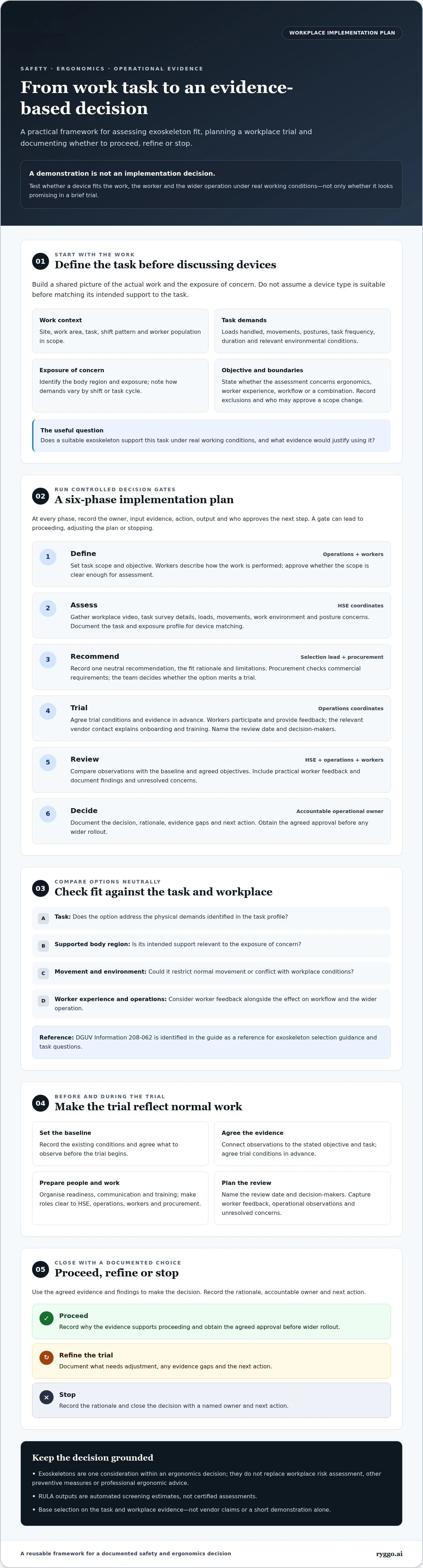
A product demonstration asks, “Can someone wear this device?” An implementation plan asks a more useful question: “Does a suitable exoskeleton support this task under real working conditions, and what evidence would justify using it?” The Powered exoskeleton overview provides background on terminology and different approaches, but workplace selection still needs to be grounded in the actual task.
Exoskeletons are one consideration within an ergonomics decision. They don’t replace workplace risk assessment, other preventive measures or professional ergonomic advice. RULA outputs are automated screening estimates, not certified assessments.
Set the workplace objective and scope
Make the trial specific enough to manage and review. Record the site, work area, task, shift pattern and worker population in scope. State whether the objective is to assess ergonomics, worker experience, workflow or a combination. For example, a team might assess whether support is appropriate during repeated overhead work while also checking whether the device interferes with normal movement.
Set boundaries too. List excluded tasks, work areas or outcomes, and document who can approve a scope change. This prevents a focused evaluation from expanding into a broader deployment decision without review.
Describe the task before discussing devices
Capture what workers actually do: loads handled, movements, postures, task frequency, duration and relevant environmental conditions. Note where demands vary by shift or task cycle. Identify the body region and exposure of concern, but don’t assume a particular device type is suitable before comparing those demands with its intended support and practical fit.
Use DGUV Information 208-062 as a reference for exoskeleton selection guidance and task questions. The task description gives HSE, operations, workers and procurement a shared basis for setting requirements before considering device options.
Build the exoskeleton implementation plan template around clear decision gates
A useful exoskeleton implementation plan template turns an initial task concern into a sequence of controlled decisions. It doesn’t assume adoption is the outcome. If the task, evidence or worker experience doesn’t support implementation, the plan should make it straightforward to adjust or stop.
A decision gate is an agreed point at which the team decides whether to proceed, adjust the plan or stop, based on the evidence available. For every stage below, record the owner, input evidence, action, output and person or group approving the next step.
- Define: Operations owns the task scope, while workers describe how the work is performed. Record the task and objective, then approve whether they are clear enough for assessment.
- Assess: HSE coordinates the review with operations and workers. Gather workplace video, task survey details, loads, movements, work environment and posture concerns. The output is a documented task and exposure profile, approved for device matching.
- Recommend: The designated selection lead reviews the assessment and records one neutral recommendation, its fit rationale and any limitations. Procurement checks commercial requirements; the team decides whether the option merits a trial.
- Trial: Operations owns trial coordination, workers participate and provide feedback, and the relevant vendor contact explains device onboarding and training. Agree on trial conditions and evidence in advance, then name the review date and decision-makers.
- Review: HSE and operations compare observations with the baseline and agreed objectives. Workers contribute practical feedback. Document findings and unresolved concerns before the final gate.
- Decide: The accountable operational owner records the decision, rationale, evidence gaps and next action. Obtain the agreed approval before any wider rollout.
Assessment and recommendation fields
Keep the assessment record practical: task and work area, video reference, survey responses, loads, movements, environmental conditions and posture concerns. With Ryggo, the assessment process starts with a 30-second workplace video and a short survey about loads, movements and the work environment, mapped to DGUV 208-062. Steps one to three take about 10 minutes. Video-based RULA outputs are automated screening estimates, not certified assessments, and uploaded videos are deleted after analysis. Document the recommendation’s rationale against the task. Paid listings are not accepted, and recommendations are based solely on fit across vendors.
Trial and decision fields
Before a trial, specify its objective, participating workers, operating conditions, measures to review, owner and review point. Ryggo’s Deploy & Decide programme offers 2-, 4- or 8-week trials. The trial fee is fully credited toward an eventual purchase, so there’s no double payment. Record the final decision, accountable owner, rationale, follow-up action and any evidence gaps. For a neutral route from assessment to a task-fit recommendation and trial, review Ryggo’s exoskeleton trial process.
Ready to find the right device for your operation?
Find my exoskeleton →Compare exoskeleton options by task fit, worker experience, and operational impact
Use the task profile from the assessment to compare options against the same requirements. Don’t rank devices by category or vendor claims alone. A passive, active or soft-suit approach is worth considering only if its intended support aligns with the task’s movements, posture demands and operating conditions. Check each candidate’s supported body region and specifications against reliable device information before evaluation.
Check fit across workers and the work environment
Use this comparison table as a working record. Complete it for each relevant candidate, applying the same task and evaluation criteria. If a detail is unknown, mark it for verification rather than assuming suitability.
| Approach or candidate | Task fit | Supported body region | Movement | Environment | Worker feedback |
|---|---|---|---|---|---|
| Passive option, if relevant | Which assessed task demands may align? | Verify against device information | Does it accommodate the task’s required movements? | Does it suit the work area and conditions? | Comfort, mobility, acceptance and task performance |
| Active option, if relevant | Which assessed task demands may align? | Verify against device information | Does it accommodate the task’s required movements? | Does it suit the work area and conditions? | Comfort, mobility, acceptance and task performance |
| Soft-suit option, if relevant | Which assessed task demands may align? | Verify against device information | Does it accommodate the task’s required movements? | Does it suit the work area and conditions? | Comfort, mobility, acceptance and task performance |
Ergonomic suitability is only one part of the comparison. Record usability and worker acceptance separately from workflow compatibility, training needs and procurement considerations. A candidate may appear relevant to the assessed posture but still prove difficult to put on or incompatible with the normal task sequence. If you compare options side by side, use the same operation and agreed observation methods so differences aren’t confused with changes in workload or conditions.
Define evidence for the decision
Before evaluation, agree what the team will observe and how it will record findings. Use consistent methods for operational observations and worker feedback before and during the trial. An initial RULA screening estimate can help inform the assessment, but it is not a certified ergonomic assessment or proof that a device is effective.
Connect any ROI rationale to the workplace’s own workload and posture data. Identify assumptions, including which tasks or operating conditions the rationale covers. If baseline information is missing, record that gap and avoid presenting projected health or productivity benefits as achieved results. The comparison should support a measured decision, not a predetermined purchase.
Use this exoskeleton rollout plan to organise a controlled workplace trial
A trial is useful only if it reflects the work the organisation needs to understand. Before introducing the device, establish a baseline and agree how the team will assess the task, worker experience and workflow. The exoskeleton implementation plan template should make the trial controlled enough to produce comparable evidence while allowing the team to document issues that emerge in practice.
Prepare workers, supervisors, and the operating area
Explain why the trial is taking place, which tasks and conditions are in scope, how workers can share feedback and how concerns will be handled. Make clear that the purpose is evaluation, not a presumption that the device will be adopted. Agree responsibilities in advance so observations and issues don’t fall between teams.
- Readiness: Confirm the task, operating area and baseline measures are documented. Agree which normal work conditions the trial should reflect.
- Communication: Brief participating workers and supervisors on the purpose, boundaries, feedback route and review arrangements.
- Responsibilities: Name the coordinator for vendor onboarding and training, task observations, feedback collection and issue escalation.
- Training: Coordinate with the vendor on the onboarding and training provided for the trial. Ryggo trials also include vendor-provided delivery and service support.
- Observation: Plan how the team will observe the task during normal operations, rather than relying on a staged demonstration alone.
- Review: Set a mid-trial check-in and a final review point, with named attendees and agreed records.
Run the trial and record consistent evidence
Keep the task definition and observation approach consistent throughout the agreed trial period. Before starting, record the relevant baseline, such as the normal task sequence, operating conditions and measures the team has agreed to review. This gives the final discussion a point of comparison rather than relying on general impressions.
Collect worker feedback alongside operational observations. Record comfort, mobility, usability difficulties, workflow changes and reasons for non-use. At the mid-trial review, check whether fit or workflow issues need attention. Don’t casually revise the success criteria to make results appear more favourable. If the original measures need to change for a sound reason, document what changed, why and how that affects interpretation.
Log deviations and contextual factors as they arise, such as differences in task mix or operating conditions. These details matter because an apparent change may reflect a different workload rather than the device. Keep observations, feedback and assumptions distinct, and don’t treat projected benefits as achieved outcomes.
For a structured route from task assessment to a workplace trial, explore Ryggo’s exoskeleton advisory.
Close the exoskeleton implementation plan with a documented proceed, refine, or stop decision
End the trial with a recorded decision, not an informal sense that it went well. An exoskeleton implementation plan template should capture what the evidence supports, what remains uncertain, who is accountable and what happens next. Proceed, refine and stop are equally valid outcomes. The right choice depends on task fit and the evidence gathered, not on the effort already invested.
Record the decision and commercial assumptions
Summarise task fit, worker feedback and workflow observations against the criteria agreed before the trial. Separate observed results from projections. If the ROI rationale depends on assumptions about workload or potential benefits, state those assumptions and note any missing baseline data. Record the selected route, decision owner, procurement dependencies and further evidence required.
Use this table to document the outcome:
| Evidence reviewed | Unresolved concerns | Decision | Accountable owner | Next action |
|---|---|---|---|---|
| Task fit, worker feedback, workflow observations and agreed measures | Concerns, evidence gaps or assumptions still to check | Proceed, refine or stop | Name and role | Specific action, owner and review point |
Proceed only to a separately scoped next phase for the task assessed. Refine when the task, trial conditions or evidence need further work. Stop when the option doesn’t fit or the evidence doesn’t support continuing. A successful trial on one task is not approval to expand to other tasks, workers or sites. Wider use needs a fresh scope and review.
If the trial used Ryggo’s Deploy & Decide programme, its fee is fully credited toward an eventual purchase, so there’s no double payment. For unsuccessful trials, refunds are up to 75% for 2 weeks, 70% for 4 weeks or 60% for 8 weeks. Ryggo operates across exactly 23 European countries under one set of commercial terms.
Plan the next phase without assuming scale-up
For any separately scoped implementation, identify who will coordinate vendor-provided onboarding and training, who will handle service support and who will review outcomes. Confirm procurement dependencies and set a review point before taking the next step. Keep unresolved evidence gaps visible; a decision to proceed doesn’t make uncertainty disappear.
Get a neutral exoskeleton recommendation based on task fit.
Not sure which exoskeleton fits your task? Let the Ryggo advisor match it independently.
Find my exoskeleton →Turn the trial evidence into a clear next step
A sound exoskeleton decision begins with a defined task, then moves through assessment, selection and a controlled trial. Use the exoskeleton implementation plan template to keep owners, evidence and approval points clear, and document whether the right outcome is to proceed, refine or stop. A positive result for one task is a reason to assess that scope, not an automatic case for wider rollout.
If you need support moving from task assessment to device selection, Ryggo provides free, unlimited RULA screening estimates from uploaded workplace videos, which are deleted after analysis. These are screening estimates, not certified assessments. Paid listings are not accepted, and recommendations are based solely on fit. If you use Deploy & Decide, the trial fee is fully credited toward an eventual purchase, so there’s no double payment.
Get a neutral exoskeleton recommendation and take the next step with a clearer basis for your decision.
Frequently Asked Questions
What should an exoskeleton implementation plan include?
An exoskeleton implementation plan should link a specific work task to assessment, device selection, a controlled trial and a documented decision. Include the site and task scope, relevant exposure and posture information, assigned owners, evidence to collect, agreed review points and approval gates. Record worker feedback and operational observations separately, then document whether the evidence supports proceeding, refining the approach or stopping. The plan should allow for the possibility that no device is suitable.
How do you create an exoskeleton rollout plan?
Start with the task, not a device. Define the work area, people and conditions in scope, then document relevant loads, movements, postures and task frequency. Assign responsibilities across HSE, operations, workers, procurement and vendor contacts. Set a baseline and agree on evaluation measures before a trial. Close each phase with an evidence-based approval gate, and record the decision owner and next action.
How long should an exoskeleton pilot last?
Choose a period that gives workers a chance to evaluate the device during the relevant work, while keeping the trial scope and review criteria clear. Ryggo’s Deploy & Decide trials are available for 2, 4 or 8 weeks. Set the trial objectives, operating conditions, observation approach and review point before it starts. A longer period alone doesn’t make evidence stronger if the trial doesn’t reflect normal work.
How can a company compare exoskeletons fairly?
Compare candidates against the same assessed task and agreed criteria, including task fit, supported body region, required movement, work environment, worker feedback and workflow compatibility. Check device information rather than assuming suitability from a category or vendor claim. If you test options side by side, keep the operation and observation methods consistent. Record training or procurement considerations separately from ergonomic fit so each factor is visible in the decision.
Are RULA scores from a video a certified ergonomic assessment?
No. Ryggo’s video-based RULA outputs are automated screening estimates, not certified ergonomic assessments, and they don’t replace professional ergonomic advice. They can help identify posture concerns for further consideration, alongside a task survey mapped to DGUV 208-062 selection guidance. Uploaded videos are deleted after analysis. Treat the screening output as one input to a workplace assessment, not proof that a device is suitable or effective.
What happens if an exoskeleton trial does not meet expectations?
Document what fell short, including task fit, worker experience, workflow issues and any evidence gaps, then decide whether to refine the scope or stop. For an unsuccessful Ryggo Deploy & Decide trial, refunds are up to 75% for 2 weeks, 70% for 4 weeks and 60% for 8 weeks. If a device is purchased, the trial fee is fully credited toward the purchase, so there’s no double payment.
Can you test more than one exoskeleton in the same operation?
Yes, Ryggo supports side-by-side trials of multiple devices in the customer’s operation. Plan the comparison carefully: define the task, criteria, participating workers and observation method in advance, and record differences in workload or conditions. A comparison should test relevant options without presuming any will be adopted. Keep the recommendation for a task clear and neutral, based solely on fit, and document the evidence behind the final decision.
Find the right device before you trial anything
The Ryggo advisor maps your task, environment, and requirements to compatible devices — independently, across the full European market.
Find my exoskeleton →