Key Takeaways
- Define the eligible worker group and observation period before calculating an adoption rate, so the denominator reflects who had a genuine opportunity to use the exoskeleton.
- For measuring exoskeleton adoption rates in workforce settings, count repeated, task-relevant use rather than demonstrations or first-time trials alone.
- Set a repeat-use threshold that matches the role’s planned work pattern. There is no universal threshold that fits every task or shift.
- Track use alongside worker feedback and reasons for non-use to distinguish task-fit or training issues from low interest.
- Use adoption evidence to decide whether to adjust, continue or stop the pilot, and assess fit for the specific task rather than treating uptake as a verdict on exoskeletons overall.
Table of Contents
- What measuring exoskeleton adoption rates in the workforce actually means
- How to calculate a workforce exoskeleton adoption rate
- Which workforce adoption metrics explain uptake, and which do not?
- How to run a workforce adoption measurement plan during a trial
- Use adoption evidence to decide the next step with Ryggo
What measuring exoskeleton adoption rates in the workforce actually means
A device being available is not the same as workers adopting it. For a useful measure, define the behaviour you’re tracking, the workers who had a genuine opportunity to use the device, and the period over which you’ll observe them.
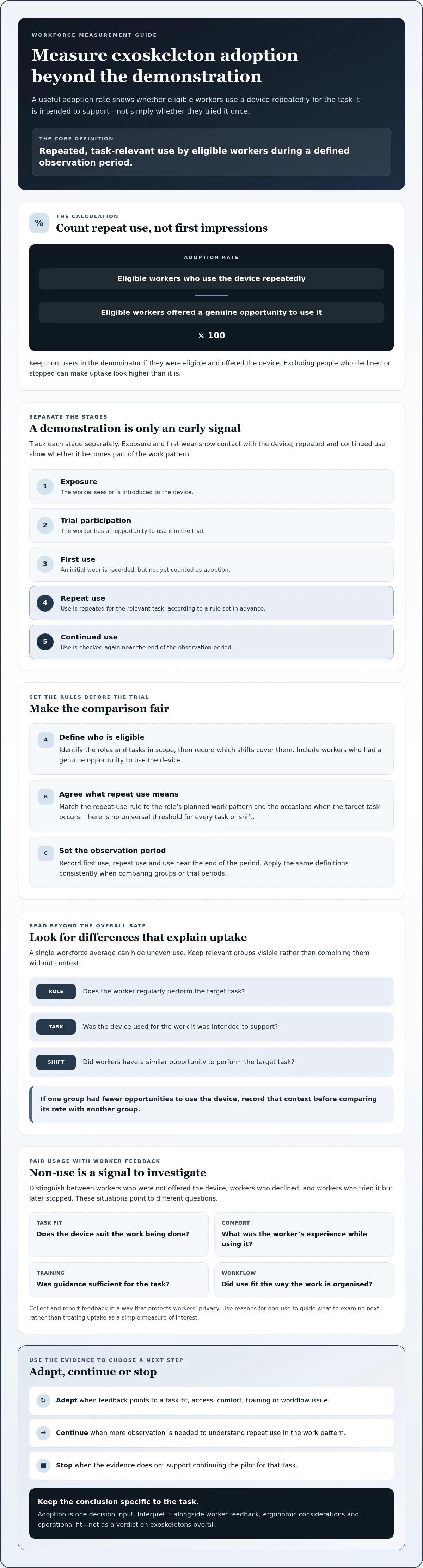
Workforce adoption is repeated, task-relevant use of an exoskeleton by eligible workers during a defined observation period, not device availability or attendance at a demonstration. This definition focuses the measure on routine work rather than initial interest. A wearable exoskeleton may be introduced to support a particular physical task, but adoption depends on whether eligible workers use it for that task in practice.

Which workforce should count in the adoption rate?
Set the eligible group before the trial starts. Identify the roles and tasks in scope, then record which shifts those workers cover. A warehouse worker who regularly performs a target handling task has a different opportunity to use a device from a colleague whose role rarely includes it. Keep those groups visible rather than combining them without context.
Also distinguish workers who weren’t offered the device from those who were offered it but declined, or tried it and later stopped. These situations raise different questions. A worker not offered the device had no chance to adopt it; a worker who stopped using it may have encountered a fit, comfort, training or workflow issue worth investigating.
Why one early-use figure can mislead
A demonstration records exposure. A first wear records initial use. Neither shows whether the device becomes part of the work pattern. Track stages separately: exposure, trial participation, first use, repeat use and continued use across the observation period. Decide in advance what counts as repeat or continued use, based on the task and planned work pattern. There’s no universal threshold that suits every role.
An overall workforce average can also conceal uneven uptake. If workers on one shift use the device repeatedly while a task group on another shift rarely does, a single combined figure may obscure a practical barrier. Break results down by relevant role, task and shift, while protecting workers’ privacy in how feedback is collected and reported.
Use adoption as one decision input, not a verdict on the exoskeleton. Regular use doesn’t prove that the device is safe or prevents injury. Low use doesn’t, by itself, prove that the device is unsuitable. Interpret the measure alongside ergonomic considerations, worker feedback and operational fit to decide what needs adjustment and what evidence to gather next.
How to calculate a workforce exoskeleton adoption rate
Use a rate that captures repeat use, not simply how many workers attended an introduction or tried the device once. The basic calculation is:
Adoption rate = eligible workers who use the device repeatedly ÷ eligible workers offered it × 100
Before collecting data, define “repeated use” in a way that matches the role’s planned work pattern. For a task performed regularly, you might count workers who use the exoskeleton on relevant occasions during agreed observation windows. For a less frequent task, account for when that work actually occurs. Set the rule before the trial begins and apply it consistently. There is no universal threshold that suits every task.
A fair denominator includes every eligible worker who was offered a genuine opportunity to use the device, not only those who accepted or completed a first wear. Otherwise, the rate can overstate uptake by excluding the people whose decisions and experience are part of the pilot’s evidence.
Set a denominator that supports fair comparison
Record the eligible cohort and any exclusions, with a clear reason for each. For example, distinguish workers who were absent during the relevant period or whose tasks fell outside the trial scope from workers who were offered access but declined. Don’t quietly remove non-users from the denominator simply because they didn’t wear the device.
When comparing roles, shifts or trial periods, define eligibility in the same way for each group. If a shift had fewer opportunities to perform the target task, record that context rather than treating its adoption rate as directly comparable without qualification.
Track use over time, not only at launch
Record first use, repeat use and use near the end of the trial separately. Use the same observation windows and recording method across groups, and note when eligible workers had an actual opportunity to use the device. A simple log can capture the date or shift, task, whether the device was available, whether it was used, and a brief reason when it wasn’t.
Keep the reported rate auditable. State the cohort, task scope, shifts, trial dates, definition of repeated use and data source beside each figure. Pair usage records with brief worker feedback and task context. A lower rate may reflect discomfort, unsuitable task fit, limited opportunities or a training gap; the percentage alone won’t tell you which.
For measuring exoskeleton adoption rates in workforce pilots, this method provides a consistent uptake measure without treating it as proof of ergonomic benefit or operational success. If you’re assessing device fit before purchase, Ryggo’s vendor-neutral exoskeleton advice can help inform selection; trial results still need to be evaluated in your workplace.
Ready to find the right device for your operation?
Find my exoskeleton →Which workforce adoption metrics explain uptake, and which do not?
A single percentage can show how much of the eligible workforce used an exoskeleton repeatedly, but it won’t explain why use varied or whether the device supported the task. Build a small set of measures that separates behaviour from worker experience and operational outcomes.
| Metric | What it answers | Main limitation |
|---|---|---|
| Eligible-worker uptake | Who used the device among workers offered access? | Doesn’t show whether use continued. |
| Repeat-use share | Who used it repeatedly under the trial’s agreed definition? | Depends on the task-specific definition and observation window. |
| Continued use | Who was still using it near the trial’s end? | Doesn’t explain why others stopped. |
| Reasons for non-use | What barriers or concerns did workers report? | Feedback needs task and trial context to be interpreted. |
| Comfort and task compatibility | How did workers describe wearing and using it for the task? | Worker reports are not usage counts or proof of ergonomic benefit. |
Separate adoption indicators from outcome measures
Label usage frequency and continued use as behavioural indicators. Report worker-reported comfort and task compatibility separately, and assess operational performance using measures suited to the task. This distinction matters: frequent use doesn’t prove ergonomic benefit, injury reduction, safety or productivity gains. Those outcomes require their own assessment and evidence.
Likewise, low uptake is a signal to investigate, not proof that the device has failed. A worker may find it uncomfortable, or the task may not provide a realistic opportunity to use it. Keep these findings distinct in reports so decision-makers can see what was observed and what remains uncertain.
Interpret non-use without blaming workers
Record practical reasons for non-use in neutral terms, such as setup effort, fit concerns, interruption to the task or limited access to the device. Then check whether onboarding, device availability and task allocation were consistent across the workforce. If use differs between shifts, ask whether the conditions differed too.
Worker feedback adds context; it isn’t a substitute for ergonomic assessment. Use it to identify what to examine or adjust during the trial, then review the change against usage records and task requirements. This makes measuring exoskeleton adoption rates in workforce settings more useful: the figures show what happened, while separate measures help explain the experience behind them.
How to run a workforce adoption measurement plan during a trial
Reliable results start before the exoskeleton reaches the workplace. Agree the eligible cohort, task scope, observation windows and definition of repeated use in advance. Record the trial dates and identify which roles and shifts are included. This gives everyone the same basis for collecting and interpreting evidence.
Build a practical data-collection routine
Keep the process simple enough to use consistently during normal operations. Assign responsibility for noting when the device was available, whether workers had an opportunity to use it, whether it was used, and any reason for non-use. Capture brief worker feedback and relevant task context using the same method across shifts. Explain to workers what is being observed and why. Aggregate reporting where appropriate, so findings support decisions about the trial rather than becoming an informal judgement of individuals.
Make the observation routine part of broader pilot planning. Decide who will gather feedback, how often the team will review records, and how findings will be shared with those responsible for the trial.
Set decision rules before reviewing results
Agree in advance what evidence would support continuing, adapting or ending the trial. Specify what you’ll review about repeated use, worker feedback, task compatibility and operational observations. These are decision criteria, not universal thresholds. Avoid setting an adoption target without a clear rationale tied to the task and the eligible workforce.
Review the evidence by task and shift before relying on a site-wide average. If use is lower in one group, check whether the device was equally available, onboarding was consistent and workers had comparable opportunities to perform the task. Then examine their feedback and observations before deciding whether to adjust the trial. A difference in uptake alone doesn’t establish its cause.
Keep conclusions proportionate to what the data can show. Adoption records describe use; they don’t prove ergonomic benefit, injury reduction or productivity gains. Consider them alongside worker experience and task-level assessment. A consistent plan makes measuring exoskeleton adoption rates in workforce settings more useful to HSE and operations teams.
To explore vendor-independent matching and testing before purchase, review exoskeleton advice for your workplace.
Use adoption evidence to decide the next step with Ryggo
Adoption results help answer a practical question: does this exoskeleton fit the task and the way work is organised? They’re evidence about use in a particular setting, not a standalone verdict on exoskeletons as a category. A low rate may point to a mismatch, limited opportunity or a need to adjust the trial. A high rate still needs to be considered alongside worker feedback, ergonomic assessment and operational observations.
Ryggo, Europe’s first independent exoskeleton exchange, offers free, unlimited RULA-based ergonomics screening from uploaded videos to help workplaces assess a task before selecting a device. A 30-second workplace video and a short task survey inform one neutral recommendation based solely on fit across vendors. The video provides an automated RULA-based screening estimate. It isn’t a certified assessment and doesn’t replace professional ergonomic consultancy. Uploaded videos are deleted after analysis.
Connect task assessment with a real-work trial
Selection is guided by DGUV 208-062. A real-work trial then lets the workplace assess whether the recommended exoskeleton suits the task and whether use is sustained beyond an initial demonstration. Deploy & Decide trials are available for 2, 4 or 8 weeks. If a trial is unsuccessful, the refund is up to 75% for a 2-week trial, 70% for a 4-week trial or 60% for an 8-week trial.
Use your adoption measures to focus the evaluation: who used the device repeatedly, where use dropped off, and what workers said about task fit or barriers. Treat those findings as prompts for a decision, not proof of safety or ergonomic benefit.
Make the commercial decision clear
If you proceed to purchase, the trial fee is fully credited toward it, so there’s no double payment. The manufacturer provides delivery, onboarding, training and service. Ryggo supports vendor-neutral matching and comparison, while manufacturers handle those device-related arrangements.
For HSE, operations and procurement teams, this links workforce evidence to a defined next step: continue, adapt or stop based on task-level fit and the evidence gathered. To explore matching and testing before purchase, explore Ryggo’s independent exoskeleton exchange.
Not sure which exoskeleton fits your task? Let the Ryggo advisor match it independently.
Find my exoskeleton →Turn pilot findings into a confident next step
A useful adoption rate measures repeated, task-relevant use among workers who had a genuine opportunity to participate. Define the cohort and repeat-use criteria in advance, then compare results across roles, tasks and shifts. Pair usage data with worker feedback and operational observations: uptake helps explain whether a device fits the work, but it doesn’t prove ergonomic benefit or safety.
That’s the practical value of measuring exoskeleton adoption rates in workforce settings. Clear evidence can help your team decide whether to adapt, continue or stop a trial, without treating one figure as the whole story.
Ryggo’s vendor-neutral recommendations are based solely on fit across vendors. Paid listings are not accepted. With Deploy & Decide, the full trial fee is credited toward purchase if you proceed, so there’s no double payment.
Ready to assess device fit for your workplace? Explore Ryggo’s independent exoskeleton exchange and take the next step toward testing before purchase.
Frequently Asked Questions
How do you calculate an exoskeleton adoption rate in the workforce?
Divide the number of eligible workers who use the exoskeleton repeatedly by the number of eligible workers offered a genuine opportunity to use it, then multiply by 100. Define “repeated use” before the trial, based on the role’s planned work pattern. Report the cohort, tasks, shifts, observation period and data source with the rate so readers can interpret what it measures.
What is a good adoption rate for an exoskeleton pilot?
There’s no universal “good” rate. A meaningful result depends on the task, who was eligible, how often the task occurred and whether workers had a fair opportunity to use the device. Set decision criteria before reviewing results. Then consider uptake alongside worker feedback, comfort, task compatibility and operational observations, rather than judging a pilot against an arbitrary percentage.
Should workers who decline an exoskeleton count in the adoption rate?
Yes, if they were eligible and offered a genuine opportunity to use it, include them in the denominator, but not the repeat-use numerator. Record that they declined and, where possible, their stated reason. Workers who weren’t eligible or weren’t offered access should be distinguished and documented separately. This makes the rate more transparent and helps identify whether access or task allocation affected uptake.
How long should a workplace measure exoskeleton adoption?
Choose an observation period that gives eligible workers a realistic chance to perform the target task and use the device repeatedly. Set the dates and observation windows before the trial, and apply them consistently across roles and shifts. The period should reflect the work pattern, not an assumed universal threshold. Deploy & Decide trials are available for 2, 4 or 8 weeks.
Can high exoskeleton usage prove that a device is effective?
No. High usage shows that workers used the device, not that it reduced strain or improved safety, ergonomics or productivity. Assess those outcomes separately using measures suited to the task, and consider worker feedback and operational context. Likewise, low usage doesn’t automatically mean the device failed. It may indicate a task-fit issue, limited access, discomfort or a training gap that needs investigation.
What should employers track when workers stop using an exoskeleton?
Record when use stopped, the task and shift involved, whether the device was available, and the worker’s reason if they’re willing to share it. Ask about practical barriers such as fit, setup effort, interruption to the task or difficulty accessing the device. Check whether onboarding and task opportunities were consistent. Use these details to guide trial adjustments, not to blame individuals.
Can Ryggo help a company test exoskeleton fit before purchasing?
Yes. Ryggo uses a 30-second workplace video and a short task survey to inform one neutral recommendation based solely on fit across vendors. Its free, unlimited RULA-based screening provides an automated estimate, not a certified assessment, and doesn’t replace professional ergonomic consultancy. Uploaded videos are deleted after analysis. Deploy & Decide enables trials before purchase; if you proceed, the full trial fee is credited toward it.
Find the right device before you trial anything
The Ryggo advisor maps your task, environment, and requirements to compatible devices — independently, across the full European market.
Find my exoskeleton →