
Key Takeaways
- Match trade-specific biomechanics directly to dedicated upper-body or lumbar systems, targeting high-strain tasks like overhead MEP installation and ground-level rebar fixing.
- Assess physical durability against abrasive jobsite dust and verify full harness compatibility to eliminate snagging hazards on scaffolding and structural framing.
- Quantify commercial return on investment by measuring sustained afternoon work pacing and lower compensation liabilities rather than relying on abstract productivity claims.
- Validate every construction exoskeleton through structured, low-risk jobsite pilots and automated ergonomic video screening before committing capital to full fleet procurement.
Table of Contents
- The Ergonomic Imperative: Why Jobsite Trades Require Construction Exoskeletons
- Classifying Construction Exoskeletons: Matching Biomechanics to Trade Tasks
- Jobsite Feasibility: Durability, Agility, and Safety Compliance
- The Economic Equation: Quantifying Exoskeleton ROI and Risk Reduction
- Deploy & Decide: A Structured Framework to Pilot Construction Exoskeletons
The Ergonomic Imperative: Why Jobsite Trades Require Construction Exoskeletons
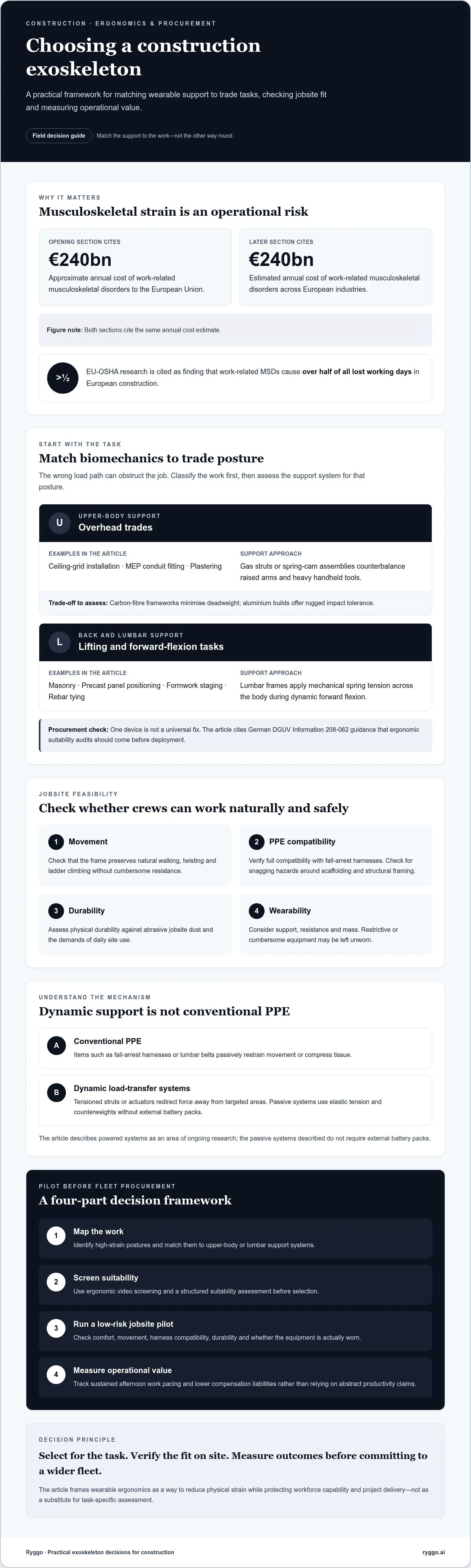
Modern jobsite productivity often collides directly with human biological limits. An industrial construction exoskeleton functions as an ergonomic wearable frame designed to disperse mechanical stress away from vulnerable joints and vulnerable muscle groups during heavy labour. Rather than treating physical exhaustion as an unavoidable operational cost, forward-thinking contractors view wearable ergonomics as a capital protection strategy. Work-related musculoskeletal disorders (WMSDs) cost European industries an estimated €240 billion annually, driving early retirements and severe project delays. Protecting seasoned tradespeople from cumulative wear is no longer just a welfare concern; it keeps projects on schedule amid persistent European craft shortages.
Combating Musculoskeletal Disorders and Skilled Labour Shortages
Repetitive heavy handling, prolonged forward bending, and continuous overhead fixing impose punishing physical loads on site crews. Research from EU-OSHA indicates that work-related MSDs represent the single largest category of occupational disease across European construction, causing over half of all lost working days. Mechanical joint offloading interrupts this path of physical deterioration. By transferring structural pressure away from the lumbar spine and rotator cuff tendons, wearable frames mitigate micro-trauma before it turns into chronic injury. Retaining an experienced master plasterer or bricklayer avoids the steep financial penalties of project downtime and costly recruitment cycles.
How Wearable Biomechanical Support Differs from Conventional PPE
Biomechanical support operates under entirely different engineering principles than traditional personal protective equipment. Standard items like fall-arrest harnesses or lumbar support belts act passively to restrain movement or compress tissue during an accident. Dynamic load-transfer systems actively alter how kinetic force flows through the human frame.
- Kinetic redirection: Tensioned struts or dynamic actuators divert compressive forces away from the lower vertebrae, directing that energy into the thighs and core pelvic structure.
- Assisted actuation: While research continues into advanced powered exoskeleton designs that use electromechanical motors, passive systems harness elastic tension and counterweights to assist movement without external battery packs.
- Kinetic freedom: High-performance wearable frames maintain natural ranges of movement, ensuring operatives walk, twist, and climb ladders without cumbersome resistance.
Adopting these ergonomic systems represents a strategic operational upgrade rather than an experimental technology trial. They deliver a measurable baseline for reducing sick leave, safeguarding field teams, and defending daily site margins.
Classifying Construction Exoskeletons: Matching Biomechanics to Trade Tasks
Equipment abandonment happens when procurement teams buy wearable hardware without evaluating specific site postures. A device engineered for overhead drilling will actively obstruct an operative tying rebar at ankle level. Single-brand manufacturers often market their proprietary system as a universal fix, yet German DGUV Information 208-062 guidance establishes that ergonomic suitability audits must precede deployment. Selecting the correct construction exoskeleton requires classifying hardware by its biomechanical load path and drive mechanism.
Shoulder and Upper-Body Systems for Overhead Trades
Overhead trades, such as ceiling grid installers, MEP conduit fitters, and plasterers, face continuous neck and shoulder strain. Upper-body wearable frames rely on gas struts or spring-cam assemblies to counterbalance the gravitational weight of elevated arms and heavy handheld tools. Specifiers balance rigid structural stability against overall harness mass; carbon-fibre frameworks minimise deadweight for all-day use, whereas aluminium builds deliver rugged impact tolerance against daily site abuse.
Back and Lumbar Support Systems for Lifting Trades
Masonry work, precast panel positioning, formwork staging, and rebar tying require dynamic forward flexion. Lumbar support frames apply mechanical spring tension across the pelvic girdle and chest harness, stabilising the lower back as workers bend forward and kickstarting their return to an upright posture. Advanced mechanical clutch systems are critical here. These clutches automatically disengage tension when an operative climbs a scaffold ladder or sits behind the wheel of an excavator, preventing dangerous mobility restrictions.
Passive Mechanics vs. Active Powered Actuation on Site
Choosing between passive kinetic tension and active electrical power defines your daily operational footprint. Field trials across Europe confirm distinct trade-offs between both architectures:
- Passive systems: Rely on elastomer bands, torsion springs, and counterweights. They require zero recharging, weigh substantially less, and feature completely sealed mechanical linkages resistant to airborne grit.
- Active systems: Use battery-powered servomotors to deliver dynamic assistive torque during heavy, irregular lifts. They adapt intelligently to changing loads but introduce charging logistics, runtime management, and water ingress risks on remote jobsites.
Passive wearable units incur minimal ongoing maintenance compared to active motor assemblies that demand scheduled diagnostic checks and battery replacements. If you are comparing multi-trade requirements, you can evaluate vendor-neutral options and simulate operational returns through Ryggo's digital advisory platform to identify the right biomechanical match before ordering hardware.
Ready to find the right device for your operation?
Find my exoskeleton →Jobsite Feasibility: Durability, Agility, and Safety Compliance
Deploying ergonomic wearables into live construction projects tests physical engineering to its limits. An industrial construction exoskeleton must survive unpaved terrain, heavy airborne abrasives, and constant contact with scaffolding. If a system clogs with concrete slurry or snags on exposed reinforcement bar, site operatives will reject it immediately. Operational success depends on evaluating environmental toughness, integration with certified safety harnesses, and pragmatic change management on the ground.
Environmental Resilience and Ingress Protection
Fine silica dust, wet concrete slurry, and driving rain attack unprotected mechanical linkages. Vulnerability concentrates around mechanical ball bearings, ratcheting hip hinges, and tension cords. Specifiers must verify manufacturer Ingress Protection (IP) ratings for wet slurry conditions before approving field use. Establishing strict daily hygiene matters just as much; operatives should blow down joints with low-pressure air lines and wipe flexible textiles with damp cloths to prevent cured cement from binding moving linkages.
Fall Protection and Personal Safety Compatibility
Operating at height introduces non-negotiable personal protection rules. assistive frames cannot interfere with certified EN 361 full-body fall arrest equipment. Safety teams must establish clear compatibility protocols:
- Dorsal clearance: Upper-body wearable arches must leave an unobstructed pathway to the rear dorsal D-ring, preventing structural interference during a fall arrest event.
- Profile dimensions: Lateral frame width must allow workers to clear standard ladder cages, narrow scaffolding bays, and temporary wall openings without snagging.
- Emergency release: The assembly must feature intuitive quick-release buckles, allowing workers to shed the entire apparatus within ten seconds during confined space evacuations.
Workforce Adoption and Cultural Change Management
Trade acceptance determines whether wearable equipment delivers value or gathers dust in a site container. Crews often resist initial use due to concerns over physical bulk, thermal load during warm weather, or peer teasing. Overcoming this barrier requires bringing trade foremen and respected senior craftspeople into early testing. When field leaders validate that a construction exoskeleton eliminates afternoon physical exhaustion without restricting natural agility, broader adoption follows. Pair this peer validation with individual fit sessions, ensuring spine lengths and harness strap tensions match each operative's specific body frame.
The Economic Equation: Quantifying Exoskeleton ROI and Risk Reduction
Commercial finance directors rarely approve capital expenditures based on ergonomic goodwill alone. To secure procurement sign-off, operations leaders must present a data-backed case linking biomechanical risk mitigation directly to site productivity. Bulk hardware purchases often fail because organisations buy unverified gear without establishing baseline operational metrics. When wearable devices arrive without clear integration pathways, they end up abandoned inside storage containers. Building a solid financial model requires looking beyond unit procurement costs to calculate tangible injury cost avoidance and stabilized daily craft output.
Direct and Indirect Musculoskeletal Claim Savings
Direct costs of musculoskeletal claims represent only the visible peak of an expensive operational problem. While statutory compensation and medical leave create immediate balance-sheet liabilities, secondary disruptions inflict far greater financial damage. Consider what happens when an experienced installer is sidelined by lumbar or rotator cuff failure:
- Subcontractor replacement premiums: Sourcing short-notice craft labour incurs premium hourly agency rates.
- Handover penalties: Slower production on critical-path activities risks liquidating damages under commercial construction contracts.
- Underwriting advantages: European commercial insurers increasingly reward documented proactive ergonomic rollouts with improved risk ratings and reduced liability premiums.
Eliminating the Risk of Pilot Purgatory
Pilot purgatory occurs when site teams test wearables informally without structured criteria, producing inconclusive feedback that paralyses commercial decisions. This trap stems from vendor bias, poor anthropometric sizing, or testing on inappropriate trade tasks. An effective pilot measures specific operational key performance indicators over dedicated observation intervals.
Contractors avoid wasted capital by tracking three practical metrics: task completion consistency during late afternoon shifts, self-reported physical fatigue scales, and voluntary utilisation rates across work cycles. Preserving worker energy stabilizes production schedules and prevents costly installation errors caused by exhaustion. If your team needs an objective, numbers-driven assessment, you can model your equipment return on investment with Ryggo to establish clear commercial viability before issuing hardware purchase orders.
A properly validated construction exoskeleton programme shifts occupational health from a regulatory compliance expense into a measurable competitive advantage.
Deploy & Decide: A Structured Framework to Pilot Construction Exoskeletons
Showroom demonstrations and single-vendor pitches cannot replicate the harsh realities of active construction sites. Selecting an industrial construction exoskeleton demands objective screening followed by empirical field validation under actual project conditions. Ryggo operates Europe's first independent wearable exchange across 23 countries under unified terms. Featuring 14 curated devices across 7 manufacturers (and more to come), the platform rejects paid listings to deliver entirely vendor-neutral guidance, ensuring equipment recommendations stem solely from task requirements rather than commercial sales quotas.
Objective Biomechanical Task Screening
Procurement should begin with postural data rather than hardware brochures. Contractors upload a 30-second mobile video of trade tasks, such as ceiling grid fixings or rebar placement, directly to the platform. Proprietary computer vision provides free, unlimited automated RULA screening estimates to evaluate joint angles, repetition rates, and mechanical load vectors. These automated screening estimates, while not certified clinical assessments, map operational movements against DGUV Information 208-062 principles to match tasks to appropriate upper-body or lumbar support systems.
Executing a Structured On-Site Field Trial
Overcoming pilot purgatory requires testing wearable systems within live production schedules using predefined operational benchmarks. The Deploy & Decide trial programme structures field pilots into three clear stages across 23 European markets:
- Targeted durations: Deploy hardware directly into trade crews for fixed 2, 4, or 8-week structured field pilots.
- Vendor onboarding: Ensure frontline operatives receive manufacturer onboarding, correct anthropometric adjustments, and progressive daily acclimation protocols.
- Guaranteed risk reduction: Unsuccessful trials qualify for transparent refunds of up to 75% for 2-week pilots, 70% for 4-week pilots, or 60% for 8-week pilots.
- Protected investment: When a device proves successful, 100% of the trial fees apply directly toward the final purchase, eliminating duplicate capital expenditure.
To identify the optimal ergonomic match and establish your jobsite trial parameters, explore deployment options via Ryggo’s vendor-neutral advisory platform.
Not sure which exoskeleton fits your task? Let the Ryggo advisor match it independently.
Find my exoskeleton →Modernising Jobsite Ergonomics with Verified Field Performance
Protecting trade specialists from chronic musculoskeletal strain requires moving beyond speculative equipment procurement. Selecting the right wearable system demands matching proven load redistribution to specific trade postures, ensuring seamless fall-arrest compatibility, and validating physical utility before committing capital. When ergonomic support aligns with genuine jobsite demands, daily pacing stabilises and injury liabilities decline.
Ryggo operates Europe’s first independent exchange listing 14 curated devices across 7 leading manufacturers (and more to come), eliminating vendor bias from your procurement strategy. Through the structured Deploy & Decide programme, contractors test wearable systems across 2, 4, or 8-week live field pilots backed by up to 75% refund terms. You don't risk wasted capital on ill-fitting equipment; 100% of trial fees apply directly toward final device purchases.
Take the guesswork out of jobsite safety. Find the right construction exoskeleton with Ryggo’s vendor-neutral trial programme and equip your crews with the validated support they need to build safely and efficiently.
Frequently Asked Questions
How much physical assistance does a typical construction exoskeleton provide to tradespeople?
Upper-body passive systems typically offload between 35% and 60% of shoulder muscle activation during prolonged overhead tasks like ceiling installation or MEP drilling. Lumbar back-support devices reduce lumbar spinal strain by up to 30%, which can offload several tonnes of cumulative physical burden across a standard trade shift. These devices redistribute structural loads into the thighs and pelvis rather than giving wearers artificial, machine-powered superhuman lifting capacity.
Can trade crews safely wear fall protection harnesses together with an exoskeleton?
Yes, provided the wearable device is specifically certified or evaluated for fall-arrest compatibility. Specifiers must ensure that the upper frame clears the rear dorsal D-ring without obstructing safety lanyard deployment under EN 361 standards. Leading designs allow the safety harness to fit smoothly over or beneath the ergonomic structure, featuring rapid-release buckles so operatives can shed the entire apparatus within seconds during an on-site emergency.
What is the operational difference between passive and active construction exoskeletons?
Passive systems rely purely on mechanical springs, elastomers, and counterweights to capture and redistribute human kinetic energy. Active units incorporate battery-powered servomotors and onboard processors to deliver variable assistive torque during heavy lifts. In commercial construction, passive models dominate because they weigh less, require no charging infrastructure on remote jobsites, and feature sealed mechanisms that tolerate heavy exposure to dust and ambient weather.
Do exoskeletons restrict normal body agility or movement on uneven construction sites?
Modern industrial devices maintain full natural movement when sized and adjusted correctly. Mechanical hip clutches automatically disengage tension when workers walk, climb scaffolding ladders, or sit to operate machinery. Restriction only occurs when procurement teams purchase the wrong category of device for a task, such as deploying a rigid overhead arm system for ground-level rebar tying.
How resilient are industrial exoskeletons against heavy masonry dust and wet weather?
Durability depends on individual manufacturer Ingress Protection (IP) ratings and mechanical linkage construction. High-grade industrial devices feature sealed bearings and dust-resistant textile covers to prevent fine silica particles from binding moving parts. Contractors must verify specific manufacturer IP ratings for extreme slurry conditions and enforce simple end-of-shift maintenance, like blowing clear mechanical pivot joints with low-pressure air lines.
Are automated RULA video assessments considered certified ergonomic workplace audits?
Automated video evaluations provide rapid screening estimates rather than certified ergonomic workplace audits. They calculate postural joint angles, repetition frequency, and biomechanical risk bands based on standard RULA scoring principles. This automated screening offers health and safety teams a fast, objective starting point to identify high-strain trade workflows, but it does not replace formal occupational health certifications.
How does the Deploy & Decide trial model de-risk commercial exoskeleton procurement?
Ryggo's Deploy & Decide programme allows contractors across 23 European countries to test curated wearable devices on live jobsites for fixed 2, 4, or 8-week periods. If an evaluated construction exoskeleton fails to meet trade performance criteria, contractors qualify for refunds of up to 75% for 2-week, 70% for 4-week, or 60% for 8-week pilots. When a trial succeeds, 100% of the trial fees credit directly toward the final purchase.
Find the right device before you trial anything
The Ryggo advisor maps your task, environment, and requirements to compatible devices — independently, across the full European market.
Find my exoskeleton →