Key Takeaways
- Compare powered assistance with passive mechanical support against the movements and tasks involved in overhead drywall work.
- Assess whether support settings suit the working heights and postures workers use throughout the job.
- Include device weight in the fit assessment, considering how it affects movement across the full task.
- Review battery operation and compatibility as part of planning how powered support fits into the workday.
- Use a workplace trial to evaluate comfort and task fit before deciding whether to purchase.
Table of Contents
- How does an active support system differ from a passive one?
- Support settings for different working heights
- Product weight
- Battery compatibility and operation
- How do passive exoskeletons support drywall lifting and overhead work?
- Ryggo: Trial programmes for exoskeletons (called Deploy & Decide)
How does an active support system differ from a passive one?
An active exoskeleton uses powered components to assist movement. A passive system uses mechanical elements, such as springs, to support or redirect some of the load. During overhead drywall installation, this difference affects how support feels while holding a tool, fastening a ceiling panel or sanding above shoulder height. Active support is powered; passive support comes from the device’s mechanical structure.
Neither type replaces a drywall lift. A lift raises and holds a sheet while workers position and fasten it; an exoskeleton is worn to support the worker during tasks. For example, a crew might use a lift to position a ceiling board, then assess wearable support during repeated fastening or overhead sanding. Match each piece of equipment to its intended task.
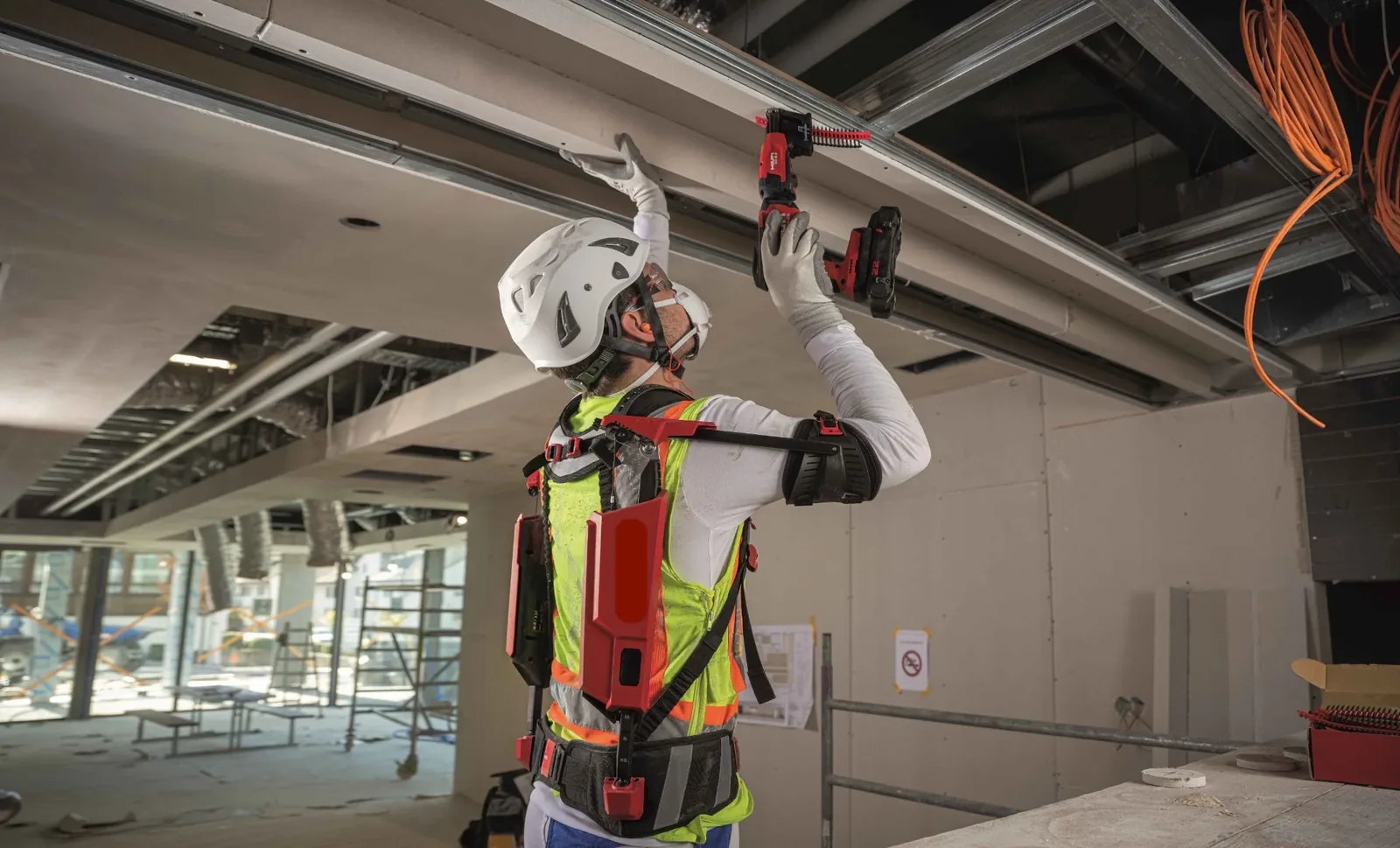
Powered assistance may suit repeated arm elevation, but assess the entire work sequence. Workers also switch between overhead and lower-level tasks, handle tools and change posture. Observe whether support feels appropriate through each movement. A device that supports raised arms but restricts reaching, walking or tool use may not suit the job.
Purchase or rental costs depend on the device, support configuration and rental period. Compare these factors with the intended tasks, such as ceiling installation, fastening or sanding, rather than price alone. The device needs to suit both the work pattern and the procurement plan.
Risks also need practical assessment. On a drywall job, restricted movement could affect positioning near a ceiling, while discomfort may discourage consistent use. Check fit and movement during realistic tasks, including reaching for fasteners. Workers should know how to respond if a device malfunctions.
Assess overhead sanding separately from board installation. Repeated movement with arms raised may feel different from holding a fastening tool, so observe comfort and posture through the task. A workplace trial can compare active and passive systems against the same sequence, recording task fit, mobility, comfort and interruptions. That gives decision-makers practical evidence for selecting support for overhead drywall work.
Support settings for different working heights
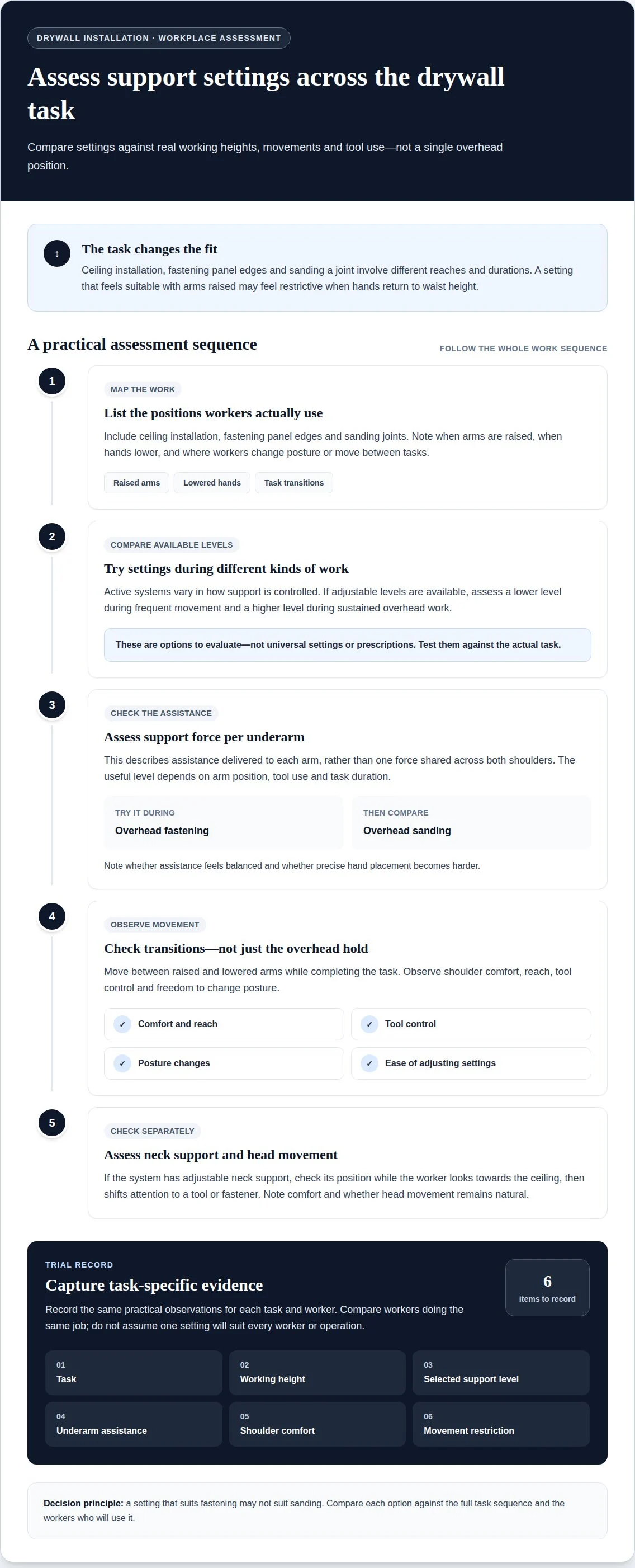
Support should suit the arm position required for each drywall task. Installing a ceiling panel, fastening its edges and sanding a joint involve different reaches and durations. A setting that feels suitable with arms raised may feel restrictive when workers lower their hands to waist height. Assess the complete sequence, not just one overhead position.
Active systems use powered assistance to help move or hold the arms, but control methods vary by design. Some offer adjustable support levels. If available, a lower setting may suit tasks with frequent movement, while a higher setting can be assessed for sustained overhead work. Treat these as options to evaluate, not universal settings or prescriptions.
Support force per underarm is an important comparison point. It describes the assistance delivered to each arm, rather than a single force shared across both shoulders. The useful level depends on arm position, tool use and task duration. During a trial, compare settings while fastening a ceiling edge and sanding overhead. Note whether assistance feels balanced and whether it makes precise hand placement harder.
Use a simple workplace sequence to assess height settings:
- Record the working positions for ceiling installation, overhead fastening and joint sanding.
- Try the available support levels during each task, including transitions between raised and lowered arms.
- Observe shoulder comfort, reach, tool control and freedom to change posture.
- Record which setting fits each task, and whether workers can change it without interrupting work.
This sequence helps distinguish a height-related adjustment from a fit problem. For example, if support feels appropriate while fastening but restrictive during sanding, compare the same worker’s posture and selected setting across both tasks. Don’t assume one setting will suit every worker or operation. Record results by task and worker, so procurement decisions reflect actual use rather than a brief demonstration.
Check neck support separately. If a system has adjustable neck support, assess its position while the worker looks towards the ceiling, then shifts attention to a tool or fastener. Check that it remains comfortable and allows natural head movement. A feature intended to help in one posture may not suit another, particularly across installation and finishing work.
Keep the trial record practical: task, working height, selected level, underarm assistance, shoulder comfort and any movement restriction. Compare those observations across workers doing the same job. Compare exoskeleton options against the task profile before choosing which settings to evaluate.
Product weight
An exoskeleton for drywall installation adds mass to the worker, so the stated weight is only a starting point. Assess how the device feels during ceiling installation, fastening and movement between work areas. It may feel manageable while standing still yet affect comfort when workers repeatedly reach, turn or carry tools. Consider its weight across the complete task, including the clothing and equipment workers normally wear.
Weight distribution matters as much as total mass. A system worn around the shoulders, torso or arms can feel different from one with components positioned elsewhere. During an assessment, note whether the device shifts when workers reach across a ceiling, turn to collect fasteners or lower their arms. Check for pressure points and interference with tool belts, protective clothing or other required equipment.
Freedom of movement is the practical test. Ask workers to follow a representative sequence: walk to the work area, raise their arms, fasten a panel, lower their hands and reposition. Observe whether the device affects balance, restricts reaching or makes turning awkward. Repeat the sequence during overhead sanding, when workers may need to move along a joint while controlling their tools.
- Before the task: record the device weight and check how it sits over normal work clothing.
- During installation: observe walking, reaching, fastening and repositioning around a ceiling panel.
- During finishing: assess movement while sanding overhead and changing position along a joint.
- After the task: ask workers where they felt pressure, restriction or unwanted movement.
Use the same sequence to assess each system. This makes it easier to separate the effects of weight, fit, support settings and task design. For example, if reaching feels restricted, check whether the device shifts or catches on clothing before attributing the problem to its overall mass. Record observations by task and worker, rather than relying on a brief demonstration.
Include transitions between overhead and lower-level work. A drywall installer may alternate ceiling fastening with collecting materials or working closer to shoulder height. Assess the device through these changes, not only while the arms are raised. Ask workers whether they can move naturally, handle tools and maintain their usual working posture throughout the sequence.
Finally, weigh comfort against the support the system provides for the intended task. A lighter device is not automatically a better fit if workers cannot use it comfortably or perform required movements. A heavier device is not automatically unsuitable if it fits and allows the movements the task requires. Compare worker feedback, task completion and movement observations during a workplace trial before deciding whether to buy an exoskeleton for drywall installation.
Ready to find the right device for your operation?
Battery compatibility and operation
A powered exoskeleton relies on its battery to provide active assistance. A passive system needs no battery for mechanical support, so charging logistics apply only to powered options. For drywall work, assess battery operation against the planned tasks: ceiling fastening, overhead sanding and movement between work areas. The key question is whether the system can operate through the work pattern without disrupting it.
Start with the manufacturer’s instructions for the exact device. Record the approved battery type, charging method and any compatibility limits. Don’t assume batteries are interchangeable, even if their connectors look similar. A battery that fits physically may not meet the device’s operating requirements. Capture these details alongside the device specification instead of treating the battery as a generic accessory.
Next, map device use across a representative shift. Note when workers start overhead tasks, switch to other activities and take planned breaks. Compare this sequence with the manufacturer’s operating information. If charging or battery replacement may be needed, identify where it can happen without interrupting work or creating a cable obstruction. Don’t estimate runtime from a brief demonstration; observe the device during the intended work pattern.
A practical evaluation can record:
- The battery and charger supplied for the device, as specified by its manufacturer.
- How workers check charge status before starting ceiling installation or sanding.
- Whether charging, storage or replacement interrupts task flow.
- What workers do if assistance stops or the battery needs attention.
Battery placement can also affect daily use. During a trial, observe whether the battery or housing catches on clothing, tool belts, materials or nearby surfaces. Ask workers to reach, turn and move between the ceiling area and material storage. Record any change in comfort or movement with the battery fitted, then compare the same actions without powered assistance.
Plan charging as part of the work process. Assign responsibility for following the manufacturer’s charging and storage instructions, and decide where batteries will be handled between work periods. Keep the device instructions available to workers who operate or prepare it. Avoid improvised chargers or unapproved battery substitutions, which may create compatibility and reliability problems.
During testing, use the same battery arrangement and work sequence for each evaluation. Record charge checks, interruptions, worker feedback and changes in assistance. This helps distinguish a battery-operation issue from a fit or task-setting issue. The findings should show whether powered support suits the workday, not merely whether the system switches on. For drywall tasks, battery compatibility is part of operational fit, alongside comfort, movement and the work itself.
How do passive exoskeletons support drywall lifting and overhead work?
Passive exoskeletons use mechanical elements, not powered motors, to support arm movement. During overhead drywall work, these elements may transfer some load from raised arms towards the torso or hips. The mechanism depends on the design, so assess where the device contacts the worker and how it behaves during the task.
This support may be relevant when workers hold tools or fasten boards above shoulder height. A passive system is intended to support the worker in those postures, but it does not hold or position a drywall sheet like a lift. The two serve different purposes.
Break the job into tasks before assessing a device. Consider positioning a ceiling board, fastening its edges, handling screws and sanding joints. A drywall lift may help raise and hold the board, while a wearable system is assessed for the worker’s movements during fastening or finishing. This distinction prevents expecting an exoskeleton to replace equipment that supports the material itself.
Passive support can also affect movement. Mechanical assistance may feel different as a worker raises, lowers or extends an arm. Test the device during the reach needed to fasten a ceiling edge, then repeat while reaching for a tool. Observe whether the support remains comfortable and whether the worker can change posture without working against the mechanism.
Use a task-based assessment rather than a single demonstration:
- Choose a representative overhead task, such as fastening a ceiling panel.
- Observe arm position, reach, tool control and changes in posture.
- Repeat the assessment for sanding, which involves a different movement pattern.
- Record worker feedback about contact points, comfort and restricted movement.
Give overhead sanding particular attention because it may involve repeated arm movement across a ceiling joint. Assess whether the device supports the posture without interfering with the sanding tool or the worker’s ability to move along the surface. Compare observations across workers doing the same task, as fit and comfort can vary between individuals.
Assess transitions too. A drywall installer may lower their arms, walk to another section and resume overhead work. Observe whether the passive mechanism moves naturally through each transition and whether the worker can handle materials and tools as usual. Record restrictions alongside task performance, rather than judging the device by perceived assistance alone.
A workplace trial can compare passive support with the existing work method, while keeping material-handling equipment and task conditions consistent. That makes it easier to judge where wearable support may fit alongside a drywall lift. Use exoskeleton comparison and assessment to structure a task-specific evaluation before deciding what to trial.
Not sure which exoskeleton fits your task? Let the Ryggo advisor match it independently.
Ryggo: Trial programmes for exoskeletons (called Deploy & Decide)
Ryggo helps construction teams move from device comparisons to assessment in drywall tasks. Its AI-powered recommendation, vendor-neutral comparisons and ROI calculations help connect device options with task requirements and inform the procurement decision.
With Deploy & Decide, companies can trial an exoskeleton before purchase. Workers can assess fit during the actual sequence, from ceiling fastening to sanding, giving decision-makers practical evidence about comfort, movement and operational suitability. A trial is a useful next step when desk-based comparisons leave questions about how a device performs in the workplace.
Record task observations and worker feedback during the trial, then compare the findings with the original requirements. If you’re considering exoskeleton support for drywall work, use Ryggo’s recommendation and Deploy & Decide programme to identify and assess a suitable option.
Turn the task assessment into a practical decision
Before selecting an exoskeleton for drywall installation, define what a successful workplace evaluation needs to demonstrate. Set criteria with the people doing the work: task suitability, freedom of movement, comfort across the shift and compatibility with site procedures. This gives operations and HSE teams a shared basis for reviewing the trial, rather than relying on preference or a brief demonstration.
Use the findings to decide whether to proceed, adjust the trial or rule out wearable support for the task. A clear record also helps explain the decision to procurement and identify what to reassess if work methods change. The next step is to match those requirements with a suitable device and evaluation route.
Ryggo’s device recommendation, vendor-neutral comparison and ROI calculation can support that decision, alongside its Deploy & Decide trial programme. Explore exoskeleton support with Ryggo and take the next step towards a workplace-based evaluation.
Frequently asked questions
Which exoskeletons are best for installing drywall ceilings?
The right fit is the system that supports the specific overhead task without restricting reach or tool control. Compare shoulder-support options during fastening and sanding, rather than choosing by category alone. Include different workers and ceiling positions in the evaluation. A drywall lift supports the sheet itself; wearable support addresses the worker’s posture and movement. Base selection on observed task fit and worker feedback.
Can an exoskeleton help one person lift and install drywall sheets safely?
An exoskeleton should not be treated as a way for one person to lift and install a drywall sheet alone. Wearable support does not hold or position the board. Plan sheet handling around suitable material-handling equipment and the site’s established work method. Assess an exoskeleton separately for tasks such as fastening after the sheet is positioned. Keep this distinction clear in procedures, so support for the worker is not mistaken for support for the material.
How much weight or strain can drywall exoskeletons reduce?
There is no single reliable weight or strain-reduction figure for every drywall task or worker. Results depend on the device, fit, posture, movement and duration of overhead work. Assess the specific activity, such as fastening ceiling edges or sanding a joint, and record worker feedback alongside task performance. Treat support as an ergonomic aid, not a change to the sheet’s weight or a substitute for handling equipment.
What training and setup steps are needed to use a drywall exoskeleton?
Start with the manufacturer’s instructions and onboarding for the selected device. Before work, confirm the fit, adjustments, permitted movements and what to do if the device feels uncomfortable or operates unexpectedly. Practise transitions such as reaching overhead, lowering the arms and handling tools. Supervisors should explain when the exoskeleton is intended for use and how workers can report fit or movement problems. Review these steps during workplace trials.
Find the right device before you trial anything
The Ryggo advisor maps your task, environment, and requirements to compatible devices — independently, across the full European market.