Key takeaways
- Match support to the carpentry task and posture; a device that helps in one position may not suit every movement.
- Assess whether workers can crouch, reach, turn and move through restricted spaces without the exoskeleton getting in the way.
- Use worker feedback and task-based training to assess comfort, control and practical fit during a trial.
- ASTM F3523-21 provides a test method for evaluating exoskeleton performance or safety during horizontal movement in confined spaces.
- Use vendor-neutral comparison and a try-before-you-buy programme to inform the purchase decision.
Table of contents
- Exoskeleton support for crouched and challenging postures
- Physical strain from carpentry tasks, including work in confined spaces
- Worker experiences using exoskeletons
- Employee training and implementation
- Testing exoskeleton movement in confined horizontal spaces
- Ryggo
Exoskeleton support for crouched and challenging postures
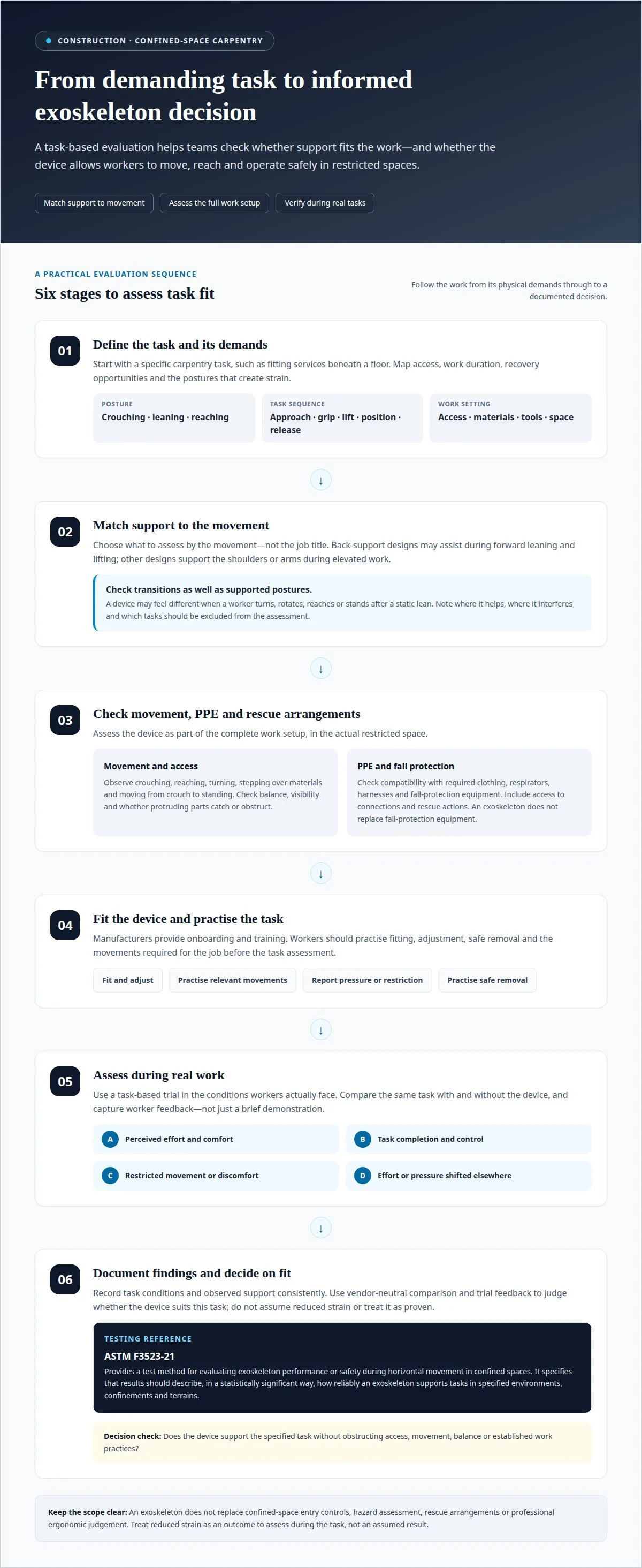
Support is useful only if it fits the carpentry task and allows practical movement. Assess the device during the actual work, including crouching, leaning forward and lifting.
Posture and lower-back support
Back-support exoskeletons may assist during forward leaning and lifting, while other designs support the shoulders or arms during elevated work. Suitability depends on the movement, not the job title. A carpenter fastening a low timber joint may need to crouch, rotate and reach repeatedly. Observe whether the device supports the posture without restricting these transitions.

Include the full handling sequence: approach, grip, lift, position and release. Support during a static lean may feel different when the worker turns or stands. Record where the device helps, where it interferes and which tasks should be excluded from the assessment. This keeps the evaluation relevant to the actual carpentry sequence.
Ergonomic benefits and movement
Exoskeletons may support selected movements and reduce physical effort, but their effects need to be assessed during the actual task. Observe the back, shoulders and hips, and note whether assistance in one area changes effort elsewhere. Worker feedback can reveal discomfort or restricted movement that a brief demonstration may miss.
Test actions such as stepping over materials, reaching for tools and moving from a crouch to standing. An exoskeleton for working in confined spaces should support the task without obstructing balance, access or established movement patterns. Treat reduced strain as an outcome to assess, not an assumed result.
PPE compatibility: Compatibility depends on the device and the respirator, protective clothing and other PPE workers wear. Assess the complete combination during the task, including fit, access and movement. For example, have workers repeat a low-level fastening task in their required clothing and respirator.
Harnesses and rescue: Assess the exoskeleton, harness, fall-protection equipment and rescue approach together. Observe whether the device affects harness fit, access to connections, movement or actions needed during rescue. An exoskeleton does not replace fall-protection equipment.
Training and implementation: Manufacturers provide onboarding and training. Workers should practise fitting, adjustment and task movements, then report pressure points or restrictions before wider use.
Evaluate the device through a task-based sequence: fit it, practise relevant movements, perform the carpentry task and record feedback. This helps distinguish useful support from restricted movement or effort shifted to another part of the body.
Ensure correct fitting and safe removal, then assess the device during the strenuous tasks it is meant to support. Identify the physically demanding tasks in your workplace and determine whether technology could help, or revise the approach where demands differ.
ASTM F3523-21 specifies that test results should describe, in a statistically significant way, how reliably an exoskeleton supports tasks in specified environments, confinements, and terrains. Record the task conditions and observed support consistently, so results reflect the setting and movement workers actually face. Consider whether the device provides reliable task support under those conditions before deciding whether it suits the work.
Physical strain from carpentry tasks, including work in confined spaces
Carpentry can combine force, repetition and restricted posture. Fitting services beneath a floor, for example, may require sustained crouching, reaching and tool handling. These demands can build physical strain even when each action seems manageable. Assess the task sequence, including access, work duration and recovery opportunities, before deciding whether an exoskeleton could provide useful support.
Permit-required confined-space work has its own entry rules. An exoskeleton should not replace site entry controls, hazard assessment or rescue arrangements. Assess the device within the existing work plan, including whether it affects access, movement or the worker’s ability to leave the space.
There is no single cost for industrial exoskeletons used for overhead or awkward work. Price depends on the device type, task requirements and implementation needs; compare the purchase decision with the work it is intended to support. A trial can help establish whether the device fits the task before a purchasing decision.
Construction, manufacturing and logistics involve varied tasks, so one device is unlikely to suit every job. A carpenter fixing overhead components, for example, faces different physical demands from a worker lifting materials from floor level. Identify the posture and movement that create the main strain, then match support to that specific task.
To assess fatigue, compare workers’ experience during the same task with and without the device. Note perceived effort, comfort, task completion and whether support changes movement or creates pressure elsewhere. These observations can inform a trial, but they do not prove injury prevention. Evidence about back pain or ergonomic risk should not be presented as proof of reduced injury.
Physical hazards also affect suitability. In a narrow work area, protruding parts could catch on materials or restrict access; added equipment may also affect visibility or balance. Include these conditions in the task assessment. Follow the manufacturer’s instructions for inspection and care, and record any damage or fit issue before use. Maintenance does not remove the need to assess task-specific hazards.
For a practical decision, document the task, posture, physical demands and worker feedback. Then assess whether the device supports the intended movement without adding restrictions. This separates a possible ergonomic benefit from an unsupported claim and gives HSE and operations teams clearer evidence for deciding whether to continue testing.
Worker experiences using exoskeletons
Worker experience depends on how a device interacts with the full task, not just its support mechanism. A carpenter fitting a panel beneath a floor may need to crouch, reach for a tool, rotate and stand. Assess these movements in sequence. Ask workers where the device assists, where it restricts movement and whether they can perform the task at a natural pace.
Separate first impressions from experience during repeated work. A short demonstration can show fit and basic movement, but it cannot represent a full shift. For a useful assessment, record feedback at the start, during the task and afterward. Note pressure points, heat, adjustment needs and any change in how workers handle tools or materials.
Task assessment should identify who needs support and when. Consider whether assistance is useful only for a particular activity or across the whole working week. A worker who uses an exoskeleton for brief overhead fastening has different exposure from someone wearing one through varied duties. Compare the planned use with actual task duration and transitions.
Education helps workers understand the device’s intended role and limits. Before a trial, explain how to fit and adjust it, which movements it supports and how to report discomfort. Practise a representative task, such as crouching to secure a joint before standing to retrieve materials. Workers should know how to stop and remove the device if it interferes with the task.
Acceptance is practical, not abstract. Workers can judge fit more meaningfully when they handle the device and perform real work, rather than assess it from a specification sheet. Invite feedback from the people doing the task, including those with different body sizes or work methods. Record specific observations, such as restricted turning or easier sustained posture, rather than asking only whether they like it.
Compare worker feedback with task requirements. If one carpenter reports useful support while another feels pressure during the same movement, treat the difference as a fit question. Check adjustment, clothing and individual technique before drawing conclusions. A device’s performance in one task or with one worker does not establish its suitability for a whole team.
Use a consistent review for each task: document the movement, observe workers performing it, capture their feedback and decide whether to continue the trial. This connects acceptance to ergonomics and operational fit. The aim is to learn whether workers can perform the target activity with appropriate support, without assuming positive feedback proves reduced injury or strain.
Ready to find the right device for your operation?
Employee training and implementation
Implementation should start with a defined task, not general device exposure. For carpentry beneath a floor, identify the sequence: enter, crouch, position materials, fasten components and exit. Training can then focus on the movements and access conditions workers will encounter. This gives teams a practical basis for evaluating fit before wider use.
The appropriate group depends on the task and workforce involved. Include workers who perform the target activity, alongside supervisors or HSE professionals who can observe movement and record operational issues. A pilot should capture different work methods, not just a demonstration by one experienced user.
Structure instruction around the device’s actual use. Workers need to practise fitting and adjustment, then perform the target task under normal working conditions. For example, a carpenter can rehearse crouching, reaching for a fastener and standing again. Training should also explain how to report discomfort, restricted movement or difficulty removing the device.
- Define the task. Describe the work posture, tools, materials and access route, such as reaching beneath a raised floor.
- Demonstrate fitting. Show each worker how to position and adjust the device before entering the work area.
- Practise transitions. Include crouching, turning, reaching and standing, not only the supported posture.
- Observe real work. Record where the device helps, restricts movement or interrupts tool handling.
- Review feedback. Compare worker observations with task demands before deciding whether the pilot should continue.
Confined-space implementation needs a separate movement check. A worker may fit the device correctly in an open area yet struggle to turn beside stored materials or pass through a narrow access point. Include these movements during training, using the actual work clothing and equipment. Also account for how the worker enters and leaves the space.
Training alone does not establish suitability. Record whether workers can complete the task, adjust the device and move through the work area without unwanted restriction. If feedback differs between workers, review fit and technique before drawing conclusions. This helps teams distinguish a training issue from a device or task mismatch.
Use pilot findings to make a clear implementation decision: continue the trial, adjust the task or stop using the device for that activity. Useful support during crouched fastening, for example, may not justify use during every carpentry duty. Keep the scope specific, and base any wider rollout on observed task performance and worker feedback.
Testing exoskeleton movement in confined horizontal spaces
Horizontal access can reveal restrictions that an open-floor demonstration misses. Assess an exoskeleton for working in confined spaces along the complete route, not only in the posture it supports.
Exoskeleton types for confined work
Choose support according to the movement and body area involved. A back-support design may suit repeated forward leaning, while shoulder or arm support may suit elevated fastening. Neither category is automatically suitable for confined work. Assess whether the wearer can enter, turn, reach tools and exit while wearing the device.
During a task trial, compare assistance with its effect on movement. A carpenter working beneath a floor may need to rotate while crouched. If a design limits that transition, it may not suit the task, even if it supports the working posture.
Compact designs for entry
Passive or powered operation alone does not show whether an exoskeleton is compact enough for entry. Consider the device’s shape when worn, its attachments and how they move with the worker. Assess the complete setup at the access point and along the work route.
Observe whether a frame catches on an edge or an attachment obstructs a tool reach. Compare the fitted device with actual clothing and task movements. A “compact” label cannot replace observing the worker enter, turn and exit at the workplace.
Dimensions and clearance
No single clearance figure applies to every industrial exoskeleton. Dimensions depend on the device and its fitted configuration. Use manufacturer dimensions alongside measurements of the access opening and work area, then assess the worker-device combination during entry, turning and exit.
Record the narrowest route, low overhead points and task areas that require rotation or reaching. Repeat the route with the device fitted. This can reveal practical interference that measurements alone may miss.
ASTM F3523-21 is a test method for evaluating exoskeleton performance or safety during horizontal movement in confined spaces. Testing may take place in a laboratory or field setting when the specified apparatus and environmental conditions are implemented. Its results describe support for tasks in specified environments, confinements and terrains.
Assessing an exoskeleton for working in confined spaces means checking the actual route: entry, horizontal movement, work positioning, tool access and exit. Record contact with surfaces, restricted movement and task completion. Worker feedback can clarify whether a restriction affects the task or calls for an adjustment.
Use the findings to decide whether the device suits that task and route. A result from one access configuration does not establish suitability elsewhere. Include the fitted device, work clothing and actual movement demands in the decision.
Not sure which exoskeleton fits your task? Let the Ryggo advisor match it independently.
Ryggo
Ryggo helps teams compare exoskeleton options and assess their fit for specific tasks, including crouched carpentry and movement through confined spaces. Its recommendation and vendor-neutral device comparison help identify a suitable option; a trial lets workers evaluate support during the actual task before purchase. This is useful when specifications alone cannot show whether a device fits the access route, clothing and work sequence.
Use workplace assessment findings to guide the next step: identify the task, compare suitable devices and evaluate practical fit through a trial. Ryggo also provides ROI calculations to support the operational decision.
Contact Ryggo to discuss exoskeleton options for your work tasks.
Turn the assessment into a practical decision
Choosing an exoskeleton for working in confined spaces should lead to a task-specific decision, not a general commitment to wearable support. Define the work you want to address, then compare suitable devices against the movements and access conditions workers actually face. A trial can help establish whether the fit works in practice.
Ryggo supports this process with device recommendations, vendor-neutral comparisons and ROI calculations. Its Deploy & Decide trial programme lets organisations assess an exoskeleton before purchase, using operational needs to guide the evaluation rather than relying on specifications alone. Connect the task assessment with a structured comparison and workplace trial to take the next step.
Contact Ryggo about exoskeletons to discuss a practical route from assessment to decision. Start with the task, involve the workers who perform it, and let evidence from the trial guide the next move.
Frequently asked questions
Do exos just shift forces to other parts of the body?
Exoskeletons can change how effort is distributed, so assess more than the body area the device supports. A frame that assists the back may affect how a worker balances, reaches or moves through a task. During evaluation, ask about pressure or effort in the shoulders, hips and legs as well as the back. New discomfort is a reason to pause and reassess fit and task suitability.
What hazards can exoskeletons create in confined spaces, including snagging or restricted movement?
In tight work areas, an exoskeleton may catch on an edge, reduce clearance or limit turning and reaching. It could also obstruct access to tools or interfere with entry and exit. Assess these hazards along the full route, including the work position and exit path. Include required clothing and protective equipment, and observe whether the wearer can move and respond without the device becoming an obstacle.
How should employers assess, fit, and train workers to use exoskeletons in confined spaces?
Start by mapping the task and access route, then assess the device with each intended wearer in their usual work clothing. Check fit and adjustment before workers practise entry, turning, reaching and exit. Manufacturers provide onboarding and training; include task-specific practice and a clear way to report discomfort or restrictions. Record worker and supervisor observations, then decide whether to continue the trial, adjust use or stop.
Which exoskeletons are compatible with respirators, protective clothing, and other PPE?
Compatibility depends on the specific exoskeleton, respirator, protective clothing and other PPE. Assess the complete combination during the task, including fit, access and movement.
What evidence shows exoskeletons reduce fatigue or injury during confined-space work?
Do not assume that exoskeletons reduce fatigue or injury in confined-space work: that has to be shown for your own task. A task trial can compare perceived effort, comfort and task completion, but those observations do not prove injury prevention.
Find the right device before you trial anything
The Ryggo advisor maps your task, environment, and requirements to compatible devices — independently, across the full European market.