Key takeaways
- Match the exoskeleton architecture to the movements and tasks workers perform, including any twisting, reaching or movement through confined spaces.
- Assess comfort, fit, clothing and protective equipment compatibility, and how easily workers can put the device on and take it off.
- Clarify who provides onboarding, training and ongoing service, and how support will scale as deployment grows.
- Compare the complete cost of adoption with potential operational returns, using measures that reflect your workplace and workload.
- Use a workplace trial to gather worker feedback and assess whether the device supports ergonomics in real working conditions.
Table of contents
- Vendor training, support, and deployment scalability
- Matching exoskeleton architecture to the intended activity
- Comparing complete system costs and regional prices
- Evaluating product fit, comfort, and ease of donning
- Injury reduction, productivity, and return on investment
- Ryggo
Vendor training, support, and deployment scalability
Choose a provider that connects device selection with fitting, training and continued service.
How a provider should explain support and return options
Review the written trial and return terms before proceeding. Confirm who handles setup questions, fault reports and return arrangements. For example, warehouse workers should know where to report a damaged strap or a fit problem. Clear responsibilities and return conditions help prevent misunderstandings during a trial.

What training and ongoing services a provider should offer
Confirm who fits each device, trains workers and provides follow-up service. Manufacturers provide onboarding, training and service for their devices. Ask how fitting is adapted for different users, and how workers practise putting the device on, removing it and adjusting it. Also establish who handles wear, damage and repairs. A named contact and clear process help prevent issues from stalling a deployment.
Match support to the physical task, not just the device category. A worker repeatedly lifting boxes may need guidance on adjustment during lifting. Someone working in a confined space may need support focused on movement restrictions and task changes. If a ceiling harness is under consideration, establish whether the task requires suspended body-weight support. It serves a different role from a wearable exoskeleton, so compare the systems against the same work activity and operational needs.
Plan support for scale before expanding beyond an initial group. Ask how the provider would train 25, 50, or even 100 users, including workers across shifts or sites. The answer should describe how fitting, onboarding and support are organised as deployment grows. During a trial, record recurring adjustment questions and service issues. Use those observations to identify where additional training or clearer procedures are needed before wider adoption.
Matching exoskeleton architecture to the intended activity
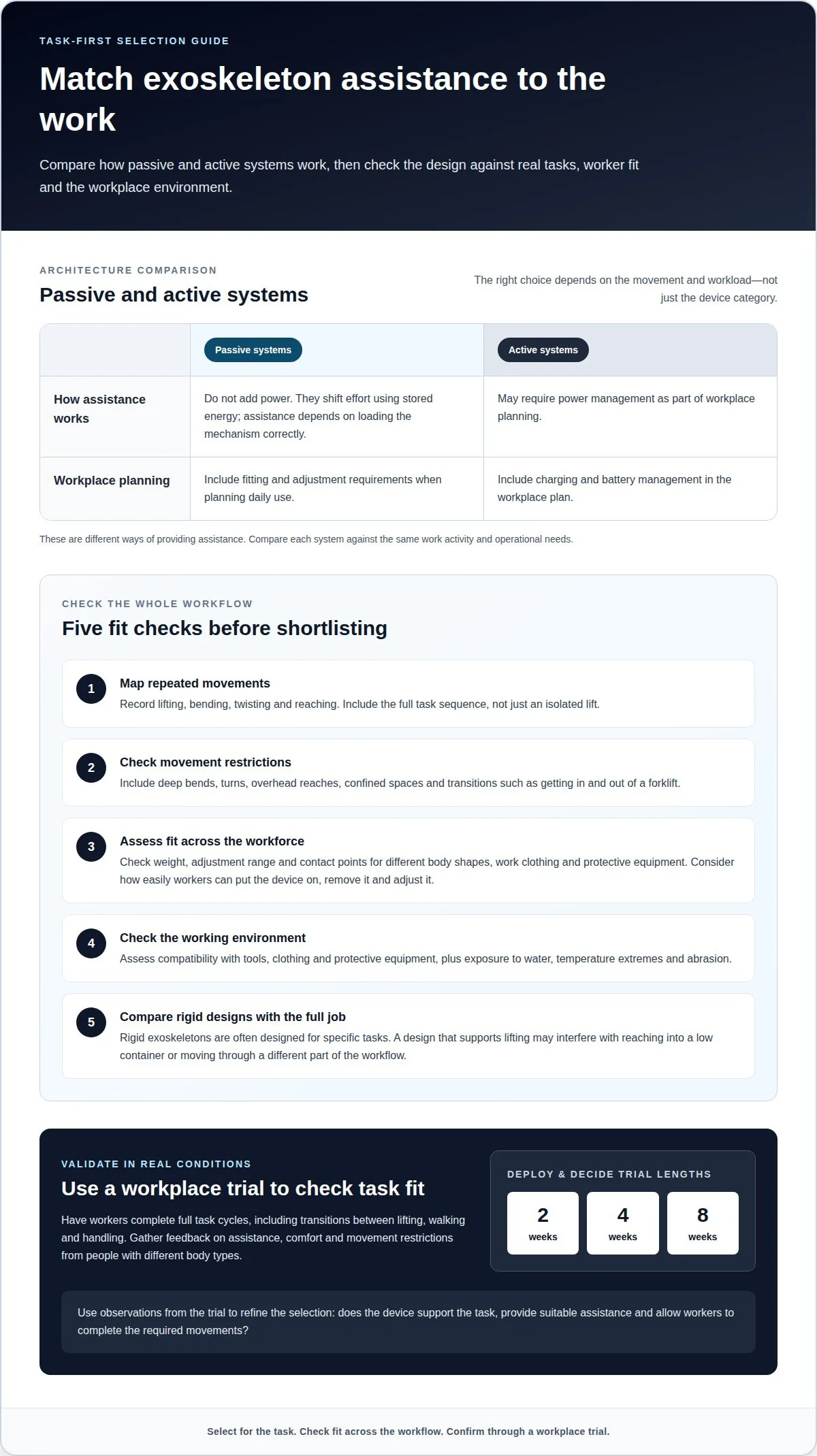
Start with the movements workers repeat, then match assistance to those tasks. Compare device design against worker fit, movement demands and the workplace environment.
How a provider matches models to tasks and worker morphology
Map each task’s lifting, bending, twisting and reaching before comparing models. A device suited to repeated forward bending may restrict someone who frequently turns or reaches overhead. Assess fit across the workforce, not just for one representative user. Check the device’s weight, adjustment range and contact points with different body shapes and clothing.
How a provider compares models across workplace scenarios
Compare lift-assist options against real task sequences, not isolated lifts. A warehouse worker may lift from floor level, turn and place items on a pallet. A factory operator may bend repeatedly at one station. Confirm that the assistance supports the required strength and movement without obstructing the task. Avoid choosing a model solely because its advertised function sounds relevant.
Separate passive and active assistance by how each system works. Passive systems don’t add power; they shift effort using stored energy, so their assistance depends on loading the mechanism correctly. Some active systems may require power management as part of workplace planning. Include charging and battery management in the workplace plan.
Check whether a rigid design suits the full workflow. Rigid exoskeletons are often designed for specific tasks rather than adapting to different jobs. A model that supports lifting may interfere with reaching into a low container or getting in and out of a forklift. Include tight spaces, deep bends and twists in the assessment. If a device restricts a frequent movement, it may not suit the operation.
Compare each model in the actual work environment. Check compatibility with tools, personal protective equipment and work clothing. Consider exposure to water, temperature extremes and abrasion, as well as the required range of movement. Cold storage and a warm production line create different conditions that may affect comfort, adjustment and consistent use.
Use a workplace trial to assess the shortlisted devices. Have workers complete full task cycles, including transitions between lifting, walking and handling. Gather feedback on assistance, comfort and movement restrictions from people with different body types. The trial can show whether a model supports the task or provides too little assistance for its physical demands. Use the observations to refine the selection.
Comparing complete system costs and regional prices
Compare the complete operating setup, not just the device price. For a powered model, include charging equipment, battery management and any additional onboarding. For a passive model, consider fitting and adjustment requirements. These items affect how a system fits your workplace and what procurement must arrange. Ask for each cost component separately, then compare equivalent configurations. A lower initial quote may exclude requirements needed for daily use.
Compare regional quotations on the same basis. Currency, delivery arrangements, service coverage and purchasing terms can change the total offered to a European site. For example, a quotation for one factory may include setup, while another covers the device alone. Ask providers to itemise what each offer includes, and align the scope before comparing totals. This makes regional differences visible without confusing a different service package with a lower system cost.
Include the practical work of integrating the device. A warehouse using powered equipment may need to plan charging locations and routines; a production line may need a storage point between shifts. Consider the time supervisors and workers will spend on fitting, training and handling. Record these requirements alongside purchase costs to reflect the real workplace setup.
Assess durability against the work environment. Water exposure may matter in a wash-down area, while abrasion and rough handling may be more important on a building site. Temperature extremes can also affect suitability. Compare the manufacturer’s stated operating conditions with the workplace, and include cleaning, storage and component replacement in the evaluation. A trial in representative conditions can show whether the system is practical.
Check compatibility with protective equipment, clothing and tools. A device that clashes with a high-visibility jacket, gloves or a harness may restrict movement or add adjustment steps. Test the full combination during a normal work cycle. For example, check whether a warehouse worker can reach shelving and use tools while wearing the required equipment. Record restrictions, delays and worker feedback to assess the fit.
Use testing to assess potential value, not to assume a fixed cost reduction. Before the trial, define measures such as task completion, worker feedback and changes to work routines. Compare observations with the baseline for the same task. A device may support ergonomic goals yet still be unsuitable for a particular workflow. Include purchase and operating requirements in the final review, then weigh expected benefits against the complete system cost.
Ready to find the right device for your operation?
Evaluating product fit, comfort, and ease of donning
Poor fit can make a wearable device uncomfortable or interfere with work. Risks include restricted movement and task disruption. Workers with orthopaedic or neurological conditions should consult a doctor before use.
Assess fit across the workforce, not just for one wearer. Include workers with different body types, roles and clothing requirements. Check contact points, adjustment range and whether the device stays in position during bending, reaching and walking. A model that fits one warehouse worker may not fit another doing the same task. Record individual fit issues rather than relying on a single demonstration.
Observe workers putting on and removing the device during a normal task. Ask them to fit, adjust and remove it without skipping steps. For example, a picker moving between shelving and packing should be able to manage each transition. Note where straps, fasteners or adjustment steps slow the process. Straightforward donning and manageable training needs can help reduce barriers to adoption.
Evaluate comfort during task changes, not just at a static fitting. Have workers bend, walk, reach and handle tools while wearing the device. Check for pressure, rubbing, heat and restricted movement. Someone comfortable while standing may feel discomfort after repeated bending. Gather feedback at different points in the task and connect it to the movement involved.
Include workplace conditions in the comfort assessment. Test the device in the hot or cold conditions workers encounter, rather than relying on a room-temperature fitting. Clothing layers can change fit in cold conditions, while heat may affect comfort during active work. Ask whether adjustments remain manageable as conditions change. This helps assess whether the model suits the intended wear.
Test the device with workers on representative tasks and gather their feedback. Use representative tasks, shifts and users, then document discomfort, adjustment needs and any workarounds. A worker repeatedly loosening a strap or removing the device provides useful evidence about fit or acceptance. Compare feedback across users. Consistent issues point to a mismatch; isolated comments may relate to individual fit.
Review comfort alongside the intended ergonomic support. Some passive lift-assist systems may need frequent adjustment, so note how often workers change them. Check comfort through full work cycles, including breaks and task changes. If workers avoid wearing the device for a particular movement, record when and why. Base the adoption decision on how it performs in actual use.
Injury reduction, productivity, and return on investment
Assess ergonomic and operational outcomes together. A device’s value depends on what changes during real work, not on claims alone.
Set a task baseline before testing a device. For repetitive warehouse lifting, record the task sequence, worker feedback, fatigue and completion quality. Compare like with like during the trial, keeping work conditions consistent where practical. Track discomfort and perceived exertion alongside operational measures. This helps distinguish a device-related change from one caused by workload, staffing or a different task mix.
Define what improvement would mean for your workplace. A production team might prioritise worker-reported fatigue after repeated handling; a distribution team might also track changes to task flow. Include worker acceptance: do people choose to wear the device for the relevant task? Output alone does not prove ergonomic benefit, and reported reductions in strain do not establish injury prevention.
Ask for evidence relevant to the task behind any performance claims. Scientific publications and real-world data can help assess effects on strain and perceived exertion. Request product specifications and clarify the conditions behind each claimed result. Compare assistance, device weight and movement demands with the work observed. Specifications describe a product, but do not by themselves demonstrate the same outcome in your workplace.
Review the provider’s range and specifications against your actual needs. A provider with multiple device types can help compare alternatives when one model does not match the task. Check that the stated assistance, fit and intended activity align with the trial scenario. Use a vendor-neutral comparison where possible, and include the complete system requirements in your ROI calculation. The device should support ergonomics, with workplace outcomes measured during use.
Distinguish occupational use from clinical use. An exoskeleton selected for repetitive workplace tasks is not automatically a medical device, and a clinical device is not automatically suitable for industrial work. European buyers should assess conformity documentation relevant to their market.
Make the investment decision from the evidence gathered, not a promised injury reduction. Compare acquisition and operating requirements with measured changes in worker feedback, fatigue, acceptance and task performance.For a structured, vendor-independent comparison and ROI calculation, explore exoskeleton advice and device matching.
Not sure which exoskeleton fits your task? Let the Ryggo advisor match it independently.
Ryggo
Ryggo is Europe’s first independent exoskeleton exchange, helping European workplaces compare options against real tasks and ergonomic priorities. Its recommendations are based solely on fit across vendors, supporting a structured selection process for warehouses, factories and healthcare settings.
When specifications alone cannot resolve questions of fit, Ryggo’s Deploy & Decide programme lets companies trial devices before buying. Healthcare organisations can also use its exoskeleton matching service to identify options for their setting.
If you’re ready to assess suitable options for your workplace, contact Ryggo.
Turn the shortlist into a workplace decision
Before a trial, define what successful implementation would look like at your site. Agree on shared priorities, such as worker acceptance, task suitability and operational fit. Assign responsibility for reviewing feedback and deciding whether to proceed, adjust the scope or stop. Clear criteria help procurement, HSE and operations stay aligned.
The best way to choose an exoskeleton provider is to assess how its process supports your workplace, from matching through evaluation. Bring your priority tasks and implementation questions into the discussion, then use the answers to plan a practical next step. A measured approach keeps the decision grounded in workplace needs rather than novelty.
Discuss your workplace needs with Ryggo and take the next step towards an informed exoskeleton decision.
Frequently asked questions
How long should the pilot period last?
A pilot should cover representative work, not just a demonstration. When considering how to choose an exoskeleton provider, ask how the trial accounts for normal task variation, different users and the pace of a working shift. Agree review points in advance, so the team can record observations throughout the pilot. The right duration depends on whether workers have enough opportunity to use the device in relevant conditions.
Is a workplace assessment required before purchase?
Complete a workplace assessment before purchase to connect the device choice with actual work demands. Include the task sequence, work area, tools, protective equipment and movements workers use. For example, document whether a handling task involves turning between the load and its destination. This gives selection a practical basis and can reveal conditions a product description alone may not capture.
How can a provider assess whether an exoskeleton fits your tasks and users?
Assess task fit by relating device specifications to the movements and workers involved. Account for body fit, required range of motion and transitions between tasks. Someone who alternates lifting with frequent walking needs a different evaluation from someone at a fixed station. Feedback from the people doing the work can reveal fit issues that a demonstration may miss.
How can you choose a provider that compares exoskeleton products and support services?
To choose an exoskeleton provider, look for a comparison that brings device options and service responsibilities into view. It should distinguish product suitability from support arrangements and clarify who handles each part of the process. Ask for the rationale behind the recommendation in relation to your use case. This helps procurement and HSE teams review the decision together.
What is the typical cost of buying, leasing, or renting an exoskeleton?
The total cost depends on the device and the scope of the workplace deployment. A purchase comparison should distinguish the device price from any separately charged items and explain how trial terms affect the decision. Leasing and rental arrangements vary by provider, so compare the actual terms offered rather than assuming they match a purchase. Evaluate options against the intended use and procurement requirements.
What should a provider explain before you purchase an exoskeleton?
Before purchase, the provider should explain the intended use, product specifications, limitations, commercial terms and return conditions. Ask for these details in writing so the decision team can review them against its procurement process. The explanation should also identify the evidence behind performance claims and distinguish those claims from results observed during workplace use. This gives buyers a clearer basis for approval and internal documentation.
How can a provider help you evaluate exoskeleton effectiveness and return on investment?
Review the assumptions behind an ROI calculation, including the tasks and operational changes it covers. Compare those assumptions with observations from the workplace. Keep worker experience measures distinct from productivity indicators, since they describe different outcomes. A useful evaluation explains how each measure informs the decision and does not treat a single positive result as proof of broader impact.
How can a provider demonstrate its experience, references, and warranty terms?
Ask for examples relevant to your sector and task, then assess whether the operating conditions resemble your own. References are most useful when they explain the application and evaluation process, rather than offering a general endorsement. Request written warranty terms that identify the responsible vendor, coverage period, exclusions and claim route. This lets procurement understand how product support is documented before committing to a purchase.
Find the right device before you trial anything
The Ryggo advisor maps your task, environment, and requirements to compatible devices — independently, across the full European market.