What exoskeletons do for order picking and where they fit
Where manual handling cannot be avoided, the employer has to organise the work and provide suitable means to reduce the risk. A wearable support is one such means, alongside rack design, lifting aids and job rotation.
Exoskeletons for picking warehouse tasks have limits. They suit repetitive lifting and bending, overhead reaching and long static postures. They are a poorer match for very confined spaces or work with highly variable movement, where a rigid or semi-rigid frame can get in the way. Nor do they solve everything with bulky items: one study of passive devices in order picking found that for bulky products, other ergonomic tools such as zero-gravity balancers may suit better than a back-support exoskeleton (Taylor & Francis).
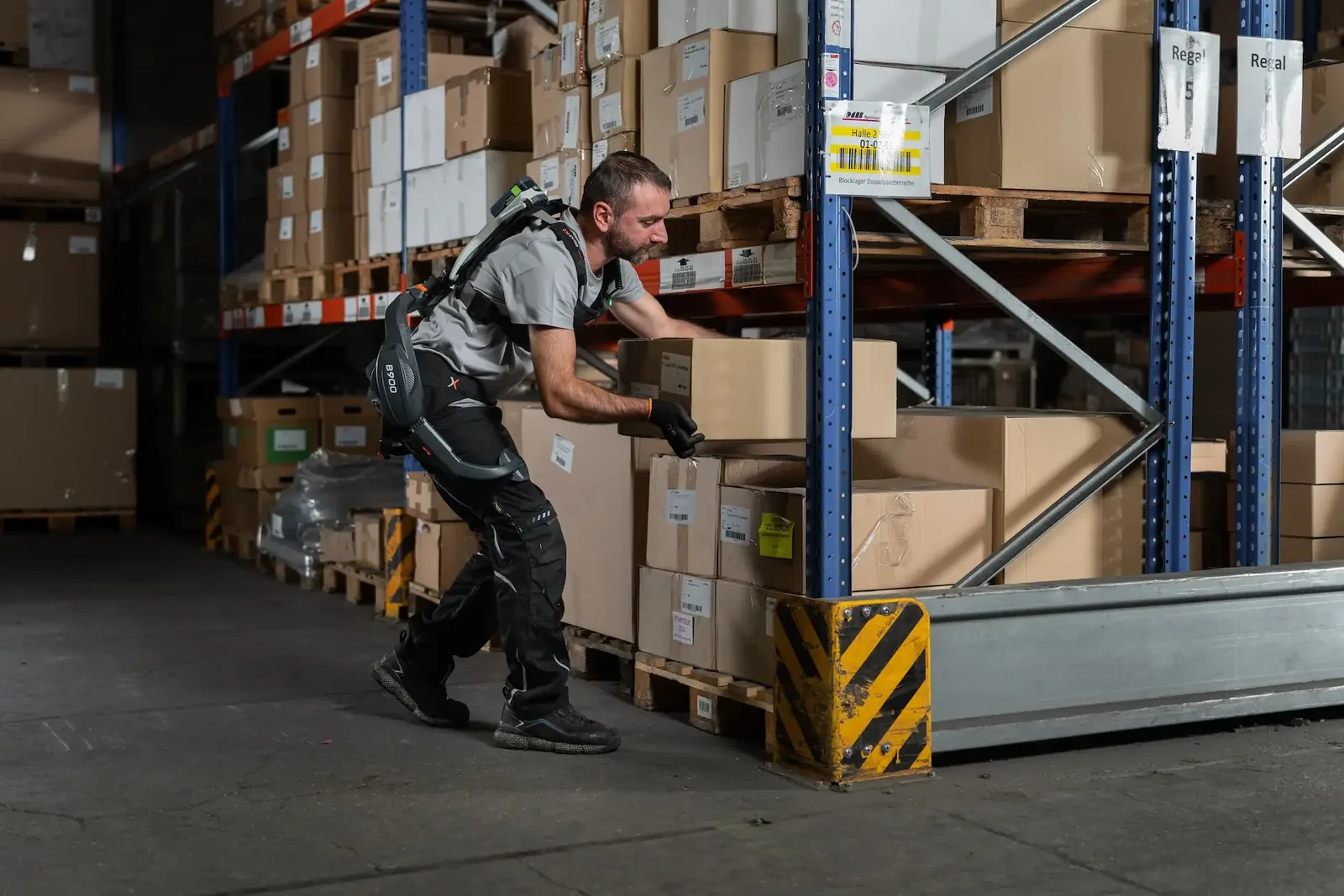
So don't start by choosing a product. Start by finding out which tasks in your picking operation generate the strain, how often, and with what loads. A short video of the task is enough to begin, and Ryggo offers a free workplace ergonomics analysis from a 30-second video for exactly that. You then have something concrete to match a device against, rather than working from a catalogue.
Task fit: matching back, shoulder and wrist devices to picking work
Task fit is the biggest factor in whether an exoskeleton for picking warehouse work helps or ends up in a locker. It's easiest to think of it by body region and by the motion that dominates the job.
Back devices are the usual starting point for picking. They suit work built around forward bending and lifting from low levels: pulling cartons from floor-level slots, building pallets, loading roll cages. If a picker spends the shift between knee and shoulder height with light items, the benefit is small. If lifts are frequent, loads moderate to heavy and the trunk stays flexed for long periods, a back device is a sensible candidate. Ryggo lists back-support options from several vendors, including the Laevo Flex, the Laevo V2 and the Comau MATE-XB, which you can compare in the exoskeletons catalogue.
Shoulder devices solve a different problem. When pickers work with their arms raised, for instance restocking high bays, labelling at head height or handling overhead conveyors, the load sits in the shoulders and neck, not the back. A back device does nothing for that. Shoulder-support options such as the Comau MATE-XT Go are built for sustained overhead postures.
Wrist and hand strain is the least well served. Repetitive scanning, gripping and sorting can load the forearm and wrist, but few logistics devices target it. If that is your main complaint, say so early in any assessment. The honest answer may be that an exoskeleton is the wrong tool and a workstation or tooling change is the right one.
A practical method: list your three or four most strenuous picking tasks and note beside each the dominant posture (bent, reaching, standing static), the typical load and the item type. Mixed jobs are common, and this is where vendor-independent advice earns its place. The Exoskeleton Advisor takes your operation's task profile and suggests suitable back or shoulder devices rather than defaulting to one brand. Also consider the environment and the people: temperature, narrow aisles, getting in and out of vehicles, and the range of body sizes in your team all affect comfort, and therefore adoption.
Ready to find the right device for your operation?
Passive vs active exoskeletons: what the evidence shows so far
The two categories behave differently on the warehouse floor, and the evidence for each is still modest.
Passive devices store and release energy through springs or elastic bands, with no battery or motor. They are lighter, need less maintenance and have no charging routine. Their assistance is fixed by design, however. It may help during a bend and be neutral, or slightly obstructive, while walking. The study of passive exoskeletons in order picking offers a practical decision rule: if the time spent in awkward postures with the device exceeds the time without it, the device isn't worth using (Taylor & Francis). It's a useful test to run on your own tasks.
Active devices use motors and sensors to deliver assistance when it's needed, which can in principle be tuned to the movement. In an hour-long order-picking task, a lightweight active back exosuit reduced peak and median back-muscle activation by 18% and 20% respectively. Treat this as an experimental result, not a final answer (Communications Engineering). Field evidence is thinner. A pilot of an active back-support exoskeleton for palletising in a logistics warehouse involved six workers, and its authors note that evaluation in real industrial settings with actual workers remains limited (Electronics).
The longer-term picture is mixed. A 24-week randomised trial of 20 logistics workers found lower back-muscle activity during lifting while the passive exoskeleton was providing assistance, but three workers stopped using it regularly during the intervention (Economy Insights summary). That drop-off matters, because muscle-activity results only count if people keep wearing the device.
In short, both types show reduced muscular effort in controlled conditions, and long-term outcomes such as absence and turnover are still being studied. Neither wins on every task. The choice depends on your tasks, your tolerance for charging and maintenance, and above all on what your own workers will wear for a full shift.
Not sure which exoskeleton fits your task? Let the Ryggo advisor match it independently.
Running a warehouse trial: baseline, measures and worker feedback
A trial of an exoskeleton for picking warehouse operations is where task fit and the evidence meet your reality. A good one is small, specific and measured. The main risk isn't a bad device. It's a vague trial that produces opinions instead of a decision.
Pick one zone and one task group. Don't pilot across the whole building. Choose a zone with a clear strain problem, such as low-level pallet building or high-bay restocking, and a group of volunteers who do that work regularly. A mix of body sizes and experience levels will surface fit issues early.
Set a baseline first. Before anyone puts a device on, record what the work looks like now: picks per hour, perceived exertion, discomfort scores by body region, and any recorded sickness absence or complaints for the group. Without a baseline, you can't tell whether a change came from the device, the season or a new layout.
Allow time to adapt. An hour in a device is not a shift in a device. Ryggo's Deploy & Decide trials run for 2, 4 or 8 weeks in your own workplace, long enough to get past the novelty and catch comfort problems that only appear on day five. What a trial costs is covered in our guide to the cost of exoskeleton trials, and the broader logic is in the try-before-you-buy buyer's guide.
Measure what you'll need to defend. A sensible checklist, echoing the outcomes the Danish RELAX project is tracking, includes:
- perceived exertion and discomfort by body region
- usage rate, meaning how many shifts each volunteer actually wore the device
- productivity and error rates
- sickness absence and, over a longer horizon, staff turnover
RELAX is a protocol that plans to follow around 90 full-time logistics workers for 18 months and is not yet peer reviewed (medRxiv), so treat it as a measurement template, not a result.
Take worker feedback seriously. Collect it weekly, in short structured conversations, and ask about fit, heat, getting in and out of vehicles, and whether the device gets in the way at any point. Colleague-led training can help, and the drop-off in the 24-week study shows why feedback matters: if people stop wearing it, the data stops meaning anything.
Business case, pilot to rollout and EU manual handling duties
A trial only pays off if it ends in a decision. A pilot can stall when nobody has agreed the success criteria, so the results are interesting but no one is authorised to act on them. Before the trial starts, write down what "good enough to roll out" means: a minimum usage rate, an agreed reduction in reported discomfort, and no productivity penalty. The result then becomes a yes, a no or a "try a different device", not a debate.
For the financial side, build the case for an exoskeleton for picking warehouse teams from costs you can document: absence linked to back and shoulder complaints, replacement and overtime costs, and the cost of the devices themselves. The payback logic is laid out in our guide to exoskeleton payback period. Be cautious with headline figures from vendor or operator announcements, which are company-reported and not independently verified. Your own trial data is the stronger evidence for your own board.
On the regulatory side, the EU framework places duties on the employer. Directive 90/269/EEC requires that where manual handling cannot be avoided, the employer takes appropriate organisational measures and provides suitable means to workers (EU-OSHA). This sits alongside the Framework Directive on health and safety at work. An exoskeleton doesn't replace the risk assessment. It becomes one of the measures recorded within it, ideally after you've first looked at whether the task itself can be redesigned or mechanised. This is practical orientation, not legal advice, so involve your safety adviser.
To choose between shortlisted devices, use concrete criteria:
- Task match: does the support direction fit your dominant posture?
- Wearability over a full shift: heat, weight, adjustability, ease of putting on and off
- Operational fit: charging or maintenance needs, vehicle use, aisle width
- Evidence you can gather yourself: can the vendor support a structured trial?
- Compliance documentation: the supplier's declarations for your use case
When the criteria are met, roll out in stages, keep measuring usage, and keep a route open for workers whose tasks or bodies are not a good fit.
Find the right device before you trial anything
The Ryggo advisor maps your task, environment, and requirements to compatible devices — independently, across the full European market.