Key Takeaways
- Separate wider investment activity from the business case for your own operation; market growth alone doesn’t establish a worthwhile return.
- Build the model around the work being done and the costs of absence, training, maintenance and other ownership requirements.
- Compare passive and powered exoskeletons by task fit and total cost, not purchase price alone.
- Use a trial to assess practical fit and gather operational evidence before committing to a purchase.
- Independent device matching and ROI calculations can help connect workload data to a more defensible investment decision.
Table of Contents
- Powered exoskeleton investment activity
- Workplace injury and sick-leave cost estimates
- Exoskeleton purchase and ownership costs
- How do trials, leasing and purchase options compare for exoskeleton investment?
- Ryggo
Powered exoskeleton investment activity
Investment activity can show where capital is flowing, but it can’t establish whether a powered exoskeleton suits a specific workplace. Treat funding as market context. A business case still depends on the task, device fit and ownership costs at the site.
Compare passive and active devices separately. A passive model may suit a task involving repeated movement where its mechanical support fits the work; a powered exoskeleton needs assessment against its own task and operating conditions. There is no single market price that makes these options comparable. Costs depend on the device and configuration, while the financial model should also account for training, maintenance and any applicable software. Define the task, identify the required support, and assess each suitable device using the same assumptions. Market funding can frame the investment climate, but a task-based comparison should guide the purchase decision.
Workplace injury and sick-leave cost estimates
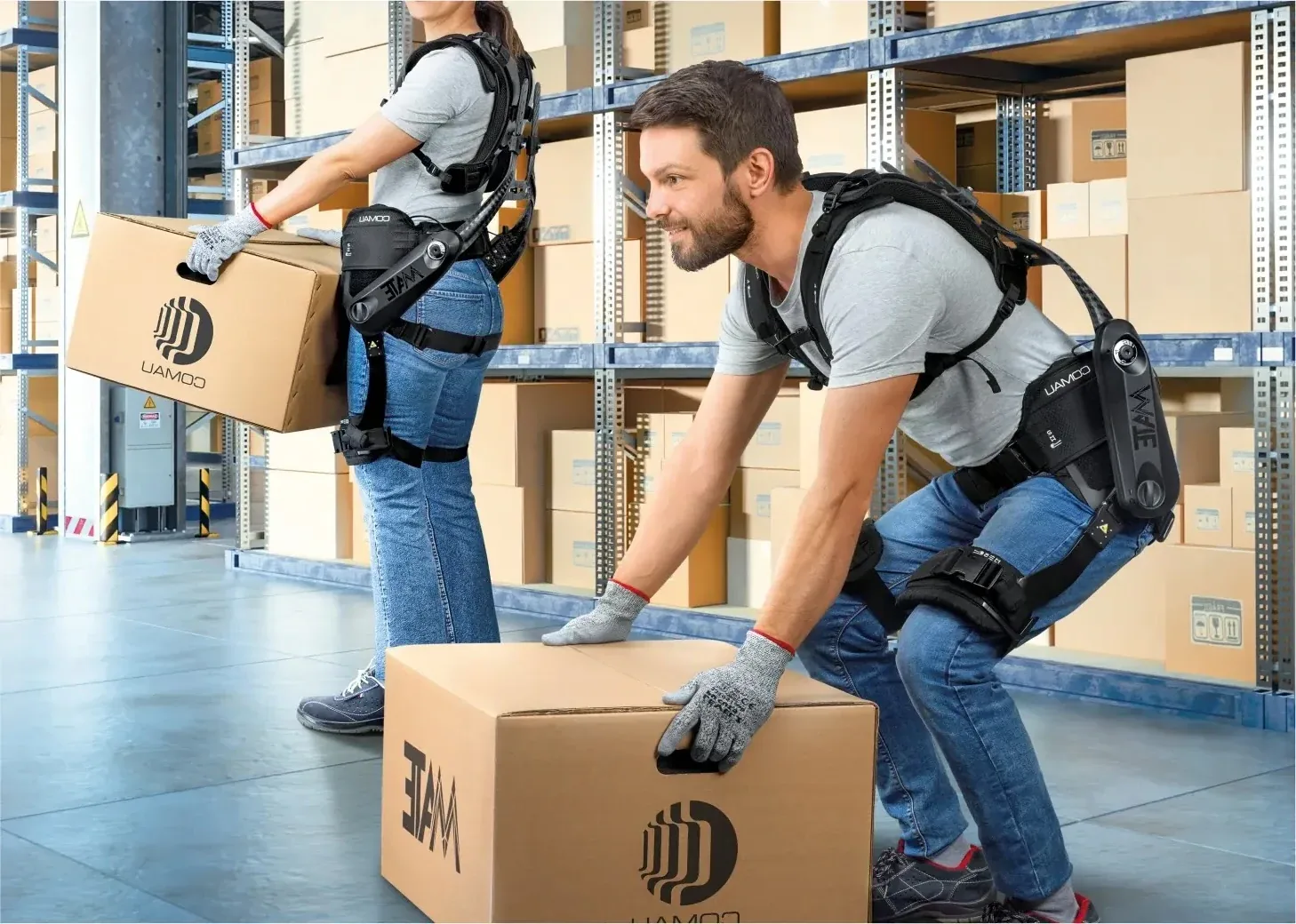
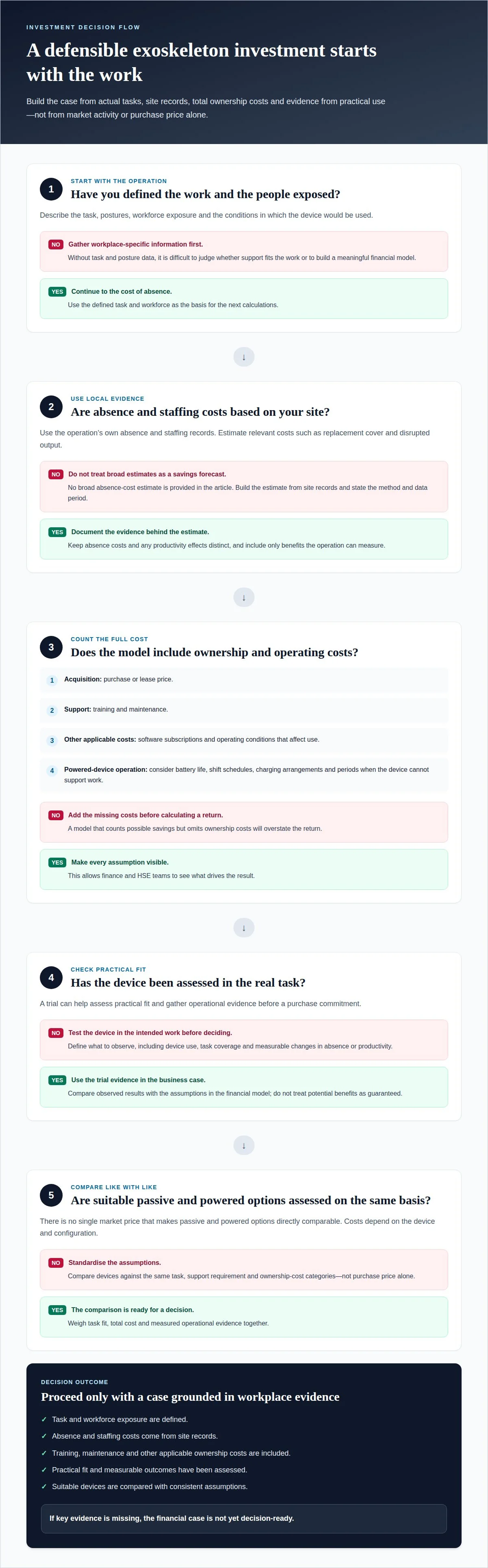
A useful investment model needs task and posture data, workforce exposure, absence records and the costs of a suitable exoskeleton. Training, maintenance, software subscriptions and expected use also shape the model. Together, these inputs connect physical strain and workplace absence with the costs of assistance and ownership. Financial models for exoskeleton investment in 2026 are most useful when based on the actual workplace, rather than broad assumptions.
Avoid treating national or industry-wide figures as a prediction of savings. Use the site’s own absence and staffing records to estimate costs such as replacement cover and disrupted output, and document the method and data period.
For a warehouse, factory, retail operation or clinic, identify which tasks involve sustained physical strain and what staffing or productivity disruption in those tasks costs. National estimates are context, not a forecast for an individual employer; cite the original source and its scope before using one.
Total cost of ownership extends beyond the purchase or lease price. Include training, maintenance and software subscriptions where applicable, and account for operating conditions that affect use. A model that counts potential savings but omits these costs will overstate the return. Make each assumption visible so finance and HSE teams can assess what drives the result.
Battery life can affect the usable time of a powered device during a shift. Model the impact through the task schedule, charging arrangements and any periods when the device cannot support work.
Build a conservative case alongside the expected case. Separate avoided absence costs from productivity effects, and include only benefits the operation can measure. Track device use, task coverage and workforce feedback during deployment. If fatigue or poor fit limits regular use, projected savings should reflect that lower utilisation. This makes financial models for exoskeleton investment in 2026 more grounded in operational evidence and less dependent on broad assumptions.
Ready to find the right device for your operation?
Exoskeleton purchase and ownership costs
Start by separating the purchase price from the cost of putting an exoskeleton into regular use. A passive model and a powered model serve different tasks, so comparing their prices without matching their function can distort the decision. Weight can help frame handling considerations, but weight alone doesn’t show whether a device suits a specific task.
For an industrial investment, the relevant device cost depends on type, configuration and intended work. Manufacturing and logistics teams should compare devices against the same task and operating pattern, rather than using a broad market figure as a purchasing benchmark.
Build the model around the planned deployment. A device assigned to one task has a different cost per use from one shared across shifts. If a warehouse plans to rotate an exoskeleton among operators, for example, account for actual availability, handovers and the tasks covered. A device that spends significant time unused can raise the cost per supported task.
Separate one-off and recurring expenses. Record the purchase cost, then include training, maintenance and any applicable software subscriptions. Note operational requirements that affect use, such as storage, charging for a powered device and onboarding new users. Attribute these costs to the relevant device or deployment so finance teams can compare options consistently.
Use a like-for-like comparison across purchase scenarios:
- Per device: record the purchase and ongoing ownership costs.
- Per user: allocate costs across the operators expected to use the device.
- Per task: relate the cost to the work the exoskeleton supports.
- Per shift: account for sharing, handovers and practical availability.
Different cost views reveal different adoption risks. A per-device calculation may seem affordable, while a per-task calculation exposes low utilisation. Repeated work on a manufacturing line can produce a different usage pattern from changing tasks in logistics. Military exoskeletons serve a distinct purpose, so their costs and specifications are not industrial benchmarks.
Distinguish an ergonomics investment from general bionics or robotics spending. Define the task, identify the intended users and allocate the exoskeleton’s ownership costs to that deployment. This makes comparisons more useful for procurement and shows whether the selected device’s cost fits its operational role.
Keep industrial devices separate from systems intended for clinical rehabilitation or military use. These categories serve different purposes and are not direct purchasing benchmarks.
How do trials, leasing and purchase options compare for exoskeleton investment?
A trial, lease and outright purchase answer different investment questions. A trial tests whether an exoskeleton fits real work before a longer commitment. Leasing spreads payments across an agreed term, while purchase creates direct ownership. For a warehouse assessing back support during repeated handling, a trial can reveal practical fit before procurement compares financing routes.
Trial periods can be 2, 4 or 8 weeks. That gives operators time to use an exoskeleton during actual tasks and lets managers observe fit, comfort, task coverage and willingness to use it. The test fee is invoiced before the trial; the guide to the cost of exoskeleton trials explains how it works.
Leasing may suit an organisation that wants to spread expenditure rather than make a full purchase payment at the start. Its financial model should account for the full contractual payment period and any included services or obligations. For example, a logistics operator considering several devices could compare the lease commitment with expected usage across shifts. Leasing does not, by itself, prove that the exoskeleton fits the work or that staff will adopt it.
Short-term rental can provide access to equipment for a defined period, but it is not the same as Ryggo’s structured trial. Compare the rental period and total payments with the evaluation objective. A trial is designed to assess suitability before purchase; rental provides access for a set term. Neither is evidence of reduced strain without observing the device in use.
An outright purchase is worth assessing when the organisation has identified a suitable device and expects sustained use. Include acquisition and ownership costs, then compare them with benefits the business can measure. A factory with a stable, repeated task may use a device differently from a retail store or construction site where duties change. Fit and utilisation drive the comparison.
Use a consistent decision sequence. First, define the task and intended users. Next, trial the candidate exoskeleton in the real working environment. Record task coverage, user feedback, practical interruptions and training needs. Then compare the trial evidence with the total commitments under leasing and purchase. A short evaluation can expose a poor fit before a longer financial commitment; it can also provide operational evidence for a more grounded investment model.
Not sure which exoskeleton fits your task? Let the Ryggo advisor match it independently.
Ryggo
Ryggo helps industrial and healthcare teams turn an exoskeleton investment question into a practical comparison. Its recommendation matches workplace tasks to suitable devices, alongside a vendor-neutral comparison and ROI calculation. This can help a warehouse, factory, retail operation, construction site, hospital or clinic assess whether an exoskeleton fits its work before deciding what to test or buy.
The process begins with task and posture information, not a general market assumption. A short task survey and a 30-second workplace video support matching. The video produces an automated RULA-based screening estimate; it does not replace professional ergonomic consultancy.
Ryggo’s recommendation is based solely on fit across vendors. Paid listings are not accepted, and vendor sponsorship does not influence recommendations. This helps finance and HSE teams understand why a device suits a use case rather than relying on one supplier’s presentation. Vendor specifications are submitted through a standard form and reviewed before a device is listed.
For a business case, connect device options with workload and posture data, then compare costs using the operation’s assumptions. A warehouse handling loads repeatedly and a clinic carrying out patient-care tasks have different requirements; the same device should not be assumed to suit both. Testing recommended devices in the workplace can show how they fit actual tasks and help inform the investment decision.
Ryggo’s Deploy & Decide programme gives companies a structured way to test exoskeletons in their own operations before purchase. Rather than relying on specifications alone, teams can observe task suitability, user feedback and how a device fits work routines. This evidence can make the cost model more realistic by grounding assumptions in operational experience.
Ryggo also supports healthcare exoskeleton matching for settings such as hospitals and clinics. Selection is guided by DGUV 208-062. Devices ship directly from manufacturers, who provide onboarding, training and service. This clarifies the roles involved: Ryggo supports matching, comparison and the investment decision, while manufacturers handle device onboarding and service.
- Task fit: relate the recommendation to actual work and posture demands.
- Financial comparison: assess relevant devices and ROI assumptions consistently.
- Practical evidence: use a trial to evaluate fit before purchase.
For an independent comparison or a trial-based route to a purchase decision, contact Ryggo.
Frequently Asked Questions
What are typical exoskeleton purchase prices by type and use case in 2026?
Purchase costs depend on device type and intended use, so compare like with like. A workplace device for back support is not directly comparable with a shoulder-support model or a rehabilitation exoskeleton. Before comparing options, align the task, body area supported, technology and intended users. This helps procurement distinguish relevant features from differences between devices designed for different settings.
What are the total cost of ownership and maintenance costs for industrial exoskeletons?
Maintenance costs depend on the device and its operating conditions. For a useful comparison, separate maintenance assumptions from purchase costs, and distinguish routine servicing from wear-related part replacement or repair. Record service exclusions and consider how downtime would affect operations. This gives procurement and operations teams a clearer basis for comparing offers without treating different service arrangements as equivalent.
What ROI and payback periods have employers reported for workplace exoskeletons?
Interpret reported payback periods in context: tasks, users, deployment periods and counted benefits can differ between employers. A reported result is useful only when its baseline and calculation method are clear. Check whether it includes direct financial effects alone or operational changes too, and whether the outcome applies to a comparable workplace. This avoids treating results from another setting as a forecast for your site.
What productivity, injury reduction, and workers' compensation savings can exoskeletons deliver?
Benefits vary by workplace and should not be combined into one assumed saving. Keep productivity measures, absence-related costs and workers’ compensation figures separate to avoid counting the same event twice. For example, a claim cost may overlap with lost working time in company records. Compare equivalent periods and job groups, and distinguish observed changes from projected savings.
Find the right device before you trial anything
The Ryggo advisor maps your task, environment, and requirements to compatible devices — independently, across the full European market.