Key Takeaways
- Understanding exoskeleton refund policies starts with separating an unsuccessful-trial refund from credit applied when you buy.
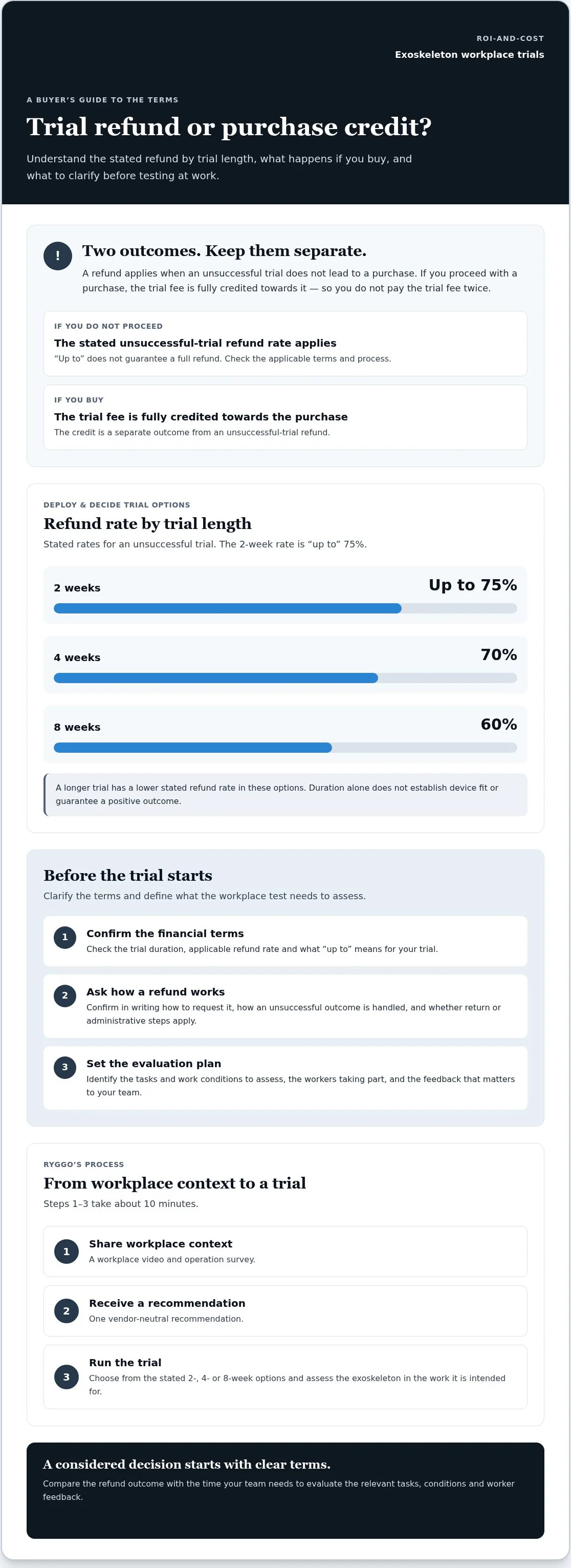
- Compare the stated unsuccessful-trial refund rates: up to 75% for 2 weeks, 70% for 4 weeks and 60% for 8 weeks.
- With Deploy & Decide, the trial fee is fully credited toward an eventual purchase, so no double payment is required.
- Before starting, confirm the trial duration, refund terms and how your workplace will judge whether the exoskeleton meets its requirements.
- Ryggo’s process moves from a workplace video and operation survey to one vendor-neutral recommendation, then a trial. Steps 1-3 take about 10 minutes.
Table of Contents
- What does an exoskeleton refund policy actually cover?
- How do exoskeleton refund rates change with trial length?
- What happens if an exoskeleton trial does not meet expectations?
- What should buyers check before agreeing to exoskeleton trial terms?
- How does Ryggo Deploy & Decide make exoskeleton testing clearer?
What does an exoskeleton refund policy actually cover?
An exoskeleton trial refund policy explains what portion of the trial fee may be refunded if the test is unsuccessful. That is different from a standard product return policy: a workplace trial lets a team assess a device in its own operation, while the refund term sets out the financial outcome if the team decides not to proceed.
For buyers considering safety, ergonomics and operational fit, it helps to understand both possible outcomes before the test begins. If the organisation does not proceed after an unsuccessful trial, the relevant refund rate applies. If it purchases the device, the trial fee is fully credited toward the purchase. Understanding exoskeleton refund policies means checking these outcomes separately rather than assuming “try before you buy” always means a full refund. For general background on powered exoskeletons, including their occupational applications, see the overview on Wikipedia.

Refund versus purchase credit: what is the difference?
For an unsuccessful 2-week Deploy & Decide trial, the stated refund is up to 75% of the trial fee. This is not a guaranteed return of the entire fee. If the buyer proceeds with a purchase, the trial fee is fully credited toward it instead, so the buyer does not pay the trial fee twice.
These are separate outcomes. The unsuccessful-trial refund applies when the test does not lead to a purchase; purchase credit applies when it does. Keeping the distinction clear helps procurement and operations teams evaluate the test without treating the fee as a second charge if they decide to buy.
What does “up to” mean for the refund?
“Up to 75%” is the stated refund rate for an unsuccessful 2-week trial, not a promise of a full refund. Before agreeing to a trial, confirm how to request the refund and what steps apply if the trial is unsuccessful. The precise refund process and any return or administrative requirements should be checked in the trial terms rather than assumed.
Ask Ryggo to confirm the applicable details in writing before deployment, including how the unsuccessful-trial outcome is handled. Clear answers help your team plan the workplace test and budget around the terms that apply.
How do exoskeleton refund rates change with trial length?
With Ryggo’s Deploy & Decide programme, the stated refund rate for an unsuccessful trial varies by duration. A longer option is not automatically the better choice. Select a period that gives the team a practical opportunity to assess the device during the tasks and work conditions it is intended for.
| Trial period | Refund rate for an unsuccessful trial |
|---|---|
| 2 weeks | Up to 75% |
| 4 weeks | 70% |
| 8 weeks | 60% |
These rates apply to the stated trial periods only. They do not establish rates for other durations or predict whether an exoskeleton will suit your operation. When understanding exoskeleton refund policies, compare the financial terms with the time your team needs to collect useful feedback from the work being assessed.
What is the refund rate for a 2-week trial?
An unsuccessful 2-week trial has a stated refund rate of up to 75%. “Up to” does not mean a full refund is guaranteed. Before deployment, confirm the applicable terms in writing, including how to request a refund and any return or administrative steps. Verify those details instead of assuming them.
How do 4-week and 8-week trial refunds compare?
The stated refund rate for an unsuccessful 4-week trial is 70%; for an 8-week trial, it’s 60%. Deploy & Decide trial periods are 2, 4 or 8 weeks. Don’t extrapolate these figures to another duration. Review the Ryggo Deploy & Decide guide for further information about the programme’s trial terms.
A longer test may give a team more time to observe the device across planned tasks, but duration alone does not establish device fit or guarantee a positive outcome. Before choosing a period, identify the tasks and operating conditions to assess, the workers who will take part, and the feedback that matters. Then select the available trial period that supports that evaluation and confirm its refund rate before the test starts.
Ready to find the right device for your operation?
Find my exoskeleton →What happens if an exoskeleton trial does not meet expectations?
At the end of a workplace test, the buyer decides whether to proceed with a purchase or return the device and treat the trial as unsuccessful. An unsuccessful trial may qualify for the refund rate associated with its duration. That does not mean the full fee will be refunded.
Agree on how you’ll evaluate the trial before it starts. Otherwise, the final decision may rely on general impressions instead of observations from the work the exoskeleton was selected to support. This matters when different tasks, teams or shifts may produce different feedback.
How should a buyer judge whether the device met expectations?
Set task-specific criteria before deployment. Identify the work activities and movements to observe, and decide what users should report about comfort and how easily the device fits into normal operations. Record feedback consistently and consider whether the device is practical for the intended workload. A trial can inform a safety and ergonomics decision, but it does not guarantee injury reduction or productivity gains.
What should buyers confirm before returning a device?
Understanding exoskeleton refund policies also means separating your internal keep-or-return decision from the provider’s confirmed return and refund steps. Confirm the process and any return or administrative requirements with Ryggo before the trial begins.
Use this sequence as a buyer’s checklist, not as a statement of Ryggo’s formal procedure:
- Assess the test. Compare user feedback and observations with the task-specific criteria agreed before deployment.
- Decide whether to keep or return. If proceeding to purchase, confirm how the trial fee is credited. If the trial is unsuccessful, check which refund rate applies to the confirmed 2-, 4- or 8-week period.
- Confirm the next steps with Ryggo. Ask how to request an unsuccessful-trial refund and how the device should be returned. Confirm any conditions or administrative steps rather than assuming a deadline, device-condition rule or refund timetable.
Get the relevant answers in writing before deployment, and make sure the people responsible for the trial know who will communicate the outcome. That keeps the operational assessment and the financial decision clear without treating an unconfirmed return process as established policy.
What should buyers check before agreeing to exoskeleton trial terms?
Put the commercial terms and workplace evaluation plan in writing before testing begins. Understanding exoskeleton refund policies is one part of the decision. Your team also needs to know what it will assess, who will use the device and what support the vendor provides during the trial.
Use this checklist with procurement, operations and HSE colleagues:
- Trial period: Confirm whether the Deploy & Decide trial is for 2, 4 or 8 weeks.
- Unsuccessful-trial refund: Confirm the rate for that period: up to 75% for 2 weeks, 70% for 4 weeks or 60% for 8 weeks.
- Purchase credit: Confirm that the trial fee is fully credited toward an eventual purchase, so you don’t pay the trial fee twice.
- Evaluation criteria: Agree how the operation will judge whether the device fits the work and meets its requirements.
- Vendor arrangements: Confirm the vendor’s onboarding, training, delivery and service arrangements for the trial.
Which commercial terms should procurement confirm?
Record the selected trial period, its corresponding unsuccessful-trial refund rate and how the full trial-fee credit applies if you purchase. Keep the outcomes distinct: the refund relates to an unsuccessful trial, while the credit applies to an eventual purchase. Confirm the refund-request and return steps, including any applicable conditions, rather than treating assumptions as policy.
Keep policy questions separate from legal or contractual conclusions. If your organisation needs particular contract wording or has questions about its obligations, refer them to the appropriate internal or professional adviser. Don’t infer a legal requirement from a trial summary.
How can buyers make the trial useful for the operation?
Define the task, intended user group and operating context before the device arrives. Document the relevant movements, workload and practical constraints, then decide what feedback users should provide and how the team will record it. Use the DGUV 208-062 framework as selection guidance when considering exoskeleton use. A trial should support, not replace, your organisation’s own risk-assessment process.
RULA-based screening can help inform the choice of exoskeleton type, but an automated RULA result is a screening estimate, not a certified assessment. Treat it as one input alongside task observations and appropriate professional judgement.
To compare options and plan a workplace test, explore Ryggo’s exoskeleton trial options.
How does Ryggo Deploy & Decide make exoskeleton testing clearer?
A workplace trial is more useful when it starts with the task, not a catalogue shortlist. Ryggo’s Deploy & Decide process moves from understanding the operation to testing a suitable exoskeleton before purchase. Steps 1-3 take about 10 minutes, offering a focused starting point without treating the recommendation as a substitute for workplace evaluation.
What does the Deploy & Decide process include?
The process moves through four stages:
- Share a workplace video. Upload a 30-second video. Uploads are free and unlimited, and videos are deleted after analysis.
- Complete an operation survey. Describe the loads, movements and work environment. The information is mapped to the DGUV 208-062 selection framework.
- Receive one neutral recommendation. Ryggo provides one recommendation based solely on fit across vendors. Paid listings are not accepted.
- Trial the recommended device or devices. Assess the recommended option in the actual operation before deciding whether to purchase. Multiple devices can be trialled side by side.
This sequence supports understanding exoskeleton refund policies by connecting the recommendation to a defined workplace test, while keeping the commercial decision clear. Before deployment, confirm which trial period and unsuccessful-trial refund rate apply, and remember that the trial fee is fully credited toward the purchase if you decide to buy.
When should a buyer explore a Ryggo trial?
Consider a trial when you have identified a specific task or work area and need to assess whether an exoskeleton is practical for the people and movements involved. Set evaluation criteria in advance, then gather feedback during real work rather than relying on a demonstration alone. A trial can inform a safety and ergonomics decision, but it cannot guarantee injury reduction or productivity gains.
Ryggo operates across exactly 23 European countries under one set of commercial terms. The platform provides a vendor-neutral recommendation based solely on fit. Ask the device vendor about onboarding and training for the trial, as well as delivery and service arrangements.
For warehouse, factory, retail, construction or healthcare teams, a neutral recommendation can help focus testing on operational fit. Explore a neutral exoskeleton recommendation, then confirm the trial terms that apply to your workplace.
Not sure which exoskeleton fits your task? Let the Ryggo advisor match it independently.
Find my exoskeleton →Make your next exoskeleton trial a clear decision
Before testing, agree how your team will assess operational fit and confirm the commercial terms. Understanding exoskeleton refund policies means distinguishing the refund for an unsuccessful trial from the credit applied if you decide to buy. With Ryggo Deploy & Decide, unsuccessful-trial refund rates are up to 75% for 2 weeks, 70% for 4 weeks and 60% for 8 weeks. If you purchase, the trial fee is fully credited toward it, so you don’t pay twice.
Ryggo operates across 23 European countries under one set of commercial terms. This gives buyers a defined basis for planning a try-before-you-buy assessment, while the final decision should rest on how well the device fits the work and the people doing it. Confirm the refund-request and return requirements before deployment rather than relying on assumptions.
Ready to assess a suitable option for your operation? Explore a neutral recommendation and test before you buy. A structured trial can help your team make a more informed safety and ergonomics decision.
Frequently asked questions
How much of the exoskeleton trial fee can be refunded?
For an unsuccessful Ryggo Deploy & Decide trial, the stated refund rate depends on the period: up to 75% for 2 weeks, 70% for 4 weeks or 60% for 8 weeks. These are partial refund rates, not a promise to return the full trial fee. Confirm the applicable rate and refund process before the trial begins.
Is the refund guaranteed if an exoskeleton does not meet expectations?
No. The stated rates apply to unsuccessful trials, but they do not guarantee a full refund or mean every case automatically qualifies. Before deployment, confirm how an unsuccessful trial is determined, how to request a refund and whether any return or administrative requirements apply. Verify the process and any conditions with Ryggo instead of making assumptions.
What is the refund rate for a 2-week exoskeleton trial?
The stated refund rate for an unsuccessful 2-week Ryggo Deploy & Decide trial is up to 75% of the trial fee. “Up to” does not mean a full refund is guaranteed. Check the terms before the trial starts, including how to request any eligible refund. Don’t assume deadlines or return conditions that haven’t been confirmed.
How do 4-week and 8-week exoskeleton trial refunds differ?
The stated refund rate for an unsuccessful 4-week trial is 70%; for an 8-week trial, it’s 60%. Ryggo’s Deploy & Decide periods are 2, 4 or 8 weeks, and the rates should not be extrapolated to other durations. Choose a period that supports your workplace evaluation, then confirm its corresponding refund rate and applicable terms with Ryggo before deployment.
Can the exoskeleton trial fee be credited toward a purchase?
Yes. If you decide to purchase after a Ryggo Deploy & Decide trial, the trial fee is fully credited toward the eventual purchase. You don’t pay the trial fee twice. This purchase credit is separate from an unsuccessful-trial refund: the credit applies if you buy, while the relevant partial refund rate applies to an unsuccessful trial.
What happens if an exoskeleton does not suit the task during a trial?
Assess the trial against criteria set before deployment, such as task fit, movement, user comfort and compatibility with the operating context. If the device doesn’t meet your requirements, you may decide to return it rather than proceed with a purchase. An unsuccessful trial may qualify for the rate tied to its duration. Ask Ryggo to confirm the return and refund-request steps, and don’t assume unconfirmed conditions or timelines.
Can companies test exoskeletons before buying across European countries?
Ryggo operates in 23 European countries under one set of commercial terms. Companies can use its try-before-you-buy option to test an exoskeleton in their operation before deciding whether to purchase. Confirm that the relevant trial is available for your workplace, then clarify its duration, refund rate and vendor-provided onboarding or training arrangements. Recommendations are vendor-neutral and based solely on fit.
Find the right device before you trial anything
The Ryggo advisor maps your task, environment, and requirements to compatible devices — independently, across the full European market.
Find my exoskeleton →