Key takeaways
- Frame the request around an operational problem and show how the proposed equipment could support ergonomics and business performance.
- Strengthen the case with relevant research and evidence that connects to the work being done at your facility.
- Include implementation and ongoing costs so decision-makers can assess the full investment, not just the purchase price.
- Use local injury, workload and production data to make benefit estimates specific and transparent.
- Trial suitable options with workers before purchasing, then use the results to refine the ROI case.
Table of contents
- Framing an ergonomic equipment request around business ROI
- Supporting proposals with peer reviews and research
- Estimating implementation and ongoing costs
- Using facility-specific injury and production data
- Assessing the return on ergonomic investments
- Ryggo: RULA-based ergonomics assessments: unlimited and free of charge, helps to decide the type of exoskeleton that is needed.
Framing an ergonomic equipment request around business ROI
To understand how to get budget approval for ergonomic technology, connect a defined workplace need to measurable business outcomes. Start with the task, identify suitable equipment and provide the evidence decision-makers need.
Common objections include uncertain returns, competing priorities, unclear funding eligibility and concerns about employee uptake. Address them with a scoped proposal, transparent assumptions and a clear plan for evaluating results.
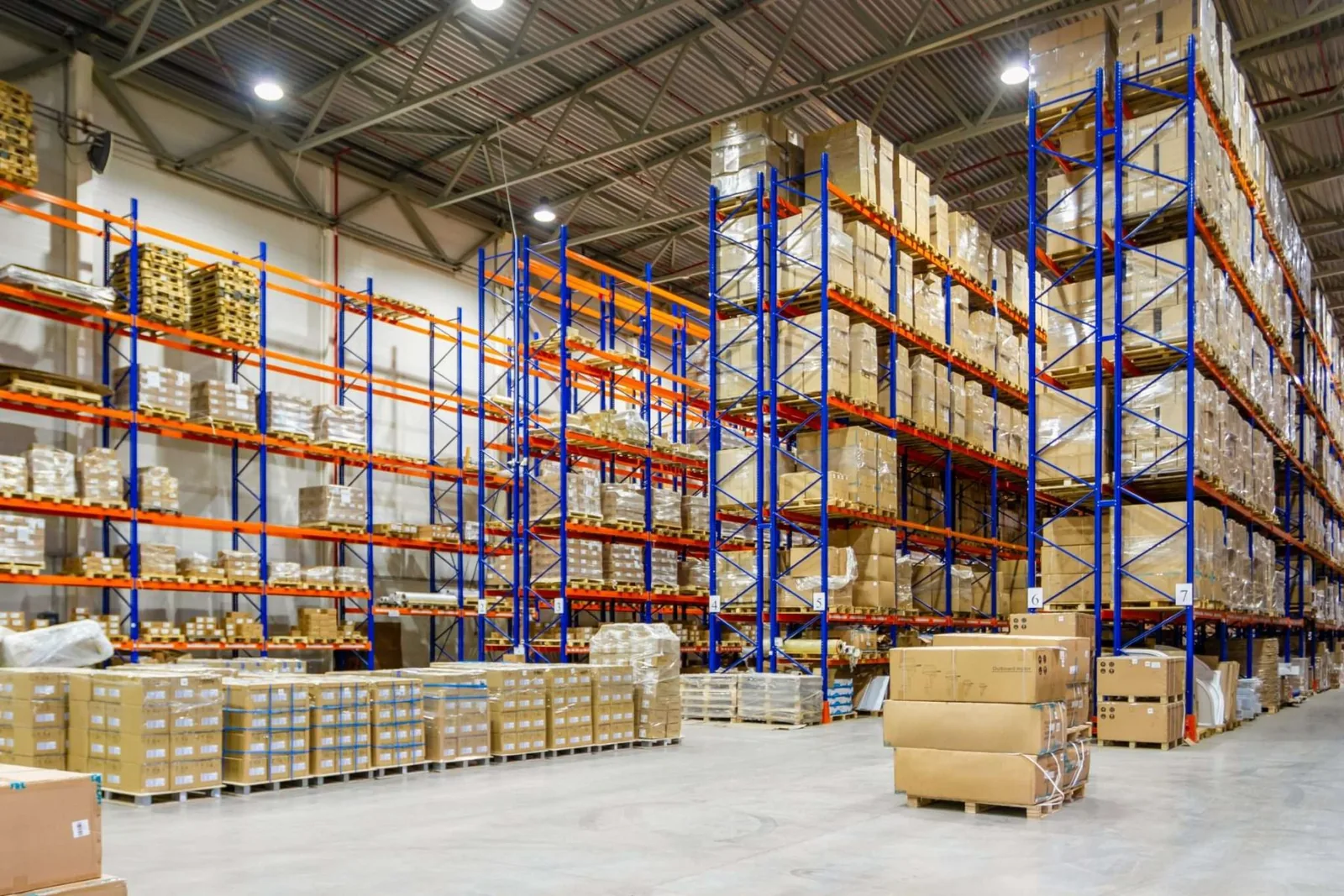
Assess equipment needs and recommendations
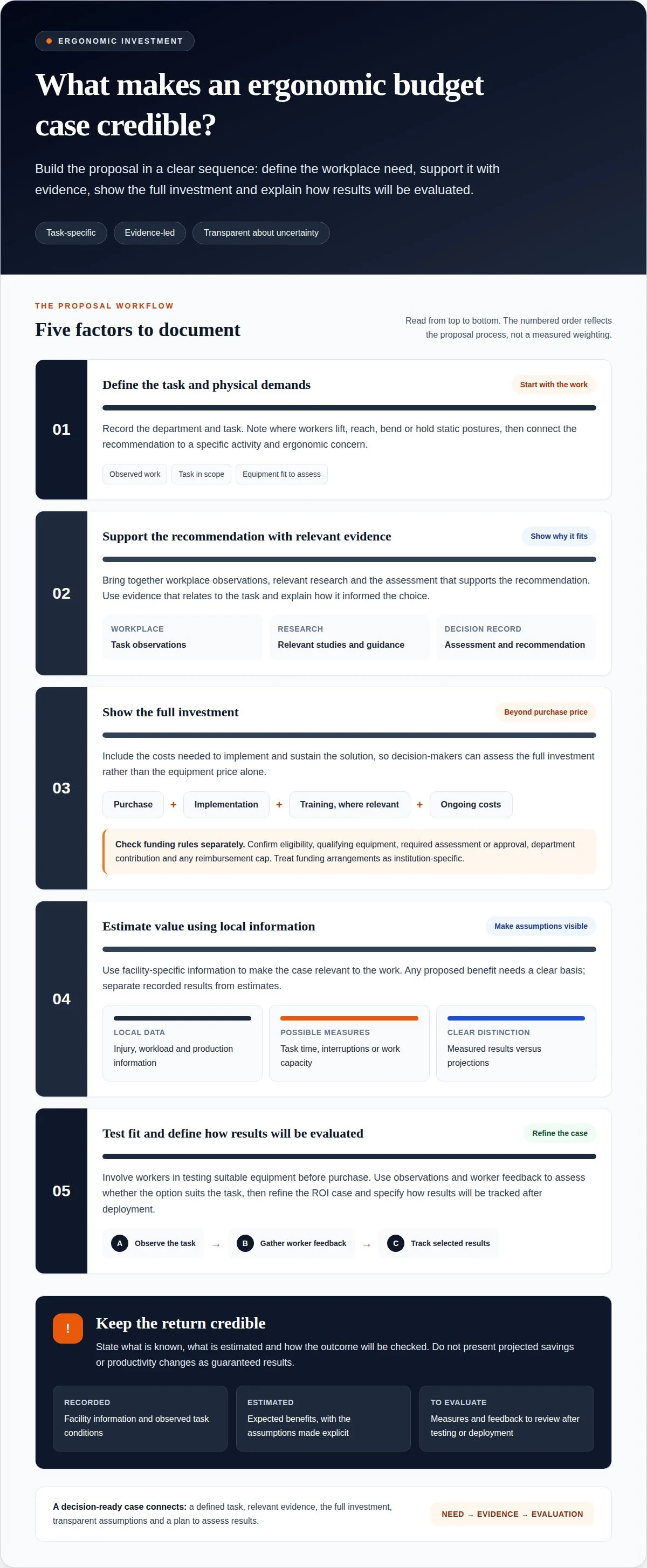
Document the task, department and physical demands before choosing equipment. Record where workers lift, reach, bend or hold static postures, and identify activities linked to ergonomic concerns. Tie each recommendation to a specific task, not a general request for improvement. Explain how the equipment could support the work and what practical factors need evaluation, rather than choosing it solely because one employee prefers it.
Check funding eligibility and reimbursement caps
Review applicable funding rules before including reimbursement in the proposal. Confirm eligibility, which equipment qualifies, what assessment or approval is required, and whether the department contributes. Funding caps may be based on an approved standard item rather than the full cost of a preferred option.
Build the business case for approval
Show finance how the request supports operational priorities. State the problem, proposed equipment, tasks in scope and expected benefits. Separate measured results from estimates: reduced task time, fewer interruptions or improved work capacity each need a clear basis. Include implementation and training where relevant, and explain how the department will evaluate results after deployment. A CFO-ready case makes assumptions visible instead of presenting projected savings as certain.
Make the decision straightforward by defining the investment, expected value and method for tracking results.
Address common budget objections
Prepare concise answers to questions about cost, evidence, adoption and alternatives. If reviewers challenge the expected return, show the calculation and distinguish facility records from estimates. If they question employee uptake, explain how users will be involved and how the equipment fits the task. Separate essential requirements from optional preferences, which may be easier to cut. If the full request is unlikely to secure funding, propose a focused first phase and specify what evidence would support future purchases.
Also identify the project sponsor and explain why the request addresses an operational priority, not a temporary fix.
Supporting proposals with peer reviews and research
Use external evidence to support why the recommendation fits the task, then document how you reached the decision. Keep research, workstation observations and approval records together so finance and HSE can review the same case.
Review peer research and recognised guidance
Compare peer-reviewed studies and recognised guidance with the work your proposal targets.
Apply the guidance to the specific workstation. For a chair request, describe whether workers can adjust the seat and backrest, and whether the lumbar support and backrest contour suit the user and task. A feature list alone does not demonstrate fit. Explain how the chair addresses observed postures and identify the practical criteria used to compare alternatives.
Keep the supporting pack ready for review. Include the assessment, equipment recommendation, relevant research extracts and purchase justification.
Use charts and supporting data
Turn the evidence into a concise chart linking the workstation issue to the proposed equipment and expected operational effect. Label each measure, state its source and distinguish recorded results from projections. For example, a chart comparing task observations before and after a trial can show whether workers report improved support or whether their posture changes. Never present an estimate as a measured outcome.
Use a few relevant visuals instead of overwhelming reviewers with research. A comparison table can show chair adjustability, backrest support and which needs each option addresses. A simple chart can show the baseline and the measure selected for follow-up. Use consistent units and definitions across options so procurement can compare them fairly.
- Attach the workstation assessment and the recommendation it supports.
- Include research that relates directly to the task, equipment or outcome.
- Identify the approver, required signatures and purchase documents before routing the request.
For exoskeleton proposals, worker feedback during a trial can add task-specific evidence before purchase. A try-before-you-buy exoskeleton trial gives the department a practical way to assess fit alongside the documented rationale.
Estimating implementation and ongoing costs
Estimate whole-life costs, not just the purchase price. Separate direct project costs from ongoing expenses, then compare them with the facility’s recorded injury and operational costs.
Identify direct and indirect employer costs
List the costs required to put the equipment into use and keep the project running. Include equipment, implementation, training, maintenance, support and any additional staffing. These categories give a fuller picture than a purchase-only estimate. If a cost does not apply, say so clearly rather than leaving reviewers to wonder whether it was overlooked.
Map the employer costs associated with musculoskeletal disorders. Direct costs include workers’ compensation payments, medical expenses and legal fees. Indirect costs include corrective measures, accident investigations, training replacement employees, lost productivity and absenteeism. These costs appear in different records: medical expenses may be easy to identify, while replacement training time may be recorded in another department.
Use consistent categories throughout the estimate. Record training time separately from equipment costs, and distinguish ongoing support from initial implementation. If the proposal covers several work areas, show costs by department and in total. This helps procurement and finance identify what drives the investment and prevents unrelated operating expenses from being counted as project costs.
Estimate avoided musculoskeletal injury costs
Review the facility’s injury logs for the past 3-5 years to establish a historical baseline. Identify the musculoskeletal cases relevant to the task and record their associated direct and indirect costs. The local calculation should rely on the organisation’s own records, not a generic estimate.
Build a transparent scenario using those records. Show the current cost baseline, the assumed change in injury frequency and the resulting estimated costs avoided. Make the assumption visible and do not present projected reductions as guaranteed savings. Separate incident-related savings from productivity benefits so you do not count the same lost time twice.
Compare projected savings with full implementation and ongoing costs over the same period. State which figures are recorded, which are estimates and who owns each data source. If an input cannot be traced to an injury, payroll or operational record, leave it out of the core calculation or label it as an assumption. This lets reviewers challenge and refine the model without confusing potential savings with confirmed results.
Ready to find the right device for your operation?
Using facility-specific injury and production data
Use records from the relevant facility and task to estimate whether ergonomic equipment could support performance. Keep observed results separate from assumptions.
Gather facility injury and production data
Start with the work area named in the proposal. Gather its injury and absence records, then identify which cases relate to the task under review. Compare these with production measures for the same work, such as cycle time, completed orders, rework or interruptions. Use the facility’s own reporting periods and definitions so the baseline reflects local operations, not a benchmark from another country or industry.
Observe how workers perform the task, including the positions they hold, the loads they handle and where strain is reported. Record relevant differences between shifts, products or work methods. For example, a warehouse proposal might focus on order picking in one zone, while a factory case might examine repeated overhead assembly. Exclude unrelated incidents and production changes from the comparison.
Record pain-related breaks as observations, not proof that equipment will reduce them. Note when pauses happen, which task is underway and whether the employee changes position or stops working. Compare similar conditions and distinguish these pauses from scheduled breaks or interruptions caused by equipment, materials or workflow. This context helps decision-makers interpret the data.
Quantify productivity gains
Choose a productivity measure that directly reflects the task. For repetitive handling, this might be cycle time per completed unit; for order picking, it could be completed picks alongside accuracy. Record the baseline using the same method planned for evaluation. Consider staffing, work sequence and quality too: a faster task is not an improvement if it shifts strain or increases errors.
Estimate the value of a change using local operating data. For example, link any observed time reduction to the facility’s actual output, then explain whether the released capacity could support more work, reduce overtime or improve workflow. Do not call available time a cash saving unless the operation can use it that way. State assumptions separately from measured changes.
Use product reviews or demonstrations to identify questions, then assess options with workers performing the relevant task. During a trial, gather feedback on fit, comfort and mobility, and note whether the equipment interferes with the appropriate position or sequence. Compare observations under representative work conditions and record reasons for non-use. This evidence helps assess practical suitability alongside production measures.
Assessing the return on ergonomic investments
Assess returns using benefits your facility can measure, not a headline ratio. A credible investment case distinguishes recorded outcomes from projections and shows how each affects payback.
Set the calculation method. Define the investment period and include purchase, implementation and ongoing costs. Then calculate net benefit by subtracting total costs from measured or projected benefits. Express ROI as net benefit divided by total investment, multiplied by 100. Keep the calculation consistent across options, and don’t combine different periods or count one benefit twice.
Payback measures how long benefits take to recover the initial outlay. Show the calculation using facility data, and state which inputs are measured and which are estimates. This gives finance a clear basis for comparing the proposal with other department purchases.
Separate benefit types. Assess injury-related costs, productivity, absence and retention as distinct outcomes. For repetitive tasks, a change in cycle time may create usable production capacity, but it is not automatically a cash saving. Explain whether the operation can turn released time into additional output, reduced overtime or another measurable result.
Stress-test the assumptions. Present a cautious scenario alongside the expected one. Vary the assumptions that most affect the result, such as equipment uptake, measurable time saved or the number of tasks covered. Show how ROI and payback change in each scenario. Do not present the maximum possible benefit as the expected outcome.
Keep ergonomics and productivity evidence visible alongside the financial calculation. A proposal can support reduced strain without claiming that a device prevents injury or guarantees a particular return. For exoskeletons, a worker trial can help establish task fit and whether expected benefits appear in practice.
Choose measures before deployment. Agree how the department will assess results, who will record them and when decision-makers will review progress. Ryggo’s free, unlimited automated RULA-based screening estimate can help identify the type of exoskeleton suited to the task. This screening estimate does not replace professional ergonomic consultancy. Use it as one input alongside operational measures, not as a substitute for ROI tracking.
Not sure which exoskeleton fits your task? Let the Ryggo advisor match it independently.
Ryggo: RULA based ergonomics assessments: unlimited and free of charge, helps to decide the type of exoskeleton that is needed.
Ryggo helps turn an ergonomic concern into a focused exoskeleton decision. Its free, unlimited automated RULA-based screening estimate helps identify the type of exoskeleton suited to the task. The estimate is not a certified assessment and does not replace professional ergonomic consultancy.
Use the screening estimate to narrow options before preparing a purchase case. Ryggo provides vendor-neutral comparisons and ROI calculations. If task fit needs practical evaluation, the Deploy & Decide programme lets companies trial exoskeletons in their own operations before purchasing.
If you’re developing an exoskeleton proposal, contact Ryggo to discuss the next step.
Move from a proposal to a practical decision
Once the business case is ready, define the next decision: which task to assess, which workers to involve and what evidence would support a purchase. This keeps the project focused on operational needs rather than treating ergonomic equipment as a general technology upgrade.
Knowing how to get budget approval for ergonomic technology means giving decision-makers a credible route from assessment to evaluation. Ryggo supports that process with vendor-independent comparisons, ROI calculations and Deploy & Decide trials. These options help teams evaluate whether an exoskeleton fits the work before committing to a purchase.
Use the next discussion to clarify the task, the intended outcome and the information your finance and operations teams need. If the case is ready to progress, contact Ryggo to discuss your needs. A focused proposal gives your organisation a practical basis for deciding what to trial next.
Frequently Asked Questions
How can I accurately measure productivity gains from ergonomic lifting devices?
Compare results while accounting for how often the device is worn during the target task. Record the share of relevant work completed with the device alongside output and quality, so you do not attribute results to equipment workers rarely use. Keep the task definition consistent across observations. If use varies between shifts, report that variation instead of combining different conditions into one average.
How can I get help with the purchase of ergonomic equipment?
For an exoskeleton purchase, Ryggo’s questionnaire and recommendation process can help identify a suitable device for the workplace task. Its Deploy & Decide programme lets companies trial exoskeletons before purchasing. This is relevant when the equipment need involves exoskeletons; chairs and other general ergonomic equipment follow the organisation’s own procurement process. Keep the task and intended users in view when selecting the support you need.
How long does it typically take to see a return on investment for ergonomic equipment?
The time to recover an investment depends on how the equipment is used and which benefits the organisation can measure. Finance teams can set review points that show whether actual results are tracking towards the expected payback.
What is the most significant cost associated with poor ergonomics?
No single cost is consistently the largest across all workplaces. For a specific operation, compare the total cost of recorded ergonomic-related cases with the operational disruption associated with them. The largest exposure may differ between a warehouse, production line and healthcare setting. Use the organisation’s accounting categories to identify the most significant local cost rather than assuming one expense dominates every business case.
What ergonomic technology qualifies for workplace budget approval?
There is no universal list of ergonomic technology that qualifies for funding. Approval depends on the employer’s procurement rules, available budget and the task the equipment is intended to support. A proposal for an adjustable chair or an exoskeleton may follow a different internal approval route. Explain the work need and intended users, then align the request with the department’s purchasing criteria.
How do you build a business case for ergonomic technology?
To show how to get budget approval for ergonomic technology, map the request to the organisation’s decision process: identify the budget owner, operational sponsor and approval stage. Clarify whether the proposal is a new purchase or replacement, and state what decision is needed now. This helps prevent a sound ergonomic proposal from stalling because ownership, timing or the requested approval is unclear.
How can you calculate the ROI of ergonomic technology?
Use a consistent timeframe and compare the equipment with the current way of working. Include project-specific costs and use benefit measures the organisation can translate into operational or financial value. Keep non-financial ergonomic outcomes visible, but do not convert them into cash without a defensible method. ROI is more useful when reviewers can trace each input to its source.
What workplace injury and productivity data supports an ergonomics budget request?
Useful supporting records include task-related incident descriptions, time away from work, restricted duties and department production reports. Where possible, link records by work area or task while protecting employee confidentiality. This can show whether the operational issue and injury pattern concern the same work. If records use different job descriptions or reporting periods, explain those differences before drawing conclusions.
Find the right device before you trial anything
The Ryggo advisor maps your task, environment, and requirements to compatible devices — independently, across the full European market.