Key takeaways
- Identify which welding and grinding postures place the greatest sustained demand on workers before considering support.
- Assess whether overhead work, task duration and movement between tasks affect fatigue and endurance.
- Consider how an exoskeleton fits with required PPE and the practical demands of the work environment.
- Match the support type to the task and the movements workers need to perform, rather than choosing by product category alone.
- Use a workplace trial to evaluate fit and ergonomics in real operating conditions before making a purchasing decision.
Table of Contents
- Physical demands of welding in constrained postures
- Fatigue and endurance during welding
- Musculoskeletal strain from welding postures
- PPE compatibility and industrial environments
- What types of exoskeletons are used for welding and grinding tasks?
- Ryggo
Physical demands of welding in constrained postures
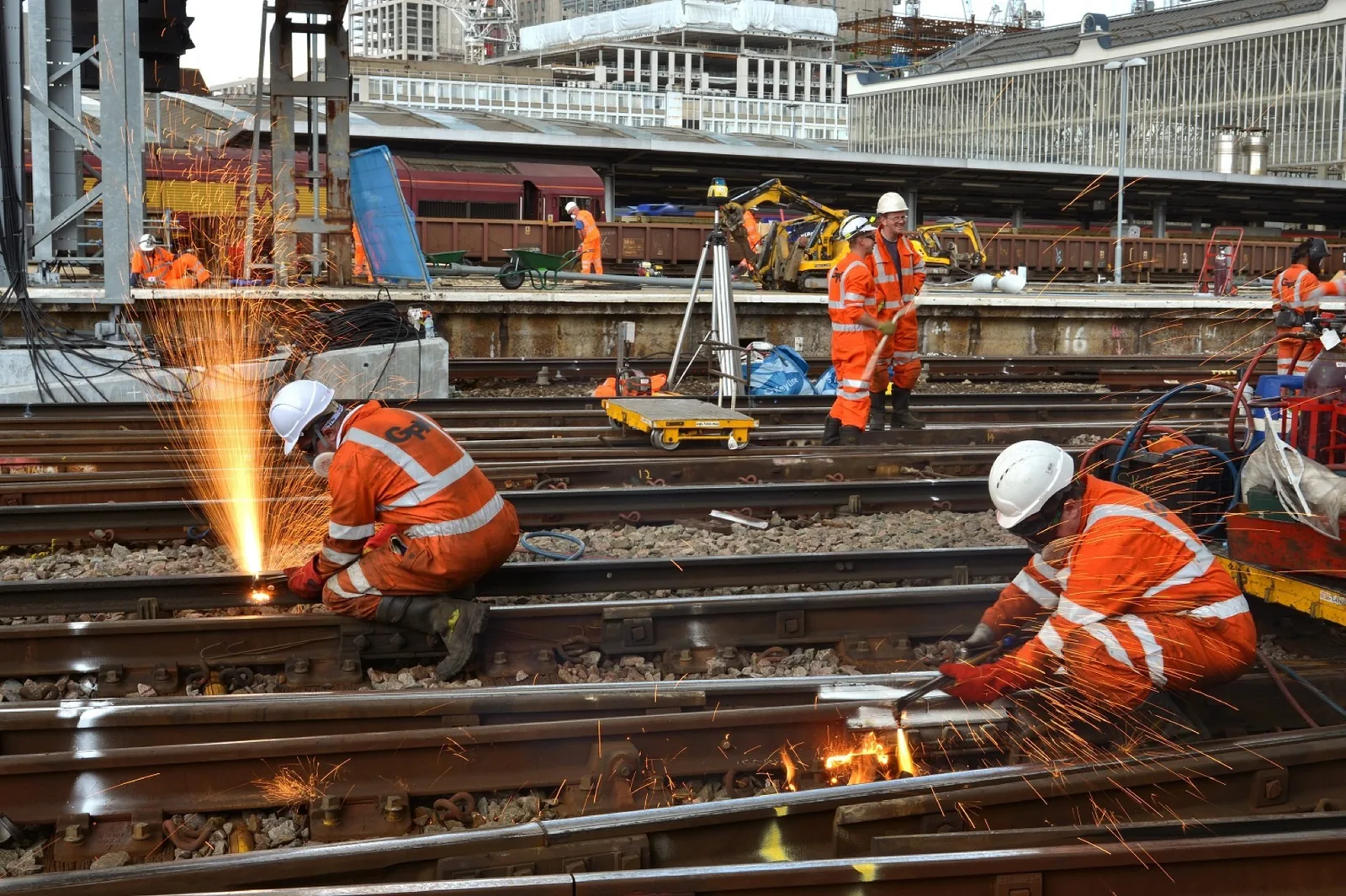
Overhead welding holds the arms and shoulders raised while the worker controls a torch and maintains a steady position. Grinding adds sustained tool handling and pressure, often in the same restricted space. Posture, tool control and physical effort therefore need assessing together.
Which exoskeletons support overhead welding and grinding? Shoulder-support exoskeletons are designed to assist with raised-arm work. Whether a device fits depends on the worker’s reach and movement, and on the full task, including transitions between welding and grinding.
How do passive and powered exoskeletons compare for welding and grinding? Passive systems use mechanical support without powered joint drives. Powered systems may use small joint drives to support or amplify movement. Which type suits an operation depends on the task, not on the category.
What European requirements apply to workplace exoskeletons? Meet the applicable European welding, grinding and PPE requirements, and assess the exoskeleton as an added ergonomic aid, not a replacement for hazard controls. How much do exoskeletons for welding and grinding cost? The price depends on the case and is given after a quote request; support type, task fit and deployment needs affect the decision.
How should employers evaluate, fit and train workers to use exoskeletons for welding and grinding? Start by assessing the actual work sequence, including posture, movement, tool handling and PPE. Fit the device to the wearer, then train workers to put it on, adjust it and move safely between tasks. A workplace trial can show whether support remains practical during real welding and grinding, not just in a brief demonstration.
Fatigue and endurance during welding
Welding endurance depends on more than shift length. During overhead work, welders hold their arms raised while controlling the torch and maintaining accuracy. As shoulder and neck muscles tire, posture and tool control can become harder to sustain. An exoskeleton may support the upper body and arms, but assess its effect against the full work sequence, not a brief demonstration.
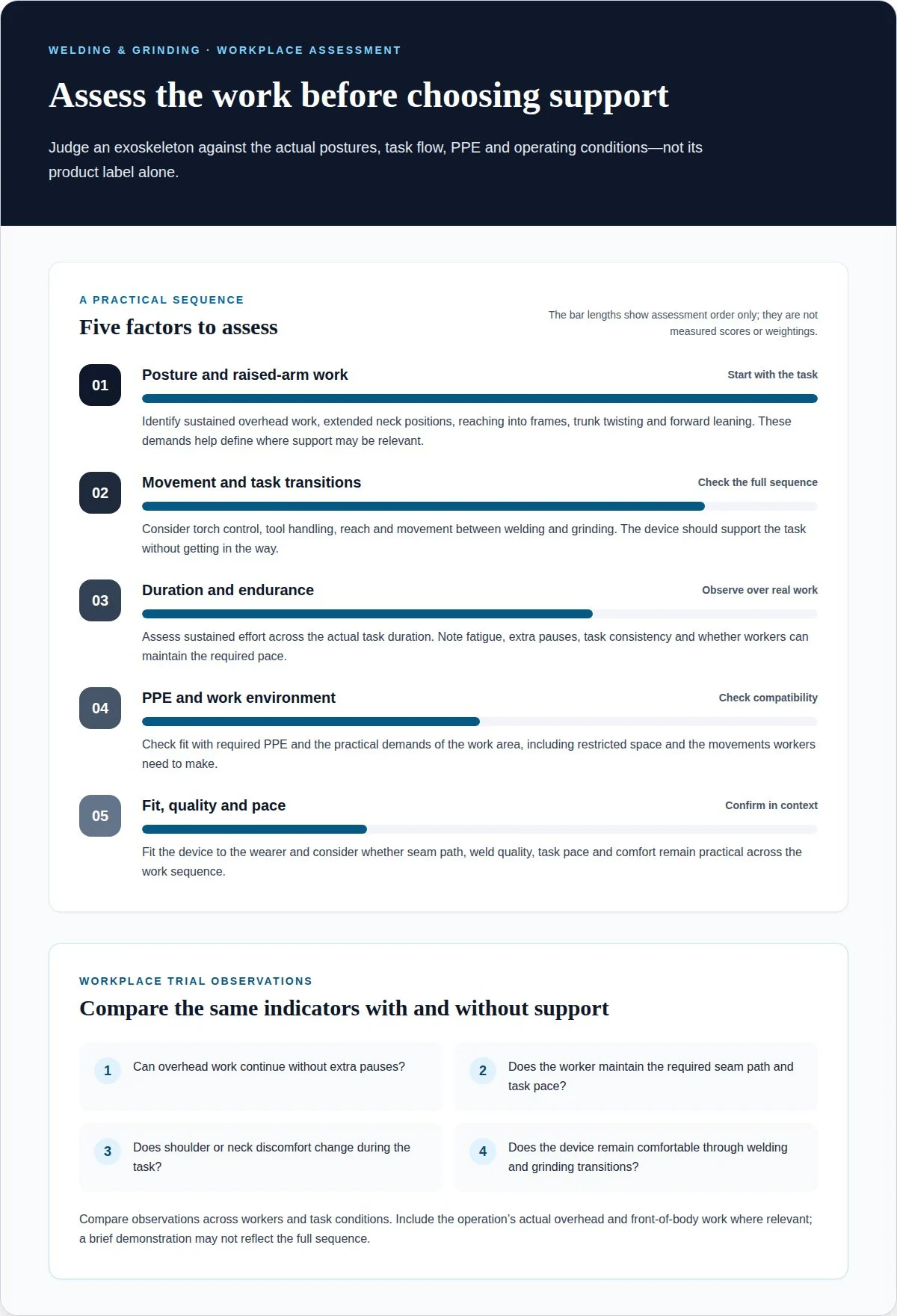
For a workplace evaluation, record the same practical indicators with and without support:
- Whether overhead work can continue without extra pauses.
- Whether the worker maintains the required seam path and task pace.
- Whether shoulder or neck discomfort changes during the task.
- Whether the device remains comfortable and unobtrusive across welding and grinding transitions.
Compare observations across workers and task conditions rather than relying on one wearer’s first impression. Including both overhead and front-of-body welding in a trial can show whether support helps with the operation’s actual demands.
Support is most relevant when the task repeatedly asks the worker to hold the arms raised and maintain control. Exoskeletons can support a welder’s upper body and arms during strenuous work such as overhead welding. Observations from the actual job should guide any decision.
Use worker feedback alongside practical observations of the welding task. Relief alone does not prove that a device suits every operation. A careful comparison can show where assistance helps and where the job may still require adjustment or further assessment.
Musculoskeletal strain from welding postures
Welding posture determines where physical effort builds up. In overhead welding, raised arms place sustained demands on the shoulders, while workers may extend their necks to see the joint. Reaching into a frame can also involve twisting the trunk or leaning forward. These positions can make it harder to vary posture while keeping the torch steady.
Grinding involves a different combination of demands. Operators guide and stabilise the tool while applying pressure, sometimes above shoulder level or inside a restricted structure. Repeated reaches can load the arms and shoulders, while bending or rotating to access a seam can involve the back. The pattern depends on workpiece height, access and tool direction.
How much can exoskeletons reduce shoulder, back and arm strain during welding? There is no single reduction figure that applies to every body region and task. The effect depends on the area supported, the worker’s posture and fit, and whether the task allows the device to assist without restricting movement.
For example, a shoulder-support device may assist with sustained overhead work, but it won’t automatically address trunk rotation at a low or awkward seam. Support for raised arms also doesn’t remove the need to consider task design, workpiece positioning and opportunities to change posture. An exoskeleton is one ergonomic measure, not a substitute for organising work to limit sustained awkward positions.
A useful assessment follows the work, rather than relying on a job title such as “welder”. Observe the worker across representative operations, including overhead welding, front-of-body welding and grinding. Note the posture, reach direction, tool handling, duration of each position and transitions between tasks. Then identify where strain is concentrated and whether the proposed support targets that area.
Compare the same tasks with and without the device. Record worker feedback on comfort and movement, as well as observations such as whether the device shifts during a reach or obstructs access to the joint. If arm support changes how the worker balances or positions their torso, include that in the assessment. The aim is to determine whether the device fits the full task sequence, not just one static posture.
For HSE and operations teams, this distinction matters: a device suited to overhead work may not suit every welding or grinding position. Match the support to the strain pattern, then assess it in the actual work environment.
Ready to find the right device for your operation?
PPE compatibility and industrial environments
A welding exoskeleton must work alongside the PPE required for the task. A welding helmet, gloves, protective clothing and respiratory protection can affect how the device fits and moves. If shoulder support presses against a helmet strap or limits reach, the combination may interfere with the job. Assess the complete set-up, not the exoskeleton alone.
Fit can change between operations. A worker may weld overhead, lower their arms to grind, then turn or step around a workpiece. Check whether straps or support elements shift during these transitions. Look for contact with the welding hood, snagging on clothing and restricted access to a seam. A device that feels acceptable while standing still may behave differently during repeated tool handling.
What ergonomic risks and limitations do exoskeletons pose in hot, confined welding environments? Added material and contact points may affect comfort and movement, particularly when workers wear protective clothing in a restricted space. A poorly fitting device can create pressure or interfere with reaching, turning and tool control. Assess these movements in the actual work area.
Pay particular attention to heat during a representative shift. An exoskeleton adds material against the body, while protective clothing already covers much of the worker. Tolerability depends on the device, clothing, task and environment. During a trial, workers can report pressure, discomfort or difficulty moving, while supervisors observe whether the device changes how the task is performed.
Confined spaces create another practical constraint. A support structure extending behind the wearer may catch on a fixture or reduce clearance when the worker turns. Test access to the workpiece from the positions welders actually use. Include entry, exit and changes of direction, not just the welding posture.
Use a compatibility check that covers the complete work sequence:
- Wear the required helmet, gloves, clothing and respiratory protection with the device.
- Practise welding and grinding movements, including reaching, turning and tool changes.
- Observe pressure points, shifting straps, snagging and any restriction near the workpiece.
- Confirm workers can move freely through the workstation and remove the device when needed.
A successful fit supports the intended task without displacing PPE or changing how workers access the job. If the device obstructs protective equipment or limits movement, it doesn’t suit that operation. Evaluate it with the actual wearer, protective equipment and workstation before deciding whether it fits the process.
What types of exoskeletons are used for welding and grinding tasks?
The main difference is how an exoskeleton provides support. Passive devices use mechanical elements to assist movement without powered joint drives. Powered devices use small joint drives to support or amplify movement. Both aim to reduce effort in selected postures, but they may feel and behave differently during work.
A passive shoulder exoskeleton is one option for overhead welding. It supports the arms while they are raised, while the worker controls the torch and guides the weld. This may suit tasks involving sustained arm elevation. It is less directly suited to work dominated by low reaches, frequent changes of direction or movement through confined spaces.
Powered support may be considered when the task calls for assistance from driven joints. The drives can contribute to movement, but the device still needs to suit the welder’s pace and control requirements. During grinding, for example, workers need to guide and stabilise a tool. Support that changes how arm movement feels may affect tool handling.
Choosing an exoskeleton for welding and grinding tasks means matching support to the work, not selecting by category alone. Identify whether the main demand is on the shoulders and arms or another body region. Then consider the full sequence: workers may need to bend, turn, reposition and grind after overhead welding.
Useful comparison points include:
- Support area: Identify which body region faces the main physical demand.
- Movement: Observe reaching, turning, tool control and transitions between welding and grinding.
- Assistance type: Compare passive mechanical support with powered joint assistance during representative tasks.
- Workstation fit: Check whether the device allows access to the joint, fixtures and surrounding work area.
A practical evaluation can start with a representative welding task and a grinding task. Compare how each device affects movement, comfort and task performance across both. Support that feels useful during overhead welding may not suit grinding or repositioning. Testing the complete sequence shows whether the assistance fits the operation, not just the task label.
Assess an exoskeleton for welding and grinding tasks in the actual work environment and across the movements workers perform. A trial can help determine whether its support fits the job and the wearer.
Not sure which exoskeleton fits your task? Let the Ryggo advisor match it independently.
Ryggo
Ryggo is Europe’s first independent exoskeleton exchange. It helps industrial teams move from identifying a demanding welding posture to comparing relevant exoskeletons and assessing their fit. The matching process is free and unlimited, and recommendations are based solely on fit across vendors.
For overhead welding or repeated grinding, the useful starting point is the task itself: posture, movement, tool handling and the sequence between operations. Ryggo’s matching process uses a short task survey and a 30-second workplace video. The video produces an automated RULA-based screening estimate, which can help inform the type of support to consider. It does not replace professional ergonomic consultancy.
Consider recommendations alongside device comparisons and ROI calculations tailored to the operation. This gives HSE and procurement teams a clearer basis for weighing practical fit against operational value. Vendor-independent comparison is especially useful when shoulder support seems suitable for overhead work but workers also need to move freely between welding, grinding and repositioning.
A trial can show whether a recommended device works in the actual environment. Ryggo’s Deploy & Decide programme lets teams try devices before deciding whether to buy, so they can evaluate support during their own tasks. Assess worker comfort, movement, PPE compatibility and task performance, not just the impression from a brief demonstration. If the device doesn’t suit the work, the trial helps teams reconsider the match.
Use this process when the strain pattern is clear but the appropriate support type is not, or when you need to evaluate a device before purchase. It can also help HSE, operations and procurement teams apply the same decision criteria. The aim is a practical match for the work, considering ergonomics and operational requirements together.
Contact Ryggo to compare exoskeleton options for your welding and grinding tasks.
Turn the decision into a workplace evaluation
Selecting an exoskeleton for welding and grinding tasks is a work-design decision, not simply a product choice. Before moving forward, align HSE, operations, procurement and the workers who will use the equipment on what a suitable outcome looks like. Agree how the team will judge fit, task performance and worker feedback before any evaluation begins.
Shared criteria keep the decision grounded in the operation’s needs. They also give decision-makers a clear basis for comparing options and deciding whether support belongs in the process. If work varies between shifts or workstations, include those differences in the evaluation plan so the decision reflects more than an idealised task.
Ryggo can help your team move from task requirements to a considered next step. Contact Ryggo about exoskeletons to discuss your welding and grinding work and the options that may fit. A clear evaluation starts with the people and tasks involved, and gives your team a practical basis for moving forward.
Frequently asked questions
Are exoskeletons compatible with welding PPE, respirators, and fall-protection equipment?
They may be compatible, but assess the complete combination for the specific device and task. Check that the exoskeleton doesn’t interfere with the respirator seal, helmet fit, protective clothing or fall-protection harness. An exoskeleton does not replace fall-protection equipment. Assess the worker’s movements and equipment arrangement together, including reaching and bending, while maintaining the required PPE configuration.
What European requirements apply to workplace exoskeletons used for welding and grinding?
Apply relevant European and national requirements for welding, grinding and PPE, including the applicable workplace risk assessment and PPE selection requirements. Assess the exoskeleton as an added ergonomic aid, not a replacement for hazard controls.
Find the right device before you trial anything
The Ryggo advisor maps your task, environment, and requirements to compatible devices — independently, across the full European market.