Key Takeaways
- Understand the biomechanics behind how industrial suits divert compressive forces from vulnerable lumbar vertebrae to the leg muscles.
- Compare passive elastic systems with powered motors to determine which exoskeletons for logistics match your specific battery swapping and mobility needs.
- Examine the real productivity returns of mechanical assistance, from reducing late-shift handling fatigue to addressing costly musculoskeletal disorders.
- Implement proven operational protocols for equipment hygiene, individual harness sizing, and workforce onboarding to secure high operative adoption.
- Structure low-risk operational pilots using the DGUV 208-062 guidance framework to validate device viability before committing capital.
Table of Contents
- What Are Exoskeletons for Logistics and How Do They Function?
- Passive vs. Active Exoskeletons: Selecting the Correct Technology
- Operational Benefits: Ergonomic Protection and Workforce Productivity
- Overcoming Shop-Floor Hurdles and Worker Adoption Resistance
- How to Pilot and Procure Logistics Suits Without Risk
What Are Exoskeletons for Logistics and How Do They Function?
Exoskeletons for logistics are industrial wearable structures designed to assist warehouse workers during continuous manual handling. Unlike science-fiction concepts or military powered armour engineered for superhuman strength, occupational exoskeletons serve a practical industrial purpose: reducing biomechanical strain within standard physiological limits. They don't turn workers into machines; they protect human joints from cumulative wear. In the context of European health and safety directives, where employers must minimise manual handling risks, wearable systems provide targeted physical offloading where fixed automation isn't feasible. Both powered and passive exoskeletons work by redistributing peak kinetic loads away from vulnerable lumbar vertebrae and channelling them into the stronger gluteal and leg muscles.
The Biomechanics of Warehouse Manual Handling
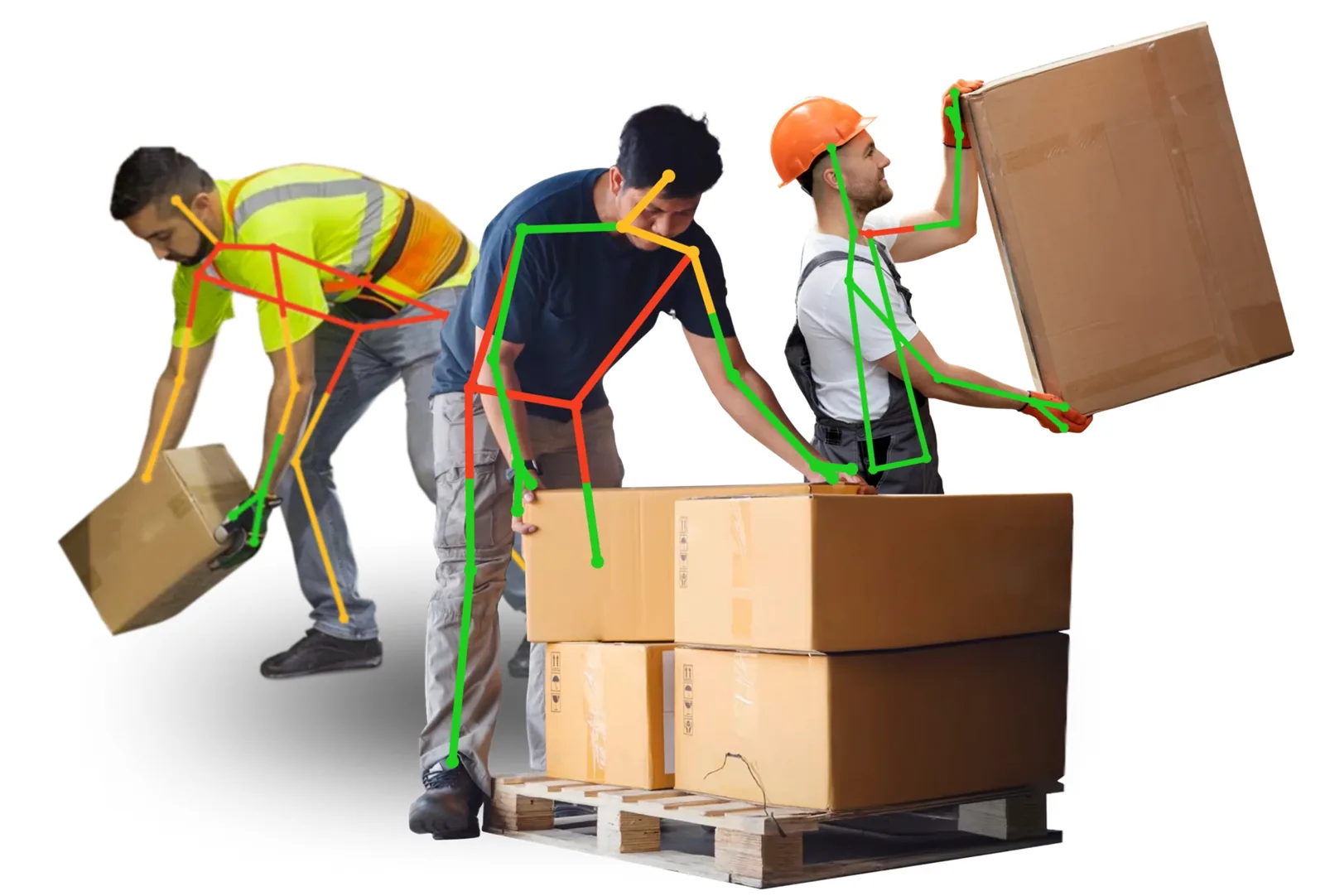
Repetitive bending exposes the lower back, particularly the L5-S1 lumbar disc, to sharp compressive forces that routinely exceed several thousand Newtons. When an operative hinges forward to grasp a carton, integrated elastic elastomers, carbon springs, or electric actuators engage. These mechanisms absorb kinetic energy during downward flexion and return that assistance during the upward concentric lift. By directly offloading the erector spinae muscles, the suit helps preserve a neutral spinal posture through hundreds of low-level pallet picking cycles each shift.
Target Workstations in Modern Intralogistics
Dynamic logistics facilities contain distinct handling profiles. Deploying exoskeletons for logistics produces the clearest safety and throughput benefits at high-frequency manual handling nodes:
- Inbound container destuffing: Manually unloading floor-loaded shipping containers involves hours of sustained bending and awkward reaches in confined spaces.
- Split-case mezzanine picking: High-density item picking requires continuous bending toward bottom bin locations across multi-tier pick towers.
- Trailer loading and parcel induction: Fast-paced sorting lines and cross-dock consolidation subject operatives to repetitive lifting of variable-weight parcels without room for static hoists.
Pinpointing these high-strain workstations ensures ergonomic interventions match actual physical demands rather than theoretical workflows.
Passive vs. Active Exoskeletons: Selecting the Correct Technology
Selecting between mechanical architectures requires balancing physical assistance against operational complexity. Neither passive nor active exoskeletons for logistics represent a universal fit; each chassis serves distinct handling profiles across the warehouse floor. Making the wrong choice introduces unnecessary equipment mass or administrative friction into your shifts.
Passive Mechanical Systems
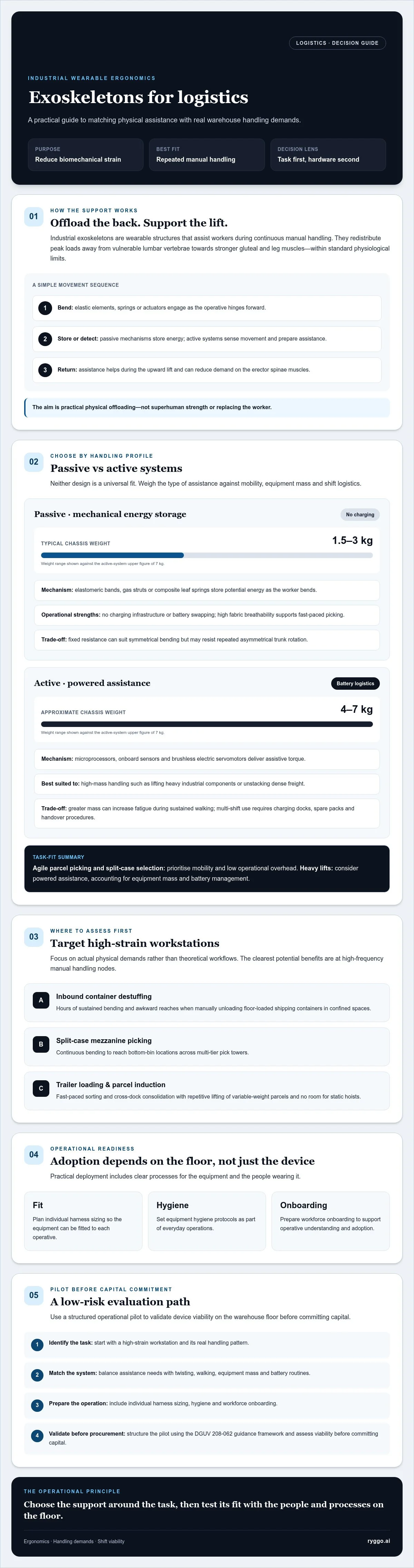
Passive exoskeletons rely on mechanical energy storage, using elastomeric bands, gas struts, or composite leaf springs. As an operative bends, the mechanism stretches, storing potential energy to assist the upward return lift. Their primary operational advantage is pure simplicity. Weighing typically between 1.5 kg and 3 kg, these harnesses demand zero charging infrastructure, eliminate battery swapping routines, and maintain high fabric breathability during fast-paced picking. However, their mechanical resistance profile remains fixed. While ideal for symmetrical sagittal bending, rigid passive designs can resist asymmetrical trunk rotation, creating noticeable physical resistance when workers twist repeatedly into deep pallet collars.
Active Motorised Systems
Active suits integrate microprocessors, onboard sensors, and brushless electric servomotors to deliver intelligent assistive torque. These systems actively detect movement velocity, injecting power precisely when spinal loads spike during heavy concentric lifts. They excel in high-mass manual material handling, such as lifting heavy industrial components or unstacking dense freight. Yet, motorised robotics introduce significant operational overhead. Chassis weight increases to roughly 4 kg to 7 kg, increasing worker fatigue if worn during sustained walking. Multi-shift operations also demand strict battery logistics, requiring centralised charging docks, spare power packs, and clear handover procedures between teams.
Task profiles dictate the hardware choice. Facilities focusing on fast, agile parcel picking and split-case selection achieve better adoption rates with lightweight passive frames. Conversely, dedicated palletising cells with consistent heavy payloads justify the weight and battery maintenance of active systems. To model how these mechanical trade-offs align with your specific material handling shifts, use our online device selection tool to map shift parameters against verified European hardware.
Ready to find the right device for your operation?
Find my exoskeleton →Operational Benefits: Ergonomic Protection and Workforce Productivity
Work-related musculoskeletal disorders (MSDs) remain the leading occupational health issue across the European Union, with approximately three out of five workers reporting chronic discomfort. In Germany alone, musculoskeletal conditions account for roughly €17.2 billion in lost production and €30.5 billion in lost gross value added annually. Broader estimates, including EU-OSHA citations, suggest the collective cost of work-related MSDs across European economies reaches up to €240 billion per year, though specific macroeconomic calculations vary depending on the reporting model. Evaluating exoskeletons for logistics is not about pursuing novel hardware; it is a calculated operational decision to curtail these severe financial and human losses.
Mitigating Musculoskeletal Disorder (MSD) Risks
Manual material handling inflicts cumulative micro-trauma on deep spinal tissues through repeated flexion and lifting cycles. Scientific evaluations show that wearable exoskeletons can reduce musculoskeletal loading by 10% to 50% for specific handling tasks, while long-term logistics studies have documented up to a 62% decrease in total strain and sprain injury rates. Offloading the lumbar spine protects workers from debilitating disc herniations, directly lowering occupational sick leave and associated agency staffing costs.
Sustaining Shift-Long Picking Performance
Physical exhaustion rarely occurs all at once. Instead, muscular fatigue degrades operational speed gradually, causing a noticeable throughput dip during the final two hours of an eight-hour shift. This late-shift exhaustion leads to specific operational issues:
- Throughput variability: Pickers slow down as back and leg muscles tire, creating bottlenecks at packing stations.
- Handling damage: Fatigued workers experience grip failure and compromised balance, resulting in dropped parcels and damaged stock.
- Elevated error rates: Physical exhaustion impairs cognitive focus, increasing mis-scans and incorrect parcel routing.
Maintaining consistent mechanical support across the working day stabilises hourly pick rates through to the end of the shift. Beyond throughput stability, mitigating daily exhaustion transforms workforce morale. In logistics markets facing chronic labour shortages, deploying effective exoskeletons for logistics serves as a strong recruitment and retention asset, proving to prospective operatives that the business prioritises health and safety over short-term physical exploitation.
Overcoming Shop-Floor Hurdles and Worker Adoption Resistance
Even the most advanced ergonomic hardware fails if workers leave it hanging in lockers. When introducing exoskeletons for logistics, operations leaders routinely encounter scepticism. Operatives worry about cumbersome equipment, restricted mobility in narrow racking aisles, excess body heat, and awkward interference with equipment like ride-on pallet trucks or order pickers. Addressing these practical floor hurdles early determines whether a deployment succeeds or stalls.
Fit, Sizing, and Thermal Management
Body proportions vary widely across any logistics team. Rigid frames that pinch or restrict natural movement cause immediate rejection. Selecting modular systems with quick-release adjustments accommodates diverse worker frames, ensuring proper support for both male and female staff. Thermal discomfort is equally critical, particularly on warm mezzanine levels during peak summer months. High-contact harnesses should feature perforated, moisture-wicking technical textiles rather than dense padding. For shared fleets, hygiene requires a strict protocol: assign personal washable textile liners to individual operatives while rotating the shared mechanical frames through regular sanitisation routines.
Structuring an Ergonomic Change-Management Rollout
Worker trust collapses if operatives suspect wearable robotics are being used to inflate shift quotas. Management must clearly establish that these suits serve strictly as ergonomic health and safety measures designed to prevent physical breakdown. Involve respected shop-floor handlers directly in preliminary trials, and implement a phased acclimatisation plan:
- Phase 1 (Week 1): Wear the suit for 60 to 90 minutes during high-frequency picking windows to adapt to the assistance mechanics.
- Phase 2 (Week 2): Expand wear time to four-hour blocks, verifying seamless clearance when stepping onto tuggers or driving reach trucks.
- Phase 3 (Week 3 onwards): Move to full-shift utilisation based on operative comfort and individual feedback.
This deliberate onboarding curve builds physical familiarity while proving that management respects operative comfort. If you want to benchmark worker-friendly systems suited to your warehouse workflows, explore vendor-neutral device recommendations to identify the right ergonomic fit for your floor teams.
How to Pilot and Procure Logistics Suits Without Risk
Committing capital to emerging warehouse technology without proof of performance creates unacceptable procurement risk. Traditional equipment sales force buyers into single-brand commitments before equipment is tested in live workflows. Procuring exoskeletons for logistics requires a phased, evidence-based approach aligned with the German DGUV 208-062 guidance framework, ensuring personal wearable solutions are validated only after technical and organisational workspace controls have been addressed.
Establishing Measurable Operational Pilot Benchmarks
Never hand equipment to workers without baseline metrics. Before testing begins, record two weeks of baseline shift data covering hourly handling volume, reported physical fatigue, and handling-related downtime. Establish clear pass-fail criteria before deploying any hardware. Measure success using daily shift checkout logs that record exact wear duration, task type, and user feedback. If operatives consistently return suits to storage racks after thirty minutes, the device fails the operational integration test regardless of manufacturer performance claims.
Deploying Structured Multi-Brand Trials
Objective hardware selection starts by assessing specific bodily postures. Logistics teams can utilise rapid video screening to generate automated RULA estimates; these serve strictly as preliminary screening indicators rather than certified ergonomic assessments, directing operations teams toward either upper-body or lumbar-support hardware architectures.
Rather than betting on a single vendor's marketing, operations leads across 23 European countries use Ryggo's neutral exchange. Cataloguing 14 industrial devices from 7 leading European manufacturers (and more to come) with zero paid listings, the platform enables direct, unbiased comparison. Procurement teams can then validate exoskeletons for logistics via structured Deploy & Decide trial programmes running for 2, 4, or 8 weeks. This model eliminates capital risk through guaranteed partial refunds if devices prove unsuited to your facility: 75% for 2 weeks, 70% for 4 weeks, and 60% for 8 weeks. When a device succeeds, 100% of the trial fee applies directly toward the final purchase price, ensuring zero double payment.
Operations and safety leaders can find the right device through Ryggo to access vendor-neutral evaluations and initiate structured warehouse trials with complete commercial clarity.
Not sure which exoskeleton fits your task? Let the Ryggo advisor match it independently.
Find my exoskeleton →Validating Wearable Ergonomics on Your Warehouse Floor
Targeted biomechanical offloading protects spinal health without compromising operational pace. Whether your facility benefits most from lightweight passive frames for high-frequency picking or motorised systems for dense cargo handling, successful integration hinges on task alignment and genuine worker adoption. Deploying exoskeletons for logistics shouldn't be a speculative gamble; it is an accountable operational investment in workforce stamina and injury prevention.
Ryggo simplifies this evaluation by offering independent matching across 14 devices from 7 leading European manufacturers (and more to come), completely free from paid vendor placements. By combining automated RULA screening estimates with transparent DGUV 208-062 alignment, operations leaders can systematically identify the right ergonomic fit. Through Deploy & Decide trial programmes offering up to a 75% refund if a unit proves unsuitable, you can test equipment under live shift conditions before committing capital. Take the next practical step: Find the right exoskeleton for your warehouse on Ryggo and secure long-term operational resilience.
Frequently Asked Questions
Can warehouse staff wear exoskeletons while driving forklifts or order pickers?
Yes, but compatibility depends on the specific harness structure. Low-profile passive suits allow operatives to sit comfortably in counterbalanced forklift seats without pushing the spine out of alignment. Bulkier active frames with rigid backplates can press against seat rests or snag cabin cages. Safety leads must evaluate whether hip hinges interfere with vehicle pedals during mounting and dismounting cycles.
How much physical lifting assistance do passive logistics suits provide?
Most commercial passive frames offload between 15 kg and 30 kg of equivalent spinal strain during forward bending. Rather than reducing the external mass of the parcel, elastic components redirect peak downward compressive forces into the thighs and glutes. This targeted support decreases lumbar muscle effort by 10% to 50%, providing critical fatigue relief across repetitive manual palletising tasks.
Do exoskeletons completely eliminate the risk of warehouse back injuries?
No wearable device eliminates injury risk entirely. Exoskeletons for logistics mitigate cumulative spinal compression, but they cannot neutralise dangerous dynamic forces caused by sudden twisting, slipping, or poor lifting technique. European workplace safety regulations position wearable exoskeletons as supplementary personal measures. They must follow technical hazard elimination, automated conveyor routing, and sensible load splitting rather than replacing proper manual handling practices.
What is the main difference between active and passive exoskeletons?
The mechanical power source forms the primary distinction. Passive suits utilise mechanical springs or elastic bands to store energy during downward motion and release it on the ascent. Active suits integrate battery-powered electric motors to generate dynamic assistive torque. While active systems provide higher lifting power for dense parcels, passive models remain significantly lighter and eliminate battery management routines during standard shifts.
How long does it take for warehouse operatives to adjust to wearing a suit?
Most operatives adapt to daily wear within two weeks of structured usage. Initial sessions should last 60 to 90 minutes so workers can get accustomed to the joint resistance and harness fit. By the second week, teams comfortably handle four-hour blocks. Full-shift adoption occurs once individuals master basic strap adjustments, movement transitions, and personal harness hygiene routines.
Do exoskeletons require complex daily charging and software maintenance?
Passive mechanical systems require zero electrical maintenance, charging infrastructure, or software updates. Maintenance involves basic textile cleaning, strap inspections, and spring checks. Active motorised suits, conversely, require dedicated operational protocols. Facilities running powered exoskeletons for logistics must establish charging docks, monitor daily battery cycles, and maintain hot-swappable battery packs to prevent device downtime across rotating shifts.
Can automated video tools provide certified ergonomic workplace assessments?
Automated motion tools provide rapid screening estimates, not certified ergonomic assessments. Video-based RULA scoring offers an objective, preliminary baseline to identify postural risk levels in picking cells or destuffing bays. However, they don't replace formal ergonomic audits. Certified safety professionals must still review physical shift factors, grip friction, and ambient conditions to formulate a complete risk assessment under local European regulations.
Find the right device before you trial anything
The Ryggo advisor maps your task, environment, and requirements to compatible devices — independently, across the full European market.
Find my exoskeleton →