Key Takeaways
- Learn how to get employee buy-in for exoskeletons by involving workers before equipment is selected, not after a purchasing decision is made.
- Use concerns about comfort, movement, privacy and work pace as practical input when deciding what to test.
- Define the task and trial questions in advance so workers can assess fit under real working conditions.
- Compare individual preferences with recurring feedback and operational observations before deciding whether a device is suitable.
- See how a task survey and vendor-neutral recommendation can help narrow options before a try-before-you-buy trial.
Table of Contents
- Why employee buy-in matters when introducing workplace exoskeletons
- How to address employee concerns about wearing exoskeletons
- How to involve workers in an exoskeleton trial
- How to assess employee acceptance before choosing an exoskeleton
- How Ryggo can support a worker-informed exoskeleton decision
Why employee buy-in matters when introducing workplace exoskeletons
An exoskeleton may seem relevant to a physically demanding task and still prove unsuitable in practice. Fit, comfort and compatibility with the work matter alongside the device’s intended function. A device that presses against the body, restricts a necessary movement or interrupts a routine may not suit the task, even if it looks appropriate on paper.
That’s why how to get employee buy-in for exoskeletons starts before procurement. Explain the work problem being assessed and invite employees to help evaluate a possible support measure. That is different from presenting a completed purchasing decision and asking staff to accept it. Exoskeletons should be considered as part of an ergonomics and health decision, not as a novelty or universal fix. DGUV Information 208-062 provides guidance for structuring device selection.

Affected workers should help shape the evaluation before purchase because they know where a device fits, interferes with the task or raises a practical concern.
What employees need to know before a trial
Describe the specific task under review and why an exoskeleton is being considered. Is the assessment about repeated overhead work, for example, or a particular lifting task? Clarify that the device is being evaluated for that activity. Don’t promise that it will prevent injuries or make every task safer. For background, a powered exoskeleton is one type of wearable assistance system; suitability depends on the task and working conditions.
Then make time for questions. Can the worker reach, turn and move through the usual work area? Does the device feel comfortable during the task? Could it affect workload or the usual workflow? Clear answers, including what the trial cannot establish, give workers a fair basis for sharing candid feedback.
Who should be involved in the decision
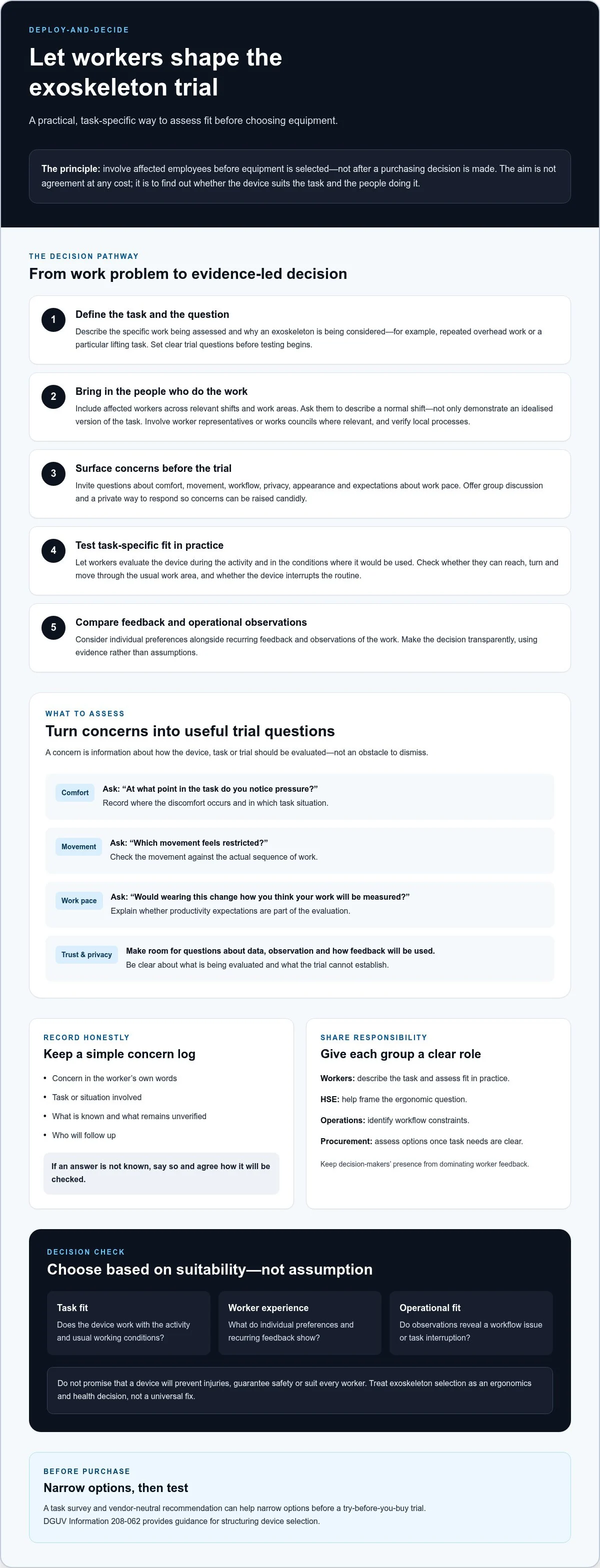
Involve the workers who perform the target task, including people from relevant shifts and work areas. One volunteer may not represent differences in task sequence, pace or working conditions. Ask participants to describe a normal shift, not just demonstrate an idealised version of the task.
Include HSE, operations and procurement, while making sure their presence doesn’t dominate worker feedback. HSE can help frame the ergonomic question, operations can identify workflow constraints, and procurement can assess options once task needs are clear. Involve worker representatives or works councils where relevant, and verify the applicable local processes. The decision is stronger when practical concerns are heard before a device is selected.
How to address employee concerns about wearing exoskeletons
Concerns aren’t obstacles to acceptance. They are information about how a device, task or trial should be evaluated. When a worker says, “It gets in the way,” ask which movement or situation they mean. Record the concern in their own words before suggesting an explanation or solution.
Offer more than one way to respond. A group discussion can reveal shared issues, while a private channel gives people room to raise discomfort, stigma or worries about job expectations without speaking in front of colleagues or managers. The U.S. Government Accountability Office’s report on employee concerns about wearables identifies factors such as ease of use and data privacy as relevant adoption challenges. Treat these as topics to investigate, not assumptions about what every worker thinks.
Listen for the concern behind the objection
Use neutral prompts: “Which movement feels restricted?” “At what point in the task do you notice pressure?” “Would wearing this change how you think your work will be measured?” The answers can help distinguish a fit issue from concerns about workload, appearance or trust. Don’t dismiss an objection as resistance, and don’t assume one person’s preference represents the whole task group.
Keep a simple record of the concern, the task or situation involved, what is known, what remains unverified and who will follow up. If you can’t answer a question during the discussion, say so and agree how it will be checked. “We’ll confirm this” is more credible than an unsupported assurance.
Build trust through clear communication
Before a trial, explain its purpose, scope and decision process. Be clear about what is being evaluated and what the trial cannot prove. Don’t claim a device guarantees safety or prevents injury, or that it will suit every worker. Address concerns about increased work pace directly. Explain whether productivity expectations are part of the evaluation, and don’t leave employees guessing about how observations will be used.
Separate verified device information from assumptions. Share confirmed details about use and handling, then assign unanswered questions to a person or team for follow-up. If using video-based screening, explain the process in advance, including that uploaded videos are deleted after analysis. Describe RULA results only as automated screening estimates, not a certified assessment. They don’t replace professional ergonomic consultancy.
Clear answers won’t resolve every concern immediately, but they give workers a fair basis for deciding whether to take part. For a vendor-neutral starting point, review Ryggo’s exoskeleton matching alongside the questions your team wants answered.
Ready to find the right device for your operation?
Find my exoskeleton →How to involve workers in an exoskeleton trial
A useful trial starts with a defined task, not a device demonstration. Select an activity where physical demands have been identified, then describe the conditions that could affect fit: task sequence, work area, typical movements and interruptions. Use DGUV Information 208-062 as selection guidance, and keep the evaluation focused on whether a candidate device suits the task in practice.
Set a worker-informed trial plan
Before testing, ask participants which movements or conditions they want the trial to examine. For repeated reaching, for example, they may want to assess overhead movement, transitions between work positions and whether the device interferes with nearby tools or colleagues. Agree how participants can raise concerns during the trial, who will respond and how feedback will be recorded.
Include vendor-provided onboarding and training in the preparation. Workers need to understand how to use the device as intended before judging its comfort or compatibility. Explain what the trial can and cannot establish, and confirm that negative feedback can lead to a decision to change or stop testing.
Collect useful feedback during real tasks
Test in representative working conditions rather than relying on a brief demonstration. Invite workers to comment on comfort, freedom of movement, compatibility with the task and whether they would choose to use the device for that work. Record observations close to the task, including when an issue occurs and which movement or workflow step is involved.
Compare those comments with the task and posture information gathered beforehand. If workers report interference during a particular reach, check whether that movement is essential, occasional or avoidable in the normal workflow. Keep fitting and quantitative pilot measures proportionate to the question being assessed. They shouldn’t displace worker feedback or turn the trial into a scorecard.
Use any screening result as one input, not a complete ergonomic assessment. It can help frame the task, but it can’t establish on its own whether a device is suitable for every worker or condition. A structured, worker-informed trial makes how to get employee buy-in for exoskeletons a practical evaluation process: define what matters, test it in context and let evidence guide the next decision.
How to assess employee acceptance before choosing an exoskeleton
After testing, assess more than whether participants liked wearing the device. Ask whether it supported the target movement without disrupting essential work, what felt uncomfortable, inconvenient or unclear under normal conditions, and whether they would choose to use it for that task again. Ask why. A specific reason, such as difficulty reaching a tool or pressure during a repeated movement, is more useful than a simple yes or no.
Acceptance evidence should connect worker experience to the actual task. Compare feedback with the requirements agreed before testing and observations of how the task was performed. Keep personal preferences distinct from recurring concerns across the task group. A concern raised by one person still matters, but record it as an individual experience rather than presenting it as a shared view.
| Evidence | What to assess | What to record |
|---|---|---|
| Worker feedback | Comfort, movement, clarity and willingness to use the device again | Individual views, reasons and recurring themes |
| Task fit | Whether the device supports the intended movement and suits the task conditions | Requirements met, limitations and any adaptation considered |
| Operational observations | Effects on normal workflow and essential work steps | Observed interruptions, constraints and unresolved questions |
Turn feedback into a transparent decision
Summarise positive, mixed and negative responses without hiding minority concerns. For each unresolved issue, note what remains uncertain, who will follow up and whether further testing or professional ergonomic input is needed. If an adaptation is considered, record what would change and check that it addresses the concern without creating another task problem.
Compare the evidence with the agreed task requirements and operational constraints. A device may be acceptable to some workers but unsuitable for an essential movement or work condition. If it is rejected, record why. That helps prevent the same mismatch from shaping another selection. No single score should replace worker feedback or professional ergonomics input. Screening results can inform the discussion, but they aren’t a complete assessment.
This is how to get employee buy-in for exoskeletons without turning acceptance into a pass-or-fail vote: make the decision traceable, explain how concerns were weighed and share the outcome with participants. To compare options on task fit before purchase, explore vendor-neutral exoskeleton matching.
How Ryggo can support a worker-informed exoskeleton decision
Worker feedback should shape the decision before a device is purchased. Once the target task and practical concerns are clear, an independent matching process can help narrow the options without relying on a single supplier’s catalogue. Ryggo combines workplace task information with a vendor-neutral recommendation, giving teams a starting point for discussion and, if appropriate, a trial in their own operation.
Use independent matching to narrow the options
The process starts with a free, unlimited upload of a 30-second workplace video and a short survey about loads, movements and the work environment. The survey is mapped to the DGUV 208-062 selection framework. Steps one to three of matching take about 10 minutes. The result is one neutral recommendation based solely on fit across vendors. Paid listings are not accepted. Its rationale relates to the task information provided, so the team can assess whether the suggested device addresses the work being evaluated.
Ryggo’s catalogue includes passive, active and soft-suit technologies for different body regions. That range supports comparison, but it doesn’t mean one device will suit every task or worker. Video-based RULA results are automated screening estimates, not certified assessments. They don’t replace professional ergonomic consultancy. Screening can inform the selection question, while worker feedback and task-specific evaluation remain essential.
Make the next step low-friction
After reviewing the recommendation, teams can decide whether further evaluation makes sense. Optional Deploy & Decide trials of selected devices are available for 2, 4 or 8 weeks, allowing workers to assess a device in the actual operation before purchase. The trial fee counts fully toward the eventual purchase, so no double payment is required. If a trial is unsuccessful, the refund is up to 75% for a 2-week trial, 70% for a 4-week trial or 60% for an 8-week trial. Use the trial to check the task-specific concerns workers identified, rather than treating a recommendation as a final decision.
That sequence supports how to get employee buy-in for exoskeletons: involve workers in defining the task, use independent matching to identify a relevant option, then let practical feedback inform the purchase decision. Review the Ryggo exoskeleton advisor once your team has defined its target task and the questions it wants a trial to answer.
Explore a worker-informed exoskeleton match to consider a vendor-neutral recommendation and whether a try-before-you-buy trial is the right next step.
Not sure which exoskeleton fits your task? Let the Ryggo advisor match it independently.
Find my exoskeleton →Make the next decision with workers, not for them
Employee acceptance grows through practical involvement: define the task, invite workers to identify what matters, and assess their feedback alongside task fit and operational observations. That’s the foundation for how to get employee buy-in for exoskeletons. A trial should help establish whether a selected device works for the people and the task, not confirm a decision already made.
Independent matching can help narrow the options. Ryggo’s recommendations are based solely on fit across vendors, and paid listings are not accepted. Optional Deploy & Decide trials let teams test selected devices in their own operation before purchasing. The trial fee counts fully toward the eventual purchase, with no double payment required.
Choose a clear next step: explore a worker-informed exoskeleton match once you’ve defined the task and the questions your team needs answered. With workers involved and evidence guiding the decision, you can move forward with greater clarity.
Frequently asked questions
How do you get employees to accept an exoskeleton at work?
Involve affected workers before choosing a device, and focus the evaluation on a clearly defined task. Explain why an exoskeleton is being considered, invite questions and agree what workers will assess during testing. To understand how to get employee buy-in for exoskeletons, treat feedback as evidence for the decision, not as approval to collect after procurement. Share what the trial showed and how concerns influenced the outcome.
Why might employees resist wearing an exoskeleton?
Workers may be concerned about discomfort, pressure points, restricted movement or interference with their normal workflow. They may also feel self-conscious, question how workplace video or feedback will be used, or worry that equipment intended to support a task could lead to faster work expectations. Ask which movement or situation concerns them. The answer can reveal a practical fit issue or a question about trust that needs addressing.
Should employees help choose an exoskeleton?
Yes. Workers who perform the task can identify movements, work conditions and interruptions that may not be obvious from a product description. Involve them in defining what a suitable device must do, then ask them to assess task fit during practical testing. HSE, operations and procurement also have useful roles, but they shouldn’t override worker feedback. Include relevant worker representatives or works councils, and check local processes.
Can workers try an exoskeleton before a company buys it?
Yes. Ryggo offers optional Deploy & Decide trials of selected devices in the company’s own operation, with trial periods of 2, 4 or 8 weeks. Workers can evaluate the device in the task and conditions it is intended to support before a purchase decision. The trial fee counts fully toward the eventual purchase, so no double payment is required.
How do you address employee concerns about exoskeletons?
Listen first. Ask employees to explain which movement, task or situation concerns them, and offer private as well as group ways to give feedback. Record concerns in workers’ own words, separate confirmed device information from assumptions, and assign unanswered questions for follow-up. Explain the trial’s purpose and limits, including how any screening works. Don’t promise that a device will prevent injuries or suit every worker.
What should employees evaluate during an exoskeleton trial?
Ask workers whether the device supports the target movement without disrupting essential work. They should also note comfort, freedom of movement, task compatibility, anything inconvenient or unclear, and whether they would choose to use it for that task again. Record when concerns arise and compare them with the task conditions agreed before testing. Worker observations are important evidence, not a substitute for professional ergonomic input.
Are RULA scores from Ryggo certified ergonomic assessments?
No. RULA results from Ryggo are automated screening estimates, not certified assessments. They can inform an initial consideration of the task, but they don’t establish by themselves that a device is suitable or replace professional ergonomic consultancy. Treat the estimate as one input alongside task details, worker feedback and operational observations. If a formal ergonomic assessment is needed, consult an appropriately qualified professional.
Find the right device before you trial anything
The Ryggo advisor maps your task, environment, and requirements to compatible devices — independently, across the full European market.
Find my exoskeleton →