Key Takeaways
- Map the repeated movements in masonry work to the body areas that need support before comparing devices.
- Assess whether adjustable support and power settings suit the task, rather than assuming more assistance is always better.
- Compare active and passive designs against the worksite’s movement demands and practical operating conditions.
- Weigh assistance against device weight, then check fit and height adjustment during representative tasks.
- Use a workplace trial to judge comfort and task compatibility before making a purchase decision.
Table of Contents
- Adjustable support zones and power levels
- Back pain and musculoskeletal disorders
- Differences between active and passive exoskeletons
- Exoskeleton weight and assistance force
- Fit and height adjustment
- Ryggo: Trial programmes for exoskeletons (called Deploy & Decide)
Adjustable support zones and power levels
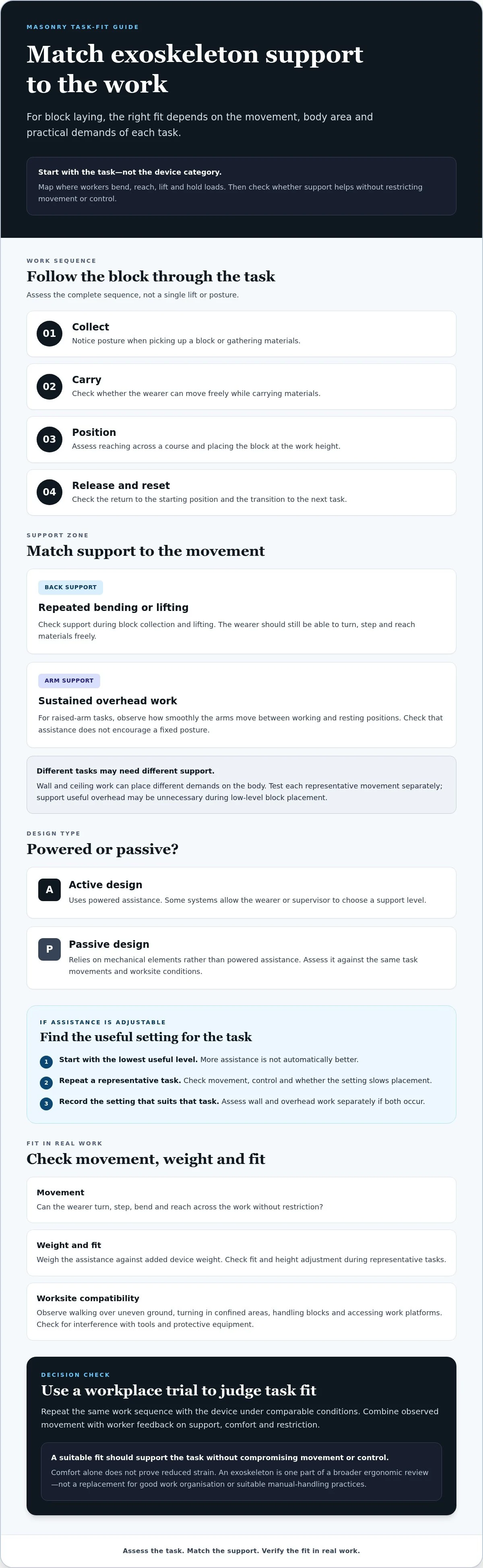
Map the task before choosing a device category. A mason laying blocks at waist height makes different movements from a worker applying mortar overhead. Note where workers bend, reach, lift, and hold loads, then match the support zone to the movements creating the greatest physical demand.
A back-support exoskeleton may assist with repeated forward bending or lifting during block laying. Its value depends on whether the worker can still turn, step, and reach materials freely. Check the support while carrying and placing a block, then returning to the starting position. If it interferes with any part of that sequence, it may not suit the task.

Overhead work needs a different assessment. Arm support may assist workers holding tools or materials above shoulder level, such as during ceiling installation. Observe how smoothly the arms move between working and resting positions. Check that the assistance suits the task rather than encouraging a fixed posture.
Powered systems can provide adjustable assistance, and some let the wearer or supervisor choose a support level. Treat each setting as a task-specific adjustment, not a measure of how much help is always best. Start with the lowest useful level, then assess whether it supports movement without slowing placement or limiting control. Record which setting suits each representative task.
Wall and ceiling work may alternate during a shift. Laying a wall can involve reaching across a course, while ceiling work may keep the arms raised for longer. Test these movements separately. Support that suits overhead work may be unnecessary during low-level block placement, while a back-focused design may not address sustained arm elevation.
On a US construction site, applicable OSHA requirements depend on the work and its hazards. Assess compatibility with site procedures, personal protective equipment, access routes, and emergency removal before introducing a device. An exoskeleton should fit within existing controls, not replace them.
Purchase and rental costs depend on the support zone, powered or passive design, adjustment needs, and the terms offered. Compare the total cost with the tasks and period of use, rather than relying on a single device price. A trial during representative masonry work can show whether the assistance suits the site before a purchase decision.
Possible drawbacks on construction sites include restricted movement, poor fit, added weight, and interference with tools or protective equipment. Check for these issues during real work: walking over uneven ground, turning in confined areas, handling blocks, and accessing work platforms. Stop if the device affects balance, control, or safe movement, then reassess its fit and conditions of use.
Back pain and musculoskeletal disorders
Masonry work can combine repeated bending, carrying, reaching, and twisting in one task cycle. A block layer might collect a unit near ground level, carry it to a wall, then position it with both hands. Each movement places different demands on the body. Assess the actual sequence before deciding whether an exoskeleton could support the work.
Back pain and musculoskeletal disorders can have multiple contributing factors, so don’t attribute them to one task or device alone. For a masonry crew, note when discomfort is reported and what activity was underway. Record whether workers were handling blocks, applying mortar, or reaching across a wall. These observations help focus an ergonomic review on the demands of the work.
An exoskeleton may support selected movements, but its category alone doesn’t show whether it will help. A back-support design targets different movements from an arm-support design. Compare the intended use with the task: repeated forward bending to collect materials differs from sustained arm elevation during overhead work.
Map the work in observable stages. For block laying, note the worker’s posture when collecting, carrying, positioning, and releasing a block. For overhead installation, observe arm position while applying mortar or using a tool. Record where workers pause, change posture, or reposition materials. The task map helps distinguish back demands from shoulder and arm demands.
Evaluate the device during the same task sequence. Observe whether the assistance matches the movement and whether the wearer can turn, step, and reach. Ask workers where they feel support, discomfort, or restriction. Keep feedback specific, such as difficulty reaching across a course or pressure when bending to collect materials.
A useful review covers the work setting, not just a demonstration. Observe block handling at the actual work height and include transitions between low and raised positions. Note where materials and tools are placed, as these locations affect how often workers bend or reach. Compare observations across the task rather than relying on a single lift or posture.
Use a consistent assessment process: document the task, introduce the device, then repeat the same work sequence. Keep conditions comparable and record worker feedback alongside visible movement. Comfort alone does not prove reduced strain. Consider whether workers can maintain control, complete the task, and move freely through each stage.
Include exoskeletons within a broader ergonomic review. Consider how task organisation, material placement, and handling methods affect the work before and during device evaluation. For a masonry team, combine worker observations with the task map and feedback. This gives decision-makers a practical basis for deciding whether further device testing is appropriate.
Differences between active and passive exoskeletons
Active and passive designs support movement in different ways. An active exoskeleton uses powered assistance; a passive design relies on mechanical elements without powered actuation. For a bricklayer, the practical choice depends on the movement needing support, the task cycle, and site conditions. Compare designs during the same representative work, such as placing blocks along a wall.
Active assistance may suit tasks that need controlled support through changing movements. For example, arm support could assist with overhead installation, when a worker raises and positions a tool. Assess how the device responds as the arms move between working and resting positions. Also consider power requirements, charging arrangements, and operating limits for the worksite.
Passive support relies on mechanical design rather than powered assistance. A back-support model may assist during repeated bending and return movements, such as picking up materials and standing to place them. It may be simpler to manage during a shift, but its support still depends on the wearer’s posture and the device’s fit. Check whether its structure restricts turning, walking, or reaching.
Neither category is automatically better for construction. A powered device may offer adjustable assistance, but its components and operating requirements must suit the site routine. A passive device avoids powered assistance, yet may still add bulk or affect movement. For outdoor masonry, include uneven ground, changing work positions, and tool handling in the evaluation.
Compare devices across three aspects of the task: the movement creating demand, how long support is needed, and transitions between actions. A mason might bend to collect a block, carry it, then rotate to position it. An overhead installer may hold a tool raised, lower it, then move along the wall. These different cycles can favour different types of support.
- Match the movement: identify whether the primary task involves bending, lifting, or sustained arm elevation.
- Check transitions: observe walking, turning, reaching, and moving between working heights.
- Assess site conditions: review the manufacturer’s operating guidance for the work environment.
- Record worker feedback: note comfort, restricted movements, and interruptions during the task.
Test shortlisted designs during representative work before deciding. Compare the same task sequence with and without assistance, and record whether workers maintain control and complete each movement. A powered or passive exoskeleton should support the intended activity without creating a new obstacle. Choose based on the task, not the device category alone.
Ready to find the right device for your operation?
Exoskeleton weight and assistance force
For masonry, assess device weight and support together during actual handling tasks. A lighter design is not automatically better if its assistance misses the movement.
Exoskeleton Weight
A mason carries a device’s weight throughout the shift, including when walking between a pallet and a wall. Check where its mass rests, whether it shifts during bending, and whether straps or frames interfere with tool belts. During an assessment, ask workers to carry blocks, turn, kneel if needed, and reach across a course. Note pressure points and restrictions on movement.
Compare the device across the full work sequence, not only in a stationary demonstration. A worker might collect a block, walk over uneven ground, then place it at shoulder height. Observe whether the exoskeleton stays stable through each transition. Include protective clothing and tools, which can change how the device sits and moves on the wearer.
Assistance for Lifting and Placing Blocks
An exoskeleton may support the wearer’s body or limbs during part of a lift; it does not lift a block independently. Back support may assist with a bending movement, while arm support may help during a raised placement. The assistance depends on the device design and movement. Assess control while lifting, carrying, rotating, and positioning the block.
Break a block-handling cycle into observable stages to assess assistance. Watch the worker reach down, secure the block, rise, carry it, and place it. Note where the device provides support and whether that support continues through movement. If assistance pulls against the task or restricts precise placement, the device may not suit the operation.
Don’t select a device based only on its stated assistance force. Consider how force is delivered through the worker’s movement and whether it matches the task’s load path. A mason placing a block forward may need different support from someone lifting mortar overhead. Compare the device’s operating guidance with the work being assessed.
Use a consistent comparison. Have the same worker perform the same representative task with each shortlisted design and the usual work setup. Record the block-handling steps, perceived effort, movement limits, and any need to adjust the device. These observations help distinguish useful assistance from support that feels strong but disrupts the task.
Include transitions and recovery movements in the assessment. After placing a block, a mason may turn, step back, or reach for mortar. Check whether the device allows these actions without catching on clothing or tools. Pair worker feedback with observed task performance and the device’s operating instructions before deciding.
Fit and height adjustment
Fit affects how support transfers through the body during work. Check adjustments while wearing the clothing and protective equipment used on site.
Start with the manufacturer’s fitting instructions, then adjust the frame, straps, and contact points for the wearer. A mason should be able to bend, turn, reach, and walk without the device shifting or pinching. Check that support stays in its intended position during movement, not just while standing still.
Height adjustment matters when workers with different body proportions share a device. Set it for each wearer instead of relying on the previous user’s settings. A frame adjusted for one block layer, for instance, may sit too high or low on another, changing its contact points and movement. Record each wearer’s settings when the device is shared.
Next, test the fit through a representative work sequence. Have the wearer collect a block, carry it, place it, and reach for mortar. Observe whether the device moves with the wearer or pulls against the body. Repeat the sequence at the site’s working height: a fit that feels comfortable while upright may restrict bending or reaching.
Clothing can affect fit. Test the device with the jacket, gloves, tool belt, and other protective equipment worn during the task. Look for straps caught under equipment, pressure where the frame contacts the body, and interference when reaching across a wall. For outdoor work, include the layers worn in the relevant conditions.
Fit checks should cover movement, not just comfort at rest. Ask the wearer to step, turn, crouch, and access the work area. Check that fasteners stay secure and that the device can be removed without disrupting the task. If adjustments cannot provide stable contact without restricting movement, reassess the model or its suitability for the wearer.
- Before work: follow the fitting instructions and set adjustments for the individual wearer.
- During work: inspect movement and contact points through the normal task sequence.
- After adjustment: repeat the same movements and note any pressure, slippage, or restriction.
For a construction team, include several intended wearers in the evaluation. One person’s fit does not establish fit for the rest of the crew. Capture feedback alongside observed movement, then use the results to guide selection and workplace testing. A task-based exoskeleton recommendation can help narrow options around the work and wearer requirements.
Not sure which exoskeleton fits your task? Let the Ryggo advisor match it independently.
Ryggo: Trial programmes for exoskeletons (called Deploy & Decide)
Ryggo helps construction teams move from task assessment to a practical device decision. Its AI-driven recommendation matches workplaces with exoskeletons based on fit, and its vendor-neutral comparison considers work requirements. For masonry teams, the Deploy & Decide programme offers a trial in their own operation before purchase.
Use a trial to evaluate the factors covered here: movement during block handling, comfort across the work sequence, and compatibility with site conditions. Ryggo’s ROI calculation can also inform a purchase decision. This approach is useful when a shortlist looks suitable on paper but workers need to assess devices in practice.
To explore a trial or discuss exoskeleton options for your construction tasks, visit ryggo.ai.
Turn task observations into a site decision
Make the next step a focused evaluation, not a broad equipment rollout. Choose a representative masonry task, involve the workers who perform it, and agree what the team needs to learn: whether the support suits the movement, fits with site clothing, and allows work to continue without obstruction. Record these criteria before comparing options, so feedback can guide a clear decision.
An exoskeleton for masonry and block laying should be judged against the real demands of your site, not its description alone. Use worker observations and task requirements to decide whether further testing is worthwhile. If the team is ready to explore options for construction work, contact Ryggo about construction exoskeletons.
A practical, evidence-led evaluation gives your team a sounder basis for deciding what belongs on site. Start with the task, listen to the people doing it, and let the results guide your next move.
Frequently asked questions
What exoskeletons are available for masonry and concrete block laying?
Options for an exoskeleton for masonry and block laying include passive back-support designs, powered exoskeletons, and soft-suit systems. Some support the back, while others target the shoulders or arms. The right category depends on whether the main demands are bending to collect blocks, carrying them, or holding tools overhead. For mixed duties, compare support zones against the full shift instead of choosing by trade label alone.
Are exoskeletons effective for repetitive overhead masonry tasks?
An arm-support exoskeleton may assist with repeated raised-arm work, such as applying mortar overhead or installing a ceiling. Its usefulness depends on whether the assistance matches the worker’s movements and allows accurate tool control. Assess the full task, including sideways reaches and lowering the arms between actions. Worker comfort and control matter alongside perceived effort, so evaluate the device in its intended working conditions.
How do you choose and fit an exoskeleton for masonry work?
Choose an exoskeleton for masonry and block laying by matching its support zone to the task’s main physical demand, then fitting it to each wearer. Follow the manufacturer’s instructions and check compatibility with protective clothing, gloves, and tool belts. Assess fit separately for every worker who will use the device, recording their adjustments. Before a trial, set practical criteria such as comfortable movement, tool control, and suitability across assigned tasks.
Are there masonry exoskeleton trials, reviews, or case studies from construction sites?
Ryggo’s Deploy & Decide programme lets companies trial exoskeletons in their own operations before purchasing. A site trial shows how a device performs during specific tasks and within the team’s clothing requirements and work routines. Treat reviews or case studies from other settings as context, not proof of the same result on your site. Record worker feedback and task observations during the trial to support a well-grounded decision.
Find the right device before you trial anything
The Ryggo advisor maps your task, environment, and requirements to compatible devices — independently, across the full European market.