Key takeaways
- Match support to the physical task, not the job title: overhead work, repeated lifting and prolonged awkward postures call for different considerations.
- Assess which body area needs support and whether the device allows workers to move naturally through the full task cycle.
- Check compatibility with hand-held tools, work surfaces and the movements required on site before selecting a device.
- Include workers’ comfort and individual needs in the assessment, especially when pain or a return after absence is involved.
- Use a vendor-neutral recommendation and a trial to evaluate whether an exoskeleton supports ergonomics in the real workplace.
Table of contents
- Construction work involving overhead tasks and awkward postures
- Which jobs can benefit from a professional exoskeleton?
- Matching back support to logistics, manufacturing, and trade
- Freedom of movement and compatibility with hand-held tools
- Suitability for workers with pain or returning after absence
- Ryggo: healthcare exoskeleton matching
Construction work involving overhead tasks and awkward postures
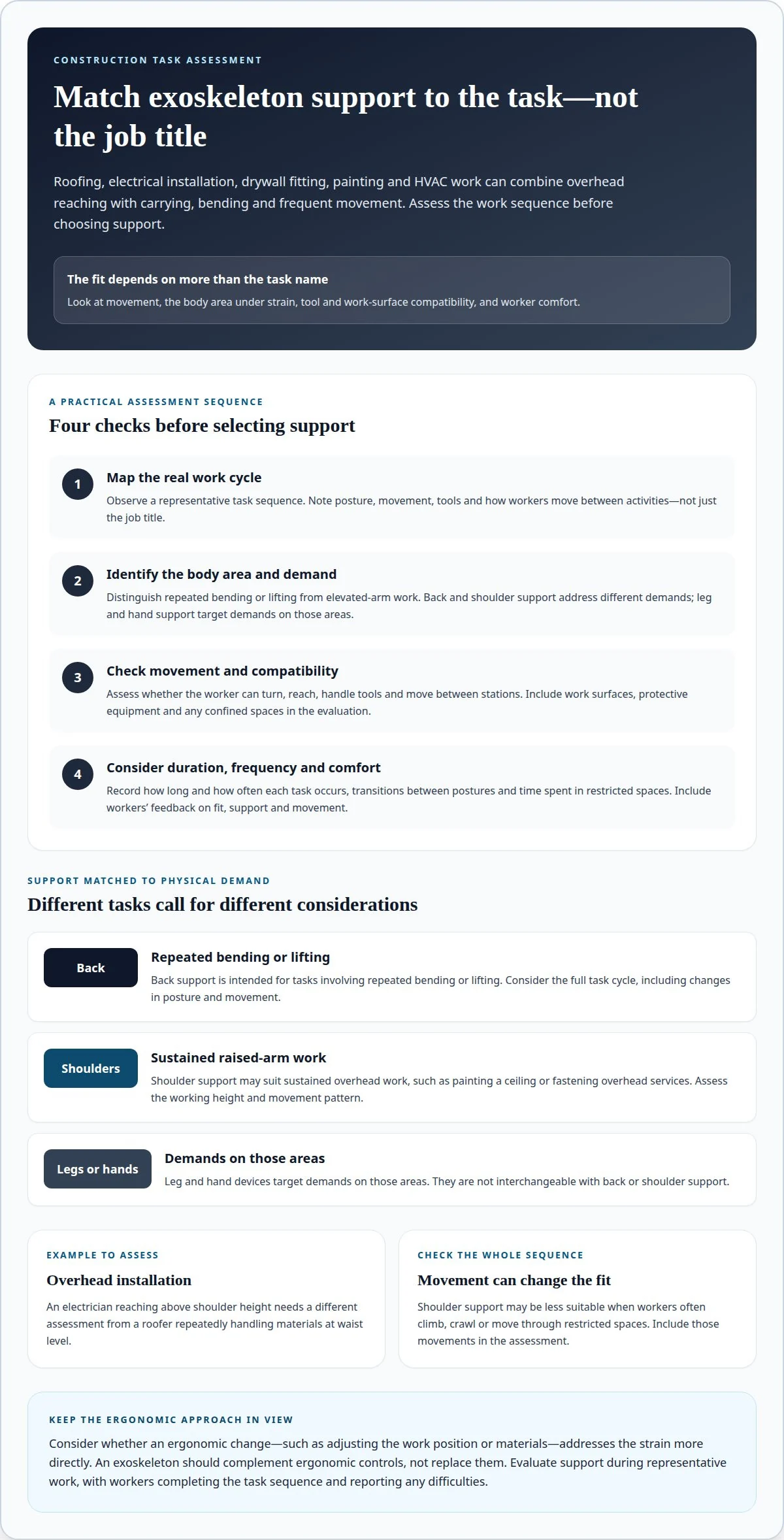
Roofing, electrical installation, drywall fitting, painting, and HVAC work can combine overhead reaching with carrying, bending, and frequent movement. Strain depends on the tasks workers repeat, not simply their construction job title. Shoulder support may suit work with sustained raised arms, such as painting a ceiling or fastening overhead services. It may be less suitable when workers often climb, crawl, or move through restricted spaces. Assess the actual work sequence before selecting support.
Exoskeletons offer different kinds of support, including back, shoulder, leg, and hand support. Back support is intended for tasks involving repeated bending or lifting; shoulder support addresses elevated-arm work, while leg and hand devices target demands on those areas. These functions are not interchangeable. An electrician reaching above shoulder height, for example, needs a different assessment from a roofer repeatedly handling materials at waist level.

How do you match an exoskeleton to specific job tasks and ergonomic risks? Map the task, posture, movement, tools, and duration, then identify the body area under strain. Observe a representative work cycle: an HVAC technician might alternate between overhead fitting, walking, and working in a confined space. Consider whether an ergonomic change, such as adjusting the work position or materials, addresses the strain more directly. An exoskeleton should complement ergonomic controls, not replace them.
Shoulder support should suit the working height and movement pattern. Sustained overhead work differs from chest-height installation, where workers may reach forward without raising their arms as much. Assess whether the device lets the worker turn, reach, handle tools, and move between stations. Include actual tools and protective equipment in the evaluation, since contact or restricted movement can make a theoretically suitable device impractical.
Task duration matters. A maintenance technician working overhead for several hours in a row has a different exposure pattern from someone doing brief overhead tasks between other duties. Assess how long and how often each task occurs, transitions between postures, and time spent in confined spaces. Trial a device during representative work, not just a brief demonstration. Workers should complete the task sequence and report any difficulties with support, fit, or movement.
How much do workplace exoskeletons cost, and what are typical maintenance costs? Costs vary by device, support function, and the manufacturer’s service arrangements, so there is no single typical figure. Compare the full cost and maintenance requirements of a selected device with the task and expected use, rather than choosing by purchase price alone.
Which jobs can benefit from a professional exoskeleton?
Job titles are only a starting point: suitability depends on each task’s physical demands. Look for repeated handling, sustained postures, or awkward movements, then assess whether support addresses the strain.
Identifying physically demanding job tasks
A physically demanding task repeatedly loads the body through manual handling, awkward postures, or sustained effort. For a warehouse picker, that might mean repeated bending and lifting; for a production worker, holding the arms raised during assembly. Identify the movement, duration, and body area involved. This keeps the assessment relevant to the work instead of assuming everyone in one role needs support.
Include repetitive and elevated-arm tasks in the same review. A worker inspecting products at a bench may hold one posture, while a painter holds both arms overhead. These patterns create different demands and may call for different ergonomic responses. Examine the work area, too: changing a workstation or handling process may address the task more directly than adding a wearable device.
Matching support types to work demands
The type of support should match the body area and movement involved. Back support may suit repeated bending and lifting; shoulder support is intended for elevated-arm work. Leg or hand support addresses different demands. This distinction matters because a device designed to support one movement may not suit a task that requires another.
Industrial exoskeletons can be passive or powered, and rigid or soft. Compare devices against the task pattern and required movement, rather than assuming one type fits a job category.
Repetitive work occurs in manufacturing, logistics, and quality assurance. An inspector, for example, may repeatedly reach, turn, and handle items along a line. Assess a device only against the physical demands of the task, such as sustained standing or repeated handling.
Exoskeletons are intended to reduce physical strain, but that intent alone does not establish that workplace injuries will decrease. Evaluate a device against the actual task, including worker comfort, freedom of movement, and whether the work can be completed as usual. A trial can reveal practical fit and changes in perceived strain; it should not be treated as proof that injuries will fall.
Limitations matter, too. A device may restrict movement, feel uncomfortable, or support a body area that is not the main source of strain. Workplace exoskeletons do not replace workers’ muscles or safe work practices. If a task involves frequent transitions between walking, reaching, and handling, assess the entire work cycle before selecting support.
Matching back support to logistics, manufacturing, and trade
Back-support exoskeletons may suit tasks involving frequent bending and lifting. Match a device to the movement pattern and work setting, not the job title alone. A warehouse picker handling goods from low shelves, a manufacturing operator moving components, and a tradesperson carrying materials may all bend, but their task cycles and movement needs differ.
Back support across workplace tasks
In logistics, a picker may repeatedly bend to handle goods at different shelf heights. In manufacturing, an operator may lift components between a container and a work surface. Tradespeople may handle materials while changing positions. Because these tasks have different cycles, assess where the lower back is loaded and how bending and lifting occur.
A targeted assessment follows each movement from start to finish. Record whether the worker bends, twists, carries, or changes position, and note how the load is handled. Then consider whether back support suits that pattern without obstructing walking, reaching, or access to materials. An exoskeleton complements ergonomic controls; it does not make a load safe to lift beyond safe limits.
Compare the device during the actual task, with normal work clothing and tools. A warehouse worker moving between shelves may need more freedom of movement than a manufacturing operator stationed at a workbench. If the task includes frequent transitions, check whether the device remains practical throughout the cycle, not only during lifting.
Pilot testing and implementation support
A pilot tests whether a selected device fits the work process before a wider purchasing decision. Include workers who regularly perform the target task, and assess normal handling, movement, and comfort. If workers perform different versions of the task, include those variations so the evaluation reflects the workplace rather than a single demonstration.
Define assessment criteria before the pilot begins. Record whether workers can complete the usual lifting sequence, reach required materials, and move between stations. Gather feedback on fit and comfort alongside observations of task performance. Use the findings to decide whether the device supports the intended ergonomic goal or whether the work process needs a different adjustment.
Implementation also requires clear arrangements for fitting, training, and support. Device vendors provide onboarding, training, and service. Set out who will coordinate the pilot, how workers will report fit issues, and how the team will review the results. This makes the decision traceable and ties it to the target task, rather than a general assumption about back support.
Ready to find the right device for your operation?
Freedom of movement and compatibility with hand-held tools
A device that supports one posture can still disrupt the task around it. Assess the full work cycle, including reaching, turning, walking, and tool handling, before deciding whether an exoskeleton fits the workplace. An assembly worker, for example, may benefit from support during one repeated movement but need unrestricted shoulder and arm movement to fasten components.
Start with the exact tool and work position. A technician using a drill overhead needs to raise and position both arms, while a worker tightening fixings at chest height needs precise control close to the body. Observe how the worker grips, changes hands, reaches for materials, and sets the tool down. Check whether the device shifts, catches, or presses against the tool, clothing, or surrounding surfaces.
Use a structured task review rather than relying on a brief fitting:
- Record the movements required for one complete work cycle, such as picking up a component, fastening it and placing it on a bench.
- Check movement in each relevant direction, including bending, twisting, reaching and walking between workstations.
- Repeat the task with the normal hand-held tool, work clothing and protective equipment.
- Ask the worker to identify restricted movements, pressure points or changes in grip and control.
These steps help distinguish useful support from interference. An exoskeleton works alongside the user’s muscles; it does not replace them. Assess whether the support lets the worker control a tool safely and consistently throughout the task. For a warehouse operative using a hand-held scanner, for example, unrestricted wrist and arm movement may matter more than support during occasional lifting.
Comfort also affects whether workers can use a device as intended. During representative work, note whether straps shift, contact with a bench changes posture, or movement becomes awkward as tasks change. Ask workers to describe fatigue and any new pressure or discomfort. These observations help show whether the device supports the target movement or creates another ergonomic concern.
Consider the wider musculoskeletal demands, too. If a worker alternates between overhead fastening and carrying materials, assess both activities rather than focusing only on the first. Do not select a device solely because it supports one isolated posture. Compare the full task sequence, tools, and worker’s freedom of movement, then use those findings to decide whether a workplace trial is appropriate.
Suitability for workers with pain or returning after absence
Pain or returning after an absence makes task-specific assessment especially important. A device may support a movement associated with strain, but it is not automatically suitable for a particular worker. Start by identifying the task, the affected body area, and the movements involved. Repeated picking from low shelves, for example, creates different demands from standing at a workbench.
A prior assessment is essential when considering an exoskeleton for someone living with chronic pain or returning after a long absence. Consider the person’s work tasks alongside their current capabilities and any movement restrictions. This helps determine whether the device’s support matches the task without adding unwanted load or limiting movement. An exoskeleton supports ergonomics; it does not replace professional assessment or the worker’s muscles.
Assess the device during the movements the worker needs to perform. Its weight, fit, and contact points can affect comfort during reaching, bending, walking, and handling. A warehouse worker, for instance, may need to move between shelves and lift items at different heights. A device that feels manageable during one lift may become uncomfortable across the full sequence.
Build worker feedback into the evaluation. Ask about comfort, pressure points, restricted movement, and whether the support feels appropriate during the target task. Compare those observations with the work process, including pauses and transitions. If the worker experiences pain during a movement, do not treat the device as a way to push through it or increase the task demand.
- Identify the specific task and movement associated with strain.
- Assess the worker’s needs and the device’s fit before workplace use.
- Observe normal work movements, including transitions between tasks.
- Record worker feedback on comfort, movement and perceived support.
The aim is to reduce strain, not prove that a device suits everyone with similar symptoms. Compare the assessment with practical alternatives, such as changing the work height or handling method. If a device is considered, a workplace trial can show how it fits the actual task and worker. Use the findings to decide whether it supports the ergonomic need without disrupting work.
For a structured comparison based on the task and worker requirements, use the exoskeleton recommendation process to assess suitable options. A clear match depends on the work demands, support area, fit and worker feedback, not a diagnosis or job title alone.
Workplace exoskeletons are used with the aim of reducing work-related musculoskeletal disorders, supporting worker well-being, and improving endurance. Those aims do not establish that a device is appropriate for every worker or task. The key question is whether the individual can perform the required movements comfortably with the device, based on assessment and trial.
If pain persists, changes, or worsens during a trial, pause and review the task, device fit, and support with an appropriate professional. Any decision to use, adjust, or reject a device should reflect the worker’s feedback and the actual job demands. Revisit the decision if capabilities, restrictions, or tasks change. This keeps the focus on a workable match and reducing strain, rather than treating the device as a substitute for professional assessment or a measure of the worker’s capacity.
Not sure which exoskeleton fits your task? Let the Ryggo advisor match it independently.
Ryggo: healthcare exoskeleton matching
Ryggo helps healthcare teams assess exoskeleton options against the physical demands of their work. In a hospital or clinic, relevant tasks may include patient handling, transfers, or long periods on foot. Matching considers the work activity and support required, rather than assuming one device suits every role.
Recommendations are based solely on fit across vendors, and vendor-neutral device comparisons help teams assess options for their setting. If a device appears suitable, Ryggo’s Deploy & Decide programme lets teams trial it before purchase. Workers and decision-makers can assess movement, comfort, and task compatibility at work, then consider the findings when deciding whether to purchase.
For a practical next step on healthcare exoskeleton matching, start with the Ryggo advisor.
Turn the assessment into a workplace decision
Make the next step a focused evaluation, not a commitment based on a job title or device description. Effective exoskeleton matching for specific job roles connects the task, worker needs, and operational priorities. Set out what the device must support, which movements it must allow, and how the team will assess its fit in practice.
Ryggo’s recommendations are based solely on fit across vendors, and vendor-independent device comparisons can help structure the decision. Its Deploy & Decide programme offers a real-world trial before purchase, so teams can assess the choice at work rather than relying on specifications alone. The goal is a practical fit for the task and the people doing it.
Find your exoskeleton with Ryggo to discuss the next step for your workplace.
Frequently asked questions
Which job roles benefit most from workplace exoskeletons?
Roles with recurring physical demands may be suitable for exoskeleton assessment when a device supports the actual task. Examples include order picking, assembly, overhead installation, and patient handling. Look beyond the role name: a stockroom worker who mostly scans items has different needs from someone repeatedly replenishing low shelves. Effective exoskeleton matching for specific job roles starts by identifying which activities create strain, how often they occur, and who performs them.
Which exoskeletons are best for construction, manufacturing, warehousing, and healthcare jobs?
There is no single best exoskeleton for an entire sector. Construction tasks with sustained raised arms may call for shoulder support, while repeated warehouse lifting may prompt an assessment of back support. In manufacturing, consider the assembly position and reach needed at each station. Healthcare work varies, too: support for a patient transfer differs from support for a task done while standing. Select according to movement, support area, and work environment.
How should employers evaluate, fit, and trial exoskeletons with workers?
Set practical evaluation criteria before introducing a device. For picking, observe whether the worker can reach shelves, handle goods, and move between locations as usual. Check the fit with normal clothing and equipment, then invite workers to report discomfort, pressure, or restricted movement. During a workplace trial, record feedback and task observations consistently, then use them to decide whether the device suits the work or needs adjustment.
How do passive and powered exoskeletons compare for different job roles?
Choose between passive and powered devices based on the task’s movements and support needs, not the job title. Compare each device against the task pattern, the movement it must allow and the worker’s comfort.
Find the right device before you trial anything
The Ryggo advisor maps your task, environment, and requirements to compatible devices — independently, across the full European market.