Key Takeaways
- Calculate the exoskeleton payback period by comparing the full investment with evidenced operational savings, not assumptions alone.
- Include relevant costs such as hardware, shipping, accessories, onboarding and staff training time in your total cost estimate.
- Use workplace ergonomics data and absence records to establish a baseline, then track changes during a trial.
- Assess potential benefits such as reduced sick leave and improved productivity, but validate them against your own site data.
- Choose a 2-, 4- or 8-week Deploy & Decide trial to test device fit and gather evidence before wider procurement.
Table of Contents
- Understanding the Exoskeleton Payback Period in European Industry
- Identifying the Hard and Soft Costs of Exoskeleton Implementation
- Quantifying the Economic Impact of MSD Prevention
- Step-by-Step: Calculating ROI on Ergonomic Improvements
- Accelerating Payback with the Deploy & Decide Model
Understanding the Exoskeleton Payback Period in European Industry
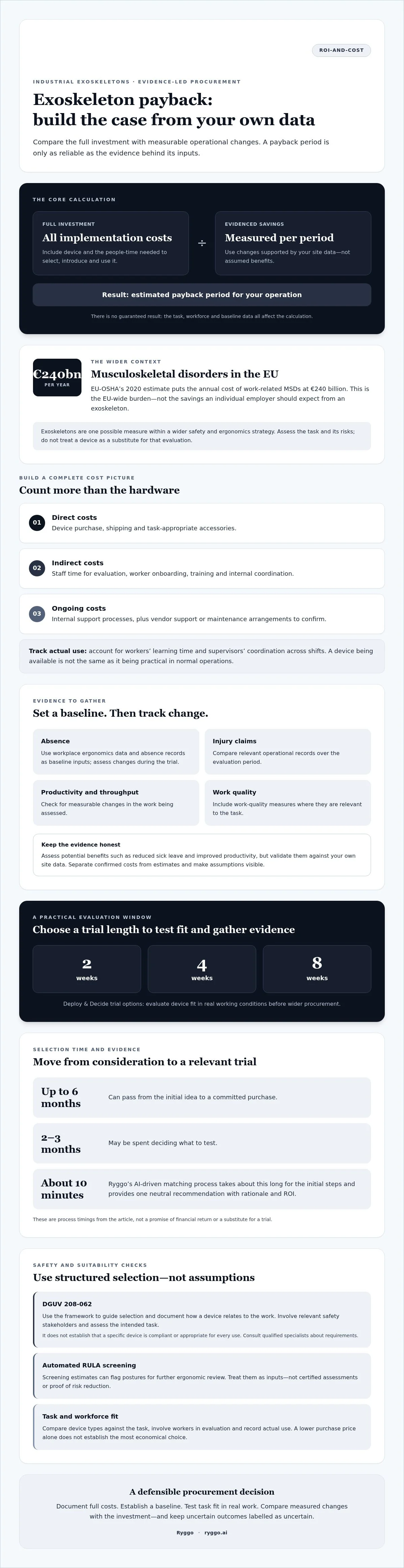
The exoskeleton payback period is the time it takes for measurable savings to equal the investment. For an industrial buyer, that means comparing the costs of selecting and implementing a suitable device with evidenced changes in areas such as absence, injury claims and productivity. The result depends on the task, workforce and quality of the baseline data. Calculate it for your own operation rather than treating it as a guaranteed outcome.
EU-OSHA’s 2020 estimate puts the annual cost of work-related musculoskeletal disorders (MSDs) at €240 billion. That figure describes the EU-wide burden, not the savings an individual employer can expect from an exoskeleton. It does, however, show why MSD prevention is a relevant business issue. Exoskeletons are one possible measure within a wider safety and ergonomics strategy, not a substitute for evaluating the task and its risks.
Devices differ in how they support movement and which tasks they suit. A foundational overview of Powered Exoskeleton technology also describes passive systems and occupational applications. For procurement, the practical question is more specific: which device, if any, fits the task and the people doing it?
The High Cost of Pilot Purgatory
Exoskeleton selection can take up to six months from the initial idea to a committed purchase, with two to three months spent deciding what to test. Time spent narrowing down devices can delay the point at which a suitable option is evaluated in real work. That delay doesn’t prove a device will deliver savings, but it postpones the evidence needed to make a decision.
Ryggo’s AI-driven matching process takes about 10 minutes for the initial steps. It uses information about the task to provide one neutral recommendation with rationale and ROI, helping teams move from initial assessment to a relevant trial. Explore exoskeleton matching and advice to get a recommendation for your operation.
Selection Guidance: DGUV 208-062
Use the DGUV 208-062 framework to guide exoskeleton selection and document how a device relates to the work. Involve relevant safety stakeholders and assess the intended task rather than assuming that any device is suitable. This framework supports selection; it does not establish that a specific device is compliant or appropriate for every use. Consult qualified specialists about requirements for the device and its intended use.
Automated RULA screening estimates can help flag postures for further ergonomic review. Treat them as screening inputs, not certified assessments or proof of risk reduction. A consistent selection process and task-level evidence give buyers a stronger basis for safety decisions and later ROI calculations.
Identifying the Hard and Soft Costs of Exoskeleton Implementation
Hardware is only one part of the investment. A complete cost picture also includes the resources needed to select, introduce and use a suitable device. Separate confirmed costs from estimates, and note which costs apply once and which may continue during implementation.
Account for:
- Direct costs: device purchase, shipping and task-appropriate accessories.
- Indirect costs: staff time for evaluation, worker onboarding, training and internal coordination.
- Ongoing costs: internal time or processes needed to support use, along with vendor-provided support or maintenance arrangements that you should confirm with the device vendor.
Some adoption costs may not appear on a purchase order. Workers may need time to learn how to use a device during the task, and supervisors may need to coordinate its use across shifts. Involve workers in the evaluation and record actual use during a trial. This helps distinguish a device that is merely available from one that is practical in normal operations.
Hardware Acquisition and Price Variance
Passive, active and soft-suit devices differ in design and application. Compare them against the task rather than choosing on purchase price alone. A lower-priced device may not be the most economical choice if it doesn’t fit the work or is rarely used. A vendor-neutral comparison can help you focus on task-relevant features and avoid paying for functionality you don’t need.
For multi-site procurement, include the effort involved in coordinating evaluation and purchasing across locations. Ryggo operates in 23 European countries under one set of commercial terms, which can support consistent comparison across participating sites. Confirm shipping arrangements and any site-specific costs before including them in your budget.
The Value of Onboarding and Training
Estimate the labour cost of time spent on setup and training. Record how many workers take part, how long each spends in onboarding and the labour-cost basis used in your calculation. These inputs vary by task and site, so use your own figures rather than assuming a standard amount.
Clarify who provides device-specific onboarding and support before the trial begins. Ryggo provides vendor-neutral matching and advice, while the device vendor can confirm its onboarding, support and maintenance arrangements. Under Deploy & Decide, the trial fee is fully credited toward the purchase, so no double payment is required if you proceed. To compare suitable devices, use vendor-neutral exoskeleton matching and confirm the trial terms before starting.
Ready to find the right device for your operation?
Find my exoskeleton →Quantifying the Economic Impact of MSD Prevention
The EU-OSHA estimate of €240 billion a year for work-related musculoskeletal disorders, cited earlier, shows the scale of the European burden. It isn’t a forecast of savings from exoskeletons. For an employer, the relevant question is which measurable costs could change at a specific site, and whether an exoskeleton suits the task.
Build your business case from local records. Consider absence and replacement labour, injury-related claims and other costs your organisation can verify. Don’t assume insurance premiums will fall. Include a premium saving only if your insurer confirms it. Likewise, don’t assign a standard cost to a back injury. Costs vary by country, employer and claim, so use documented figures from your own organisation rather than an unverified average.
There may also be indirect value. Retaining experienced staff can reduce recruitment and training demands, while steadier work pace may support output and quality. These are potential benefits, not automatic outcomes. Research on the economic benefits of ergonomics can help frame direct and indirect costs, but use site-specific evidence in your calculations.
Reducing Absenteeism and Presenteeism
Compare absence records and relevant injury costs before and during an evaluation. Account for changes in workforce size, task mix and other conditions that could affect the result. Presenteeism, when a worker is present but limited in what they can do, is harder to quantify. Use a consistent operational measure instead of assigning it an assumed monetary value.
Don’t claim that preventing one injury will pay for an entire fleet unless your own figures support that conclusion. For a credible exoskeleton payback period, count avoided costs only when there’s evidence linking the change to the intervention. Track retention and replacement costs over a suitable period, but don’t attribute every improvement to the device.
Productivity and Output Consistency
In warehouse order picking, compare output, errors and relevant task quality at the start and end of shifts during a controlled trial. In overhead assembly, monitor task time and quality alongside worker feedback. Keep the task, measurement method and operating conditions consistent. A faster cycle isn’t a benefit if quality or safe working practices decline.
Automated RULA screening estimates can help identify postures for further ergonomic review and focus attention on tasks where strain and output concerns overlap. Treat estimates as screening inputs, not proof of risk reduction or financial savings. The strongest case combines ergonomic evidence with operational measures, then checks whether any improvements persist under normal working conditions.
Step-by-Step: Calculating ROI on Ergonomic Improvements
Use one calculation sheet for each task and deployment scope. Make it possible for a reviewer to trace each projected benefit to a baseline, a measurement method and the person responsible for validating it.
- Set the baseline. Record the task, movement, frequency and relevant ergonomic observations before the trial. Use the same definitions and measurement conditions when reviewing results.
- Define the investment. Include the relevant cost categories identified above. Record the trial fee, and apply any purchase credit or refund according to the selected trial’s terms.
- Estimate annual benefits. Use changes in absence-related costs and output only when you have a defensible measurement. Separate observed results from projections.
- Calculate ROI. Use (net benefits ÷ total costs) × 100, with net benefits calculated as benefits minus costs over the period being assessed.
- Estimate payback in months. Divide the net investment by average monthly net benefits. If benefits vary, use cumulative monthly cash flow to identify when it equals the investment.
Baselines and Risk Assessment
For an initial assessment, upload a 30-second workplace video and describe the loads, movements and environment in the accompanying survey. Ryggo provides a free automated RULA screening estimate to help flag postures for further review. It is not a certified assessment. Map the task to the DGUV 208-062 selection framework, then choose a practical measure to track, such as task completion, quality or worker-reported usability. Uploaded videos are deleted after analysis.
The Final ROI Formula
For a logistics deployment, define the scope before entering figures: which operation, workers and devices are included, and which outcomes you’ll measure. Apply the relevant refund terms as a reduction in potential downside, not as an operating saving. If you purchase the device, the trial fee is fully credited toward the purchase, so no double payment is required. The exoskeleton payback period is reached when verified savings meet the investment, making it one input to a decision that also considers worker safety and operational needs.
To apply this method to your operation, calculate your exoskeleton ROI with a neutral device recommendation and comparison.
Accelerating Payback with the Deploy & Decide Model
A short demonstration can show how a device looks or feels during a brief try-on. It can’t, on its own, tell you whether workers will use it through a normal shift, whether it suits the task or whether operational measures improve. A structured trial lets your team assess fit in real working conditions and gather evidence for the business case. That evidence can make the exoskeleton payback period estimate more grounded, though it can’t guarantee savings.
Deploy & Decide offers trial periods of 2, 4 or 8 weeks. Choose a period based on what you need to evaluate, such as worker acceptance, task compatibility and changes in agreed measures. Before starting, set a baseline and decide how you’ll record use, feedback, safety observations and relevant operational outcomes. Multiple devices can be trialled side by side in your operation. Agree how you’ll compare them and review the results before the trial begins.
The trial fee is fully credited toward a purchase, so no double payment is required. If you don’t proceed after an unsuccessful trial, the refund is up to 75% for a 2-week trial, 70% for a 4-week trial and 60% for an 8-week trial. Confirm the applicable terms before approval. In your ROI calculation, record the trial fee and any refund or purchase credit in the relevant scenario. Don’t count a purchase credit as an additional operating benefit.
Risk Mitigation in Procurement
Try-before-you-buy lets you test a device in your operation before committing to a purchase. It also gives workers a chance to provide feedback that procurement specifications alone may miss. Vendor-neutral matching and comparison help keep the decision focused on task fit. That matters: continuing with an unsuitable option simply because time or money has already been invested can distort the decision.
Next Steps: From Data to Deployment
Ryggo’s initial matching process takes about 10 minutes. Before a trial, identify the target task and participants, capture baseline measures, brief relevant supervisors and workers, and agree how results will be reviewed. The selected device’s vendor provides onboarding and training, and can confirm arrangements for support and service. At the end of the trial, compare the evidence with your baseline and decide whether to stop, gather more data or proceed to purchase.
To begin with a neutral assessment of suitable devices, start your neutral exoskeleton assessment here.
Not sure which exoskeleton fits your task? Let the Ryggo advisor match it independently.
Find my exoskeleton →Turn Your ROI Case into a Measured Decision
A sound procurement decision doesn’t depend on a headline estimate. It depends on whether workplace evidence supports the next step, whether that means refining the trial, selecting a suitable device or deciding not to proceed. Keep assumptions visible so stakeholders can see what the figures do and don’t show.
The exoskeleton payback period is useful only when its inputs reflect the real task and implementation costs. Treat it as one part of a wider decision about worker wellbeing, operational requirements and financial viability.
Calculate your exoskeleton ROI with an independent advisor and use a structured comparison to inform your procurement discussion. Start with a neutral recommendation based on fit, then test the selected device in your operation before deciding whether to buy.
Frequently Asked Questions
What is the average payback period for an industrial exoskeleton?
There’s no reliable average that applies across industrial tasks and workplaces. The exoskeleton payback period depends on device fit, total implementation costs and savings your organisation can verify, such as changes in absence or output. Build the estimate from a site-specific baseline and trial data rather than relying on a generic timeframe. If the evidence is limited, label the result as an estimate and state the assumptions behind it.
How do you calculate the ROI of an ergonomic improvement?
Calculate ROI as (net benefits ÷ total costs) × 100 for a defined period. Net benefits are the measured or estimated benefits minus the costs for that period. Include purchase and implementation costs, such as onboarding and training time, then compare them with evidenced changes in relevant costs or operational results. Keep assumptions visible and avoid counting the same saving twice. For payback in months, compare the net investment with average monthly net benefits.
Can I include productivity gains in my exoskeleton payback calculation?
Yes, if you measure them and can explain how the figures were obtained. Compare output, task time and quality against a consistent baseline, while accounting for factors such as staffing, workload and process changes. Don’t assume that a device will increase productivity or convert worker feedback into a financial saving without a clear method. Treat projected gains as estimates until trial or operational data supports them.
What are the hidden costs of exoskeleton implementation?
Look beyond the device purchase. Account for shipping, accessories, staff time for onboarding and training, and time spent coordinating the evaluation. Worker acceptance and consistent use also matter: a suitable device that isn’t used as intended may not deliver the expected benefits. Confirm what onboarding, support and service the device vendor provides, then identify any additional internal time or processes your organisation must fund.
Does the Deploy & Decide trial fee count towards the purchase price?
Yes. The trial fee is fully credited toward the eventual purchase, so no double payment is required. In your cost model, record the fee and purchase credit clearly to avoid counting the same amount twice. Check the terms for the selected trial before approval, and distinguish the purchase scenario from the alternative of returning a device after an unsuccessful trial.
How does an automated RULA screening estimate help with ROI?
An automated RULA screening estimate can help identify postures that may need further ergonomic review and inform early device matching. It is an automated screening estimate, not a certified assessment or proof that a device will reduce risk or costs. Use it alongside task observations and operational data to set a baseline, then check relevant measures during a trial. Uploaded workplace videos are deleted after analysis.
Are there tax incentives in Europe for ergonomic investments?
Tax incentives depend on the country, the type of investment and the rules that apply to your organisation. Don’t include a tax benefit in your ROI forecast until you’ve confirmed eligibility and how it applies to the specific purchase. Check with your local tax authority or a qualified tax adviser before making a procurement decision. Until then, calculate the business case without the incentive and show any confirmed relief separately.
What happens to the trial fee if the exoskeleton does not meet our expectations?
If a trial is unsuccessful, the refund is up to 75% for a 2-week trial, 70% for a 4-week trial or 60% for an 8-week trial, subject to the applicable terms. The refund isn’t 100%. If you decide to purchase instead, the trial fee is fully credited toward that purchase, so no double payment is required. Confirm the relevant conditions before the trial starts and reflect the appropriate scenario in your cost calculation.
Find the right device before you trial anything
The Ryggo advisor maps your task, environment, and requirements to compatible devices — independently, across the full European market.
Find my exoskeleton →